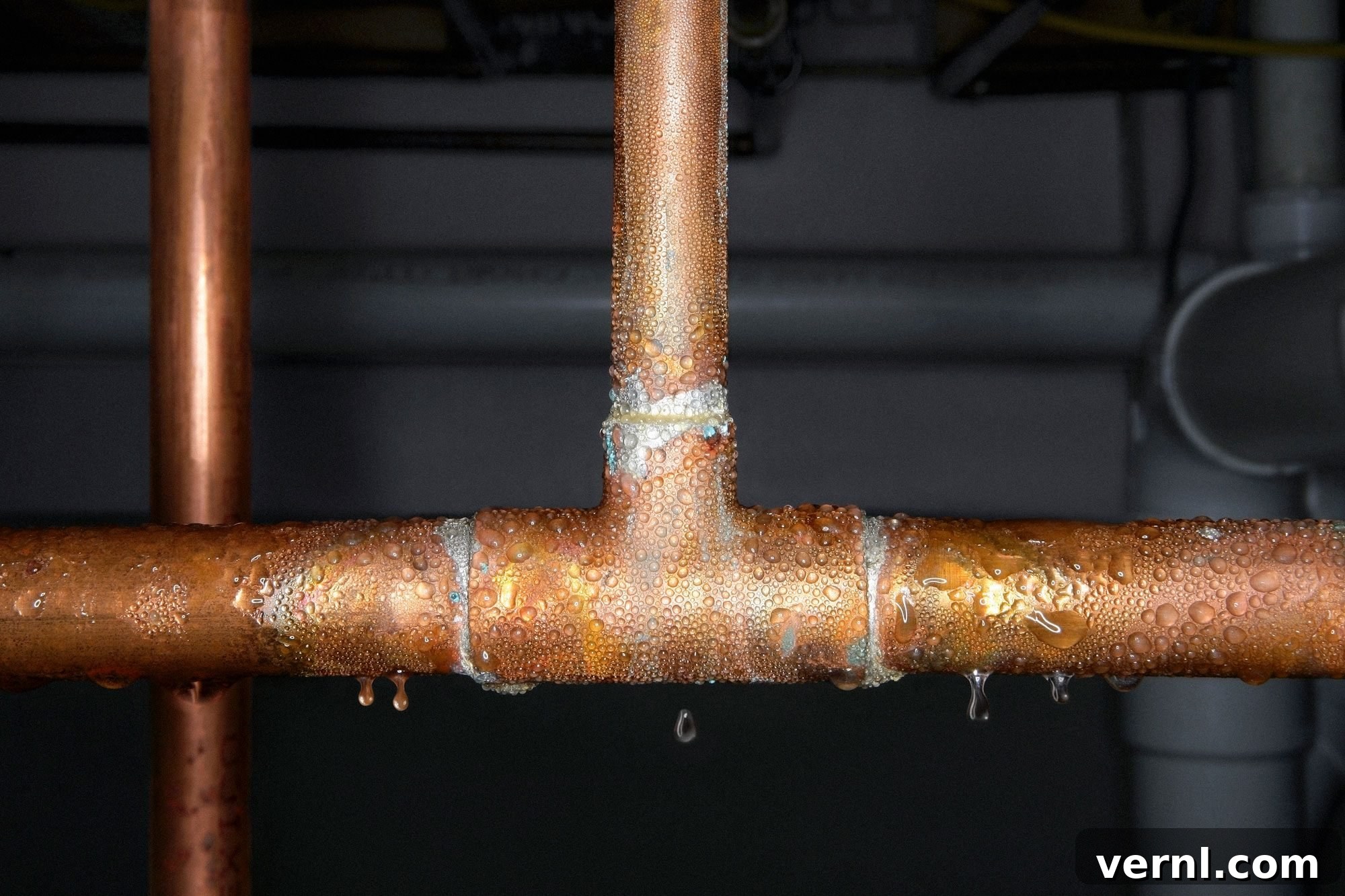
While pipe condensation might seem like a minor plumbing issue at first glance, it’s a problem that should not be overlooked. Experts across the plumbing and HVAC industries consistently emphasize its potential for significant, long-term damage. Asif Bux, owner of a Calgary-based plumbing and HVAC service, succinctly outlines four major negative consequences of neglecting this common household phenomenon: mold growth, structural damage, premature pipe corrosion, and reduced energy efficiency in your HVAC systems. Each of these issues represents a substantial threat to your home’s integrity and your family’s health and comfort.
Many homeowners refer to pipe condensation as “sweating pipes,” a term that can sometimes create confusion for plumbers who use “sweating” to describe the process of soldering copper pipes. However, the visual effect is clear: water droplets accumulate on the exterior of pipes, giving the impression they are perspiring. This phenomenon is most commonly observed on cold water pipes, but HVAC expert Keith Wortsmith points out that hot water pipes are also susceptible under certain conditions. Understanding why pipes “sweat” and what proactive measures you can take to prevent it is crucial for maintaining a healthy and efficient home.
Understanding What Causes Condensation on Cold Water Pipes
Condensation is a natural physical process that occurs when moist air comes into contact with a surface that is cooler than the air’s dew point temperature. Simply put, the air can no longer hold all its moisture, and the excess precipitates out as liquid water onto the cooler surface.
Think of single-pane windows on a cold winter day. The warm, humid air inside your home meets the frigid glass surface, causing water droplets to form and sometimes even freeze. This happens because the cold air directly adjacent to the window cannot retain as much moisture as the warmer air circulating through the rest of the house. The same principle applies directly to your plumbing system.
When warm, humid air in your home encounters a cold water pipe, the moisture in the air condenses on the pipe’s surface. The severity of condensation is directly proportional to two primary factors: the temperature differential and humidity levels. A greater difference between the pipe’s temperature and the room’s temperature will lead to more condensation. For instance, a very cold pipe in a warm, humid basement will “sweat” far more profusely than the same pipe in a cool, dry utility closet. Similarly, higher indoor humidity levels significantly increase the likelihood and amount of condensation, regardless of the temperature differential.
Differentiating Between Condensation and ‘Sweating’ Pipes
Outside of the specific plumbing context of soldering, there is no practical difference between pipe condensation and what homeowners commonly refer to as “sweating pipes.” Both terms describe the same phenomenon: atmospheric moisture condensing onto the exterior of a pipe. Initially, this moisture forms tiny, almost imperceptible droplets. Over time, these droplets coalesce, growing larger until gravity takes over, and they begin to drip. This visual effect can easily mislead someone into thinking the water is originating from inside the pipe, indicating a leak, when in fact, it is entirely external, drawn from the surrounding air.
It is, of course, critical to assume that the pipe itself is not leaking. Differentiating between benign condensation and a potentially damaging leak is a fundamental skill for any homeowner.
How to Distinguish Between Condensation and a Leaky Pipe
While both condensation and small leaks can manifest as water droplets on pipes, there are key indicators to help you tell the difference. Bethany Uribe, a damage mitigation specialist, notes that very old copper pipes, particularly those situated in consistently humid environments, are susceptible to corrosion and the development of tiny pinhole leaks. When water seeps through these microscopic holes, it can genuinely be described as the pipe “sweating” from within. Because these holes are often minuscule, the water doesn’t spray but rather forms individual droplets on the pipe’s surface, closely mimicking condensation.
The crucial distinction lies in the nature and distribution of these droplets. Condensation typically covers the entire surface of the cold pipe where the temperature differential is present, often forming a fine film or evenly distributed droplets that gradually grow. In contrast, droplets from a pinhole leak will usually be localized to a specific spot or area around the breach, and they tend to drip more actively and consistently than typical condensation. Observing the persistence and origin point of the droplets can provide clarity.
Furthermore, leaks can also occur at screw joints that haven’t been adequately tightened or at solder joints weakened over time by pipe vibrations or structural movements. Even if water travels along the pipe for some distance before becoming visible as a drip, pinpointing a leaky joint is often achievable through careful inspection. Repairing such a leak, however, can be more involved, frequently requiring you to drain the water from the system, disassemble the faulty joint, and then meticulously re-do the connection to ensure a watertight seal.
The Overlooked Risks of Persistent Pipe Condensation
Every expert interviewed, reinforcing Asif Bux’s initial assessment, consistently agreed on the four primary dangers associated with unchecked pipe condensation. These are not merely cosmetic concerns; they pose tangible threats to your home’s structure, air quality, and operational efficiency:
- Mold and Mildew Growth: The continuous presence of moisture from condensation creates an ideal breeding ground for mold and mildew. These fungi can rapidly proliferate on pipes, nearby walls, insulation, and even within air ducts. Mold exposure can trigger a range of health issues, including respiratory problems, asthma attacks, allergies, skin irritation, and other adverse reactions, particularly in sensitive individuals. Beyond health, mold can also cause unpleasant musty odors throughout your home, significantly impacting indoor air quality.
- Structural Degradation and Damage: When condensation goes unaddressed, the persistent dripping and moisture can lead to severe water damage. Walls, ceilings, and floors in proximity to “sweating” pipes can absorb this moisture, leading to discoloration, warping, softening of drywall, and weakening of wooden structural elements. Over time, this consistent dampness can compromise the structural integrity of your home, potentially leading to costly repairs and even requiring extensive renovation work.
- Accelerated Pipe Corrosion: Metal pipes, especially those made of copper or galvanized steel, are vulnerable to corrosion when constantly exposed to moisture. The repeated wetting and drying cycles, coupled with potential mineral deposits in the condensate, can accelerate the oxidation process. This corrosion weakens the pipe material, increasing the risk of pinhole leaks, hairline cracks, and eventual pipe bursts. Such failures can lead to sudden and catastrophic water damage, necessitating emergency repairs and significant cleanup.
- Reduced Energy Efficiency: Condensation can significantly impair the efficiency of your home’s heating and cooling systems. When cold pipes condense moisture, they effectively transfer heat from the surrounding warm air into the colder water, making your HVAC system work harder to maintain desired temperatures. Furthermore, if insulation around HVAC ducts or pipes becomes damp due to condensation, its thermal performance is severely compromised, allowing more heat transfer and forcing your systems to consume more energy, ultimately leading to noticeably higher utility bills.
Beyond these primary concerns, Bethany Uribe also issues a critical warning regarding condensation in freezing climates. In sub-zero environments, the evaporative cooling effect of condensation can make pipes even colder than the ambient air, significantly increasing the risk of pipes freezing and bursting. Keith Wortsmith adds another important perspective, suggesting that condensation itself can serve as an early warning sign of a broader issue within your home: inadequate ventilation and persistent indoor humidity problems.
Comprehensive Strategies to Prevent Condensation on Cold Water Pipes
Experts consistently recommend a multi-faceted approach to combat pipe condensation effectively. By addressing the root causes – temperature differential and humidity – homeowners can largely eliminate this troublesome issue:
- Insulate the Pipes: This is arguably the most direct and effective method. Insulation acts as a thermal barrier, physically separating the cold surface of the pipe from the warm, humid air. By preventing direct contact, insulation stops the warm air from cooling sufficiently to reach its dew point, thereby eliminating the primary condition for condensation. Various types of pipe insulation are available, including foam sleeves, fiberglass wraps, and rubber insulation, each designed to provide an effective thermal break. Proper installation, ensuring all exposed surfaces are covered and seams are sealed, is crucial for maximum effectiveness.
- Improve Ventilation: “Installing exhaust fans or promoting natural airflow is paramount,” advises Asif Bux. Adequate ventilation is essential for dispelling humid air and preventing moisture buildup in areas prone to condensation, such as bathrooms, kitchens, laundry rooms, basements, and crawl spaces. Utilizing bathroom exhaust fans during and after showers, running kitchen range hoods when cooking, and ensuring proper attic and crawl space ventilation can drastically reduce ambient humidity levels, thereby minimizing the chance of condensation forming on pipes and other surfaces.
- Reduce Indoor Humidity: Actively controlling the overall humidity levels in your home is a vital preventative measure. Deploying dehumidifiers in problem areas, especially in basements, crawl spaces, or utility rooms where pipes are exposed, can make a significant difference. Bux emphasizes that maintaining indoor relative humidity levels below 60% is a critical threshold, as it substantially reduces the likelihood of condensation forming on pipes and surfaces. Other strategies include fixing leaky faucets, drying clothes outdoors or in a well-ventilated area, and avoiding over-watering indoor plants.
For a more permanent and long-term solution, Keith Wortsmith suggests considering the replacement of existing metal water pipes with modern plastic alternatives. “Plastic pipes are inherently less prone to condensation than metal pipes because they do not conduct heat as efficiently,” Wortsmith explains. Materials like PVC (ideal for cold water lines), CPVC (suitable for both cold and hot water due to its higher temperature rating), and PEX (a flexible, versatile option for both cold and hot water) are excellent choices. Their lower thermal conductivity means they don’t get as cold as metal pipes, thereby reducing the temperature differential that drives condensation.
Do Hot Water Pipes Sweat?
While less common than with cold water pipes, condensation can indeed occur on hot water pipes. Keith Wortsmith explains that this typically happens in environments with exceptionally high humidity. In such conditions, moist air can come into contact with the hot surface of the pipes. Although the pipes are hot, the surrounding air may be cool enough, or the humidity so high, that the air’s dew point is reached, causing moisture to condense on the slightly cooler outer surface of the hot pipe. It’s a less frequent occurrence, but the underlying principle of temperature differential and humidity remains the same.
Wortsmith also extends this caution to HVAC pipes, particularly those carrying refrigerant for air conditioning systems. “These pipes are typically much colder than the ambient air, making them highly susceptible to condensation,” he notes. The condensation on refrigerant lines, if not managed, can lead to similar problems of mold growth and structural damage. Maintaining the relative humidity throughout your home below 60 percent is a universally recommended solution for mitigating condensation issues on both hot water pipes and HVAC refrigerant lines.
Choosing the Best Pipe Insulation to Prevent Condensation
When it comes to insulating pipes for condensation prevention, you don’t necessarily need the most expensive or complex materials. Inexpensive foam pipe insulation, readily available at most hardware stores for around $0.50 per linear foot, is typically highly effective. This type of insulation is favored for its ease of installation and excellent thermal properties.
Installation is straightforward: simply locate the pre-cut slit along the length of the foam tube, separate it, position it around the pipe you wish to insulate, and then firmly press the edges back together. For added security and to ensure a complete seal, wrap PVC insulation tape or similar adhesive tape around the foam at regular intervals, especially at seams and joints. The most critical aspect is to ensure you purchase the correct diameter of insulation to snugly fit your pipes, guaranteeing optimal contact and thermal protection. Proper sizing prevents air gaps that could still allow condensation to form.
About the Experts
- Asif Bux is the owner and service manager of Comfort Union, a full-service plumbing and HVAC company based in Calgary, Alberta. He is also a licensed gas fitter, bringing extensive expertise in home systems.
- Keith Wortsmith serves as the president of DASH Heating, Cooling and Plumbing, a long-standing family-owned business operating in Central Arkansas since 1931. His insights draw from decades of practical experience in the field.
- Bethany Uribe is an AHERA certified building inspector and a damage mitigation consultant affiliated with ASAP Restoration, based in Phoenix, AZ. Her expertise lies in assessing and remediating water and environmental damage in residential and commercial properties.