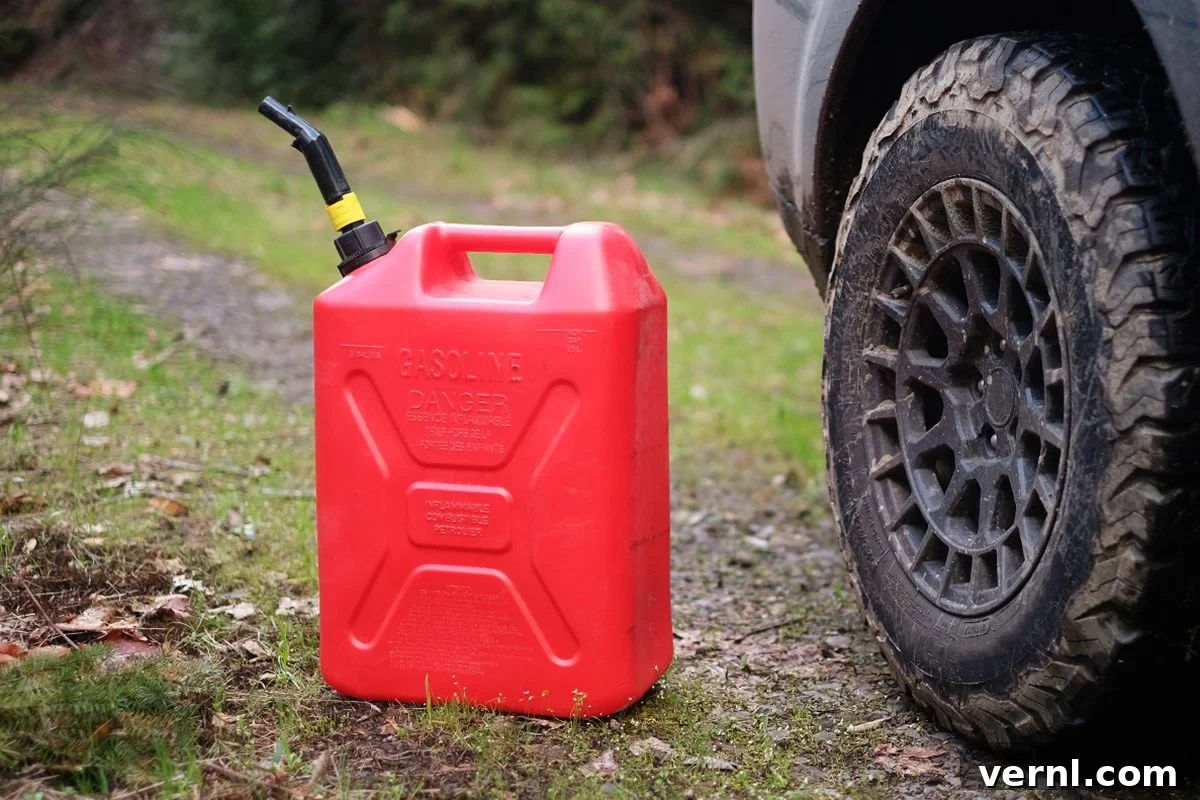
Swollen or Collapsed Gas Cans: What You Need to Know for Safety
Understanding the science behind gas can behavior and how to handle them safely.
The Science Behind Swelling and Collapsing Gas Cans
Discovering a swollen or collapsed gas container in your garage can be a bit alarming, but it’s also a great opportunity to learn about the science at play. The changing shape of your gas can is primarily due to the fluctuating vapor pressure of gasoline. Gasoline is a highly volatile substance, meaning it readily evaporates, and this evaporation process is key to understanding the phenomenon.
Scientists have long understood that the pressure exerted by a vapor within a closed container changes with temperature. This relationship is described by the Boyle-Mariotte Law, also known as the Ideal Gas Law. This law, often introduced in high school science classes, describes the relationship between pressure, volume, the amount of gas, temperature, and a constant.
Mathematically, the Ideal Gas Law is expressed as PV = nRT, where:
- P = Pressure
- V = Volume
- n = Amount of gas
- R = Universal Gas Constant
- T = Temperature
For a gas container with a fixed volume, the equation simplifies to P = kT, where ‘k’ is a constant. This simplified version tells us that as temperature increases, the vapor pressure inside the container also increases, and vice versa. This explains why gas cans change shape with temperature fluctuations.
As Sergey Nikolin, an HVAC professional, explains, “Gas cans swell and collapse due to temperature changes, as gasoline vapors expand when heated and contract when cooled.” This expansion and contraction are the direct result of the principles outlined in the Ideal Gas Law.
Why Do Gas Cans Swell?
A gas can swells when the ambient temperature rises, which leads to an increase in the vapor pressure inside the container. When you fill a gas can and seal it, the pressure inside is initially the same as atmospheric pressure. However, as the temperature increases, the gasoline vaporizes more readily, increasing the pressure within the sealed container. When the internal pressure exceeds atmospheric pressure, it pushes against the container walls, causing them to bulge outward.
“It’s completely normal for a sealed container, but honestly, it can be a little surprising if you’re not used to it,” says Chris Turner, a designer specializing in luxury fire pits.
Is a Swollen Gas Can Dangerous?
A swollen gas can can present potential hazards, particularly if the container is old or damaged. As Nikolin points out, “Excessive swelling can weaken the can over time or even cause it to rupture if it’s old or damaged. Over time, the flexing can cause invisible micro-cracks, potentially leading to undetected vapor leaks.”
Using an older gas can increases the risk of these issues.
OSHA-Compliant Gas Cans: A Safer Choice
Choosing an Occupational Safety and Health Administration (OSHA)-compliant gas can can significantly improve safety. These containers are designed with specific features to mitigate potential risks. OSHA-approved containers typically include the following:
- A maximum capacity of five gallons.
- A flame-arresting screen located under the cap to prevent flashback.
- A spring-closing lid and spout cover for secure sealing.
- A pressure-relief valve that safely vents pressure when the container is exposed to fire.
While not all gas cans available meet OSHA standards, prioritizing an OSHA-compliant container is a critical step towards safe fuel handling.
How to Open a Swollen Gas Can Safely
Opening a swollen gas can requires caution to prevent inhaling gasoline vapors and minimizing fire hazards. Always open the can slowly and carefully in a well-ventilated area, preferably outdoors. This allows the built-up vapor pressure to release gradually. Avoid opening the can near any source of heat or open flames. Vapor ignition can lead to a flashback, potentially igniting the liquid gasoline and causing an accident. According to NBC News, there were 11 deaths and 1,200 emergency room visits between 1998 and 2013 due to such incidents. It’s also important to avoid opening the can on a metal surface, as metal can generate static electricity, which could create a spark.
In addition, avoid opening the can on a metal surface, as metal can generate static electricity, which could create a spark.
Should You Use Gasoline From a Swollen Gas Can?
If the gas container remains intact and the swelling is moderate, the gasoline is likely safe to use. However, if the container is old, or the swelling is extreme, it could indicate minor ruptures or potential contamination. If you suspect either, it’s best to discard the fuel rather than risk using potentially compromised gasoline.
Why Do Gas Cans Collapse?
Gas cans collapse when the ambient temperature drops significantly, reducing the vapor pressure inside the container. The lower vapor pressure is then unable to counteract the force of atmospheric pressure pushing on the can’s exterior, leading to its collapse.
Is a Collapsed Gas Can Dangerous?
A collapsed gas can, especially if it’s old, can be a potential safety concern. As Chris Turner explains, “Old cans don’t always handle pressure changes well. Cracks or leaks can develop, and that’s where the fire hazard comes in.” While a collapsed can might not release fumes when the temperature is low, a rise in temperature could cause the vapor pressure to increase, potentially leading to a release of fumes when the can regains its normal shape or begins to swell. This highlights the importance of regular inspection and safe storage practices.
How to Restore a Collapsed Gas Can
Surprisingly, a collapsed gas can is often a natural consequence of modern regulations. The Environmental Protection Agency (EPA) often prohibits pressure-relief vents to prevent the escape of fuel vapors. Without a vent to equalize internal and external pressure, the container collapses.
Restoring an EPA-approved, non-vented container to its normal shape is usually straightforward. Remove the lid to allow the pressure to equalize, then replace the lid tightly and place the container in the sunlight. It should return to its normal form within an hour or two.
How to Prevent Gas Cans from Collapsing
Preventing gas can problems, including collapse, begins with selecting the right equipment and proper storage practices. Nikolin recommends using modern gas cans that incorporate pressure-relief mechanisms. He also advises, “And periodically inspect for cracks or warping and replace every 5–7 years for safety.”
Turner adds, “Don’t overfill them, this can make the whole situation worse. It’s one of those things that seems fine until it’s not.”
Additionally, storing gas cans on raised platforms can minimize ground heat transfer and thus reduce the likelihood of extreme temperature fluctuations.
About the Experts
Here are some of the experts mentioned in this article:
- Sergey Nikolin is the President of Product Air Heating & Cooling, LLC, which he established in 2019 with his brother. He provides expert insights on HVAC systems, which includes familiarity with vapor pressure dynamics.
- Chris Turner is the owner and designer at Studio Nisho, a brand renowned for luxury fire pits. His expertise includes design and an understanding of the materials that are involved with working with combustible materials.
Sources
This article references the following sources:
- Occupational Safety and Health Administration: Letter to Dennis Vance; (2004)
- NBC News: Warning: Scientists say gas cans carry risk of explosion; (2013)
- Sure Can: Collapsing Gas Cans, EPA Regulations; (2019)