For many, the hum of a well-maintained engine or the smooth rotation of a bicycle wheel represents more than just transportation; it’s a testament to thoughtful care and proper upkeep. I find immense satisfaction in understanding how things work and, more importantly, in making them work better when they falter. Perhaps it’s an innate sense of curiosity, a desire to be self-reliant, or simply a practical approach to saving money, but whenever a mechanical item I own shows signs of needing attention, my first instinct is to roll up my sleeves and tackle the repair myself.
Of course, there are limits to every do-it-yourselfer’s capabilities. Major undertakings, such as replacing a rear differential in a heavy-duty truck, often demand specialized equipment, extensive space, and a level of expertise that goes beyond the average home mechanic. These are the tasks best left to certified professionals. However, for a vast array of common issues affecting my bicycle, lawn mower, snowblower, boat, motorcycle, or family vehicles, I am always eager to undertake the repairs personally. This hands-on approach not only saves on labor costs but also provides an invaluable learning experience, deepening my understanding of the machines that serve me daily.
The journey into DIY mechanical maintenance often begins with acquiring the right set of tools. Fortunately, for many routine repairs, the arsenal required isn’t extensive. A basic setup typically includes a reliable adjustable wrench, a comprehensive socket set, a sturdy breaker bar, a mallet, and crucially, a torque wrench. Beyond these essential items, the most vital component is an unwavering willingness to get your hands dirty and, inevitably, a bit greasy. These tools, when wielded with patience and a touch of common sense, empower individuals to tackle a surprising number of repairs and maintenance tasks.
Among the tools mentioned, the torque wrench stands out as the least common in a typical homeowner’s toolbox, yet its importance cannot be overstated. Unlike a standard wrench that merely tightens, a torque wrench is a precision instrument designed to apply a specific, measurable amount of rotational force (torque) to a fastener. This precision is critical because both over-tightening and under-tightening bolts can lead to significant problems. Over-tightening can strip threads, deform components, or even cause fasteners to break, while under-tightening can lead to vibrations loosening the fastener, potentially causing catastrophic failure or parts falling off. The torque wrench ensures that every bolt is tightened exactly to the manufacturer’s specifications, guaranteeing safety, reliability, and the longevity of mechanical parts.
Torque wrenches are available in various styles and torque ratings, each suited for different applications. Beam-type torque wrenches are simple and economical, offering a visual reading. Click-type wrenches are popular for their audible click once the preset torque is reached. Digital torque wrenches provide precise electronic readings and often come with advanced features like peak hold and angle measurement. The range of applications is vast, from the delicate components of ultralight carbon fiber bicycles, where precise tension prevents crushing expensive parts, to the robust demands of heavy-duty farm or construction equipment, where immense force requires careful application to prevent structural failure. Choosing the right type and rating of torque wrench is fundamental for anyone serious about performing accurate and safe mechanical work.
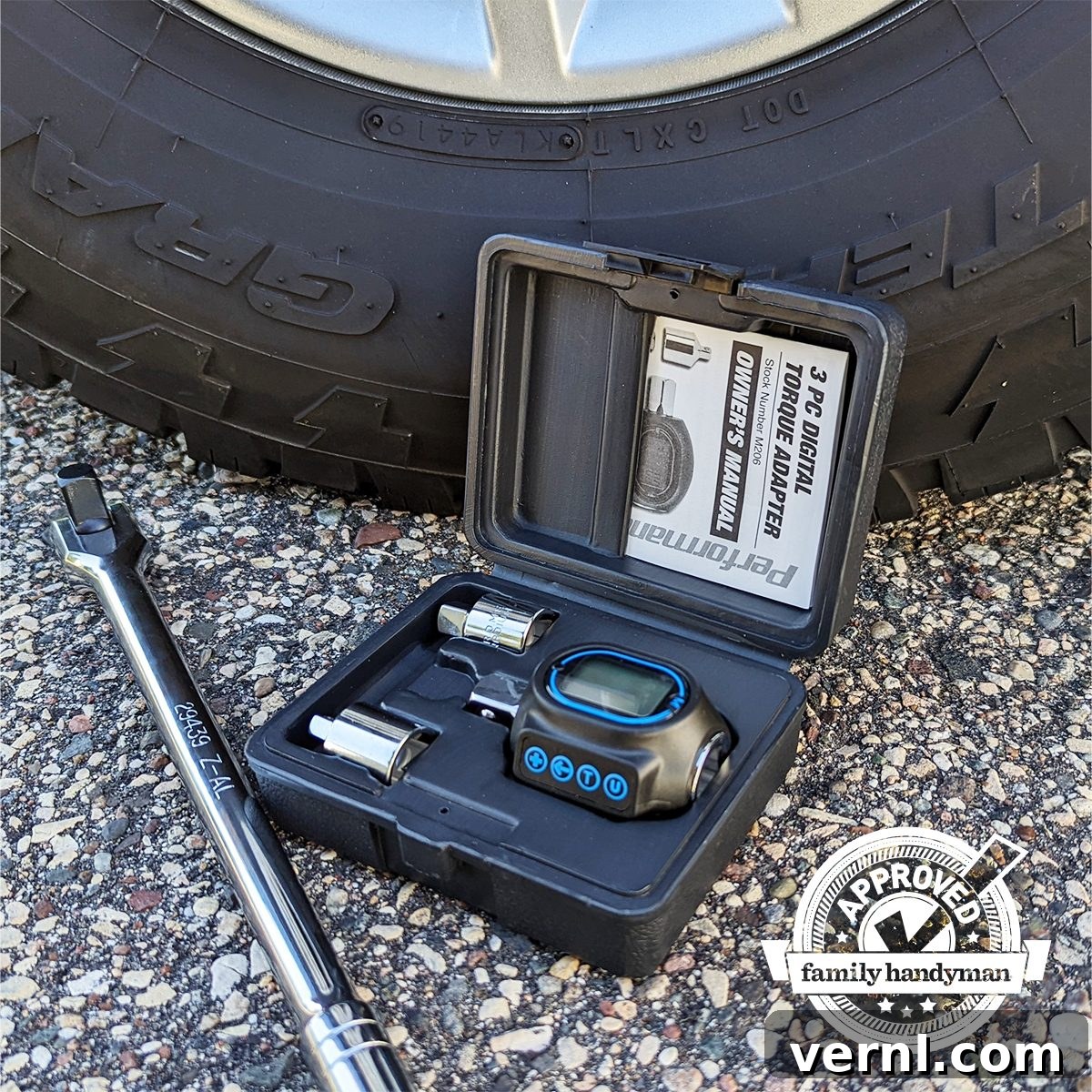
During a recent visit to a friend’s garage, I stumbled upon a tool that immediately caught my attention: the Performance Tool M206 Digital Torque Adapter. This compact attachment, designed to transform a standard wrench into a precision torque tool, seemed perfectly suited for my diverse mechanical needs. Intrigued by its potential to streamline my DIY efforts, I promptly ordered one to experience its capabilities firsthand.
Unveiling the Performance Tool M206 Digital Torque Adapter: A Detailed Look
The Performance Tool M206 Digital Torque Adapter is an innovative and highly practical device for any mechanic, hobbyist, or DIY enthusiast. Resembling a small, ergonomic lime, this attachment is engineered to seamlessly integrate with your existing 1/2-inch socket handle or breaker bar, instantly converting it into a sophisticated digital torque wrench. This clever design eliminates the need to purchase a separate, often bulky, dedicated digital torque wrench, offering a cost-effective and space-saving solution.
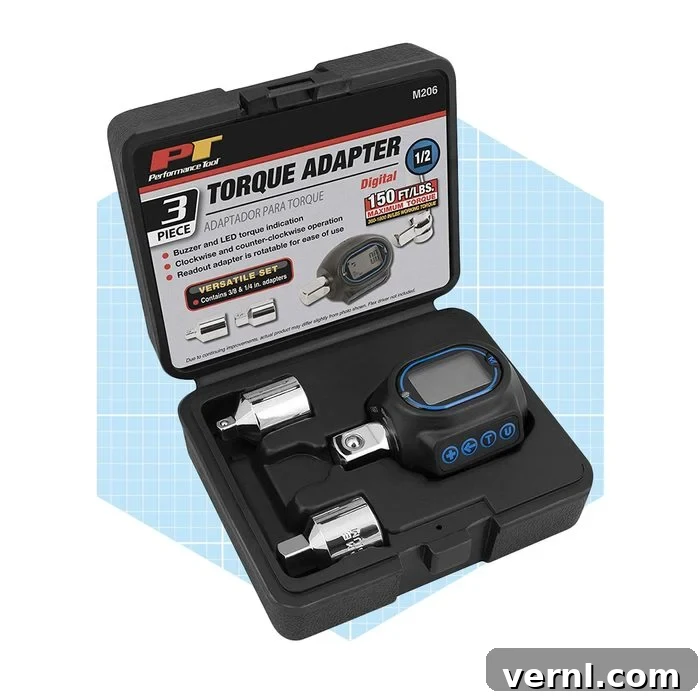
At its core, the M206 adapter is designed for precision. It accurately measures torque within a range of 30 to 150 foot-pounds (ft/lb), a common and highly useful range for most automotive and general mechanical tasks. Its standout feature is its remarkable accuracy, boasting a measurement tolerance of within +/-2%. This level of precision is comparable to, and often surpasses, many more expensive dedicated torque wrenches on the market, instilling confidence that fasteners are tightened correctly every time.
Versatility is another key aspect of the M206. It offers five selectable units of measurement: kilogram-force centimeter (kg/cm), kilogram-force meter (kg/m), foot-pounds (ft/lb), inch-pounds (in/lb), and Newton-meters (N/m). This multi-unit capability makes it adaptable to various specifications, whether you’re following U.S. customary units or metric standards. Compatibility is broad, as any standard 1/2-inch drive socket can be used directly with the adapter. Furthermore, the kit thoughtfully includes adapters for 3/8-inch and 1/4-inch sockets, significantly extending its utility to smaller fasteners and more delicate applications found in motorcycles, bicycles, or electronic components.
Beyond its measurement capabilities, the M206 features a user-friendly, programmable interface. This allows for the storage of up to ten adjustable pre-set torque values. This feature is particularly useful for repetitive tasks, such as tire rotations or engine assembly, where specific torque settings are frequently applied. Once a pre-set value is reached during tightening, the adapter provides clear audible and visual indicators, preventing both under-tightening and over-tightening. The entire kit comes neatly packaged in a durable storage case, protecting the adapter and its accessories from damage and ensuring convenient organization in your toolbox or garage.
Real-World Testing: Putting the M206 Digital Torque Adapter Through Its Paces
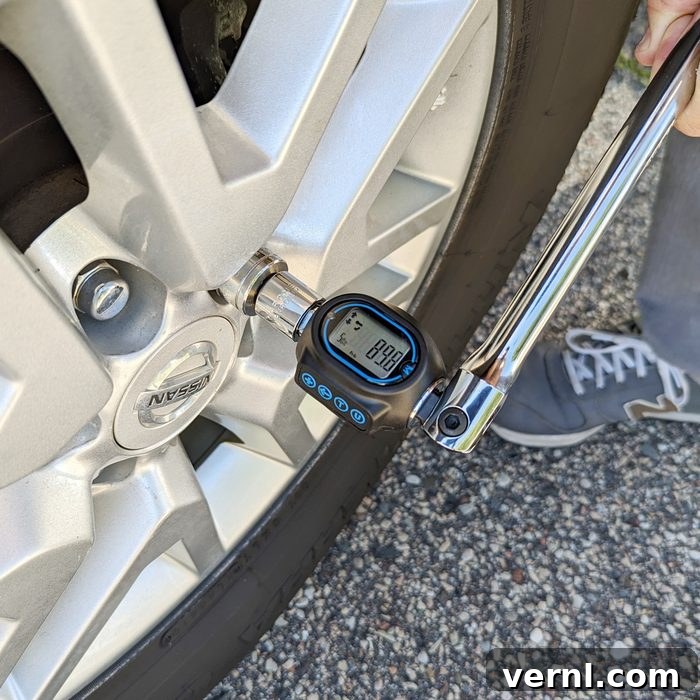
The arrival of the Performance Tool M206 Digital Torque Adapter couldn’t have been more timely. Both our family cars were due for their regular tire rotations, a crucial maintenance step for even tire wear and extended tire life. Concurrently, my motorcycle was approaching its end-of-summer routine maintenance, which involves a series of precise adjustments and fastener checks. These tasks presented the perfect opportunity to thoroughly evaluate the adapter’s capabilities, particularly its programmable interface and its performance across different drive sockets and their respective adapters.
Accuracy Validation: A Rigorous Scientific Approach
My initial and most critical test focused on verifying the manufacturer’s claim of +/-2% accuracy for the Performance Tool M206 Digital Torque Adapter. This claim immediately piqued my interest because my much older, traditional click-type torque wrench, while reliable, is rated for a broader accuracy of +/-4%. Achieving greater precision with a more compact and versatile tool would be a significant advantage, especially for sensitive applications.
To conduct this test, I devised a relatively straightforward yet effective experimental setup. I firmly clamped an old, inexpensive deep-well socket to a sturdy workbench using a pipe wrench, ensuring it was completely immobilized and could not rotate. Next, I attached the Performance Tool M206 Digital Torque Adapter to the secured socket, and then connected my 14-inch breaker bar to the adapter’s end. The breaker bar served as the lever arm to apply a controlled force.
To generate a known force, I carefully hung a precise combination of dumbbells and a lightweight bag from the very end of the breaker bar. Through meticulous weighing, the total hanging mass amounted to exactly 36.16 pounds. With the weights suspended, the Performance Tool Digital Torque Adapter immediately displayed a reading of 39.9 ft./lb. of torque. To independently verify this reading, I had to recall some fundamental high school physics principles and, naturally, reach for a calculator.
The formula for torque is simple: Torque = Lever Length × Force. My breaker bar measured 14 inches in total length. The effective lever length, from the pivot point (the center of the socket) to the point where the force was applied (the bottom knob of the breaker bar), was precisely 13-3/8 inches (or 13.375 inches). The applied force was 36.16 lbs. Plugging these values into the equation: 13.375 inches × 36.16 lbs. = 483.64 inch-pounds (in/lb) of torque. To convert this to foot-pounds, the standard unit for this tool, I divided the inch-pound value by 12 (since there are 12 inches in a foot): 483.64 in/lb ÷ 12 = 40.3 ft./lb. of torque. Comparing this calculated value (40.3 ft./lb.) with the adapter’s reading (39.9 ft./lb.), the difference was minimal, indicating an astonishing accuracy of approximately 1%. This result was incredibly impressive and significantly better than my older click-style wrench.
To ensure the consistency and reliability of these findings, I repeated the experiment several times, using various other heavy objects like brake rotors and bricks to apply the known force. In every single trial, the Performance Tool M206 Digital Torque Adapter maintained its exceptional accuracy, consistently performing within the stated +/-2% tolerance, and often even better. This rigorous testing confirmed its precision, making it a trustworthy tool for critical applications where exact torque is paramount for safety and component integrity.
Real-World Performance: Tackling Vehicle Maintenance with Confidence
With the accuracy rigorously confirmed, it was time to move the Performance Tool M206 Digital Torque Adapter into the garage for practical, real-world applications on our vehicles. The first task on the agenda was rotating the tires on both my wife’s Subaru and my truck, a job that often involves repeated tightening of lug nuts to specific torque settings.
The tire rotation process was transformed into a remarkably smooth and efficient operation. Before commencing, I easily programmed the required torque settings for both vehicles into the adapter’s memory. This pre-setting capability proved to be invaluable, as it eliminated the need to constantly reference manuals or manually adjust the tool. After safely lifting each vehicle and removing the lug nuts, I swapped the wheels according to the rotation pattern. As I began to re-tighten the lug nuts, I discovered a surprisingly useful feature: the Digital Torque Adapter could accurately read torque in both clockwise and counterclockwise directions. While I primarily use it for tightening (clockwise), this bidirectional capability could be handy for specific diagnostic tasks or when needing to measure the breakaway torque of a fastener, though I anticipate less frequent use of the counterclockwise feature in my routine.
With the torque settings saved and the adapter providing clear audible and visual alerts, we rotated both sets of tires quickly and entirely hassle-free. The certainty that each lug nut was tightened precisely to the manufacturer’s specification provided immense peace of mind, enhancing safety and preventing potential issues with wheel retention. Now, these specific torque settings are conveniently stored in the adapter, ready for future tire rotations, streamlining subsequent maintenance tasks.
The next challenge involved my motorcycle, which required an oil change and valve access for routine inspection and adjustment. This meant removing several covers and guards secured by numerous delicate screws and bolts, each with specific, often low, torque values. For this particular task, instead of relying on the adapter’s presets, I opted to freehand the tightening process while referencing the torque values directly from an online service document. This approach proved slightly more challenging due to what I observed as an “erratic behavior” of the digital gauge when applying torque without a preset target. The readout would sometimes fluctuate or jump slightly before settling. However, with a bit of patience and carefully “feathering” each bolt to its specified torque, the Digital Torque Adapter handled all the intricate tasks we asked of it with commendable ease. The inclusion of smaller 1/4-inch and 3/8-inch drive sockets and their respective adapters was particularly beneficial for these motorcycle tasks, allowing precise work on smaller fasteners without over-stressing delicate components.
Ease of Use: Navigating the Digital Interface
While I wouldn’t go so far as to describe the Digital Torque Adapter as inherently difficult to use, I also wouldn’t label it as immediately “user-friendly” for a first-time operator without consulting the manual. The device features only five physical buttons, which might suggest simplicity. However, a quick glance at the digital readout reveals a significant amount of programmable data and information, including current torque, selected units, peak hold, track mode, and various pre-set configurations. Mastering the navigation through these features, understanding the different modes, and effectively programming the ten adjustable pre-set values requires a dedicated learning curve.
For someone accustomed to the straightforward operation of a click-type torque wrench, the digital interface, while powerful, demands a period of familiarization. This is why I have made a conscious decision not to discard the owner’s manual anytime soon. I am confident that I will need to re-reference it periodically, especially when attempting to utilize some of the more advanced programmable features or when I haven’t used the tool for a while. However, once the initial learning phase is overcome, and a user becomes proficient with its button combinations and menu logic, the adapter’s capabilities, particularly its programmable presets, significantly enhance efficiency and precision in repetitive mechanical tasks.
Pros of the Performance Tool M206 Digital Torque Adapter
- Compact and Portable: Its small, lime-shaped design makes it incredibly easy to store and transport, a significant advantage over bulkier dedicated torque wrenches.
- Versatile Compatibility: Seamlessly works with existing 1/2-inch drive socket handles and breaker bars, and includes adapters for 3/8-inch and 1/4-inch drives, covering a wide range of fastener sizes.
- Exceptional Accuracy: Tested to be remarkably accurate, consistently within +/-2% of the target torque, ensuring precise and safe fastener tightening.
- Programmable Presets: Offers ten adjustable pre-set torque values, streamlining repetitive tasks by providing quick access to frequently used settings with audible and visual alerts.
- Comprehensive Kit: Comes complete with a durable storage case and all necessary adapters, offering great value and protection for the tool.
- Multi-Unit Measurement: Supports five different units (kg/cm, kg/m, ft/lb, in/lb, N/m), making it adaptable to international specifications and diverse projects.
- Bidirectional Reading: Capable of measuring torque in both clockwise and counterclockwise directions, useful for diagnostic work and determining breakaway torque.
Cons of the Performance Tool M206 Digital Torque Adapter
- Learning Curve for Programming: The interface, while powerful, involves a lot of programmable information, requiring users to consult the owner’s manual and practice to fully master its features.
- Erratic Readout Without Presets: When not utilizing pre-set values, the digital gauge can sometimes display slightly erratic or fluctuating readings as torque is applied, necessitating a patient and steady hand to achieve precise, unguided torque.
Frequently Asked Questions About Digital Torque Adapters
To help potential users make an informed decision and clarify common queries, here are some frequently asked questions about digital torque adapters like the Performance Tool M206:
Q: This Digital Torque Adapter is advertised as compatible with 1/2-inch drive sockets and breaker bars. Are there similar models made specifically for 3/8-inch drive handles, or would I need another adapter?
A: While the Performance Tool M206 itself is primarily designed around a 1/2-inch drive, it conveniently includes adapters for 3/8-inch and 1/4-inch sockets. This means you can use your 3/8-inch sockets with the M206 by attaching the included 3/8-inch adapter to the 1/2-inch drive of the unit. There are indeed other digital torque adapters on the market that are natively 3/8-inch or 1/4-inch drive, but for the M206, the included adapters ensure broad compatibility without needing a separate native 3/8-inch drive unit.
Q: Do your saved torque presets disappear when you replace the battery in the Performance Tool M206 Digital Torque Adapter?
A: No, this is a very thoughtful and practical design feature. The saved torque presets and other programmed settings are stored in non-volatile memory. This means that battery changes do not affect their programming, and your customized settings will remain intact, ready for your next project.
Q: How often should a digital torque adapter be calibrated?
A: Like all precision measuring instruments, digital torque adapters benefit from periodic calibration to maintain their accuracy. While specific recommendations may vary by manufacturer, a general guideline for professional use is typically annually or after 5,000 cycles. For a DIY enthusiast who uses the tool less frequently, checking its accuracy against a known weight or having it professionally calibrated every two to three years, or if you suspect it’s giving inaccurate readings, is a good practice.
Q: What is the ideal storage environment for a digital torque adapter?
A: To ensure the longevity and accuracy of your digital torque adapter, it should be stored in a dry, temperate environment. Avoid extreme temperatures, high humidity, or direct sunlight. Storing it in its original durable storage case, as provided with the Performance Tool M206, helps protect it from physical damage, dust, and moisture, extending its operational life.
What Other Enthusiasts Had To Say
The sentiment from other users of the Performance Tool M206 Digital Torque Adapter largely mirrors my own experiences, particularly regarding its balance of accuracy and the initial learning curve. In a five-star Amazon review, MWD succinctly captures this duality, writing, “Handy and accurate … Understanding the buttons to get to the features is a bit tricky but once understood this is a nice unit. … I checked its readings against two other torque wrenches and they are all either accurate to my needs or all off the same amount across the usable scale. I call it a win-win.” This feedback reinforces the idea that while the initial setup might require a moment of patience, the consistent and reliable performance ultimately makes it a valuable addition to any toolkit.
Echoing the positive sentiment, Amazon verified purchaser WVUFAN4LIFE gets right to the point, highlighting its practical benefits by writing, “Worth the money!” and “Great product for those hard to reach places.” These concise reviews underscore the adapter’s perceived value and its utility in challenging access situations, further solidifying its reputation as a smart investment for precise mechanical work.
Final Verdict: Precision and Portability for Every DIY Mechanic
For individuals embarking on their journey into DIY mechanical maintenance, or for seasoned mechanics seeking a compact, highly precise, and versatile alternative to traditional torque wrenches, the Performance Tool M206 Digital Torque Adapter stands out as an exceptional choice. This innovative tool represents a significant upgrade for any garage, offering professional-grade accuracy in a portable package.
Its core strength lies in its remarkable accuracy, which our rigorous testing confirmed to be consistently within +/-2%. This level of precision is paramount for ensuring that fasteners on critical components, from engine parts to wheel lug nuts, are tightened exactly to specification, preventing costly damage and enhancing safety. Furthermore, its broad compatibility with all standard socket sizes (1/2-inch, 3/8-inch, and 1/4-inch through included adapters) means it can handle a wide array of tasks, eliminating the need for multiple specialized tools. The ability to program and save specific torque settings for your vehicles or equipment is a game-changer, simplifying repetitive maintenance and ensuring consistency with every use.
Beyond its technical merits, the Performance Tool M206 is built for durability. The inclusion of a robust plastic storage case ensures that the adapter and its accessories are well-protected from the rigors of a workshop environment, promising years of reliable service. While there’s a slight learning curve to fully master its programmable interface, the benefits of precision and efficiency it offers far outweigh this initial investment of time. In essence, it’s not just a tool; it’s an investment in the long-term health and safety of your mechanical assets, making it an indispensable addition to any DIY mechanic’s arsenal.
Where to Buy the Performance Tool M206 Digital Torque Adapter
The Performance Tool M206 Digital Torque Adapter is readily available for purchase at Amazon.com, offering convenient online ordering and delivery.