
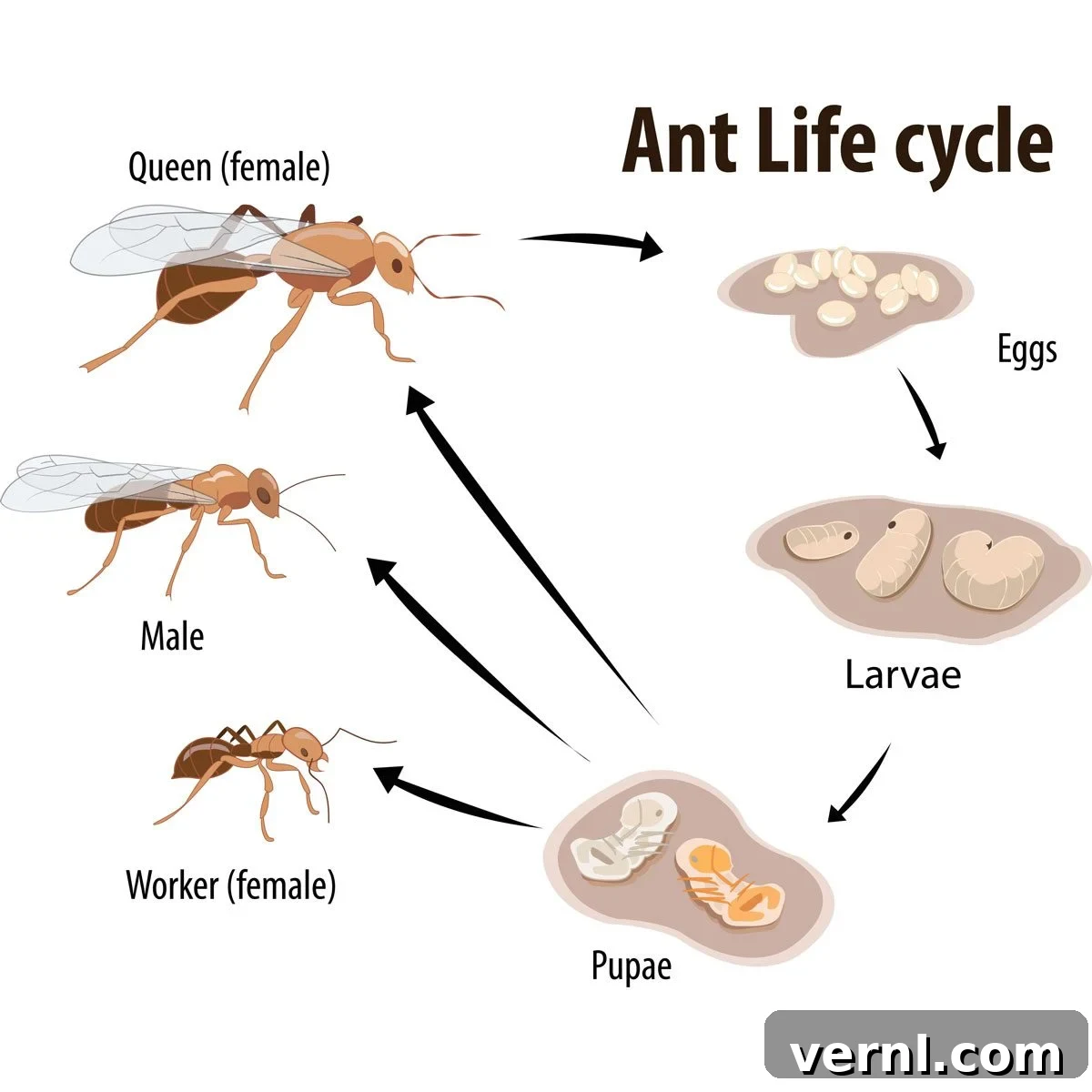
Ants, an ancient and remarkably successful lineage, have navigated Earth’s diverse landscapes for hundreds of millions of years, predating even the dinosaurs. Their extraordinary survival and proliferation are profoundly rooted in their highly evolved social structures, known as colonies. These tiny creatures are truly fascinating and complex organisms, exhibiting intricate behaviors, sophisticated communication, and unparalleled collective action. However, their relentless drive for resources and innate explorative nature can also transform them into a formidable pest, capable of infesting homes, yards, and gardens with surprising fervor and determination.
The Intricate Ant Life Cycle: A Journey of Metamorphosis
Like many other social insects—including bees, wasps, and hornets—ants undergo a complete metamorphosis, transitioning through four distinct and critical life stages: egg, larvae, pupae, and finally, adult. This complex biological process, fundamental to the development of every ant within a colony, can span anywhere from a few weeks to several months, typically taking up to 60 days from its initial stage to completion. The precise duration is largely dependent on the specific ant species, as well as environmental factors such as ambient temperature, humidity, and the availability of food resources.
Understanding the intricacies of an ant’s complete life cycle, from their initial reproductive mechanisms to their functional roles within their elaborate community, offers more than just scientific insight. For homeowners, this detailed knowledge can be an incredibly powerful tool, proving immensely helpful in combating an ant infestation more effectively, should one arise. By comprehending their growth and developmental patterns, we can implement more targeted control efforts and proactively prevent future problems, leading to more sustainable pest management.
Egg Stage: The Humble Beginnings of an Ant
Every ant’s journey begins as a tiny, often translucent and glistening white egg. These minuscule ovums are typically oval-shaped and possess a slightly sticky surface, which allows worker ants to easily carry and group them together within specialized nursery chambers deep inside the nest. The genetic destiny of an ant is determined at this earliest stage: fertilized eggs invariably develop into females (which can then differentiate into queens or sterile workers), while unfertilized eggs give rise to males, commonly known as drones. This fascinating reproductive strategy, known as haplodiploidy, is a characteristic trait among many Hymenoptera species, including ants, bees, and wasps.
The sheer reproductive capacity of ant queens is nothing short of astounding. For instance, a queen leafcutter ant, renowned for her prolific egg-laying capabilities, can produce an astonishing 150 million workers over the course of her lifetime. Even more remarkably, an army ant queen, continuously on the move with her nomadic colony, is capable of laying up to 300,000 eggs in a single day during her peak reproductive phase. Such incredible output ensures the continuous growth, resilience, and adaptability of her colony, serving as a powerful testament to nature’s profound efficiency in maintaining species survival.
Larvae Stage: A Period of Intense Growth and Dependency
Upon hatching from the egg, an ant enters its larvae stage. At this point, the ant larva is a legless, C-shaped, grub-like creature with a soft, segmented body. It is completely helpless and entirely dependent on the diligent adult worker ants for its survival and nourishment. Larvae are voracious eaters, requiring a constant and substantial supply of food to fuel their rapid growth. Worker ants tirelessly bring predigested or liquid food, which they regurgitate directly into the mouths of the larvae—a highly social feeding process known as trophallaxis. This communal exchange not only transfers vital nutrients but also facilitates the distribution of pheromones, which are crucial for regulating the colony’s social dynamics and development.
The larva’s growth is so accelerated that it must molt, or shed its skin, multiple times throughout this phase. This period typically lasts between seven and 14 days, though it can vary significantly depending on the species and prevailing environmental conditions. Each successive molt allows the larva to increase in size, progressively developing towards its next profound transformation. The rapid development at this stage is critical for quickly bolstering the colony’s workforce, enabling the continuous expansion and maintenance of the ant society.
Pupae Stage: The Great Transformation and Metamorphosis
Following the intense feeding and growth of the larval stage, the ant enters its third developmental phase: the pupae stage. During this quiescent period, which can last anywhere from six to 10 weeks, the larva undergoes a profound metamorphosis, transforming its internal and external structures to emerge as a fully developed adult ant. The pupa itself is often cream-colored and superficially resembles a miniature, pale adult ant, but it is motionless and does not feed. This stage is akin to the chrysalis of a butterfly, where remarkable cellular reorganization takes place.
Interestingly, the appearance of the pupa can vary significantly among different ant species. The pupae of some ant species, such as the common black garden ant, spin a protective silk cocoon around themselves, giving them a rice-grain-like appearance. These cocoons offer a crucial layer of defense against dehydration and potential predators during this vulnerable, immobile stage. Other species, however, remain uncovered, referred to as “naked pupae,” relying entirely on the diligent care and protection provided by the worker ants, who continually move them to optimal temperature and humidity zones within the nest, demonstrating their extraordinary brood care.
Adult Stage: Fully Formed and Ready for Action
Once the transformation within the pupa is complete, the adult ant emerges, a process known as eclosion. At this point, the ant is fully formed, its exoskeleton hardened, and it is ready to assume its predetermined role within the colony. Initially, these newly emerged adults, often paler in color and softer in cuticle, spend some time within the nest. Here, they are meticulously groomed and fed by older workers, allowing their outer cuticle to fully harden and mature. They gradually integrate into the colony’s intricate social structure, taking on various duties that are often based on their age and the colony’s immediate needs, a phenomenon known as temporal polyethism.
Given that a single queen has the potential to produce thousands upon thousands of worker ants, understanding this reproductive engine is paramount for effective pest control. The most direct and often the most effective method to eliminate an ant colony and prevent future infestations is to target the queen herself, precisely where she lives and breeds. Without a queen to continuously replenish the worker population, a colony is destined to decline, weaken, and eventually collapse, making queen elimination a strategic priority in pest management.
The Social Hierarchy: Differences Between Adult Male and Female Ants
Ant colonies are highly organized and complex societies, characterized by a clear division of labor among different castes. These castes are primarily distinguished by their reproductive capacity, distinct morphology, and their assigned roles within the colony’s intricate ecosystem. The three primary castes are the queen, drones, and workers, each playing a vital, albeit distinct and specialized, part in the colony’s survival, growth, and overall prosperity. This caste system ensures efficiency and resilience in the face of environmental challenges.
The Queen: The Heart and Matriarch of the Colony
At the very core of every ant colony resides at least one queen, though some species, such as the notorious Argentine ant, can be polygyne, meaning they may host two or more queens, sometimes even dozens. These multi-queen colonies often grow to immense sizes and can present particular challenges for effective pest control due to their distributed reproductive capacity.
Significantly larger than her compatriots, often possessing a more robust thorax (designed to accommodate powerful flight muscles, even if shed after mating), the queen is the undisputed reproductive center of the colony. She is solely responsible for laying all the eggs that hatch into new generations of ants. Among these eggs are those destined to become new queens, which are born with wings. These winged virgin queens, along with winged males (drones), embark on a synchronized “nuptial flight” – a crucial mating ritual where they fly out of the nest, often high in the air, to mate with individuals from other colonies. Queens are the only females in the colony capable of reproduction, making their role indispensable.
Once successfully mated, a new queen will typically shed her wings and locate a suitable, secluded spot to establish her own nest. In a process known as claustral colony founding, she seals herself off and uses her stored fat reserves and degenerate flight muscles to nourish her first brood of eggs. She diligently feeds and grooms the hatched larvae until they turn into pupae (or remain uncovered, depending on the species). Within a few weeks, these first offspring emerge as new adult worker ants. At this critical juncture, the colony is officially “up and running,” and these new workers immediately take over foraging, nest construction, and brood care, allowing the queen to focus exclusively on her primary, lifelong duty: laying eggs and continuously expanding the colony.
Drones: The Transient Males with a Singular Purpose
Drones are the fertile, winged male ants whose sole biological function is to impregnate a virgin queen during the nuptial flight. They are typically smaller than the queen but often possess larger eyes and more robust wings, which are essential adaptations for their aerial mating endeavors. Drones are not involved in foraging, nest building, or brood care; they are essentially genetic vehicles. Once the crucial deed of mating is accomplished, the drone’s purpose is fulfilled. Their lifespan is remarkably short; they generally die within a few weeks after mating, sometimes even immediately after the flight, as they are neither equipped nor programmed to contribute to the colony’s ongoing maintenance. Their brief existence ensures the continuation and genetic diversification of the species.
Workers: The Backbone and Labor Force of the Colony
Of all the castes within an ant colony, the multi-tasking workers are by far the most numerous, forming the vast majority of the population. These are sterile females, meaning they lack the ability to reproduce, and they perform the vast majority of essential duties that keep the colony thriving. Their roles are incredibly diverse and dynamically assigned, often changing as they age—a concept known as temporal polyethism. Younger workers, for example, typically serve as nurses, diligently tending to the eggs, larvae, and pupae, carefully moving them to optimal conditions within the nest and feeding the hungry larvae through trophallaxis.
As workers mature, they might transition to tasks such as nest maintenance, burrowing new tunnels, excavating chambers, and ensuring the structural integrity and cleanliness of the nest. They also act as “warehouse” ants, storing liquid food within their crops (a specialized stomach) and distributing it to other ants in the colony. Older workers typically become foragers, venturing outside the nest to locate and collect food, water, and building materials, bravely facing the numerous dangers of the external world. A specialized sub-caste among workers is the soldier ant. These are typically larger workers with more developed mandibles and robust bodies, whose primary role is to defend the nest against predators, rival ant colonies, and other threats. Both regular workers and soldiers are relatively long-lived compared to drones, often surviving for as long as seven years, contributing significantly to the stability and productivity of the colony over extended periods.
The Remarkable Lifespan of an Ant: A Tale of Caste and Species
The average lifespan of an ant can vary dramatically, ranging anywhere from a mere few weeks to an astonishing 15 years or even more. This considerable difference is primarily influenced by several key factors: the specific ant species, the individual ant’s caste or role within the colony, and the availability of crucial resources such as food and water, as well as prevailing environmental conditions like temperature and humidity. For instance, a common black garden ant (Lasius niger) queen can live for almost two decades, while her worker offspring might survive for a few years. In stark contrast, fire ant workers (Solenopsis invicta) are expected to live less than a month, constantly being replaced by the queen’s rapid and continuous egg-laying.
Indeed, a common adage in the ant world is “Long live the queen!” In almost every known species, the queen reigns supreme not only in authority and reproductive power but also in longevity. Her royalness typically outlives every other member of the colony by a significant margin, ensuring the long-term stability and success of the ant society. While most worker ants may live for a few months to a few years, and drones only for weeks, some ant queens are believed to have lived and reigned for an astounding 28 years! This extraordinary lifespan is a biological marvel, allowing a single queen to establish and maintain a thriving, multi-generational colony for decades, ensuring the continuous lineage and prosperity of her species.
Ant Communication: The Language of Pheromones
One of the most remarkable and fascinating aspects of ant social behavior is their sophisticated communication system, which primarily relies on chemical signals known as pheromones. These invisible, volatile chemical cues are released by special glands on an ant’s body and are detected by other ants through their highly sensitive antennae. This allows for complex and nuanced information exchange within the colony, enabling collective action and coordinated behaviors.
Pheromones serve multiple critical functions: they guide foragers to valuable food sources, mark trails for easy navigation, alert colony members to danger or threats, and even help in distinguishing nestmates from hostile intruders. When a worker ant discovers a lucrative food source, it lays down a trail of pheromones on its way back to the nest. Other workers follow this distinct scent, reinforcing it as they travel to and from the food, creating a robust chemical highway that can lead hundreds or even thousands of ants to a bountiful supply. Alarm pheromones, released when an ant is threatened or injured, can quickly mobilize soldiers for defense. This intricate chemical language is both precise and incredibly efficient, enabling seamless cooperation and intricate coordination without the need for verbal communication.
Ant Nests and Habitats: Architectural Marvels of the Insect World
Ants construct an astonishing variety of nests, each uniquely adapted to their specific environment and species-specific needs. These structures range from deceptively simple burrows in the soil to elaborate subterranean cities, and from intricate arboreal nests woven from living leaves to tunnels within wood. Most ant nests are found underground, consisting of a complex network of interconnected tunnels, chambers, and galleries. These underground architectures provide stable temperatures, regulated humidity, and crucial protection from predators and harsh weather conditions.
Some species, like carpenter ants, excavate their nests within wood, creating smooth galleries inside decaying or damp timber. It’s important to note that while they tunnel through wood, they do not consume it; however, their activity can cause significant structural damage to homes over time. Weaver ants (genus Oecophylla) construct truly impressive arboreal nests by stitching together living leaves using silk produced by their larvae. Each type of nest is a testament to the ants’ remarkable engineering prowess and their collective ability to modify their environment to suit their survival needs, from specialized nurseries for the brood to communal food storage areas and protected queen’s chambers.
Why Ants Become Pests: Understanding and Preventing Infestations
While often rightfully viewed as fascinating and ecologically important creatures, ants frequently transition from their natural roles to becoming unwelcome household pests. The primary reasons ants invade human dwellings are their relentless search for three fundamental and essential resources: food, water, and shelter. Homes inadvertently offer an irresistible bounty of these necessities, making them prime targets for infestation.
Sweet and greasy food crumbs, sugary spills, and poorly sealed pantry items are powerful attractants. Even pet food left out in bowls can draw entire colonies indoors. Accessible sources of water, such as leaky pipes, condensation around windows, dripping faucets, or even a pet’s water bowl, can be vital for ant survival, especially during dry periods. Shelter is also a key factor; ants seek protected, stable, and often warm environments for their nests, whether it’s within wall voids, under flooring, behind appliances, in foundation cracks, or even within insulation. Common entry points include tiny cracks in foundations, unsealed gaps around windows and doors, utility line openings, and even tree branches or shrubs that make contact with the house. Once a scout ant discovers a lucrative resource inside, it lays a powerful pheromone trail, inviting the rest of the colony to join the feast, rapidly escalating a minor annoyance into a full-blown infestation that can be challenging to eradicate.
Effective Ant Control and Prevention Strategies for Your Home
Given the pervasive potential for ants to become persistent household pests, implementing effective control and prevention strategies is absolutely crucial for maintaining a pest-free home. An Integrated Pest Management (IPM) approach, which combines various methods for long-term and sustainable control, is often the most successful strategy. The first and arguably most important step involves thorough sanitation: regularly cleaning up food crumbs, wiping spills immediately, storing all food items in airtight containers, and ensuring pet food bowls are clean and put away after feeding. Eliminating readily available water sources, such as promptly fixing leaky faucets, addressing damp areas, and improving ventilation to reduce condensation, is equally important.
Physical barriers play a significant role in prevention by blocking access points. Meticulously sealing cracks and crevices in foundations, around window and door frames, and where pipes and wires enter the home can prevent common entryways. Trimming back shrubs and tree branches that touch your house is also vital, as these can serve as literal “ant highways” directly into your home. For active infestations, baiting is often the most effective method, as it targets the entire colony, including the crucial queen. Baits contain a slow-acting insecticide mixed with an attractive food source. Worker ants carry the bait back to the nest and share it with the queen and larvae through trophallaxis, ultimately eradicating the colony from within. Understanding the ant’s life cycle and social structure directly informs these strategic approaches, allowing for more targeted, efficient, and sustainable pest management in and around your home.