Effective Strategies for Identifying, Removing, and Preventing Common Chickweed
Common chickweed (Stellaria media) is a remarkably resilient and widespread weed, thriving in diverse environments across the lower 48 states of the U.S. Its pervasive nature often makes it a top concern for homeowners and gardeners striving to maintain pristine landscapes. This comprehensive guide will equip you with everything you need to know about identifying chickweed, implementing effective removal techniques, and preventing its stubborn return, ensuring your lawn and garden remain healthy and beautiful.
Understanding Common Chickweed and Its Cousins
Before embarking on any weed control strategy, it’s crucial to understand the enemy. There are primarily two types of chickweed that gardeners commonly encounter: Common Chickweed and Mouseear Chickweed, each with distinct characteristics and growth habits that influence the best approach to management.
Common Chickweed (Stellaria media): The Annual Intruder
Common chickweed is classified as an annual weed, meaning its entire life cycle, from germination to seed production and death, occurs within a single year. Typically, it emerges in mid-to-late summer, flourishes throughout the fall, overwinters as a small plant, and then rapidly completes its growth cycle the following spring before dying back as temperatures rise. During its relatively short lifespan, each individual common chickweed plant is an incredibly prolific seed producer, capable of generating thousands of tiny seeds. These seeds then lie dormant in the soil, ready to germinate in subsequent summers, perpetuating a relentless cycle of infestation and frustration for gardeners.
Mouseear Chickweed (Cerastium fontanum): The Perennial Challenger
In contrast to its annual relative, Mouseear chickweed is a perennial weed. This designation means that the same plant can live for multiple years, returning season after season. If left unchecked, Mouseear chickweed will not only reseed itself, creating new “offspring” plants that contribute to its spread, but it also possesses a unique ability to expand vegetatively. Its stems can produce new roots at each node – the point where a leaf meets the stem – whenever they come into contact with bare soil. This allows it to quickly form dense, mat-like patches, making it more challenging to control. Mouseear chickweed generally grows lower and more compactly than common chickweed, often making manual removal a more tedious task.
Mastering Chickweed Identification in Your Landscape
Accurate identification is the first step toward effective weed management. While both types of chickweed share some similarities, key distinctions allow for precise identification and targeted control.
Identifying Common Chickweed
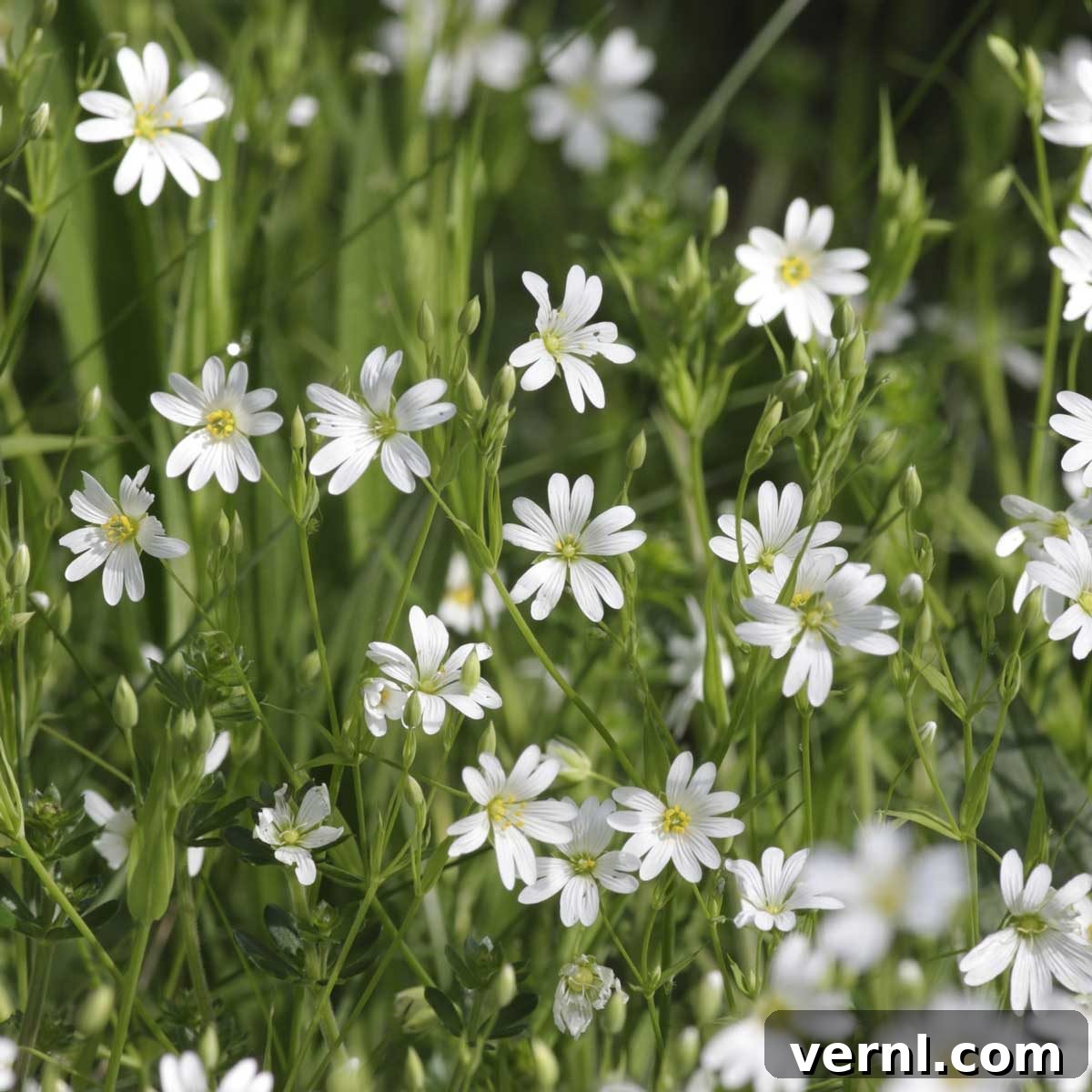
Common chickweed is relatively easy to spot in lawns and garden beds. It typically forms small, sprawling mounds or mats, usually ranging from three to eight inches in diameter. In the spring, you’ll observe its delicate, star-shaped white flowers, which often appear to have ten petals but are actually five deeply lobed petals, sometimes exhibiting a faint pinkish tint. The leaves are bright green, shiny, and oval-to-oblong in shape, tapering to a point at the end. The stems are somewhat weak and often have a single line of fine hairs along one side, which can be a distinguishing feature.
Distinguishing Mouseear Chickweed
Mouseear chickweed can be differentiated from its common cousin by several distinct characteristics. Its leaves are elliptical, dark green, and notably hairy, giving them a somewhat fuzzy or sticky texture when touched – a key identifier. This hairiness is where it gets its “mouse-ear” moniker. Mouseear chickweed grows in denser, more compact patches compared to the looser growth habit of common chickweed. Its small white flowers also have five petals, but unlike common chickweed, these petals are not deeply lobed, giving them a more distinct, singular appearance.
Unveiling the Causes: Why Your Lawn Attracts Chickweed
Understanding why chickweed decides to call your lawn or garden home is fundamental to preventing future infestations. Both common and Mouseear chickweed thrive under specific environmental conditions, often indicating underlying issues with your soil or lawn care practices.
Damp Soil and Watering Practices
A primary attractant for both types of chickweed is consistently damp or poorly drained soil. These weeds flourish in moist conditions, often outcompeting desirable turfgrass or garden plants in such environments. Overwatering your lawn or garden, especially with frequent, shallow irrigation, creates the ideal soggy habitat for chickweed to thrive. It’s crucial to evaluate your watering practices. If chickweed appears, consider reducing the frequency of irrigation and ensure your watering sessions are deep and infrequent, encouraging deeper root growth in your desired plants while allowing the soil surface to dry out between waterings.
Shade and Soil Conditions
Common chickweed has a particular affinity for shaded areas, often found flourishing under trees, along fence lines, or in dense garden beds where sunlight is limited. It’s frequently observed around tree mulch skirts, where constant moisture and shade provide perfect growing conditions. Mouseear chickweed, while also tolerant of shade, is more adaptable and can be found thriving in both shady and sunny locations, demonstrating its broader environmental resilience.
Thin, Weak, or Stressed Lawns
Like many opportunistic weeds, chickweed quickly exploits weaknesses in your lawn. Thin, malnourished, or stressed turfgrass provides an open invitation for chickweed seeds to germinate and establish themselves without competition. A dense, vigorous lawn naturally crowds out weeds by competing for sunlight, water, and nutrients. Therefore, maintaining a healthy, thick lawn through proper fertilization, aeration, and overseeding is one of the most effective long-term weed prevention strategies. Avoid mowing your lawn too low, as this practice stresses turfgrass, weakens its root system, and creates an ideal environment for weeds to invade.
Comprehensive Methods for Removing Existing Chickweed
Once chickweed has established itself, a multi-pronged approach combining cultural, manual, and potentially chemical methods may be necessary for effective removal. The University of California Integrated Pest Management Program (UC IPM) emphasizes that to prevent the build-up of viable seeds in the soil, the most opportune time to eliminate chickweed is before it has a chance to flower and set seed.
Manual Removal: Hand-Pulling and Digging
For common chickweed, manual removal is often the easiest and most environmentally friendly solution. This bunch-type weed has a notably shallow root system, making it incredibly amenable to hand-pulling, especially after a rain or thorough watering when the soil is soft. Grasp the plant firmly at its base and pull gently but steadily to ensure the entire root system is removed. However, a crucial weed control tip is to take extreme care in disposing of pulled chickweed, as it has the ability to reroot from stem nodes if left on moist soil. Compost it only in a hot compost pile or dispose of it in municipal waste to prevent regrowth.
Removing Mouseear chickweed by hand can be more challenging due to its dense, low-growing, mat-forming habit. While it also possesses a relatively shallow root system, its sprawling nature means you’ll often need to remove larger sections of soil to ensure complete eradication. Using a hand trowel or a spade to dig out patches, particularly after a good rain, can be more effective than simply pulling. This method is excellent for gardeners with “pent-up energy to burn” and a desire for a chemical-free approach.
Cultural Control Techniques
Beyond hand-pulling, cultural controls can significantly aid in chickweed removal and prevention, particularly in garden beds.
- Solarization: For heavily infested garden areas, solarization can be an effective non-chemical method. This involves covering a moistened, weed-infested area with clear plastic sheeting during the hottest months of summer. The sun’s heat gets trapped, effectively “baking” and killing weeds, seeds, and pathogens in the upper soil layers.
- Smothering: In non-turf areas, laying down several layers of cardboard or newspaper, then covering them with mulch or compost, can effectively smother existing chickweed by blocking light and airflow, causing it to decompose.
Chemical Control: Herbicides
When infestations are widespread or manual removal is impractical, herbicides can be an effective tool. It’s imperative to always read and strictly follow the label instructions for all herbicide products to ensure safety, proper application rates, and environmental protection.
- Pre-Emergent Herbicides: For common chickweed, as an annual weed, a pre-emergent herbicide product applied in late summer or early fall (before the seeds germinate) can provide excellent control. These herbicides create a chemical barrier in the soil that prevents germinating seeds from developing roots and shoots.
- Natural Pre-Emergents: For those preferring more natural weed control options, corn gluten meal, widely available at garden centers, acts as an organic pre-emergent. It releases peptides into the soil that inhibit root formation in germinating seeds. Apply it in late summer or early fall for common chickweed, or in early spring for cool-season weeds.
- Post-Emergent Herbicides: Traditional broadleaf herbicides are effective when applied to chickweed plants that are actively growing. These selective herbicides are formulated to target broadleaf weeds without harming turfgrass. They typically work by mimicking plant hormones, causing uncontrolled growth that leads to the weed’s demise. Applying them when temperatures are moderate (not too hot or cold) and when the weeds are not stressed generally yields the best results. These products often control a wide spectrum of other broadleaf weeds as well.
- For Mouseear Chickweed: Because Mouseear chickweed is a perennial, a broadleaf herbicide will typically yield the best and most consistent results for eradicating established patches. It’s crucial to ensure the herbicide label specifies control for perennial chickweed or “Mouseear chickweed.”
- Horticultural Vinegar: As a natural, non-selective option, horticultural vinegar (acetic acid at concentrations typically 10-20%, much stronger than household vinegar) can effectively burn back chickweed on contact. However, caution is advised as it will also damage or kill any desirable plants it touches. It’s best used as a spot treatment in non-lawn areas and may require repeated applications as it primarily affects above-ground growth, not necessarily killing the root system of perennials.
Strategic Prevention: Keeping Chickweed from Returning
Preventing chickweed from re-establishing itself is often more effective and less labor-intensive than continuous removal. Given that a single common chickweed plant can produce 800 seeds or more, and these seeds can remain viable in your soil for up to a decade, as highlighted by the Clemson Cooperative Extension, proactive prevention is paramount.
- Optimize Watering: Limit watering frequency, especially in the fall, and ensure your irrigation is deep and infrequent. This encourages deep root growth in your turf and garden plants, while allowing the soil surface to dry out, making it less hospitable for chickweed germination.
- Adjust Mowing Height: In the fall, raise your mowing height to the highest setting recommended for your grass type. Taller grass shades the soil, naturally inhibiting weed seed germination by blocking sunlight. It also promotes a stronger, healthier turf system better equipped to outcompete weeds.
- Mulching in Gardens and Flower Beds: For gardens or flower beds, mulch is an incredibly effective and aesthetically pleasing method of preventing chickweed. Apply a two-to-four-inch layer of organic mulch (like wood chips, bark, or straw) or inorganic mulch (like gravel or landscape fabric) over the soil. Mulch acts as a physical barrier, blocking sunlight from reaching weed seeds and suppressing their growth. It also helps retain soil moisture and moderates soil temperature, benefiting your desirable plants.
- Improve Soil Health: Regularly amend your soil with compost and other organic matter to improve its structure, drainage, and fertility. Healthy soil fosters robust plant growth, making your landscape less susceptible to weed invasion.
- Overseeding: For lawns, overseeding with desirable turfgrass varieties in the fall helps create a dense canopy that outcompetes weeds. A thick lawn leaves little room for chickweed to take root.
- Proper Fertilization: A well-fed lawn is a strong lawn. Follow a balanced fertilization schedule appropriate for your grass type to ensure it receives the nutrients needed for vigorous growth, making it more resilient against weed pressure.
Frequently Asked Questions About Chickweed
What is the importance or potential uses of chickweed?
Beyond being a common weed, chickweed has a surprising history of traditional uses, particularly in herbal medicine and as an edible wild food. Its leaves are known to contain beneficial compounds such as flavonols (like quercetin and rutin), saponins, and small amounts of vitamin C, as well as minerals. Traditionally, chickweed has been used topically in poultices for skin irritations, minor cuts, and insect bites due to its purported soothing properties. Internally, it has been consumed to help manage conditions such as diabetes, high cholesterol, and obesity. Some proponents also suggest it has diuretic and mild laxative effects. However, it is crucial to note that while traditional uses exist, there is limited scientific evidence and clinical research to definitively back these health claims. It is always recommended to consult a healthcare professional before using any plant for medicinal purposes. Additionally, when considering chickweed for culinary use, ensure positive identification and that it has not been treated with pesticides or grown in contaminated soil.
Is chickweed edible? How can it be consumed?
Yes, common chickweed is indeed edible and is considered a nutritious wild green. It has a mild, somewhat grassy flavor, reminiscent of spinach or watercress. The leaves, stems, and flowers can be eaten raw or cooked.
- Raw: Chickweed can be added to salads, sandwiches, or green smoothies for a fresh, nutrient boost. Its delicate texture makes it a pleasant addition to spring mixes.
- Cooked: It can be lightly sautéed, steamed, or added to soups, stews, and stir-fries, much like spinach or other leafy greens. Cooking can help reduce any slightly bitter notes.
When foraging, always be 100% certain of your identification, avoid areas that may have been sprayed with herbicides or pesticides, and wash thoroughly before consumption.
Sources and Further Reading
- Clemson Cooperative Extension: “Common Chickweed (Stellaria media) | Home & Garden Information Center”
- Edible Wild Food: “Buttered Chickweed Recipe”
- Beyond Pesticides: “Chickweed – ManageSafe™”
- Clemson Cooperative Extension: “Managing Weeds in Warm Season Lawns”
- University of California Integrated Pest Management Program (UC IPM): “Chickweeds Management Guidelines”
- University of California Integrated Pest Management Program (UC IPM): “Common chickweed”