The Ultimate Guide to Tomato Plant Support: Staking, Caging, and Alternative Methods
When it comes to growing delicious, juicy tomatoes, experienced gardeners often find themselves facing a common dilemma: how best to support these vigorous plants. Some swear by the traditional method of staking, a practice passed down through generations. Others advocate for the robust structure of a tomato cage. The truth is, there isn’t one “right” way. Both staking and caging offer effective means of support, each with its own set of advantages and considerations. This comprehensive guide will delve into the nuances of various tomato plant support systems, helping you choose the best approach for your garden, climate, and specific tomato varieties to ensure a bountiful and healthy harvest.
Why All Tomato Plants Need Support for a Successful Harvest
Regardless of the variety you choose to grow, providing adequate support for your tomato plants is absolutely crucial for a successful season. Tomato plants, by nature, are sprawling vines that produce heavy fruit. Without proper structural assistance, their branches can break under the weight of ripening tomatoes, leading to damaged plants and lost harvests.
Indeterminate tomato varieties, often referred to as “pole tomatoes,” are particularly notorious for their vigorous growth. These plants continue to grow and produce fruit throughout the entire growing season, easily reaching heights of six to eight feet or even more. Left unsupported, they will quickly become a tangled mess, taking up an exorbitant amount of garden space.
Even determinate tomato varieties, also known as “bush tomatoes,” which typically grow to a predetermined height of three to four feet and produce their crop within a shorter window, greatly benefit from support. While they may not reach the towering heights of their indeterminate cousins, their fruit-laden branches can still collapse or touch the ground without assistance.
The consequences of unsupported tomato plants are significant:
- Rot and Disease: Tomatoes left sprawling on the ground are highly susceptible to moisture-related diseases such as blight and fungal infections. Direct contact with moist soil also increases the risk of fruit rot.
- Pest Damage: Ground-level tomatoes become easy targets for various garden pests, including slugs, snails, and small animals, which can quickly decimate your crop.
- Reduced Airflow: A dense, unsupported tomato plant canopy restricts air circulation, creating a humid microclimate that is ideal for the proliferation of diseases.
- Inefficient Space Usage: Uncontained plants sprawl widely, monopolizing valuable garden real estate that could otherwise be used for other crops.
- Difficulty in Harvesting: Retrieving fruit from a tangled mass of vines on the ground is inconvenient and can lead to missed or damaged tomatoes.
By implementing a proper support system, you elevate your plants, improve air circulation, protect your fruit from pests and disease, and make harvesting a much more enjoyable experience.
The Art of Staking Tomato Plants: Pros and Cons
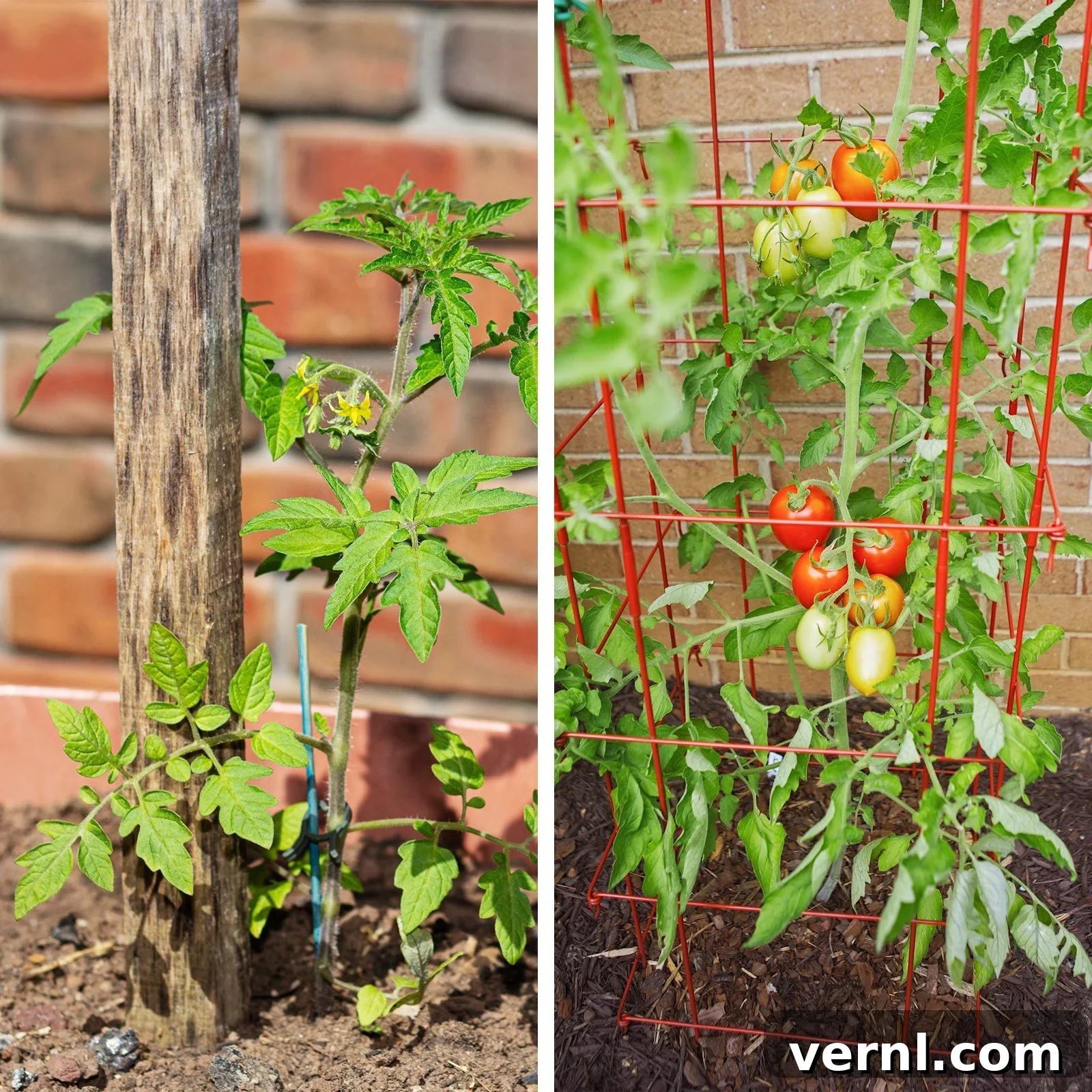
Staking is a time-honored method of supporting tomato plants, popular for its simplicity and space-saving qualities. It involves driving a sturdy stake into the ground near each plant and tying the main stem to it as the plant grows.
How to Stake Your Tomatoes Effectively
To stake your tomatoes, begin by placing a robust stake a few inches from the seedling or young plant. This placement is critical to avoid disturbing the developing root system. Materials for stakes can range from wooden posts (like lumber or bamboo poles) to metal rebar or specialized garden stakes. The stake should be tall enough to accommodate the full growth of your chosen tomato variety, typically five to eight feet for indeterminate types.
As your tomato plant grows, you will need to perform two main tasks:
- Pruning Suckers: Staking is often paired with pruning, specifically the removal of “suckers.” Suckers are the small shoots that emerge from the axil – the point where a branch meets the main stem. If left unchecked, these suckers will develop into new branches, producing leaves and fruit, leading to a bushier plant. While some gardeners prefer a less aggressive pruning approach, traditional staking typically involves removing most suckers to direct the plant’s energy into vertical growth and fruit production on the main stem. This concentrates the plant’s resources, often resulting in larger, earlier-ripening fruit, though potentially fewer overall.
- Tying the Main Stem: Regularly tie the main stem of the plant to the stake. Use soft, sturdy materials such as garden twine, narrow strips of cloth, or specialized vinyl plant ribbon. These materials prevent the tie from cutting into the stem as it thickens. Space your ties approximately eight to twelve inches apart along the stake, ensuring the plant has enough support as it gains height. Make sure the ties are secure but not overly tight, allowing for some stem expansion and natural movement.
Advantages of Staking Tomatoes
- Efficient Use of Space: Staked tomatoes grow vertically, occupying a much smaller footprint in the garden. This is ideal for gardeners with limited space or those who wish to maximize the number of plants in a given area.
- Improved Airflow: The vertical growth and open structure created by pruning suckers allow for excellent air circulation around the plant’s foliage. This significantly reduces humidity within the plant, which is crucial for preventing fungal diseases like blight.
- Faster Ripening and Enhanced Flavor: With suckers removed, the plant’s energy is channeled into fewer fruits, which often grow larger and ripen more quickly. Furthermore, the increased sun exposure to the ripening tomatoes can contribute to better flavor development.
- Easier Harvesting: Fruit is elevated and readily visible, making harvesting a straightforward task without bending over or searching through dense foliage.
- Propagation from Suckers: A unique benefit for gardeners with long growing seasons is the ability to root the removed suckers in a glass of water, then plant them as new, genetically identical plants, effectively extending your harvest or increasing your plant count.
Disadvantages of Staking Tomatoes
- Labor-Intensive Maintenance: Staking requires consistent attention. You’ll need to inspect your plants every few days to pinch off new suckers and secure the growing vines to the stake. This can be time-consuming, especially for a large garden.
- Potentially Lower Yield: By removing suckers, you are eliminating potential fruit-producing branches. While the remaining fruits may be larger, the overall quantity might be less compared to plants allowed to grow more bushily.
- Risk of Sun Scald: In very hot and sunny climates, the increased exposure of ripening fruit to direct sunlight, due to reduced foliage from pruning, can lead to “sun scald” – white or yellow, leathery patches on the fruit.
- Requires Pruning Knowledge: Proper pruning techniques are essential. Incorrect pruning can stress the plant or remove branches that would contribute to healthy growth and fruit production.
Embracing the Cage: Pros and Cons of Tomato Cages
Tomato cages offer a less hands-on approach to plant support compared to staking, providing a self-contained structure for the plant to grow within.
Setting Up Tomato Cages for Success
When selecting or constructing a tomato cage, size is paramount. Most store-bought cages are often too small and flimsy for the robust growth of indeterminate tomato varieties. For these vigorous plants, cages should ideally be at least three feet in diameter and four to five feet tall to adequately support a fully grown vine.
Many experienced gardeners choose to build their own cages using heavy-duty materials like concrete reinforcement mesh or hog panels. These materials are sturdy enough to bear the weight of a mature plant and its fruit. When installing cages, they need to be securely anchored to the ground, typically by tying them to rebar stakes or driving their legs deep into the soil. This prevents the entire cage from toppling over as the plant grows larger and heavier, especially during strong winds.
Advantages of Caging Tomatoes
- Reduced Maintenance: Once cages are properly installed, they require significantly less ongoing maintenance than staked plants. You can largely allow the tomato plant to grow naturally within the cage without the constant need for pruning suckers or tying vines.
- Potentially Higher Yield: Since suckers are generally not removed in caged systems, the plant produces more foliage and, consequently, more potential fruit-bearing branches. This can lead to a higher overall yield of tomatoes.
- Natural Sun Protection: The denser foliage within a cage provides more natural shade for the ripening fruit, reducing the risk of sun scald in hot climates.
- Stronger Structure: Well-built, large cages provide robust, all-around support for the entire plant, including lateral branches, which helps prevent breakage.
Disadvantages of Caging Tomatoes
- Storage Challenges: Large, sturdy tomato cages can be cumbersome and difficult to store during the off-season, particularly for gardeners with limited storage space.
- Overgrowth Issues: Smaller, less robust cages are often quickly outgrown by indeterminate varieties. Once a plant exceeds the cage’s capacity, it can become top-heavy, leading to instability, or branches may grow outside the cage, negating its purpose.
- Harvesting Difficulties: Reaching ripe tomatoes deep within a dense cage can sometimes be challenging, requiring more effort and potentially leading to missed or damaged fruit.
- Increased Disease Risk (Potentially): The denser foliage inside a cage can sometimes lead to reduced airflow compared to a heavily pruned, staked plant, potentially increasing the risk of fungal diseases if not managed well. Good plant spacing can help mitigate this.
- Initial Cost/Effort: While less ongoing maintenance, the initial investment in large, durable cages (whether purchased or DIY) can be higher, both in terms of cost and construction effort.
Exploring Alternate Tomato Plant Support Methods
Beyond traditional staking and caging, several innovative support systems offer unique advantages, especially for gardeners looking to grow tomatoes in rows or maximize space.
The Florida Weave (Basketweave Method)
The Florida weave, also known as the basketweave method, is an excellent support system for growing multiple tomato plants in a row. It’s particularly favored by commercial growers and home gardeners with long rows of tomatoes.
This method typically involves installing sturdy posts (such as heavy-duty metal fence posts or wooden stakes) at each end of a row and at regular intervals (every 2-3 plants) within the row. As the plants grow, strong twine or string is woven between the posts and around the plants. The twine is run down one side of the row, looping around each plant, and then back down the other side at increasing heights (every 8-12 inches). This creates a continuous “basket” that cradles the plants and prevents them from sprawling.
Susan Mulvilhill, author of “The Vegetable Garden Problem Solver Handbook,” effectively uses this method in her raised beds. She secures a heavy-duty metal fence post at each end of an eight-foot-long raised bed and then fastens a sheet of four-foot by eight-foot concrete reinforcing wire between them, planting her tomatoes 18 inches apart along the fence. “As the tomatoes grow,” she explains, “I carefully weave them in and out of the wire and occasionally tie the plants to the wire with jute twine to give the plants extra support.” This system allows her to grow more plants in a single bed and makes harvesting much easier by avoiding the need to reach deep into a cage.
Advantages of the Florida Weave:
- Efficient for Rows: Ideal for supporting multiple plants in a linear fashion, making it highly space-efficient for row gardening.
- Good Air Circulation: Provides a balance between support and airflow, allowing adequate air movement around plants.
- Easy Harvesting: Plants are kept upright and accessible, simplifying the picking of ripe fruit.
- Cost-Effective: Can be more economical than individual cages for a large number of plants, requiring only posts and twine.
Trellising and Overhead Support Systems
For gardeners with a penchant for vertical gardening or those growing in greenhouses, trellising systems using overhead wires and string are another popular option. This method involves suspending strong twine or rope from an overhead support structure (like a greenhouse frame or a sturdy trellis). As the tomato plant grows, its main stem is gently twisted around the string or clipped to it with specialized plant clips. This allows for very precise vertical growth and excellent air circulation. It’s often used for indeterminate varieties, enabling them to grow to their full potential height.
Lean-to or A-Frame Trellises
These structures provide broad support for multiple plants and can be particularly aesthetic in a garden setting. They involve two panels, often made of wire mesh or netting, hinged at the top to form an “A” shape, or leaned against each other. Plants grow up the sides, offering good air circulation and easy access to fruit from the outside.
Choosing the Best Tomato Plant Support for Your Garden
The “best” method of tomato plant support ultimately depends on several factors specific to your gardening situation:
- Tomato Variety: Indeterminate varieties generally require more robust and taller support than determinate varieties. Consider methods that can accommodate significant vertical growth.
- Garden Space: If you have limited space, staking or vertical trellising methods that encourage upward growth are ideal. For larger gardens with rows, the Florida weave or robust caging might be more suitable.
- Climate: In hot, sunny climates, cages or more bushy pruning for staked plants can offer some sun protection. In humid environments, methods that promote excellent airflow (like staking with aggressive pruning) can help prevent disease.
- Time Commitment: Staking requires more frequent attention for pruning and tying. Caging, once set up, is relatively low-maintenance.
- Personal Preference: Some gardeners enjoy the daily interaction with their plants that staking offers, while others prefer a more hands-off approach.
Don’t be afraid to experiment! You might even find that a combination of methods works best for different areas of your garden or for specific varieties. The goal is always to provide robust support that keeps your precious tomatoes healthy, off the ground, and ready for harvest.
Recommended Ready-Made Tomato Support Options
While many gardeners enjoy DIY solutions, there are excellent ready-made options available that can provide effective support for your tomato plants.
Sturdy Tomato Stakes
For those who prefer staking, a simple yet effective choice is a metal fence post. These robust posts are designed to withstand the elements and provide durable support for many seasons. They can be driven deep into the ground for maximum stability.
Color-Coded Cages
Greg Peterson of “The Urban Farm Podcast” suggests a clever way to keep track of different tomato varieties: using color-coded tomato cages. This practical approach not only provides support but also serves as an easy visual indicator for your early tomatoes, yellow tomatoes, or heirloom varieties, simplifying identification and harvest planning. Look for sturdy, heavy-duty cages that will not buckle under the weight of a mature plant.
Spiral Stakes for Continuous Support
Spiral stakes, often made from metal, offer a unique form of support where the plant can be gently woven through its coils as it grows. These eliminate the need for constant tying, though they can sometimes be difficult to secure firmly in the ground. A good trick for ensuring stability is to first pound a two-foot section of one-inch PVC pipe at least one foot deep into the soil using a small mallet. Then, drop the spiral stake into the PVC pipe. This creates a stable anchor for the stake, preventing it from leaning or falling over.
Compact Cages for Determinate or Smaller Vines
While large indeterminate plants can quickly outgrow them, ready-made cages are an excellent option for determinate varieties or smaller tomato vines. Many available cages are four feet tall, perfectly suited to provide ample support for bush-type tomatoes without being overly large or intrusive.
By understanding the benefits and considerations of each support method, you can make informed decisions that will lead to stronger plants, healthier fruit, and a more rewarding gardening experience. Happy growing!