
Mastering Electrical Grounding: An Essential Guide for Home Safety
Whether you’re an experienced DIYer tackling complex home improvement projects or just starting to learn about your home’s infrastructure, electrical grounding is undoubtedly one of the most critical — and often misunderstood — concepts to grasp. It’s a foundational element of any safe electrical system, yet its purpose and function can seem shrouded in mystery for many homeowners.
Perhaps you’ve heard the term “grounding” before, but aren’t entirely sure what its practical implications are. Maybe you’ve visually identified, and even connected, the distinctive green “ground wire” during a recent DIY electrical endeavor. Or perhaps the concept of grounding is completely new territory for you, and you’re seeking a clear, straightforward explanation to demystify this vital safety feature.
In this comprehensive guide, we will meticulously break down electrical grounding. We’ll explore precisely what it is, elaborate on its essential functions, and underscore why it plays such an indispensable role in safeguarding every electrical circuit within your home, protecting both your property and, more importantly, its occupants.
What Is Electrical Grounding? A Fundamental Safety Concept
At its core, electrical grounding refers to the process of creating a direct physical connection to the Earth itself, or extending this protective connection to various metallic components throughout your home. This includes the metal frames and enclosures of electrical equipment, the intricate wiring within walls, a wide array of appliances, light fixtures, and electrical receptacles – even those situated far away from the actual soil outside your house. This deliberate establishment of a connection to the Earth provides several significant safety and operational benefits, so much so that it has been a mandated requirement, in various forms, by the National Electrical Code (NEC) since the very dawn of widespread electricity use.
The Earth, being an immense and naturally conductive body, acts as a universal reference point for electrical potential. By connecting parts of our electrical system to this vast, unchanging potential (effectively zero volts), we create a critical safety pathway. Before we delve deeper into the specifics of grounding, it’s beneficial to take a moment to review the basic principles of how electricity is delivered and utilized throughout your residence.
Understanding the Flow: How Does Electricity Work in Your Home?
When you enter a room and effortlessly flip on a light switch, you initiate a fascinating chain of events. Electricity, in the form of current, begins to flow instantaneously through that switch and onward to the light fixture. This electrical current is fundamentally composed of countless electrons, which are incredibly tiny subatomic particles that are perpetually in motion. It’s the directed movement of these electrons that performs the work we rely on daily – they cause your lights to illuminate, your toaster to perfectly brown your bread, and your washing machine to efficiently clean your laundry.
Until you switch off the device or appliance, these electrons continue to circulate in a continuous, uninterrupted loop. This loop starts from your home’s main electrical panel, travels to the appliance or light, and then returns to the panel. This complete pathway is known as an electrical circuit. The persistent flow of current within this loop is governed by a fundamental principle of electricity: it always seeks to return to its original source. This ultimate source is typically the electric utility transformer, which might be mounted on a pole or pad outside your home, or located elsewhere within your neighborhood’s infrastructure. For simplicity within your home’s context, we can consider your main electrical panel as the immediate source and return point for all circuits.
The current itself is carried by specially designed wires, known as conductors. These are most commonly made from highly conductive metals such as copper or aluminum. These materials are chosen precisely because electrons can travel through them with very little resistance. Voltage, often thought of as electrical pressure, is the force that propels or pushes this current (the flow of electrons) through the circuit. Think of voltage as the “push” and current as the “flow.”
Crucially, the Earth itself is also a conductor, and, unfortunately, so is the human body. Electrical current is inherently opportunistic; it will always take the path of least resistance to complete its circuit and return to its source. If you happen to inadvertently become part of that circuit – by touching an energized component while also being connected to ground – the current could choose to pass directly through your body. This is an extremely dangerous scenario, as it takes only a surprisingly small amount of current, just a few milliamps, to cause severe injury or even be fatal. Modern safety devices, such as ground-fault circuit interrupters (GFCIs), are specifically engineered to detect these dangerous leakage currents and rapidly cut off the electricity flow, typically reacting when current levels reach between 4 and 6 milliamps (0.004 to 0.006 amps).
Why Do We Ground? The Uncompromisable Priority: Safety
In the simplest terms, the overarching reason for electrical grounding is: Safety. Given the potentially lethal nature of the electrical current that powers our lights, appliances, and tools, it is absolutely paramount to mitigate that inherent danger. Grounding is the primary method by which we achieve this critical level of protection, and it is accomplished through two distinct but interconnected mechanisms:
System Grounding: Stabilizing Your Home’s Electrical Backbone
Your entire house wiring network constitutes an intricate electrical system, which is intentionally connected to ground at your main electrical panel. This critical connection serves several vital functions, foremost among them being the stabilization of voltages throughout your entire home. Tools, appliances, lighting fixtures, and electronic devices are all designed to operate correctly and safely within very specific voltage ranges. System grounding ensures that, regardless of where you plug in your computer or television, it consistently receives the expected 120-volt circuit (allowing for minor fluctuations of a few volts). Similarly, every time you operate your electric clothes dryer, the system reliably delivers the necessary 240 volts for its safe and efficient function.
Beyond maintaining stable operating voltages, system grounding provides crucial protection against voltage surges. If a powerful event like a lightning strike occurs directly on your home or in the surrounding area, or if a utility line fault introduces an excessive voltage into your system, the grounding connection provides a safe, low-resistance path for this dangerous excess energy to dissipate into the Earth, protecting your sensitive electronics and preventing potential fires. Without system grounding, such surges could cause widespread damage to appliances and pose significant fire hazards.
Equipment Grounding and Bonding: Protecting Against Dangerous Faults
When you typically think of “electrical equipment,” your mind likely goes straight to the appliances, power tools, and electronic gadgets that you plug into outlets and actively use. And you’d be correct in that assessment. However, within the context of grounding, the term “equipment” also encompasses a broader range of metallic components that do not, under normal operating conditions, carry or utilize electricity. This includes the metal frames of appliances, junction boxes, rigid metal conduit, and other metallic enclosures. These “non-current carrying” metal parts must be rigorously grounded – meaning they are connected back to the Earth – specifically to prevent them from becoming dangerously energized in the event of an electrical fault.
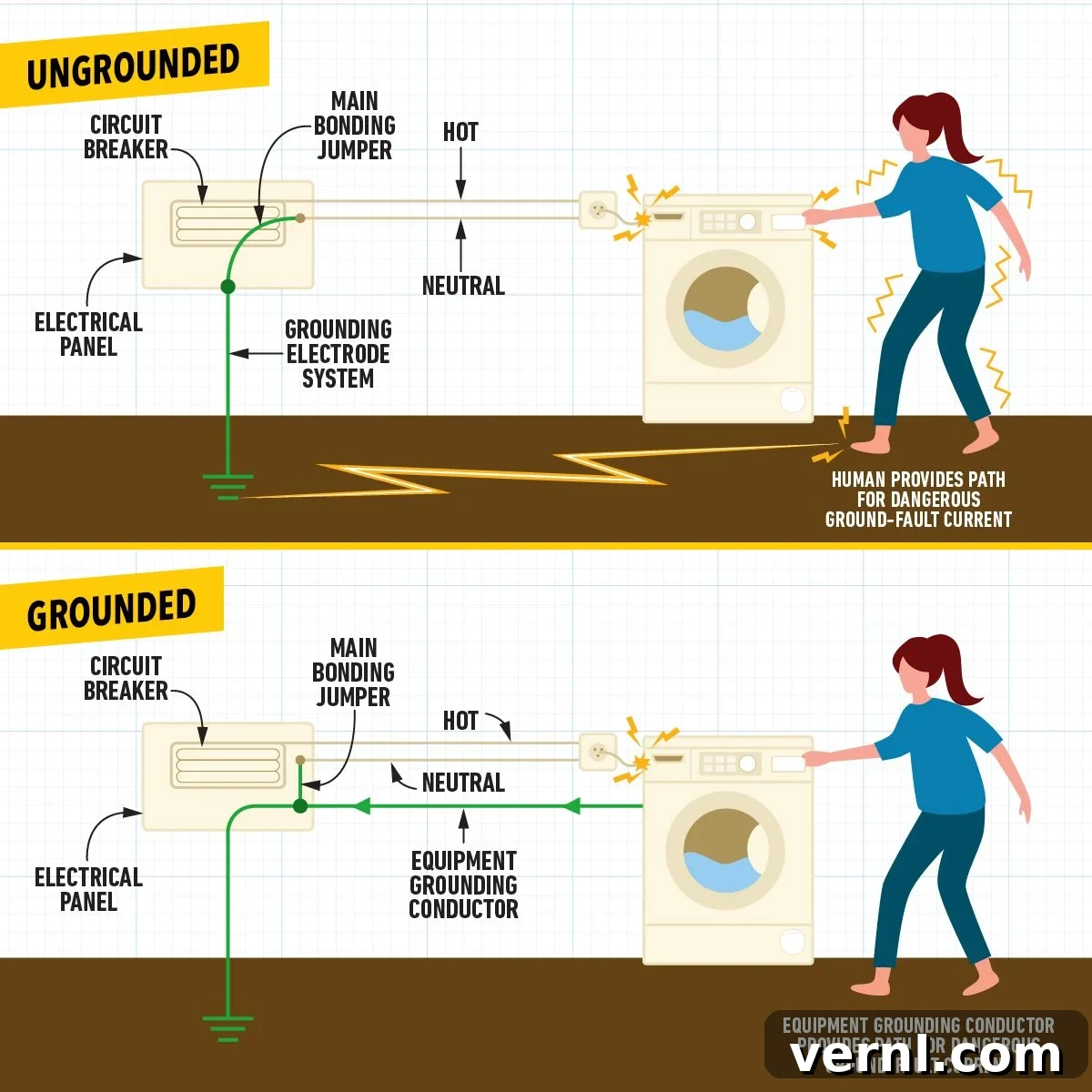
Consider your washing machine as an example. Over time, due to age, vibration, or simple friction, the “hot” conductor (the wire carrying live electricity) delivering power to your washer could become loose, frayed, or otherwise damaged. If this damaged wire accidentally makes contact with the washing machine’s metal frame, the frame itself would instantly become energized with potentially lethal voltage. In a properly grounded home, this scenario triggers a critical safety mechanism: your home’s circuit breaker, designed to protect that specific circuit, will quickly trip and shut off the power.
But how does the circuit breaker “know” to trip? This is where the concept of bonding becomes crucial. Bonding refers to the act of connecting various metallic components together to establish a continuous, electrically conductive pathway. When that frayed hot wire unexpectedly touches the metal frame of the washing machine, it creates what electricians call a dangerous ground-fault condition. This fault results in an unintentional surge of exceptionally high current that needs to return to the electrical panel and its corresponding circuit breaker – and it needs to do so extremely rapidly. It cannot simply travel back along the regular circuit conductors (the hot and neutral wires) because the washing machine’s metal frame has effectively interrupted that normal path. Therefore, it must take an alternate, specifically designed route. Electricians deliberately install this alternative, low-resistance path for this very purpose.
This critical alternate route can be either an appropriately sized green-insulated or bare copper wire, or it can be the metal parts of the electrical system themselves (like metal conduit), provided they are properly connected and continuous all the way back to the main electrical panel. Without this dedicated fault path, the washing machine’s frame could remain energized indefinitely, silently waiting to deliver a severe, potentially fatal electric shock to anyone – a person or even a pet – who happens to touch it. Equipment grounding and bonding are therefore essential safeguards, meticulously designed to mitigate the grave danger posed by electric shock by providing a swift and safe route for fault currents.
How Does Electrical Grounding Work in Practice? Demystifying Electron Behavior
So, we’ve established that grounding is profoundly important for safety, but precisely how does this connection to the Earth make things safer? This particular aspect can often be the most confusing, but let’s break it down with a simple analogy.
Think back to your childhood – or perhaps even last week! – when you might have shuffled across a carpet in your socks, building up static electricity, and then playfully touched a friend to give them a mild shock. Your friend received that jolt because you had accumulated an excess of electrons from the carpeting, while your friend, by comparison, had a relative deficiency of electrons. The electrons, sensing this disparity, which electricians and physicists refer to as a potential difference, quickly moved from you to your friend to re-establish a state of electrical equilibrium.
Electrons in electrical circuits behave in a remarkably similar fashion; they are constantly driven to move towards a different potential. The Earth (our ultimate ground connection) has a natural potential of zero volts. In stark contrast, your home’s operational electrical circuits maintain much higher potentials – typically 120 volts and 240 volts above Earth potential. (Indeed, “potential” in this context is synonymous with “voltage.”)
Recall our earlier discussion about how you, unfortunately, can also act as an electrical conductor. If you were to touch an electrified metal frame of an appliance while simultaneously standing on the zero-potential Earth, the electrons within that 120-volt (or 240-volt) circuit would immediately sense that vast potential difference. Just like when you zapped your buddy with static electricity, those electrons could then choose to use your body and the Earth as their preferred path to return to their source. This scenario, as we’ve highlighted, is exceptionally dangerous and precisely what grounding aims to prevent.
Fortunately, electrons will only flow through you if they detect a significant difference in potential. This is where the magic of proper grounding comes into play. By meticulously connecting the washing machine frame, for instance, to ground – either through the dedicated green equipment grounding conductor or via the system of bonded metallic conduit – that frame is kept at Earth potential (zero volts). Because there is no significant potential difference between you (standing on Earth) and the grounded appliance frame, you cannot become an attractive part of the electrical circuit. The electrons have no incentive to pass through you.
To summarize, if there is an unfortunate failure of the plastic insulation surrounding the “hot” wire, and it inadvertently makes contact with the metal frame of an appliance like a washing machine, a highly dangerous ground-fault circuit will be instantly established. When this occurs, the fault current will surge from the utility transformer, flow through the supply conductors to your home, pass through the relevant circuit breaker in your electrical panel, travel to the precise point of the unintentional ground-fault connection within the washing machine, then swiftly divert through the dedicated green equipment grounding conductor (or the integrated metal conduit system), continue back through your electrical panel, and finally return to the utility transformer. If this vital ground-fault circuit is complete and properly installed as mandated by the NEC, a massive amount of current will flow, causing the circuit breaker to trip instantaneously and stopping the flow of electricity with minimal delay. This rapid interruption effectively eliminates the dangerous shock hazard, protecting anyone nearby. Think of the grounding system as a silent, ever-vigilant sentry: it stands ready to protect us from harm the moment something goes wrong with our home’s electrical system, offering an unseen but incredibly powerful layer of safety.
Proper electrical grounding is not just a regulatory requirement; it is a fundamental pillar of modern electrical safety, safeguarding both property and lives. Understanding its principles empowers you to appreciate the intricate design behind your home’s electrical infrastructure and reinforces the importance of never bypassing these critical safety measures.