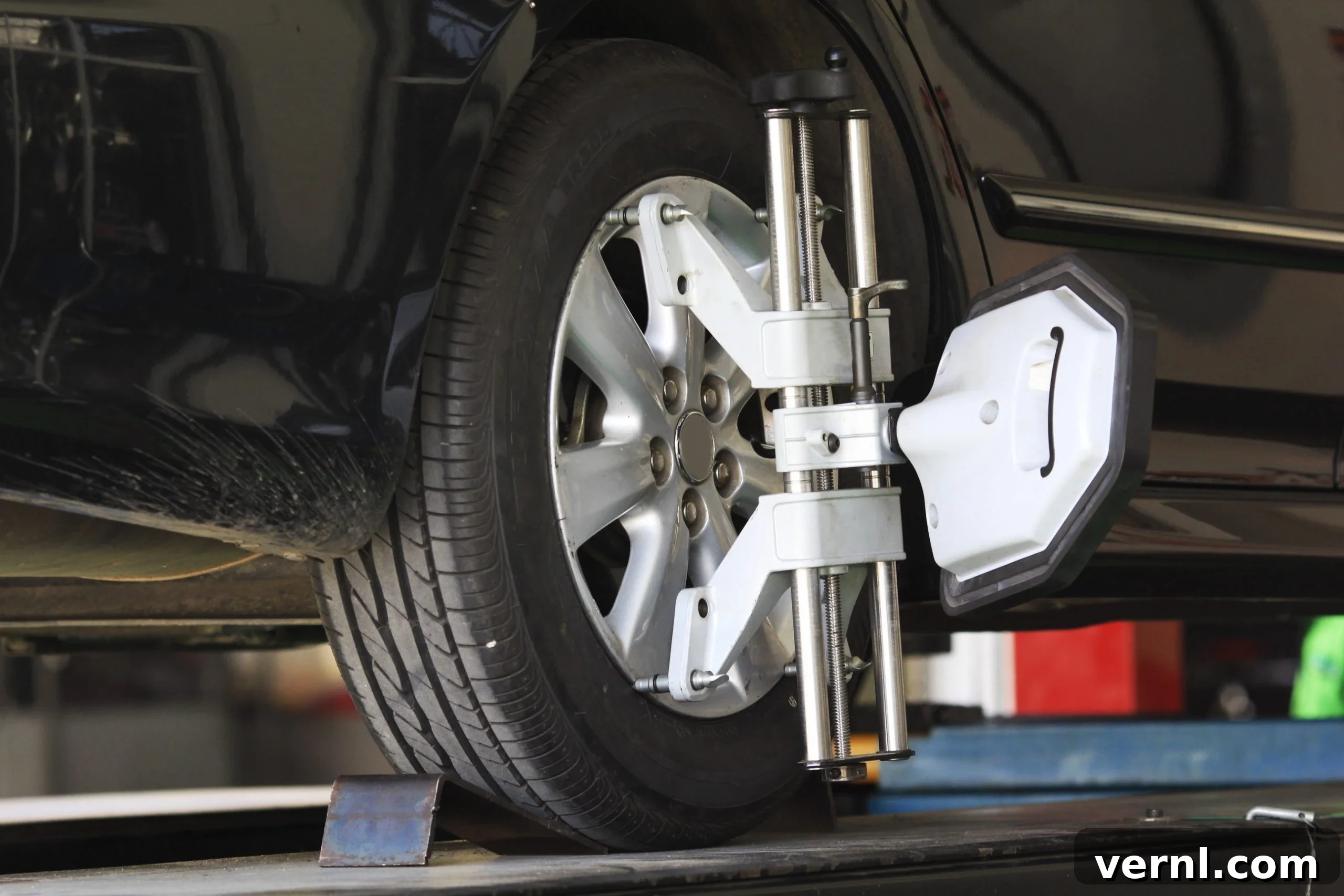
Ensuring your vehicle performs safely and efficiently hinges on two critical maintenance procedures: tire balance and wheel alignment. These services are paramount for maintaining a smooth ride, preventing premature tire wear, and crucially, keeping your tires firmly connected to the road surface. This connection point, known as the contact patch or footprint, is surprisingly small—often no larger than the palm of your hand. Despite its modest size, this patch is the sole interface between your vehicle and the road, making its integrity absolutely vital for vehicle control, braking effectiveness, and overall responsiveness.
Many drivers, unless acutely attuned to their vehicle’s nuances, might overlook subtle signs of imbalance or misalignment until the problem escalates. A slightly bumpier ride or a car that consistently pulls to one side might be dismissed as typical reactions to road imperfections or windy conditions. However, as Duane “Doc” Watson, a technical trainer at Bosch Mobility Aftermarket, highlights, “Some drivers might mistake a bumpier ride or a car that’s pulling to one side more than the other as reactions to road conditions, but in reality both can be signs of imbalanced or misaligned tires.” Understanding these distinctions is key to proactive vehicle care and preventing more serious issues down the road.
While tire/wheel balancing and alignment services are distinct in their technical execution, they are deeply complementary and often addressed simultaneously. Repair shops frequently recommend and perform both during a single service visit, recognizing their combined impact on vehicle performance, safety, and tire longevity. This comprehensive approach ensures that all aspects of tire and suspension health are addressed, offering peace of mind and maximizing your vehicle’s operational efficiency.
This guide will delve deeper into how tire balance and alignment work, their individual importance in vehicle dynamics, and the tell-tale signs that indicate your vehicle might be in need of these essential adjustments. Properly understanding these concepts can empower you to make informed decisions about your vehicle’s maintenance, safeguarding your investment and ensuring a safer, more comfortable driving experience for years to come.
Note: For clarity, when a tire (the rubber component that contacts the road) is mounted onto a wheel (the metal rim that attaches to the vehicle’s hub), the complete unit is referred to as a tire/wheel assembly.
Understanding Wheel Alignment: The Foundation of Stable Driving
A wheel alignment, often referred to as a “front-end alignment” or, more comprehensively, a “four-wheel alignment” for vehicles equipped with independent rear suspension, is a sophisticated adjustment process focusing on your vehicle’s suspension system. This procedure does not involve physically altering the tires or wheels themselves, but rather fine-tunes the intricate angles at which they connect to the car’s chassis. The overarching goal is to ensure that all wheels are parallel to each other and perpendicular to the ground, allowing for optimal handling, even tire wear, and overall vehicle stability. This precision adjustment is fundamental to how your car drives and feels on the road.
Chris “Moose” Pyle, an automotive mechanic expert with JustAnswer.com, vividly explains the necessity of alignment: “Vehicles are designed to have the tires aiming basically straight ahead and be vertical. When suspension and steering parts wear out, or when you clobber a pothole or hit a curb, you likely need an alignment to get the tires rolling perfectly again. This will help with the feel and it will make the tires last their longest.” Indeed, everyday driving, cumulative wear on suspension components, or sudden impacts from road hazards like potholes or curbs can instantly throw off meticulously set alignment angles. When this occurs, the tires no longer track straight and true, leading to immediate handling issues, accelerated tire wear, and a compromised driving experience.
An out-of-alignment suspension system forces tires to drag or scrub across the pavement rather than roll smoothly and efficiently. This creates unnecessary friction, heat, and stress, which leads to distinct and often rapid uneven wear patterns on the tire’s edges or shoulders. To better visualize this phenomenon, consider the analogy of rolling a tapered coffee cup on a flat surface; it naturally veers in a circle rather than rolling in a straight line. Similarly, a misaligned wheel causes your car to constantly pull to one side, requiring continuous steering correction from the driver. This constant effort not only causes driver fatigue but also significantly increases stress on the tires and steering components.
The ultimate objective of a proper wheel alignment is to ensure your suspension components are geometrically positioned with precision, so that all your tires track in the exact same direction. This phenomenon, known as “tracking,” is crucial for maintaining vehicle stability, especially at higher speeds, and ensuring a predictable response to steering inputs. When tires track correctly, they remain firmly planted on the pavement, promoting exceptional grip, responsive steering, and predictable handling under various driving conditions. Beyond the critical safety aspects, correct alignment significantly increases tread life, postponing costly tire replacements, and markedly improves overall driving enjoyment by providing a smooth, effortless steering experience free from wandering or pulling.
The Three Critical Alignment Angles: Camber, Toe, and Caster
Vehicle alignment is a precise adjustment process measured across three primary angles. Each of these angles plays a distinct and crucial role in tire wear, vehicle handling, and steering dynamics. Understanding them helps appreciate the complexity and importance of proper alignment:
- Camber: This refers to the inward or outward tilt of the wheel when viewed directly from the front of the car. If the top of the wheel tilts outwards away from the vehicle, it’s called positive camber; if it tilts inwards towards the vehicle, it’s negative camber. The ideal camber setting is typically very close to zero or slightly negative, ensuring that the entire load of a vehicle is evenly distributed across the full width of a tire’s tread. When camber is out of specification—either excessively positive or negative—it places the vehicle’s weight predominantly on only one side of the tire. This imbalance in load distribution leads to premature and uneven wear on that specific edge of the tire (either the inner or outer shoulder), significantly reducing its lifespan and compromising cornering grip and overall stability.
- Toe-in/Toe-out Measurements: Toe describes the angle at which the front of the tires on the same axle point inwards (toe-in) or outwards (toe-out) relative to each other when viewed from above the vehicle. These angles are measured in very small fractions of an inch or degrees. Even a slight deviation from the manufacturer’s specified toe setting can have a dramatic impact on tire wear and steering. When toe is out of spec, tires are effectively dragged sideways as the vehicle moves forward, rather than rolling cleanly. This “scrubbing” action causes rapid and distinctive tire wear patterns, often appearing as “feather edging” (where the tread blocks are worn higher on one side and lower on the other). More importantly, incorrect toe settings severely affect steering response and straight-line stability, making the car wander, feel “nervous,” or unstable, especially when driving straight or initiating turns.
- Caster: Caster refers to the tilt or angle of the steering axis (the imaginary line through the upper and lower ball joints that the wheel pivots around) when viewed from the side of the vehicle. A positive caster angle means the steering axis is tilted towards the rear of the car, while a negative caster means it’s tilted forward. Unlike camber and toe, caster does not directly affect tire wear. Its primary function is to influence steering stability, steering effort, and the vehicle’s ability to self-center after a turn. A proper positive caster setting helps the steering wheel easily return to the centered position without requiring constant driver assistance, much like the front wheel of a bicycle. Insufficient or uneven caster can lead to a “loose” steering feel, reduced straight-line stability (making the car prone to wandering), and difficulty in recovering from turns, diminishing driving confidence and comfort.
It’s important to recognize that even regular driving on seemingly perfect roads subjects suspension components to constant movement, minor impacts, and the stresses of braking and acceleration. Over time, these parts naturally weaken and wear, inevitably affecting a vehicle’s wheel alignment. Consequently, even if your tires appear to be wearing evenly and your car seems to be driving fine, a tire alignment should be an integral part of your annual maintenance service. This proactive approach helps catch minor deviations before they become significant issues, saving you money on premature tire replacements and potentially costly suspension repairs, while also improving safety and fuel efficiency.
Clear Indicators You Need a Tire Alignment
Provided your tires are inflated to the correct air pressure and are in good condition, your vehicle will likely exhibit several noticeable symptoms if it requires a wheel alignment. Paying close attention to these signs can help you address the issue promptly, preventing further damage, enhancing safety, and improving your driving experience:
- Vehicle Drifts or Pulls: The most common and immediate sign of misalignment is if your car consistently drifts or pulls to one side of the road, even when you’re driving on a flat, straight surface. You’ll find yourself constantly having to adjust the steering wheel to keep the vehicle going straight. This isn’t just annoying; it can be dangerous, especially at highway speeds or in emergency maneuvers, as it reduces your control over the vehicle.
- Abnormal Tire Wear Patterns: Visually inspect your tires for excessive, abnormal, or uneven tread wear. This might manifest as one side of the tire wearing down significantly faster than the other, “feather edging” (where the tread blocks are worn higher on one side and lower on the other across the tread face), or distinct bald spots. These patterns are direct evidence of tires scrubbing rather than rolling properly, a tell-tale sign of incorrect alignment angles.
- Squealing or Squeaking Tires: If your tires squeal or squeak when driving or cornering, especially at low speeds or during gentle turns, it could indicate that they are not making even, consistent contact with the road due to misalignment. This excessive friction generates the noise and accelerates wear.
- Off-Center Steering Wheel: When driving straight on a perfectly level road, your steering wheel should be perfectly centered and straight. If it appears “off-center” (tilted to one side) even though the car is going straight, it’s a strong indicator of misalignment within the steering or suspension system.
- Steering Wheel Vibrations: While often primarily associated with tire balancing issues, a misaligned vehicle can also cause your steering wheel to vibrate, especially as you increase speed or when accelerating from a stop. This occurs because the tires are fighting against each other or scrubbing unevenly, creating chaotic forces that translate into vibrations.
- Excessive Steering Wheel Play: If you notice excess side-to-side steering wheel play, meaning there’s a noticeable delay or looseness in the steering response when you slightly move the wheel, it might stem from worn steering components exacerbated by or contributing to misalignment, making the vehicle feel less responsive and secure.
As Watson wisely advises, “If you notice any of the above interfering with business as usual, it’s best practice to take your car in and have a professional repair tech get to the bottom of the problem.” Ignoring these signs not only compromises your safety and driving comfort but also leads to more extensive and costly repairs, such as premature tire replacement, suspension component wear, and reduced fuel economy, down the line.
Decoding Tire Balancing: Eliminating Vibrations for a Smooth Ride
Any round object that spins, be it a bicycle wheel, a turbine, or your car’s tire and wheel assembly, must be meticulously “balanced” to prevent unwanted vibrations. Tire balancing is the precise process of distributing weight evenly around the tire and wheel assembly to ensure it spins uniformly and smoothly at all speeds. Without proper balance, even tiny discrepancies in weight distribution can lead to significant centrifugal forces that manifest as noticeable and often annoying vibrations, especially as vehicle speed increases. These vibrations can severely diminish ride comfort and overall vehicle performance.
Chris Pyle further elaborates on this mechanical necessity: “Wheels and tires are round but they are not perfect, so there are areas that are heavy and light. A wheel balancing machine spins a mounted tire on a rim to find those heavy spots so you can add weights on the opposite side. This reduces vibrations at highway speeds.” It’s crucial to understand that even brand-new tires and wheels aren’t perfectly uniform out of the factory; manufacturing tolerances mean there will always be slight variations in weight distribution that need to be compensated for with small, strategically placed weights to achieve perfect balance.
An out-of-balance tire and wheel assembly isn’t just an annoyance for the driver; it can inflict considerable damage on your vehicle and dramatically shorten the life of your tires. Constant, persistent vibrations stress vital suspension components, wheel bearings, and steering linkages, accelerating their wear and potentially leading to premature failure and costly repairs. More directly, the repetitive “bouncing” or uneven contact with the road caused by an imbalance can create localized hot spots and rapid, irregular wear patterns on the tire tread, such as cupping or scalloping, significantly reducing its useful lifespan and requiring earlier replacement.
To vividly demonstrate the concept of wheel balancing, one might imagine taping a few flat washers to a basketball. When the ball is rolled, it visibly “bounces” or thumps every time the heavier side—where the washers are attached—hits the floor. This simple analogy clearly illustrates how a heavy spot on a tire causes a repetitive impact or vibration as it spins, directly affecting the smoothness of the ride and the consistent contact with the road surface.
The process of wheel balancing involves a trained technician using specialized equipment called a wheel balancer. This sophisticated machine accurately spins the tire and wheel assembly at high speeds while sensitive sensors detect any imbalances in weight distribution. Based on these precise readings, the machine indicates precisely where and how much weight (typically small lead-free weights) needs to be added to counteract the heavy spots. There are primarily two common and effective types of wheel balancing techniques:
- Dynamic Balancing: This is the most prevalent and widely used method. A dynamic wheel balancer measures imbalances in both the horizontal (static, or up-and-down motion) and vertical (dynamic, or side-to-side wobble) planes of the spinning wheel. It precisely identifies the exact heaviest point of the tire/wheel assembly and calculates the precise amount and location for wheel weights to be installed, typically on both the inner and outer edges of the rim. These strategically placed weights counteract the tire’s imbalance, effectively eliminating vibrations and preventing tire “hop” or side-to-side wobble at various speeds, ensuring a consistently smooth and stable ride.
- Match Balancing (or Road Force Balancing): This advanced balancing technique goes a significant step further than conventional dynamic balancing. A road force balancer not only measures static and dynamic imbalances but also applies a simulated load (mimicking the weight of the vehicle on the road) to the tire while it spins. This allows the machine to identify the tire’s “low point” (the softest or most flexible part of the tire) and the wheel’s “high point” (the stiffest or highest point of the rim, which can contribute to minor runout). To provide the smoothest possible ride and minimize potential vibrations that might persist even after dynamic balancing, the technician will then “match mount” the tire to the wheel by temporarily loosening the tire from the rim and rotating it until these identified low and high points are aligned. This technique is particularly beneficial for resolving persistent vibrations that conventional balancing might miss, and it’s often recommended for high-performance vehicles, larger wheel/tire combinations, or when addressing specific ride quality complaints that are difficult to diagnose otherwise.
Recognizing the Signs Your Tires Need Balancing
An out-of-balance tire generally announces itself through distinct and often frustrating symptoms, primarily involving vibrations. Identifying these early can prevent accelerated tire wear, potential damage to your vehicle’s suspension, and improve your overall driving comfort and safety:
- Vibrations While Driving: This is arguably the most definitive sign. If the front tires are out of balance, the vibrations will typically be felt directly through the steering wheel. These vibrations often begin or intensify as your speed increases, commonly becoming noticeable between 40-70 mph. If the rear tires/wheels are out of balance, the vibrations might pulsate through the seats or floorboards, and you might notice the rearview or side mirrors bouncing or looking blurry. The specific location and feel of the vibration often provide a clue about which axle is affected.
- Irregular Tire Wear: While alignment issues also cause uneven wear, an out-of-balance tire can lead to specific wear patterns such as “bald spots” or scalloping (also known as cupping) on the edge or middle of the tire tread. These distinct wear patterns occur because the tire is repetitively bouncing or hitting the road unevenly as it spins, causing excessive and localized wear in certain areas.
- Unusual Noises: You might hear rumbling, growling, or thumping noises emanating from the tires. These sounds are often a direct result of the tire’s uneven contact with the road surface due to imbalance, especially noticeable at certain speeds or under specific driving conditions.
- After Tire Repair or Installation: If you repair a tire with an internal patch or plug, or if you install new tires, it’s crucial to have the tire/wheel assembly rebalanced. Even a small patch or the slight weight variation of a new tire can alter its original balance, requiring recalibration to prevent vibrations and ensure optimal performance.
It can indeed be challenging for drivers to discern whether their vehicle issues stem from misalignment or imbalance, as Duane Watson points out: “The telltale sign with imbalanced tires is often unusual vibrations, be it in your steering wheel, your seats or under your floorboard; but this can also mean your tires are misaligned.” The key difference often lies in the nature and constancy of the symptom; balancing issues tend to produce vibrations that are speed-dependent and often come and go as speed changes, while misalignment might cause a more consistent pull or irregular wear that may or may not be accompanied by significant vibration, and is often linked to steering input.
To unequivocally extend the life of your tires, ensure better handling and braking performance, guarantee a smoother and more comfortable ride, and even achieve increased fuel economy, it is imperative to integrate regular tire maintenance into your vehicle care routine. Specifically, make it a practice to rotate and balance your tires and wheels every 6,000 to 8,000 miles, or according to your vehicle manufacturer’s recommendations. This proactive approach not only keeps your vehicle performing at its best and ensures your safety but also provides significant long-term savings by maximizing tire life and preventing more serious mechanical issues from developing.
Meet Our Automotive Experts
- Duane “Doc” Watson is a distinguished technical trainer at Bosch Mobility Aftermarket. With an impressive career spanning over 45 years in automotive repair, Doc has been instrumental in training thousands of technicians across the industry. His profound expertise has been widely recognized with numerous prestigious industry accolades, including the coveted Chevrolet Technician of the Year and Buick Service Master of the Year awards, underscoring his deep knowledge and dedication to the automotive field.
- Chris “Moose” Pyle is a master-certified technician boasting more than two decades of comprehensive automotive experience. Since 2006, he has served as a trusted expert for JustAnswer.com, where he provides invaluable advice and answers hundreds of car maintenance and repair questions daily. Chris’s extensive practical knowledge, coupled with his ability to clearly explain complex automotive issues, makes him a highly sought-after and reliable resource for vehicle owners seeking expert guidance.