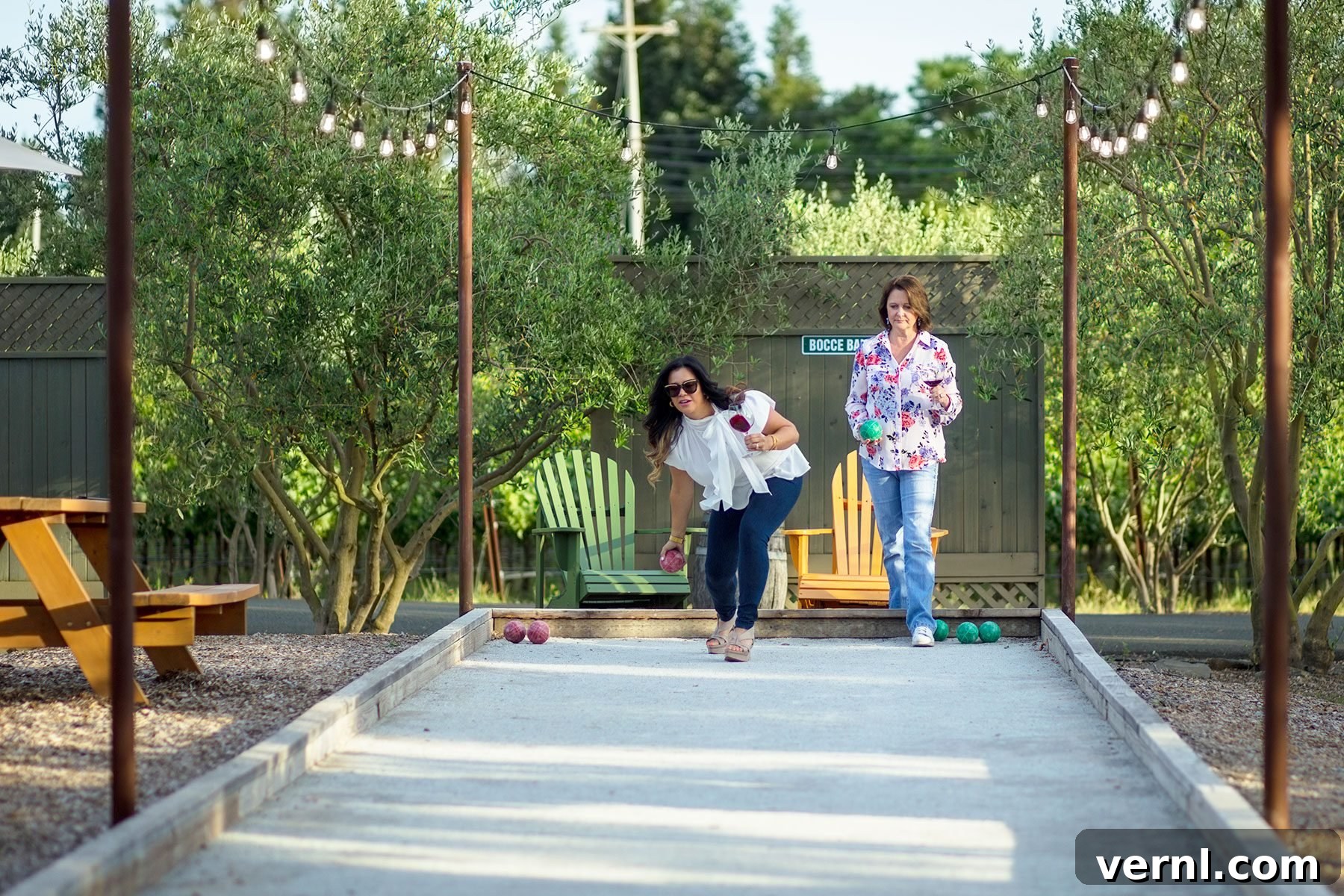
Bocce, a sport steeped in history, traces its origins back to ancient Egypt, Greece, and the grandeur of the Roman Empire. Often likened to shuffleboard or curling, this engaging game is traditionally played on a long, rectangular court, typically surfaced with crushed stone, oyster shells, or finely manicured grass. The fundamental objective is straightforward yet challenging: strategically rolling or tossing your team’s bocce balls to land closer to a smaller target ball, known as the pallino, than your opponents.
For many, particularly in regions with a significant Italian-American heritage, the sight of a bocce court is a familiar and welcoming one. However, the true charm of bocce lies in its remarkable versatility; it’s a game that transcends formal settings and can be enjoyed almost anywhere – from vibrant city parks and sandy beaches to the comfort of your very own backyard. This adaptability makes it an ideal addition to any home looking to enhance its outdoor entertainment options.
If you’re considering bringing the timeless joy of bocce to your personal outdoor space, you essentially have two primary routes. You can opt for a temporary setup, simply marking out a court on your existing lawn for casual play. Or, for a more enduring and dedicated experience, you can embark on a rewarding DIY bocce court construction project, creating a permanent fixture that will provide years of enjoyment for family and friends alike.
While the prospect of building a permanent bocce court might seem more involved than constructing, for instance, a temporary DIY pickleball court, it is an entirely achievable endeavor. With careful planning, a bit of elbow grease, and perhaps some assistance, most backyard bocce courts can be completed over a single weekend. The core process involves several key stages: meticulous excavation of the ground, constructing a sturdy perimeter to define the court, and finally, filling the playing area with the appropriate layers of crushed rock and playing surface material. The beauty of the perimeter design is its flexibility – it can be fashioned from a wide array of materials, including wood, concrete, metal, or even decorative stones, allowing for considerable creative expression to match your landscaping aesthetic.
Essential Preparations Before You Dig
Before any ground-breaking project commences, especially one involving significant excavation, safety and planning are paramount. It is absolutely crucial to contact your local utility services or visit call811.com. This free service will dispatch professionals to accurately mark the precise locations of underground water, electric, and gas lines, preventing potentially dangerous and costly accidents. This simple step can save you immense trouble and ensure the safety of your project.
Once utility lines are marked, dedicate time to planning your court. Sketching out your design on paper or utilizing CAD software like SketchUp can help visualize the layout, dimensions, and material requirements. Consider different court sizes and how they will fit within your available space. Following this, gather all necessary supplies and tools. A typical backyard bocce court construction will require a comprehensive toolkit including shovels for excavation, wheelbarrows for transporting materials, and tampers for compacting layers. Essential measuring and leveling tools include tape measures, a dependable level, string, and wooden stakes for marking. For the court structure itself, you’ll need dimensional lumber (e.g., pressure-treated 4x4s or 2x6s), rebar for securing the perimeter, and high-quality landscaping fabric to act as a weed barrier and prevent material migration between layers.
Crucially, be prepared for a substantial quantity of crushed rock. The base and middle layers of your bocce court will consume several tons of aggregate. It is highly advisable to contact a local quarry or a landscaping supply store well in advance to arrange for delivery. They can also assist in calculating the precise volume needed based on your court dimensions, often providing different grades and types of crushed stone suitable for bocce court construction.
Choosing the Perfect Location for Your Bocce Court
When selecting the ideal spot for your backyard bocce court, understanding size requirements is key. While official regulation bocce courts, as stipulated by organizations like bocce.org, measure an impressive 91 by 13 feet, most backyard and casual-use courts can be significantly scaled down to fit available space. Many bocce organizations suggest a minimum practical size of 60 by 10 feet for recreational play, which still provides an ample challenge. A long, relatively narrow side yard often presents an optimal location, but with thoughtful planning, a bocce court can be integrated into almost any area where you have the necessary room.
Beyond mere dimensions, consider several critical factors for your chosen location. A large expanse of flat, level ground will inherently simplify the construction process, reducing the amount of earth moving and leveling required. Excellent drainage is paramount for a durable and enjoyable court; standing water can quickly degrade your playing surface and perimeter. Assess the natural slope of your yard and be prepared to build up any low spots or, in areas prone to poor drainage, consider installing a French drain system beneath the court to whisk away excess moisture. Also, think about sun exposure – a court positioned in partial shade can be more comfortable during hot summer months, but avoid areas with excessive tree cover that could drop leaves and debris, requiring more frequent maintenance. Proximity to outdoor living areas, water sources, and electrical outlets (for potential future lighting) can also enhance the court’s functionality and enjoyment.
Precisely Laying Out Your Bocce Court
Before you even think about breaking ground, accurately marking the perimeter of your bocce court is a crucial step that ensures a straight and perfectly square playing area. If your planned court runs parallel to an existing structure like your house or a fence, use that as a dependable reference point. This will help you establish a perfectly straight baseline for your bocce court.
- Begin by measuring equal distances from your chosen reference point at what will be the four corners of your court. Drive a sturdy wooden stake firmly into the ground at each of these four corner points.
- To ensure your corners are truly square – a critical detail for proper ball roll – measure the diagonals of your staked rectangle. For a perfectly square or rectangular court, both diagonal measurements must be identical. Adjust your stakes incrementally until these diagonal measurements match. For added precision, you can employ the 3-4-5 rule: measure 3 units along one side from a corner, 4 units along the adjacent side from the same corner, and the diagonal between these two points should measure 5 units. This mathematical principle guarantees a perfect 90-degree angle.
- Once your stakes are precisely positioned and the diagonals are equal, pull a tight string or chalk line tautly between the stakes, encircling the entire perimeter. This string line represents the exact outer edge of your court. Using brightly colored spray paint or chalk, mark the ground directly beneath this string. This outline will serve as your excavation guide, clearly indicating where you will remove dirt and grass.
The Dig: Excavating Your Court Base
With the perimeter clearly marked and the locations of underground utilities confirmed, it’s time for the physical work of excavation. Begin by removing all existing sod and then proceed to dig out the soil to an appropriate depth. The exact depth of your excavation will depend directly on the chosen height of your perimeter material and the total thickness of your court layers. As a general guideline, you’ll be adding roughly six inches of fill material (gravel and playing surface), and your perimeter edging should extend a few inches above the finished fill level to prevent bocce balls from rolling off the court during play. A typical excavation depth of approximately two to four inches below grade is often sufficient, ensuring the finished court surface is slightly above or flush with the surrounding landscape.
As you dig, strive to reuse or recycle the excavated sod and dirt. You will accumulate a significant amount, so plan ahead for its disposal or repurposing. Consider using the sod for patching other areas of your lawn or composting the soil. During excavation, try to level the ground as much as possible, though perfection isn’t strictly necessary at this stage. You’ll soon add a thick layer of gravel for the base, which will allow for fine-tuning the level. Using a rake and shovel to evenly distribute the soil and remove any large rocks will make the subsequent compaction process much easier.
Building a Robust Perimeter for Your Bocce Court
The perimeter is more than just an aesthetic border; it’s a critical structural component that contains the playing surface and keeps the bocce balls within the court. Depending on your chosen materials – be it treated lumber, concrete, metal edging, or stacked pavers – you will need to sink the perimeter slightly into the ground for maximum stability. This not only anchors the structure but also creates a clean, defined edge while providing the essential “lip” to keep the playing surface materials and bocce balls from straying. For materials like 4×4 pressure-treated lumber, stacking them on top of each other and securing them with long pieces of rebar driven deep into the ground makes for an incredibly strong and durable edging. If using concrete, you’ll need to construct forms and ensure proper reinforcement.
Before the permanent installation of your perimeter, if you had to remove your initial marking stakes during excavation, replace them precisely and re-square the corners using your earlier diagonal measurements. This ensures the perimeter is perfectly aligned. As you install each section of your chosen perimeter material, constantly check for levelness using a carpenter’s level. This step is non-negotiable, as an unlevel perimeter will lead to an uneven playing surface and an unsatisfactory bocce experience. Shims or minor adjustments to the underlying ground may be necessary to achieve a perfectly level frame for your court.
Adding the Crucial Drainage Layer
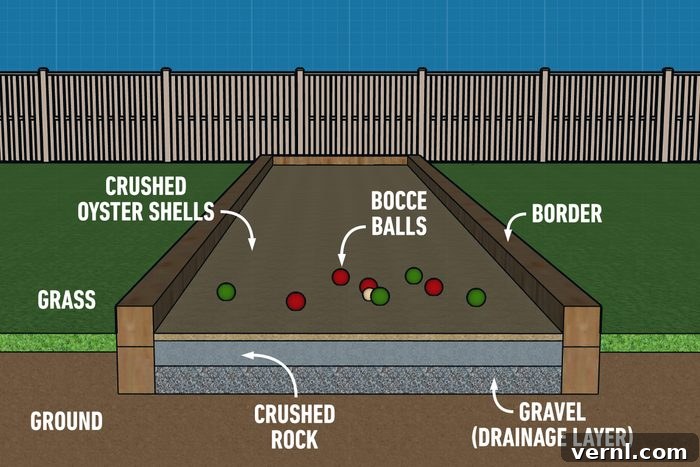
A well-drained bocce court is a long-lasting and enjoyable bocce court. The first layer you will add is the drainage layer, typically consisting of three to four inches of one-inch gravel (often referred to as #57 stone or crushed aggregate). This coarse gravel layer provides an excellent foundation and, more importantly, facilitates rapid water drainage, preventing saturation of the upper layers and potential damage from freezing and thawing cycles. Your rock supplier or various online calculators can help you accurately determine the number of tons required for your court’s dimensions.
If you’ve opted to install a French drain to address particularly poor drainage, this is the layer where it should be integrated. Lay the perforated drain pipe within this gravel layer, ensuring the holes in the pipe face downwards to maximize water collection. To prevent clogging, always cover the French drain pipe with a filter sock, which allows water to enter but keeps fine debris and soil particles out. Once the gravel is spread, compact it thoroughly using a plate compactor or a hand tamper. Proper compaction is essential for a stable base and to prevent future settling. After compaction, lay down a high-quality weed barrier or landscape fabric directly over the gravel. This barrier serves a dual purpose: it prevents the finer playing surface materials from sifting down into the coarser aggregate, and it acts as an effective deterrent against weed growth, significantly reducing future maintenance.
Constructing the Middle Layer with Crushed Rock
Following the drainage and weed barrier, the next critical layer for your bocce court is the middle layer, which typically consists of about two inches of decomposed granite (DG) or finely crushed limestone. This material provides a more stable, finer base than the coarse gravel and allows for excellent compaction, creating a firm and consistent foundation for the final playing surface. Carefully spread this material to an even thickness across the entire court, ensuring there are no high or low spots.
Achieving a perfectly level surface at this stage is crucial. You can use a long 2×4 board and a carpenter’s level to screed the material. Rest the 2×4 on the top edges of your perimeter and drag it across the crushed rock, leveling as you go. Alternatively, for more precision and ease, you can construct a simple screed board. This involves attaching a shorter 2×4 (cut to fit inside the court) perpendicularly to a longer 2×4 (long enough to rest on the perimeter edges). Position the shorter board so that its bottom edge sits at the desired height of your crushed rock layer. Drag this custom screed across the court, filling in depressions and removing excess material as you progress. Once leveled, compact this layer thoroughly with a plate compactor to create a dense, stable, and incredibly smooth foundation.
Precisely Marking the Court Lines
With the base layers firmly in place, it’s time to define the critical boundaries of your bocce court. Depending on the overall length of your court, you will need to decide on the placement of the foul lines at each end. These lines are crucial as players must throw or roll their bocce balls from behind them. For official bocce play, the foul lines are typically located 13 feet from the back of the court. However, for more casual backyard courts, these foul areas can be scaled down; a distance of four to five feet is quite common and still allows for strategic play without requiring an excessively long court.
You can mark these lines directly onto the edge of your perimeter material using paint, or for a more permanent and professional look, you can embed thin strips of dimensional lumber (e.g., cedar or composite decking strips) flush with the playing surface when installing the final layer. Ensure these embedded lines are precisely straight and accurately measured. You’ll also need to establish a distinct center line, which is pivotal for starting the game; the pallino must be thrown or rolled past this line. This center line must be located precisely in the middle of your court. For example, if your court measures 60 feet long, the center line would be at the 30-foot mark. If you’ve modified the length, simply measure in from each end until you find the exact midpoint and mark it accordingly. Accurate line placement enhances fair play and adheres to the spirit of the game.
Adding the Final Playing Surface
The top surface is where the magic happens – it must provide a smooth, consistent rolling experience for the bocce balls. Traditionally, finely crushed oyster shells are considered the preferred choice for their superb drainage, firm compaction, and ideal ball roll characteristics. However, depending on your geographic location, acquiring oyster shells may be challenging or prohibitively expensive. Fortunately, several excellent alternatives are available.
Finely crushed rock, often a blend specifically designed for bocce courts, or agricultural lime, can also provide an excellent playing surface. Some even opt to simply play directly on the well-compacted second layer of decomposed granite or crushed limestone, which offers a perfectly acceptable surface. Sand is another possibility, though it results in a notably different ball-rolling experience, often creating more resistance and requiring a different throwing technique. Pea gravel is generally too loose and not recommended. The key is to select a material that compacts well and allows for consistent ball movement. Once your chosen material is spread evenly, it is absolutely essential to thoroughly tamp or roll the entire surface. Use a heavy roller or a plate compactor to achieve the smoothest, firmest possible playing surface. This final compaction step is vital for the optimal performance and enjoyment of your new bocce court.
Game On! Enjoy Your New Bocce Court
Congratulations! You’ve successfully built your very own backyard bocce court. Now, it’s time to gather your friends and family, assemble two teams (typically consisting of one to four players per team), and immerse yourselves in the timeless enjoyment of this ancient game. Familiarize yourselves with the official rules of bocce, or simply create your own house rules for casual fun. The joy of having a dedicated space for bocce will provide countless hours of friendly competition, laughter, and outdoor relaxation for years to come. Maintain your court regularly with simple sweeping and occasional rolling to keep it in pristine condition, ensuring every game is played on a top-tier surface.