
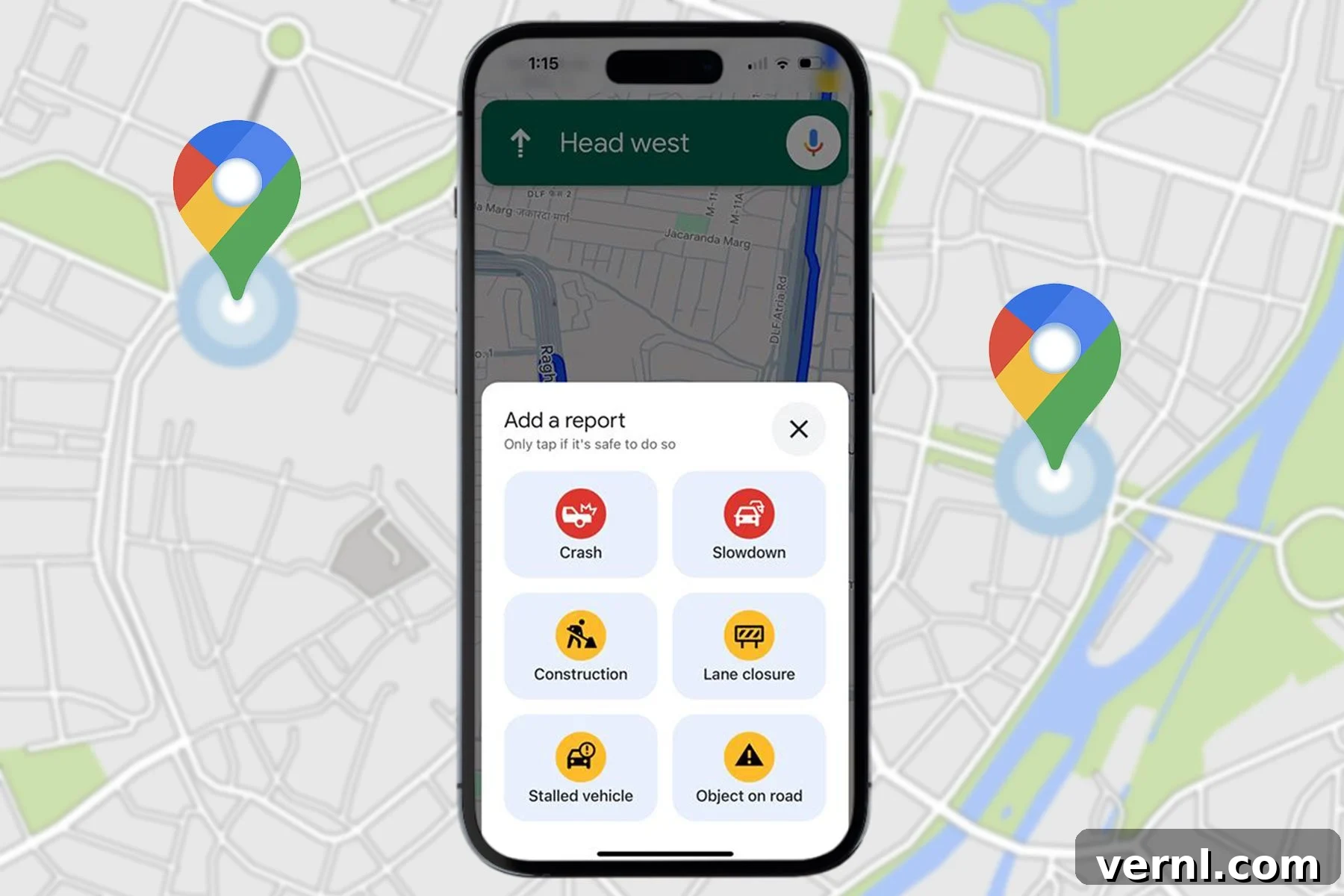
Enhance Road Safety: Your Comprehensive Guide to Real-Time Incident Reporting with Google Maps
Have you ever found yourself unexpectedly stuck in heavy traffic, wishing you had received an earlier warning? Or perhaps you’ve encountered a sudden road hazard that you wanted to immediately communicate to other drivers heading your way? The experience of navigating our roads just became significantly smarter and more collaborative. With the widespread rollout of real-time incident reporting across all major navigation platforms, including the recent integration into Android Auto, drivers now possess a powerful tool to contribute to road safety and community awareness, regardless of their preferred device.
This innovative feature represents a genuine paradigm shift in how we approach collective road safety and real-time traffic management. Whether you’re operating an iPhone, an Android smartphone, or utilizing your vehicle’s integrated smart display system, you can swiftly alert fellow motorists to various critical situations. These include reporting accidents, identifying dangerous road hazards, or flagging areas of significant traffic congestion. It effectively transforms every driver into a vigilant scout, providing a direct line of communication to everyone else on the road in your vicinity. The most compelling aspect? Its remarkable simplicity, and in this comprehensive guide, we’ll walk you through the precise steps for submitting an incident report on each platform.
The Power of Real-Time Incident Reporting: Fostering Safer, Smarter Roads
The ability to report incidents in real-time isn’t just a minor update; it’s a monumental leap forward for everyday navigation and road safety. Modern GPS navigation applications, with Google Maps at the forefront, have evolved beyond simply providing directions. They now serve as dynamic, community-driven platforms that actively help prevent accidents, mitigate delays, and enhance the overall driving experience. By allowing users to instantly share information about road conditions, these systems create a living, breathing map that adapts to the present moment.
Consider the tangible benefits:
- Enhanced Safety: Real-time alerts about hazards like debris on the road, disabled vehicles, or sudden weather changes can give drivers crucial extra seconds to react, potentially preventing serious accidents. Knowing about an upcoming accident scene can also encourage drivers to proceed with greater caution.
- Time and Fuel Efficiency: Traffic jams are a significant drain on both time and fuel. With immediate incident reports, navigation apps can quickly re-route drivers around congested areas, saving precious minutes and reducing fuel consumption from idling in stop-and-go traffic.
- Community Empowerment: This feature cultivates a sense of collective responsibility among drivers. It’s a proactive way for individuals to contribute to the well-being of their community, transforming solitary commutes into a shared effort for safer roads.
- Dynamic Navigation: The more reports submitted, the more accurate and responsive the navigation system becomes. This constant flow of user-generated data allows Google Maps to provide more precise estimated arrival times and suggest optimal routes that truly reflect current road conditions.
- Situational Awareness: Beyond just avoiding problems, incident reporting keeps drivers better informed about their surroundings, fostering a more mindful and less stressful driving experience.
From reporting an unexpected pothole to alerting others about a stationary police speed trap, the types of incidents that can be shared are diverse and incredibly valuable to the driving community.
Safety First: Essential Guidelines for Responsible Incident Reporting
Before diving into the technical steps of reporting an incident, it is paramount to emphasize the critical importance of safety. Your safety, and the safety of everyone else on the road, must always be your absolute top priority when considering submitting a report. While the feature is designed to be user-friendly, it must be used responsibly to avoid creating additional hazards.
Here are crucial safety notes and best practices:
- Minimize Distraction with Voice Commands: Whenever possible, utilize voice commands to initiate and complete incident reports. This significantly reduces the need to look at or touch your device, keeping your eyes on the road and your hands on the wheel. Modern voice assistants like Google Assistant and Siri are remarkably adept at understanding natural language, making this the safest method.
- Keep Reports Concise and Factual: When using voice notes or selecting incident types, aim for brevity and accuracy. A quick, clear report is more effective and less distracting than trying to provide extensive details while driving.
- Passenger Assistance is Key: If you cannot safely use voice commands, never attempt to submit a report while actively driving. Instead, if you have a passenger, ask them to handle the reporting process for you. This delegates the task to someone who can safely interact with the device without compromising driving focus.
- Pull Over to a Safe Location: In situations where voice commands aren’t feasible and no passenger is available, find a safe location to pull over before interacting with your phone or car’s display. This could be a parking lot, a rest stop, or a safe shoulder of the road. Only once your vehicle is stationary and out of the flow of traffic should you manually document any incidents.
- Emergency Services Come First: Remember that the incident reporting feature is designed to help other drivers avoid trouble spots. However, if you are involved in or witness a situation that requires immediate assistance from emergency personnel – such as a serious accident with injuries, a fire, or a crime in progress – your very first action should always be to contact emergency services (e.g., 911 or your local emergency number). Reporting via Google Maps is a secondary action for general awareness, not a substitute for professional emergency response.
- Avoid Abuse: This feature relies on the integrity of its users. Only report genuine incidents to maintain the system’s reliability and trustworthiness for the entire driving community.
Adhering to these guidelines ensures that you contribute to a safer driving environment without compromising your own safety or that of others.
Your Comprehensive Guide to Reporting Incidents with Google Maps
This guide will walk you through the process of reporting incidents using the Google Maps application, which is the foundational element for these instructions to work across all listed devices and platforms. Ensure you have the Google Maps app installed and updated on your device for optimal functionality.
How To Report an Incident in Google Maps on Android Auto
Android Auto seamlessly integrates your phone’s capabilities with your car’s infotainment system, providing a simplified interface optimized for driving. Reporting incidents here is designed to be intuitive and minimize distraction.
- While Google Maps is actively navigating your route on the Android Auto display, look for the ‘Report’ icon. This is typically represented by a shield symbol, often located on the right side of your car’s screen. Select this icon.
- A menu will appear with various reporting options. Choose “Report Incident” or a similarly labeled option.
- You will then be presented with a selection of common incident types, such as “Accident,” “Hazard,” “Speed trap,” “Traffic Jam,” “Roadwork,” or “Stalled Vehicle.” Tap the most appropriate incident type from the displayed choices. The report will typically submit automatically upon your selection, ensuring a swift process.
- Optional Enhancement: If it’s safe to do so (e.g., if you are stopped in traffic or have a passenger), you may have an option to add a brief voice note with further specific details. For instance, you could say, “Accident on the left shoulder involving two cars.”
How To Report an Incident in Google Maps on Apple CarPlay
Apple CarPlay offers a smart, safe way to use your iPhone while driving, mirroring essential apps like Google Maps onto your car’s built-in display. Its integration with Siri makes incident reporting particularly hands-free.
- As you are navigating with Google Maps displayed on Apple CarPlay, locate and select the ‘Report’ icon, which often appears as a shield symbol on your car’s screen.
- Voice Command Alternative: For maximum safety and convenience, you can also initiate an incident report using Siri. Simply activate Siri (usually by pressing a button on your steering wheel or saying “Hey Siri”) and then utter a command such as: “Hey Siri, report an incident on CarPlay.” This method streamlines the process significantly.
- Once the reporting menu appears, whether initiated via touch or voice, choose the category that best describes the incident (e.g., “Accident,” “Hazard,” “Speed Check,” “Traffic Jam”). The system is designed to submit the report automatically once your category selection is made, facilitating a quick return to driving focus.
How To Report an Incident in Google Maps on an iPhone (Standalone App)
For those not using CarPlay or Android Auto, or who prefer to use the Google Maps app directly on their iPhone, the process is equally straightforward, incorporating iOS features for ease of use.
- While Google Maps is actively providing navigation on your iPhone screen, tap the “Report” button, which is typically found in the bottom-right corner of the display.
- From the options presented, select “Report Incident.”
- Voice Command Alternative: You also have the option to use Siri directly on your iPhone. Simply activate Siri and say something like: “Hey Siri, report an incident.” This will prompt the Google Maps reporting interface to appear.
- Finally, tap the appropriate incident category from the choices provided (e.g., “Accident,” “Hazard,” “Speed trap,” “Traffic Jam”). The report will be submitted automatically upon your selection, keeping the interaction brief.
How To Submit an Incident Report in Google Maps on an Android Phone (Standalone App)
Similar to the iPhone, reporting incidents directly from the Google Maps app on an Android phone is designed for efficiency, leveraging the intuitive interface of the application.
- When Google Maps is actively navigating and displayed on your Android phone screen, tap the “Report” button, which is consistently located in the bottom-right corner of the screen.
- A list of incident types will be displayed. Choose the one that accurately describes the situation you are reporting (e.g., “Accident,” “Hazard,” “Speed trap,” “Traffic Jam,” “Roadwork”). As with other platforms, the report will submit automatically once you make your selection, ensuring minimal interaction time with your device.
- Google Assistant Integration: While not explicitly listed in the original steps, Android users can also often leverage Google Assistant by saying “Hey Google, report a traffic incident” to bring up the reporting interface in Google Maps, offering a hands-free option similar to Siri on iOS.
Maximizing Your Impact: Tips for Effective Incident Reporting
To ensure your incident reports are as helpful as possible to the driving community, consider these additional tips:
- Be Specific When Possible: While brevity is key, if you can quickly add a detail via voice (e.g., “hazard, large tire tread on left lane”), it enhances the report’s utility significantly.
- Report Promptly: The value of real-time information diminishes quickly. Report incidents as soon as it is safe to do so to give other drivers maximum lead time.
- Avoid Duplicate Reports (Usually Handled): Google Maps has sophisticated algorithms to detect and consolidate multiple reports for the same incident. You don’t need to worry excessively about reporting something that might already be on the map, but also avoid reporting the exact same thing repeatedly.
- Use Responsibly: The integrity of the system relies on genuine reports. Do not submit false reports, as this degrades the reliability of the system for everyone.
- Stay Aware of Local Laws: Always be mindful of local laws regarding phone use while driving, even for voice commands. Some jurisdictions have stricter rules than others.
The Future of Connected Driving and Community Collaboration
The ability to report incidents directly from our navigation apps is a testament to the evolving landscape of connected driving. These features are not static; they are continuously refined with advancements in artificial intelligence and machine learning, which help process and validate user reports more efficiently. As vehicles become smarter and more integrated, we can anticipate even more seamless ways for drivers to contribute to a collective intelligence of the road.
This community-driven approach to traffic management underscores a powerful idea: when drivers work together, everyone benefits. It transforms the act of driving from a solitary journey into a collaborative effort to ensure safer, more efficient, and more predictable travel for all.
Conclusion: Drive Smarter, Drive Safer
Incident reporting in Google Maps, now readily available across Android Auto, Apple CarPlay, iPhones, and Android phones, is a powerful tool designed to make our roads safer and our commutes smoother. By empowering every driver to share real-time information about accidents, hazards, and traffic, we collectively build a more informed and responsive navigation system.
Remember to always prioritize your safety, utilizing voice commands or a passenger for reporting, and reserving manual interaction for when you are safely pulled over. This feature is a prime example of how technology, combined with community spirit, can significantly enhance our daily driving experiences. Take advantage of this capability, use it responsibly, and contribute to a network of drivers committed to safer and more efficient journeys for everyone.