
Pressure treated lumber stands as a cornerstone material for countless outdoor construction projects, from sturdy decks and robust fences to durable landscaping elements. It is wood that has undergone a specialized chemical treatment process, typically involving high pressure, to infuse it with protective agents. This crucial treatment significantly enhances the wood’s resilience, providing prolonged resistance against common threats like rot, fungal decay, and insect infestations. Without this process, many outdoor wood structures would quickly succumb to the elements and biological degradation.
The effectiveness of pressure-treated wood lies in the active ingredients permeated deep into its fibers. Historically, chromated copper arsenate (CCA) was widely used, but due to environmental and health concerns, the industry has largely transitioned to more eco-friendly alternatives. “The active ingredients commonly used in treated wood today are alkaline copper quaternary (ACQ), copper azole (CA), or micronized copper azole (MCA),” according to industry experts. These advanced compounds chemically react with the wood’s natural fibers, establishing a formidable barrier that actively slows down natural decay processes. Their inherent properties provide exceptional resistance to termites, various fungi, excessive moisture absorption, and other environmental elements that promote rot and contribute to the structural degradation of untreated wood. For those interested in exploring natural alternatives, check out our roundup of naturally rot-resistant woods.
Understanding the Pressure Treatment Process
The journey of ordinary lumber to becoming robust pressure-treated wood begins with a carefully orchestrated industrial process. First, lumber is loaded into a large, sealed cylinder. A vacuum is then applied to remove air and moisture from the wood cells. Following this, the cylinder is filled with a water-borne preservative solution, and intense hydraulic pressure is applied. This pressure forces the preservative deep into the cellular structure of the wood, ensuring thorough saturation. Once the treatment is complete, the wood is removed and allowed to dry. This process ensures that the protective chemicals are not just on the surface but are integrated throughout the wood, offering long-lasting protection. Different treatment levels are available, specified by the amount of preservative retained per cubic foot of wood, making certain lumber suitable for specific applications like ground contact or marine environments.
How Long Will Pressure-Treated Wood Last in the Ground?
The longevity of pressure-treated wood, particularly when used in ground contact applications such as fence posts or structural supports, is a critical consideration for any outdoor project. While designed for durability, its actual lifespan can vary significantly, ranging from 15 to 40 years or even more, depending on a confluence of factors. Key among these are the specific application of the post, the type of surrounding soil, local climatic conditions, and the treatment retention level of the wood itself.
For example, a pressure-treated 4×4 post used for a simple fencing structure, where it experiences minimal stress and is surrounded by well-draining soil, may indeed have a longer lifespan than wood used for decking supports in a high-moisture environment or areas subject to heavy foot traffic and constant moisture exposure. Soil type plays a crucial role; sandy, well-draining soils are less conducive to rot than heavy clay soils that retain moisture for extended periods. Similarly, regions with high humidity and frequent rainfall will generally put more stress on the wood than arid climates.
Beyond these environmental factors, the quality of the pressure treatment is paramount. Wood labeled for “Ground Contact” has a higher concentration of preservatives and is specifically designed to withstand the harsh conditions of being buried or in constant contact with soil. Ensuring proper drainage around the base of posts and avoiding direct contact with untreated organic matter can further extend the life of pressure-treated lumber in the ground. With optimal conditions and appropriate maintenance, pressure-treated lumber truly has the potential to last for many decades, safeguarding your outdoor investments.
Key Considerations When Choosing Pressure-Treated Lumber
Selecting the right pressure-treated lumber for your project goes beyond simply picking up the first piece you see. Understanding the nuances of treated wood can save you time, money, and future headaches, ensuring the structural integrity and longevity of your outdoor construction.
What is a Peeler Core? And Why Does It Matter?
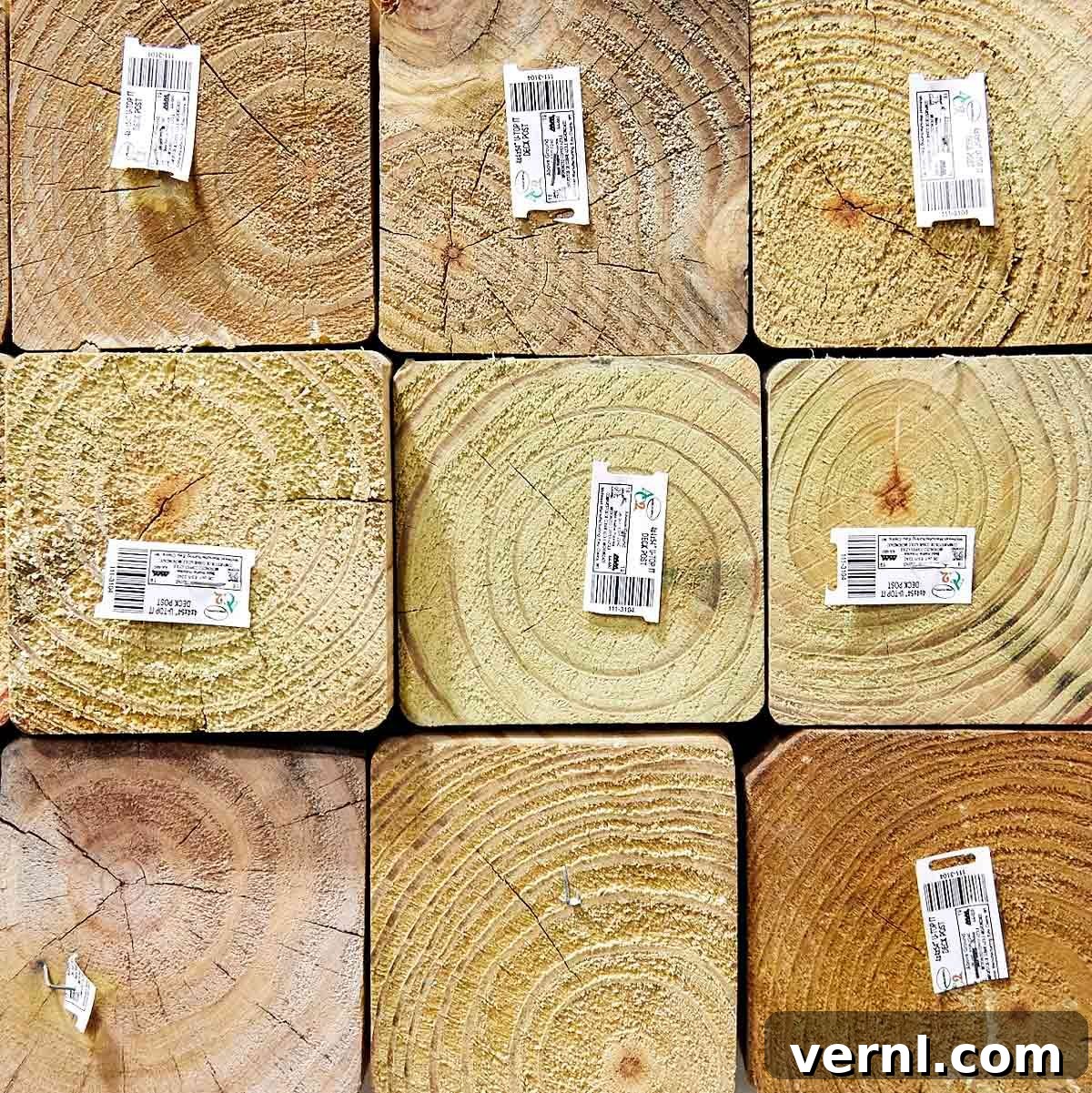
One critical aspect to be aware of when purchasing pressure-treated 4×4 posts, especially those typically 8-feet in length, is the origin of the wood. Many of these posts are made from “peeler cores,” which are a byproduct of plywood production. When a large log is mounted on a lathe and spun against a blade to create thin sheets of veneer for plywood, a solid cylindrical core remains at the center. This remnant, known as the peeler core, is often repurposed into a 4×4 post.
While seemingly economical, peeler cores present several disadvantages. They frequently contain the “pith” – the very center of the log – which is the youngest and weakest part of the tree. The pith, along with the wood surrounding it, has a different cellular structure that doesn’t accept pressure treatment chemicals as effectively as wood from other parts of the tree. This can lead to uneven preservative penetration, leaving some sections more vulnerable to decay. Furthermore, peeler-core posts are inherently more prone to warping, twisting, and checking (cracking) as they dry, due to the stress patterns around the pith. This can compromise the structural integrity and aesthetic appeal of your project. Posts cut from sections farther away from the log’s center exhibit greater stability and more consistent treatment absorption.
Interpreting Growth Rings to Identify Peeler Cores
A simple yet effective way to identify whether a 4×4 post is a peeler core is by examining its growth rings at the end of the lumber. If the growth rings are concentrically centered within the post and expand outwards from that central point, it is a strong indicator that the post originated from a peeler core. This configuration suggests the pith is enclosed within the post, signaling that it may not accept pressure treatment optimally and is more susceptible to warping. Conversely, if the growth rings are noticeably off-center or appear as arcs rather than full circles, it indicates that the post was cut from a section of the log away from its very center. These off-center ring patterns are generally preferred, as such wood tends to be more stable and accepts preservative treatments more uniformly.
Smart Buying Tips for Pressure-Treated Lumber
When you’re at the lumberyard shopping for pressure-treated posts, particularly 4x4s, a careful inspection of the ends can provide invaluable insights. As mentioned, if the growth rings are tightly centered within the post and radiate outward, you are almost certainly looking at a peeler core. If the rings are significantly off-center or form a portion of a larger circle, the post was cut from a more stable part of the log.
To avoid the potential issues associated with peeler cores, our practical suggestion is to opt for longer posts when possible. Instead of purchasing standard 8-foot peeler-core posts, consider buying 10-foot pressure-treated posts. These longer posts are less likely to be made from peeler cores and offer you the flexibility to trim them to your desired 8-foot length, effectively cutting off any potential end-grain issues or minor imperfections while ensuring you start with a more structurally sound and consistently treated piece of lumber.
Beyond Peeler Cores: Other Essential Selection Criteria
To ensure you’re choosing the best pressure-treated lumber for your project, consider these additional factors:
- Treatment Level and Retention: Always check the end tag on the lumber for its treatment designation. “Ground Contact” (e.g., .40 PCF – pounds of preservative per cubic foot) is essential for any wood making direct contact with soil or fresh water, or for critical structural components. “Above Ground” (e.g., .25 PCF) is suitable for applications that remain dry and are not in contact with the ground. Using above-ground treated wood for ground contact applications will severely limit its lifespan.
- Wood Species: While treatment enhances durability across various species, Southern Yellow Pine is the most common wood used for pressure treatment in North America due to its porous nature, which readily accepts preservatives. Other species like Douglas Fir also accept treatment but may require incising (small cuts) to ensure deeper penetration.
- Kiln Dried After Treatment (KDAT): Freshly treated lumber often has a high moisture content, making it heavy and prone to warping or shrinking as it dries. KDAT lumber has been kiln-dried after the pressure treatment process, resulting in a more stable product that is less likely to warp, lighter, and ready for staining or painting sooner. While often more expensive, KDAT can prevent issues down the line.
- Visual Inspection for Quality: Beyond growth rings, always inspect each piece of lumber for visible defects. Look for excessive warping, twisting, bowing, or cupping. Check for large, loose knots that could compromise strength, and avoid pieces with significant splits or cracks (known as checks) that extend deeply into the wood. Also, ensure the treatment appears consistent across the surface; splotchy or pale areas might indicate poor penetration.
Working Safely with Pressure-Treated Lumber
While pressure-treated lumber offers exceptional benefits, it’s crucial to handle it with appropriate safety measures. Always wear gloves, eye protection, and a dust mask when cutting or sanding, as the sawdust can contain preservative chemicals. Avoid inhaling the dust and ensure proper ventilation in your workspace. When disposing of scraps, do not burn treated lumber, as the smoke can release toxic chemicals; instead, dispose of it according to local waste regulations.
Furthermore, due to the copper content in modern preservatives, it’s essential to use corrosion-resistant fasteners and hardware. Hot-dipped galvanized, stainless steel, or specifically coated fasteners (e.g., ceramic-coated deck screws) are recommended to prevent premature corrosion and staining of your project. Using standard uncoated fasteners will lead to rapid rust and structural compromise over time.
By understanding the science, making informed choices during selection, and adhering to best practices during installation and maintenance, you can maximize the performance and longevity of your pressure-treated lumber, ensuring your outdoor projects stand strong and beautiful for many years to come.