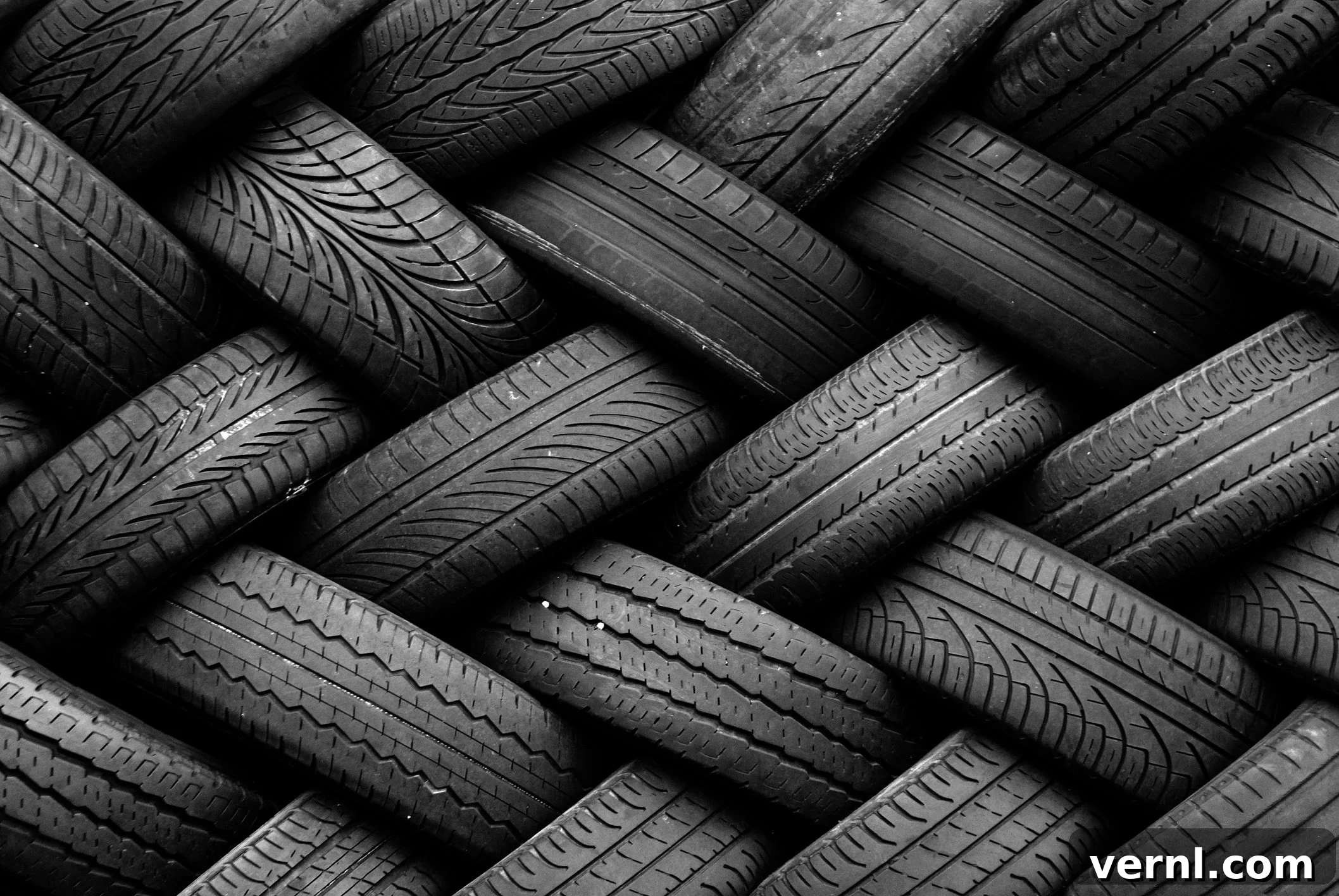
The Undeniable Dominance of Black Tires: Unraveling the Science, History, and Style
Tires and wheels are far more than mere functional components on a vehicle; they are a profound statement of engineering and, indeed, a significant element of automotive fashion. Just as clothing adorns the body, tires “attire” the wheel, a linguistic connection evident in the origin of the word “tire” itself, a shortened form of “attire” according to the Online Etymology Dictionary. This interplay between utility and aesthetics has profoundly shaped the evolution of tire design.
Over the decades, as technology advanced and aesthetic preferences shifted, so too did the appearance and composition of tires. The rudimentary solid rubber tires of the 19th century have given way to sophisticated, air-filled radial designs that offer superior performance and comfort. A century ago, a striking visual difference was commonplace: tires were predominantly white. Today, a quick glance at any road reveals a near-universal sea of black rubber, prompting many to wonder about the reasons behind this monochromatic dominance. Is it simply a matter of practicality, or is there a deeper scientific explanation?
Auto expert Chris “Moose” Pyle from JustAnswer.com highlights one practical aspect: “Black tires are easier to make look shiny. When you have a sidewall that is white, yellow or red, the colors get dinghy and look worse if you do not clean them. So most of us just choose a solid black tire.” While aesthetics play a role, the story of black tires is much richer, intertwining historical innovation with groundbreaking material science. Let’s delve into the fascinating reasons why the vast majority of tires gracing our vehicles today are, unequivocally, black.
From Milky White to Midnight Black: The Transformation of Tire Color
To truly understand why tires are black, we must first dispel a common misconception: tires are not naturally black. The primary raw material for tire production, natural rubber, begins its life as a milky white latex extracted from rubber trees. Early tires, including the first mass-produced inflatable varieties for automobiles, bicycles, and motorcycles, reflected this natural hue. However, these pristine white tires were notoriously short-lived and prone to rapid degradation under the harsh realities of road use and environmental exposure.
The dawn of the 20th century brought about a pivotal discovery that would forever change the face of tire manufacturing. Tire engineers, in their relentless pursuit of enhanced durability and performance, began experimenting with various additives. This quest led to the incorporation of a seemingly simple, yet profoundly effective, ingredient: carbon black. This fine, powdery substance, a byproduct of the incomplete combustion of coal and oil, proved to be a game-changer. What started as an additive to improve wear resistance quickly revealed a host of other indispensable benefits, transforming the once-fragile white rubber into the robust, long-lasting black tires we recognize today. The modern tire is a complex marvel of engineering, incorporating up to 200 distinct ingredients, with refined carbon black remaining one of the most critical.
The Science Behind the Shade: Why Carbon Black is Indispensable for Tires
The transition from natural rubber’s inherent white to the deep black of modern tires is no mere coincidence; it’s a testament to the unparalleled properties of carbon black. Tire manufacturers discovered that integrating carbon black, alongside polyester, metal, and other synthetic rubber compounds, drastically improved tire performance and significantly extended their lifespan. Without the fortifying presence of carbon black, tires would scarcely endure 5,000 miles, a stark reality underscored by Jack L. Koenig in his authoritative book, Spectroscopy of Polymers. Beyond its colorizing effect, carbon black acts as a molecular reinforcement, fundamentally altering the structural integrity and resilience of the rubber.
Beyond Aesthetics: The Multifaceted Benefits of Carbon Black
The role of carbon black in tire manufacturing extends far beyond simply imparting a black hue. It is a critical functional ingredient that endows tires with a suite of essential characteristics vital for safety, longevity, and performance. Its integration dramatically increases tire mileage and durability, but its contributions don’t stop there:
- Enhanced UV Protection and Dry Rot Prevention: Carbon black effectively shields the rubber from harmful ultraviolet (UV) radiation, which is one of the primary culprits behind tire degradation. UV rays cause the rubber polymers to break down, leading to cracking, hardening, and a loss of elasticity—a process commonly known as dry rot. By absorbing and dissipating UV light, carbon black significantly prolongs the life of the tire and protects it from premature aging and decay, ensuring it remains supple and structurally sound for longer.
- Improved Handling, Stability, Braking, and Fuel Economy: The reinforcing properties of carbon black lead to a stiffer, more stable rubber compound. This increased rigidity translates directly into superior road contact, enhancing a vehicle’s handling precision, stability during rapid maneuvers, and overall braking efficiency. A firmer tread, made possible by carbon black, also experiences less rolling resistance. Reduced rolling resistance means less energy is lost to tire deformation as it rolls, which in turn contributes to better fuel economy and reduced emissions.
- Superior Heat Dissipation: Tires generate significant heat through friction with the road and continuous flexing during operation. Excessive heat is a major enemy of rubber, accelerating its degradation and increasing the risk of tire failure, including dangerous blowouts. Carbon black is an excellent thermal conductor, meaning it rapidly transfers heat away from the tire’s critical core and treads to the surrounding air. This efficient heat management is crucial for maintaining tire integrity, preventing overheating, and dramatically increasing the tire’s operational lifespan, especially under strenuous driving conditions.
- Static Electricity Dissipation: In an era of increasingly sophisticated vehicles packed with highly sensitive electronic systems, the accumulation of static electricity can pose a serious threat. As tires roll, friction generates static charges that can build up. Carbon black is electrically conductive, providing a continuous pathway for these static charges to safely dissipate into the ground, grounding the vehicle. This preventative measure helps protect expensive onboard electronic devices from potential damage caused by sudden static discharge, ensuring the seamless operation of modern vehicle systems.
- Aesthetic and Maintenance Advantages: While performance is paramount, practical aesthetics also play a significant role in consumer preference. Black tires are inherently easier to maintain because they effectively camouflage road grime, brake dust, oil stains, and other environmental contaminants far better than lighter colors. This makes them easier to keep clean and allows for the application of tire shine products to achieve that coveted glossy finish, contributing to a vehicle’s overall polished and well-maintained appearance.
The Colorful Detour: Why Non-Black Tires Never Gained Traction
The idea of colored tires isn’t new; it’s a concept that has been revisited throughout automotive history, yet consistently failed to capture widespread appeal. In various experiments, manufacturers produced tires in vibrant shades of orange, blue, yellow, and green. These colorful counterparts were often designed to meet the same stringent U.S. standards for road safety and performance as black tires, demonstrating that the underlying technology for alternative hues existed. However, despite their functional equivalence, they never achieved significant market penetration or lasting popularity among the general public.
One notable attempt came from BFGoodrich, which once offered tires with intriguing colorful treads. Michelin, BFGoodrich’s parent company, even recalls an era in the 1950s when Goodyear manufactured different colored tires specifically designed to match a car’s paint job. The whimsical notion was that drivers could change tires to perfectly complement their fancy evening attire, akin to selecting an accessory. Goodyear also experimented with more radical designs, including translucent tires fitted with internal lights – a truly futuristic, albeit impractical, concept for its time that ultimately did not catch on.
Ultimately, these colorful ventures proved to be fleeting fads. The primary reasons for their lack of success were practical and economic. Just like the early white tires, colorful tires quickly became dirty, stained by road grime and brake dust, making them look unkempt and detracting significantly from their intended aesthetic appeal. More importantly, manufacturing these tires without the high concentration of carbon black meant sacrificing the superior durability, longevity, and performance benefits that black tires offered. Without carbon black’s reinforcing and protective qualities, these colorful alternatives were simply less robust and prone to faster wear, making people hesitant to spend extra money on a product that wouldn’t last as long or perform as reliably as its black counterpart. The practical advantages of black overwhelmingly outweighed the fleeting novelty of color.
Niche and Novelty: Where Colored Tires Still Exist
Despite the overwhelming dominance of black, colored tires haven’t entirely disappeared. They thrive in specific niche markets and custom applications where aesthetics or historical accuracy are paramount. For enthusiasts of classic and antique vehicles, authentic white tires and wide whitewall tires, often manufactured using original molds and specifications, are readily available. These are essential for ensuring historical accuracy in restorations and maintaining the nostalgic appearance of vintage automobiles.
Similarly, tires with raised white letters, narrow whitewalls, and thin red-striped sidewalls cater to custom builders, hot rod enthusiasts, and owners seeking a distinctive, performance-oriented aesthetic for their vehicles. In the ultra-high-end segment of the automotive market, innovation continues. Pirelli, for instance, produces specialized tires for luxury and performance vehicles featuring different colored sidewalls, lettering, and stripes. These bespoke options leverage advanced compounds and production processes, often derived from their Formula 1 racing car tire technology, allowing for aesthetic customization without compromising the critical performance attributes that carbon black provides to the overall tire structure.
The Art and Engineering of Tire Manufacturing
The journey from raw materials to a finished tire is a sophisticated process, blending intricate engineering with meticulous craftsmanship. It begins with the precise layering of various rubber compounds, often akin to a complex sandwich. These layers, which include inner liners, plies, and sidewall compounds, are carefully rolled out and assembled onto a cylindrical mold, forming the initial “green” (uncured) tire structure. Next, reinforcing elements, such as steel and/or nylon belts, are strategically incorporated. These belts provide critical strength, stability, and puncture resistance to the tire’s carcass, especially in the tread area. More layers of rubber follow, culminating in the application of the tread pattern, which is crucial for grip, traction, and efficient water dispersion.
Chris “Moose” Pyle aptly describes this early stage: “It’s kind of like black electrical tape being added to a tube of cardboard, spun round and round building up the layers.” Once the composite structure is complete, the “green” tire is transferred to a curing press, often referred to as a vulcanizer. Here, it is subjected to immense pressure, pushing outwards from inside the tire via a bladder and inwards from the outside mold. Simultaneously, precise heating, typically around 350 degrees Fahrenheit (177°C), melts all the rubber layers together. This process, known as vulcanization, permanently bonds them and forms the final, durable tire shape, complete with its distinct tread pattern, sidewall markings, and the characteristic elasticity, strength, and resilience that define a modern tire.
Decoding Subtle Shades: What Different Tire Colors Can Imply
While the vast majority of tires are black, subtle variations in shade can sometimes offer insights into their composition, though these are typically not discernable to the casual observer. Generally, darker, richer blacks often indicate a higher concentration of carbon black, which correlates with greater durability and performance characteristics, as carbon black is a primary reinforcing filler. However, for the average consumer, these nuanced distinctions in black are rarely a primary consideration when purchasing tires.
Beyond the functional black, occasional accent colors on tire sidewalls or lettering are almost exclusively aesthetic and do not carry specific performance implications. As Chris “Moose” Pyle notes, “They are just a preference by the car owner. A lot of older vehicles had white wall tires and owners might want to retain that nostalgic appearance. Some luxury cars have tires with a pinstripe that is often red or yellow, which just catches the eye and looks neat.” These decorative touches allow car owners to personalize their vehicles, adding a splash of individuality and style without compromising the fundamental engineering excellence and performance advantages inherently provided by the primary black rubber compound.
Conclusion: The Unrivaled Reign of Black
The ubiquity of black tires on our roads is no accident of design or mere fashion whim; it is a direct consequence of scientific innovation, engineering necessity, and practical efficiency. From protecting rubber from the sun’s harsh UV rays and preventing dry rot, to enhancing grip, dissipating critical heat, improving fuel economy, and ensuring long-lasting durability, carbon black stands as the fundamental ingredient that transformed fragile, milky-white rubber into the high-performance, robust, and safe tires we rely on today. While splashes of color may appear in niche markets or as subtle aesthetic accents, the core function, enduring form, and unwavering reliability of the modern tire remain steadfastly black—a testament to a perfect marriage of advanced chemistry and the demanding realities of automotive performance.
About the Experts
- Chris “Moose” Pyle is a master-certified technician with over 20 years of extensive automotive experience. He has been a trusted expert for JustAnswer.com since 2006, where he diligently answers hundreds of car maintenance and repair questions daily, sharing his deep knowledge with a wide audience of vehicle owners.