Unlock Versatility: Crafting Your Own Portable Router Table Base for Precision Woodworking
In the expansive and creative world of woodworking, a router stands as an undisputed champion of versatility and precision. From shaping decorative edges and cutting intricate joinery to creating perfectly sized dados and rabbets, this handheld power tool is indispensable for both hobbyists and seasoned professionals. However, to truly harness its full potential and achieve consistently professional-grade results, operating a router freehand is often impractical. This is where a router table becomes not just a luxury, but a fundamental necessity. While many commercially available router tables offer dedicated setups, the concept of a portable router table base – ingeniously adapted from an existing portable workbench – presents an exceptionally smart, space-saving, and highly cost-effective solution.
Imagine transforming your trusty portable workbench, such as the ubiquitous Black & Decker Workmate, into a robust and reliable foundation for all your precision routing tasks. This innovative approach not only maximizes the utility of the tools you already own but also provides unparalleled flexibility, making it an ideal choice for compact workshops, garages with limited space, or even for taking your routing capabilities on-site. This comprehensive guide will take you through the compelling advantages, detailed construction, and practical applications of building your own portable router table base. By following these steps, you’ll gain the confidence to tackle a vast array of woodworking challenges, elevating the quality and precision of your projects with remarkable ease and efficiency.
Why a Portable Router Table Base is a Game-Changer for Woodworkers
The decision to build a portable router table base, particularly one that leverages an existing portable workbench, offers a myriad of benefits that make it a superior choice for many woodworkers over a traditional, permanent router table setup or a dedicated standalone unit. Understanding these advantages can highlight why this DIY solution is so compelling:
- Unrivaled Space Efficiency: For woodworkers whose craft often unfolds in compact spaces – be it a corner of a garage, a basement workshop, or a shared utility area – every square foot is precious. A portable router table allows you to set up a fully functional routing station only when specific tasks demand it. Once your routing is complete, the tabletop can be easily detached and stored flat against a wall, instantly reclaiming valuable floor space.
- Significant Cost Savings: By cleverly repurposing a tool you likely already own, such as a portable workbench, you dramatically reduce the financial outlay associated with acquiring a dedicated router table base. This approach ensures that high-precision routing capabilities are accessible on even the most constrained budgets, allowing you to invest more in quality bits or other essential tools.
- Exceptional Versatility and Dual Functionality: One of the most attractive aspects of this design is that your portable workbench retains its original functionality when the router table isn’t in use. This means you have a dual-purpose tool that seamlessly transitions from a clamping station or general workbench to a precision routing platform, adapting to the diverse needs of your various woodworking projects.
- Effortless Transportability: Do you frequently work on projects at different locations, or perhaps lend a hand to fellow woodworking enthusiasts? A portable router table base means your entire routing setup can be easily transported. This makes it an invaluable asset for job sites, communal workshops, or anytime you need precision routing capabilities away from your main shop.
- Rapid Setup and Teardown: The design principles outlined here prioritize ease of assembly and disassembly. You can transition from a stored, flat router tabletop to a fully operational routing station in mere minutes, and just as quickly revert it back to storage. This speed and convenience are paramount for maximizing productivity and maintaining an organized workspace.
The Ingenious Concept: Repurposing Your Portable Workbench as a Foundation
At the very heart of this clever and practical woodworking solution lies the adaptability of the humble yet incredibly sturdy portable workbench. Models like the Black & Decker Workmate are iconic for their robust construction, powerful integral clamping mechanisms, and inherent stability. These characteristics make them not just suitable, but ideally suited, to serve as the temporary yet rock-solid base for a precision router table. The genius resides in their adjustable sliding jaws, which can exert a significant and secure clamping force – perfectly designed for holding a custom-made router tabletop firmly and safely in place.
The underlying principle is remarkably simple and elegant: instead of undertaking the more involved project of building an entire, bulky router table stand, you focus solely on constructing a high-quality router tabletop. This custom-built tabletop then temporarily and securely mounts onto your portable workbench. The substantial weight and solid build of the workbench effectively dampen vibrations and provide the necessary unwavering stability – two critical factors for achieving clean, precise, and consistent routing results. This symbiotic relationship between your custom router tabletop and your versatile portable workbench creates a highly functional and powerful routing station without the need for additional, cumbersome, and often expensive dedicated equipment.
Crafting Your Router Tabletop: Essential Design and Material Considerations
Building the router tabletop is the core DIY component of this entire project. The objective is to construct a surface that is not only sturdy, perfectly flat, and highly durable but also precisely designed to accommodate your router and provide an exceptionally stable platform for guiding your workpieces with accuracy.
Key Materials You’ll Need for Your Router Tabletop:
- Tabletop Substrate Material:
- MDF (Medium-Density Fiberboard): Highly recommended for its excellent flatness, dimensional stability, and relatively low cost. A thickness of at least 3/4 inch (19mm) is generally considered ideal to prevent warping and ensure rigidity.
- High-Quality Plywood: Options like Baltic Birch or cabinet-grade plywood can also be used, especially if you desire more impact resistance or screw-holding power. Again, a 3/4 inch thickness is preferred.
- High-Pressure Laminate (HPL) Surface: For the ultimate low-friction, highly durable, and easy-to-clean surface, consider applying a layer of HPL (such as Formica) to your MDF or plywood substrate. This significantly improves workpiece glide and table longevity.
- Support Blocks: Two robust pieces of hardwood or dense plywood, each at least 3/4 inch thick. These blocks will be the direct interface clamped by the jaws of your portable workbench.
- Router Plate/Insert (Optional but Highly Recommended): A pre-manufactured phenolic or aluminum plate specifically designed to securely hold your router. This allows for convenient above-table bit changes and height adjustments, dramatically improving usability.
- Fasteners: High-quality wood screws for attaching the support blocks to the tabletop, and appropriate machine screws (often supplied with the router plate) for mounting your router to the insert plate.
- Wood Glue: For permanently bonding the support blocks to the tabletop (in addition to screws) or for laminating the HPL surface, if chosen.
Crucial Design Considerations for Your Router Tabletop:
- Optimal Dimensions: A common and highly functional size for a portable router tabletop ranges from approximately 16×24 inches (40×60 cm) to 20×28 inches (50×70 cm). This provides ample working space for most projects without becoming overly cumbersome or difficult to store. Always measure the maximum width your workbench jaws can comfortably clamp while leaving sufficient overhang for stability.
- Router Mounting Method:
- Direct Mount (Simple but Less Convenient): You can directly mount your router to the underside of the tabletop. This involves carefully tracing your router’s base plate and drilling precisely spaced mounting holes. While the simplest method, it makes bit changes and height adjustments more cumbersome as you have to access the router from underneath.
- Router Insert Plate (Preferred Method): This is the professional and highly recommended approach. It involves cutting a precise, recessed opening into your tabletop to perfectly accommodate a pre-made router plate. Your router then securely attaches to this plate. This setup allows for quick router removal for handheld use, and significantly easier above-table bit changes and height adjustments. It is absolutely crucial that the insert plate sits perfectly flush with the tabletop surface to prevent snagging workpieces.
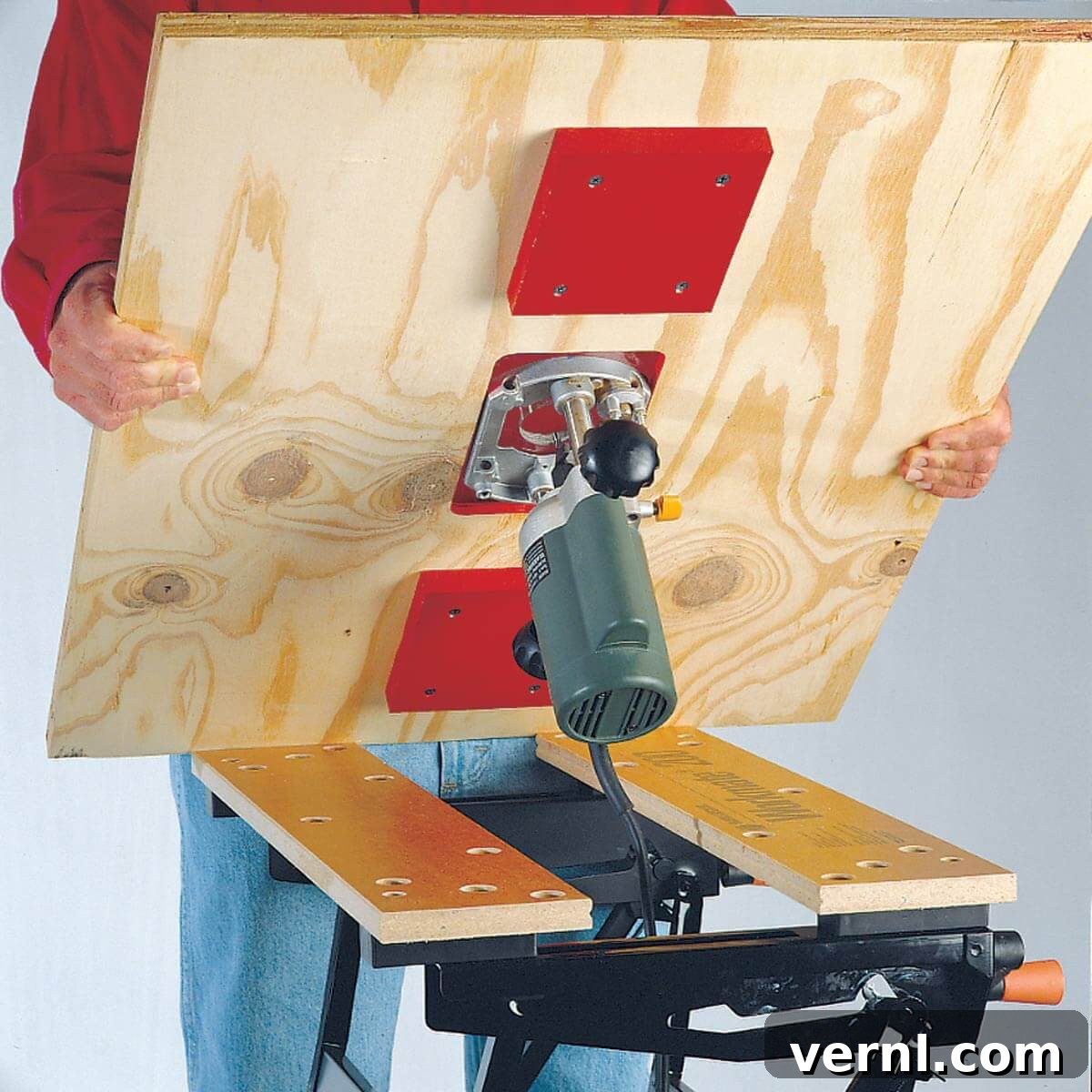
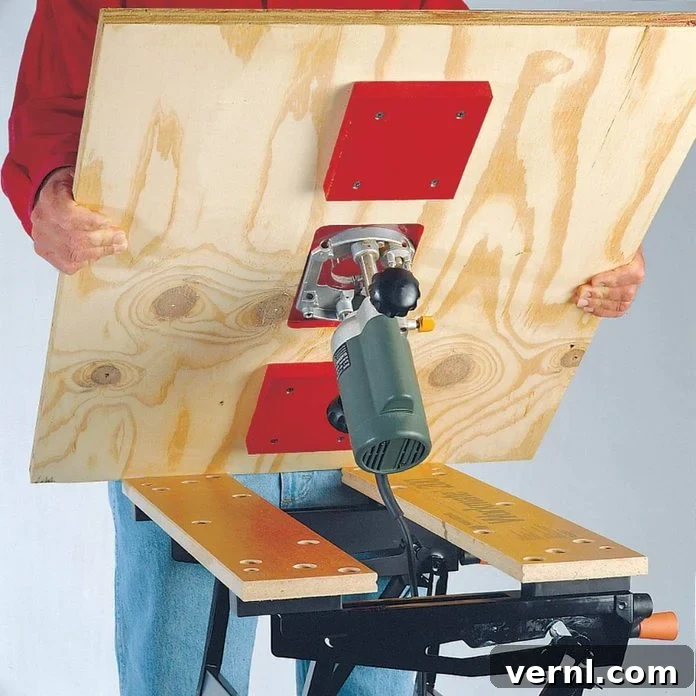
- Precise Support Block Placement: The two support blocks must be strategically positioned on the underside of your tabletop to ensure they align perfectly and squarely with the clamping jaws of your portable workbench. Before attaching them, accurately measure the distance between the clamping surfaces of your workbench jaws when they are in an adequately open, ready-to-clamp position. The support blocks should be attached to your tabletop so that their outer edges are slightly closer together than this maximum jaw opening. This allows the workbench jaws to apply effective and strong clamping pressure.
- Incorporating Additional Features (Optional Enhancements):
- Miter Slot: Integrating a T-track miter slot, carefully routed into the tabletop, allows for the use of standard miter gauges, custom sleds, and other invaluable accessories, greatly enhancing precision for cross-cutting or angled routing operations.
- Basic Fence System: A simple, straight fence is absolutely crucial for controlled routing. This can be as straightforward as a perfectly straight piece of MDF or plywood that is clamped securely to the table, or you can opt for a more sophisticated, adjustable fence system.
- Dedicated Dust Collection Port: Routing a strategically placed hole into your fence or underneath the router plate for vacuum attachment will drastically improve dust and chip extraction, leading to a cleaner workspace, better visibility, and improved air quality.
Step-by-Step Assembly: Seamlessly Integrating Your Router Tabletop with the Workbench
Once your custom router tabletop has been meticulously constructed and all its features are ready, the process of integrating it with your portable workbench is surprisingly straightforward and rapid. This phase brings your portable router table to life.
- Prepare Your Portable Workbench:
- Begin by ensuring your portable workbench is thoroughly clean, stable, and locked securely in its fully open, ready-to-use position.
- Adjust the movable jaw of the workbench to an appropriate width. It should be slightly wider than the distance between the support blocks that are attached to the underside of your router tabletop.
- Attach Support Blocks to the Router Tabletop:
- Lay your router tabletop upside down on a clean, stable surface.
- Carefully position the two sturdy support blocks on the underside of the tabletop. These blocks must be perfectly parallel to each other and precisely aligned to match the intended clamping position of your workbench jaws.
- Securely attach these blocks using strong wood screws. Ensure the screws are long enough to penetrate well into the tabletop without protruding through the top surface. Pre-drilling pilot holes for your screws is essential to prevent the wood from splitting. For maximum strength and permanence, you can also apply a high-quality wood glue in addition to the screws.
- Position and Secure the Tabletop onto the Workbench:
- Carefully lift and place your router tabletop (with the router already mounted if you’re using an insert plate) onto the portable workbench. Align the previously attached support blocks directly with the clamping jaws of the workbench.
- Ensure the tabletop is centered, stable, and rests evenly on the workbench.
- Begin to gradually and evenly tighten the sliding jaws of your portable workbench. Apply firm, consistent pressure until the support blocks are compressed and firmly clamped, and the entire router tabletop is held absolutely securely in place without any perceptible wobble or movement. This robust clamping action is the cornerstone of this portable system’s effectiveness and stability.
- Install Your Router (If Not Already Done):
- If you are utilizing a router insert plate, ensure your router is securely mounted to it following the plate’s specific instructions.
- Carefully insert the assembled router and plate into the precise recess in your tabletop, making sure the plate sits perfectly flush with the main tabletop surface.
- Set Up Your Fence System:
- Position your chosen fence system on the router tabletop. For most basic operations, a perfectly straight piece of MDF or plywood, clamped securely to the tabletop with quick-release clamps, will suffice.
- Crucially, ensure the fence is positioned perfectly square to the router bit and parallel to the intended path of your workpiece to ensure accurate cuts.
Using Your Portable Router Table: Essential Tips for Optimal Performance and Uncompromised Safety
With your newly assembled portable router table standing firm and ready, you’re now equipped to tackle a wide variety of routing tasks. However, as with all power tool operations, prioritizing safety and adhering to best practices is paramount for achieving the best results and ensuring a secure working environment.
Crucial Safety First Protocols:
- Mandatory Personal Protective Equipment (PPE): Always wear appropriate safety glasses or a face shield to protect against flying debris and chips. Hearing protection (earmuffs or earplugs) is also highly recommended, as routers can be quite loud.
- Respiratory Protection: Routing, especially with MDF, generates very fine dust. A dust mask or respirator is strongly advised to protect your respiratory system.
- Secure Your Workpiece: Never attempt to route workpieces freehand on a router table. Always use featherboards, push blocks, or other clamping mechanisms to keep your workpiece firmly pressed against both the fence and the tabletop. This ensures control and prevents kickback.
- Always Disconnect Power: Before performing any adjustments, changing router bits, or making any modifications to your setup, always unplug the router from its power source. This eliminates the risk of accidental startup.
- Perform Test Cuts: Prior to routing your final workpiece, always make a test cut on a piece of scrap material of the same type. This allows you to verify bit height, fence setting, and overall results without risking your primary material.
Essential Operational Tips for Superior Results:
- Correct Router Bit Selection: Always select the appropriate router bit for the specific profile, cut, and material you are working with. Ensure the bit is sharp, clean, and free of any nicks or damage.
- Consistent Feed Rate: Guide your workpiece into the router bit at a steady, moderate pace. Feeding too quickly can lead to tear-out, burning of the wood, or strain on the router. Feeding too slowly can also cause burning due to excessive friction. Find the sweet spot that yields clean cuts.
- Proper Direction of Feed: For most router table operations, you should always feed the workpiece against the rotation of the router bit. This provides optimal control and prevents the workpiece from being “grabbed” by the bit (a dangerous condition known as climb cutting, which should generally be avoided on a router table unless explicitly advised for very specific, light passes).
- Multiple Shallow Passes for Deep Cuts: When making deep or wide cuts, resist the urge to complete the entire cut in a single pass. Instead, take multiple, shallower passes. This significantly reduces strain on the router motor, extends the life of your router bit, minimizes the risk of tear-out or burning, and greatly enhances safety by reducing the chance of kickback.
- Effective Dust Collection: If you’ve integrated a dust port into your setup, always connect a powerful shop vacuum or dust collector. Effective dust extraction not only keeps your workspace significantly cleaner and improves visibility during the cut but also contributes to a healthier breathing environment.
Enhanced Functionality: Thoughtful Additions to Your Portable Router Table Setup
While a basic portable router table built using your workbench is highly functional and capable, you can significantly enhance its capabilities and convenience with a few thoughtful additions and modifications. These upgrades can make your routing experience even more precise, safer, and enjoyable:
- Integrated Power Switch: Consider installing an external power switch, often a large, easy-to-access paddle switch, directly to the side or front of your router table. This allows for rapid and safe power control, enabling you to quickly shut off the router in an emergency situation without fumbling for the router’s smaller built-in switch.
- T-Tracks and Jigs for Versatility: Integrating T-tracks into your fence or even the tabletop itself allows for the easy and precise attachment of various accessories. Featherboards can be quickly mounted to hold workpieces firmly against the fence, while stops and custom sleds can be used to improve repeatability and accuracy for repetitive tasks or specialized cuts.
- Micro-Adjustable Fence System: For those who demand the utmost precision in their routing operations, a micro-adjustable fence can be a truly transformative addition. While more complex to build or integrate, such a fence allows for extremely fine and repeatable adjustments to the depth of cut, which is invaluable for joinery and intricate profiles.
- Bit Storage Solutions: Consider adding a small, dedicated storage area or a custom-drilled block on the underside of your tabletop or attached to the workbench for easy access to your most frequently used router bits.
Seamless Storage and Unparalleled Portability
One of the most compelling and highly appreciated features of this DIY router table solution is its effortless storage and inherent portability. Once your routing tasks are successfully completed, the process of putting away your setup is incredibly simple and quick. You merely need to loosen the clamping jaws of your portable workbench, carefully lift off the router tabletop, and then store it flat. Many ingenious woodworkers opt to hang their tabletop on a wall using a couple of sturdy hooks, ensuring it is completely out of the way and ready for its next use without consuming any precious floor space. Your portable workbench then immediately reverts to its original, versatile role, ready to be used for other clamping, sawing, or general support tasks. This unparalleled ease of setup and teardown is absolutely paramount for maintaining an organized, efficient, and highly functional workspace, particularly in environments where space is a constant and valuable commodity.
Conclusion: Empowering Your Woodworking Journey with a Smart, Adaptable Solution
The portable router table base, ingeniously adapted from a common and widely available portable workbench, stands as a brilliant testament to smart, efficient, and resourceful woodworking. It effectively demystifies the process of establishing a reliable and precise router station, making advanced routing techniques accessible and affordable for nearly every woodworker, regardless of their experience level or workshop size. By diligently following these comprehensive guidelines, you possess the power to transform a simple, multi-purpose workbench into a versatile and formidable powerhouse, capable of consistently producing professional-grade routing results on a myriad of projects. Embrace the remarkable adaptability, revel in the significant space-saving benefits, and unquestionably elevate the quality and precision of your woodworking endeavors with a custom-built, highly portable router table that works just as hard and as smartly as you do.
Whether your projects involve shaping elegant decorative edges, meticulously cutting complex joinery, or simply smoothing out rough stock with perfect consistency, this portable routing solution provides the unwavering stability, pinpoint precision, and exceptional convenience you need to excel. Take the initiative, build yours today, and prepare to discover an entirely new level of efficiency, craftsmanship, and satisfaction in your workshop. Your woodworking journey is about to become even more rewarding.