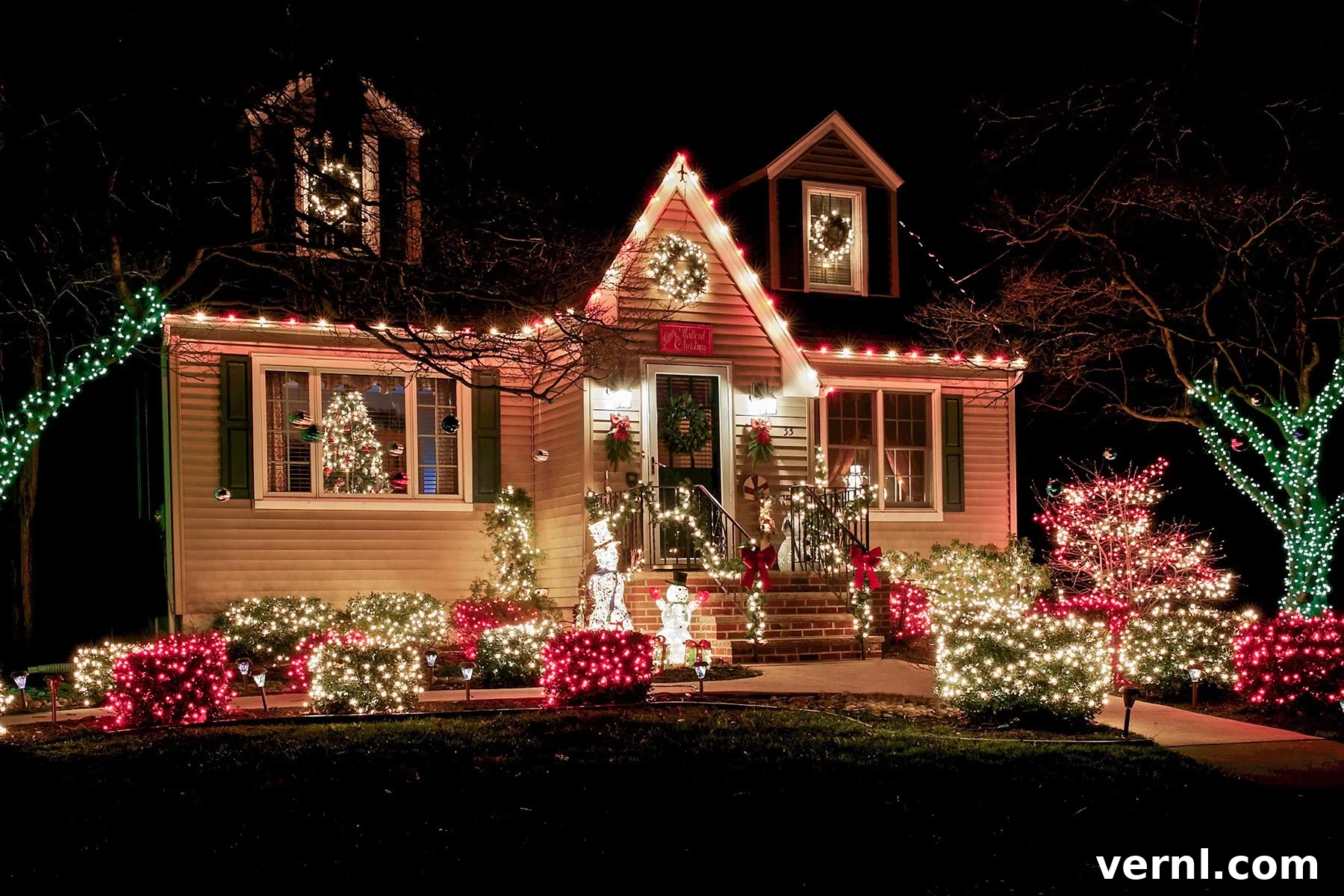
As the festive season twinkles into full swing, neighborhoods transform into dazzling spectacles of light and cheer. Streets are adorned with everything from majestic inflatable characters to intricate light displays that would make a passing airplane passenger marvel. For many, the joy of holiday decorating is immense, but it often comes with a nagging question: How much will all these festive lights and animated figures add to my electricity bill? As an electrician, this question is particularly pertinent to me, especially when I compare my modest garland-and-wreath setup to the elaborate displays of my neighbors.
Are you more of a minimalist “Grinch” when it comes to holiday decorations, or do you channel your inner “Griswold”? We all remember the iconic Clark Griswold from Christmas Vacation, whose truly outlandish display famously threatened to shut down the local power grid. While most of us won’t reach Griswoldian levels, it’s natural to wonder about the energy consumption of our own festive adornments. This comprehensive guide will walk you through the precise steps to calculate the electricity cost of your holiday decorations, helping you manage your budget and illuminate your home without any unexpected surprises.
Demystifying the Power Bill: Calculating Inflatable Decoration Costs
Those charming, oversized inflatables that populate so many yards are a staple of modern holiday decor. But how much electricity do they truly consume, and what will that cost you? The answer largely depends on a few key factors: the size and specific motor specifications of your inflatable, and of course, your local electricity rates. The good news is that for most common inflatables, the cost is surprisingly low, and you can easily determine it using a straightforward formula. To do so, you’ll need three crucial pieces of information:
- The **input watts (W)** of the inflatable’s motor. Watts are the fundamental unit of electrical power, indicating how much energy the motor uses.
- The **daily operating hours (h)**, specifying how long you keep the inflatable running each day.
- The **price of electricity per kilowatt-hour (kWh)**, which is the unit your utility company uses to charge you.
To find the wattage, inspect the power adapter or the motor’s nameplate on your inflatable. You’ll typically find both input and output electrical specifications listed. For calculating electricity costs, always refer to the **input** numbers, as these represent the total power drawn from your home’s electrical system. If watts aren’t explicitly provided, you can often find the **amperes (amps or A)**, which measure electrical current flow. Simply multiply the amperes by 120 volts (V), the standard voltage in U.S. homes, to calculate the watts (Watts = Amps x Volts).
Let’s illustrate with an example. Consider a popular 6-foot-tall inflatable Santa currently available, which typically draws about 0.6 amps (A) at 120 volts (V). Using our formula, the wattage is 0.6A multiplied by 120V, resulting in 72 watts (W). For context, a smaller 3-foot pink pig inflatable might draw a mere 0.3 amps, equating to just 36 watts, while a colossal abominable snowman inflatable would naturally require more power due to its larger size and more powerful motor.
Now, let’s calculate the cost. Imagine you inflate your 6-foot Santa for eight hours a day. To determine the price of electricity, consult your most recent electric bill; you’ll find the charge per kilowatt-hour there. For our calculation, we’ll use the November 2024 national average of $0.176 per kilowatt-hour. Before we proceed, we need to convert Santa’s 72 watts into kilowatts by dividing by 1000, giving us 0.072 kW.
With all our figures ready, the daily cost calculation is straightforward: Power in kilowatts (kW) multiplied by operating time in hours (h) multiplied by the price of electricity per kilowatt-hour ($/kWh). So, 0.072 kW x 8 h x $0.176/kWh = $0.1014. This means running your 6-foot inflatable Santa for eight hours a day costs approximately ten cents. Over a month, this amounts to roughly three dollars – a surprisingly affordable addition to your holiday budget.
Of course, costs can accumulate if you have a grand display. If you’re a true enthusiast with ten inflatable Santas, and they’re all illuminated from Thanksgiving through January 6th (the traditional date when you’re meant to take down your decorations), your total electricity expenditure for these festive giants could reach around $45 for the entire season. While more substantial than a single inflatable, it’s often less than people anticipate, especially given the visual impact.
Illuminating Your Home: Holiday Lights Electricity Usage and Costs
Beyond inflatables, holiday lights are the quintessential element of festive decor. The electricity cost of your light display, much like inflatables, hinges on your decorating ambition – are you aiming for subtle elegance or a full-blown Griswold-esque spectacle? Critically, the type of lights you choose, specifically incandescent versus light-emitting diodes (LEDs), will be the primary determinant of your energy consumption and, subsequently, your bill. You can break down the cost for lights using the same fundamental formula as with inflatables: Power (kW) x Time (h) x Price ($/kWh).
LED Holiday Lights: Efficiency and Savings
Light-emitting diodes (LEDs) have revolutionized holiday lighting, offering unparalleled energy efficiency. These modern marvels are typically up to 90% more efficient than traditional incandescent bulbs, making them the eco-conscious and budget-friendly choice. To calculate their cost, simply check the tag located at one end of your light string for the listed watts or amps. Once you have this figure, convert it to kilowatts and plug it into our established formula.
Consider a small, sentimental display, such as my miniature Charlie Brown Christmas tree. It proudly hosts a single 25-foot string of 100 mini LED lights, which consumes a meager 6.48 watts (or 0.00648 kW). Applying our cost formula – power multiplied by time multiplied by price – illuminating this tree for eight hours a day costs less than a penny. Even if you upgrade to a more standard 6-foot tree adorned with six strings of these efficient LED lights, your daily operational cost would still be barely a nickel. The initial investment in LEDs might be slightly higher than incandescents, but the significant long-term savings on your electricity bill and their extended lifespan make them an incredibly smart choice for any holiday decorator, from a modest enthusiast to a grand decorator.
Incandescent Holiday Lights: Traditional Glow, Higher Cost
Despite the rise of LEDs, traditional incandescent holiday lights still hold a special place in many hearts, prized for their classic warm glow and often lower upfront purchase price. However, this nostalgic charm comes at a higher operational cost due to their inherent inefficiency. Incandescent bulbs generate light by heating a filament, which means a significant portion of the electricity they consume is wasted as heat rather than converted into visible light. Furthermore, incandescents have safety limitations; you cannot string as many of them together end-to-end before hitting the limit specified on the package. This restriction is enforced by safety organizations like UL (Underwriters Laboratories), which certifies lights and thousands of other products for safety, primarily to prevent circuit overload and fire hazards.
A typical 25-foot string of 100 mini incandescent lights consumes approximately 41 watts. Based on our national average electricity price, running these lights for an eight-hour period would cost around $0.06 per day, which accumulates to about $1.73 per month. The costs escalate considerably with larger bulb types. For instance, classic C7 and C9 strings, which use between 5 and 7 watts per bulb, are significantly more power-hungry. A single 25-light string of 5-watt C7 bulbs totals 125 watts. Running such a string for eight hours daily would cost approximately $0.18 per day, or a more substantial $5.28 per month. This stark difference highlights why many decorators are gradually transitioning to LED technology, especially for extensive displays.
The Ultimate Display: Cost of a Clark Griswold-Scale House
If your ambition is to truly emulate the legendary Clark Griswold and blanket your entire home in a spectacular blaze of holiday lights, then opting for LED lights is not just a suggestion, it’s a financial imperative. While the upfront investment for such a vast quantity of LED lights will undoubtedly be higher, the long-term energy savings are immense and crucial for making such a monumental display even remotely feasible. For the sake of fun and demonstration, let’s break down the hypothetical cost of running Clark Griswold’s famous Christmas Vacation house, both with traditional incandescents and modern LEDs.
In the beloved film, Clark proudly declares he has installed “two hundred and fifty strands of lights, one hundred individual bulbs per strand, for a grand total of twenty-five thousand individual miniature imported Italian twinkle lights.” (Yes, this movie is a holiday classic, and I’ve watched it more times than I can count!) Now, let’s calculate what it would cost to power those 25,000 lights. Considering the movie was released in 1989, every single one of Clark’s lights would have been incandescent. We’ll start our calculation there to truly appreciate the energy evolution.
Clark’s Incandescent Nightmare: The Original Display Cost
Clark claims to use 250 strands of mini lights. As we established earlier, a typical string of 100 mini incandescent lights consumes about 41 watts. Now, let’s apply today’s electricity prices to Clark’s colossal incandescent setup.
If these 250 strands were run for six hours every night, the daily electricity cost would be staggering: 250 strands x 0.041 kW/strand x 6 hours/day x $0.176/kWh = $10.82 per day. This equates to nearly $325 per month for just mini lights! The financial shock doesn’t end there. If Clark had used larger C7 incandescent strands, which can consume around 5 watts per bulb, the cost would skyrocket dramatically. With 25,000 bulbs, this would be equivalent to 1,000 25-light C7 strands (125 watts per strand). Running these for six hours daily would cost an astounding $132 per day, or approximately $4000 per month. This figure truly puts into perspective the sheer energy drain of such a traditional incandescent display, making Clark’s initial struggles with his power bill highly relatable.
And let’s not forget the practical side of such an endeavor. These calculations only cover the electricity cost; they don’t even begin to factor in the extensive electrical upgrades and additional circuits you’d need to install to ensure such a massive display could operate safely. (A crucial piece of advice: please do not attempt to plug all your lights into the same receptacle outlet as Clark famously did, unless you enjoy frequently tripping your circuit breakers or worse.)
Modern Marvel: Reimagining Griswold with LEDs
If you were to undertake the ambitious project of recreating the Griswold home today, but wisely opting for LED technology, your electricity costs would be dramatically lower. While LEDs are indeed pricier to purchase upfront, requiring a more substantial initial investment, the long-term operational savings are profound and undeniably make them the superior choice for large-scale displays.
Let’s recalculate Clark’s 25,000 lights using modern LED mini light strings. As previously noted, a 100-light mini LED string consumes only 6.48 watts. Plugging 250 of these ultra-efficient strands into our formula (250 strands x 0.00648 kW/strand x 6 hours/day x $0.176/kWh) yields a daily cost of approximately $1.71. This translates to a far more manageable monthly bill of around $51.32. This incredible difference illustrates the power of LED technology in transforming what was once a financial burden into an achievable holiday dream.
Even for larger LED C7-style lights, which might consume roughly 2.5 watts per 25-light strand (meaning Clark would need about a thousand such strands for 25,000 bulbs), the costs remain incredibly reasonable. Running these LED C7s for six hours daily would set you back about $2.64 a day, amounting to roughly $79 per month. The comparison is stark: $4000 a month for incandescent C7s versus $79 a month for LED C7s. This alone should convince any aspiring Griswold that LED is the only sensible path for a truly spectacular, yet financially responsible, holiday light display.
Prioritizing Safety: Essential Holiday Decoration Guidelines
While understanding the electricity cost of your holiday decorations is important for your budget, it’s crucial to remember that it’s only half the story. The dazzling display is meaningless if it compromises the safety of your home and family. Before you even consider stapling thousands of lights to your roof, take time to think critically about safety, encompassing not only electrical safety but also the often-overlooked aspect of ladder safety when installing lights at height.
**Preventing Electrical Overload:** Always adhere strictly to the manufacturer’s instructions regarding the maximum number of light strands you can safely string together and connect to a single circuit. Overloading electrical circuits with too many lights is a common, yet dangerous, mistake. It can cause your circuit breaker to trip, plunging your decorations and possibly other areas of your home into darkness. More seriously, it can damage your lights, extension cords, or even trigger an electrical fire. This risk is significantly higher with incandescent lights due to their much greater wattage, which adds up quickly. Even with energy-efficient LEDs, if you’re planning an elaborate holiday light show complete with synchronized music and animated reindeer, you might still need to consider adding extra dedicated circuits to handle the cumulative power demand safely.
**Ground-Fault Circuit Interrupters (GFCIs): Your Safety Net:** All outdoor lighting and any indoor lighting near water sources (like sinks) must be protected by a Ground-Fault Circuit Interrupter (GFCI). A GFCI is a vital safety device designed to immediately shut off an electric power circuit when it detects that current is flowing along an unintended path, such as through water or a person. This rapid response can prevent severe electrical shocks and electrocution, especially in damp or wet outdoor conditions common during the holidays.
**Inspect Your Lights Thoroughly:** Before you begin the annual ritual of putting up your decorations, take the time for a careful inspection of every single string of lights. Look for any signs of damage: frayed wires, cracked insulation, broken or missing bulbs, and corroded sockets. Immediately replace any broken bulbs. If an entire string, or even half of it, fails to light up, try troubleshooting it with a dedicated Christmas light tester or by changing the fuse in the plug. Crucially, discard any light strings that have exposed wiring or show significant damage; they pose a serious fire and shock hazard and are not worth the risk.
**Secure Lights Safely:** Remember Clark Griswold’s infamous attempt to install lights using metal staples? That’s a classic example of what NOT to do. Metal staples can easily pierce the wire insulation, creating a short circuit and a significant electrical hazard. Instead, always use plastic clips, insulated hooks, or specially designed light hangers to secure your lights. These methods protect the wiring and prevent damage. Additionally, ensure that extension cords used outdoors are rated for outdoor use and are positioned in areas where they won’t become tripping hazards or be subjected to moisture accumulation.
**Know When to Call a Professional:** If you have any doubts about your home’s circuit capacity, the condition of your outdoor outlets, or any other complex electrical safety issues related to your holiday display, do not hesitate to contact a licensed electrician. They can assess your system, provide expert advice, and ensure your decorations are installed safely, allowing you to enjoy the beauty of the season with complete peace of mind.
Sources:
- Bureau of Labor Statistics: “Average Energy Prices for the United States, Regions, Census Divisions, and Selected Metropolitan Areas”
- Energy.gov: “Lighting Choices to Save You Money”
- Script Slug: “National Lampoon’s Christmas Vacation”