
[ez-toc]
Imagine a home without the silent guardians of your electrical system. Our modern lives, powered by countless devices and appliances, would be fraught with danger without circuit breakers. These essential safety devices are more than just simple switches; they are critical components designed to protect your home, its occupants, and your valuable electronics from the dangers of electrical faults. By automatically disconnecting an electrical circuit when current levels become unsafe, or by allowing manual intervention for maintenance, circuit breakers are at the heart of residential electrical safety. They are the unseen heroes preventing power surges, maintaining a consistent electricity flow, and, most critically, safeguarding your home from potentially devastating electrical fires.
“Circuit breakers are massively important when it comes to keeping your home running efficiently and safely,” emphasizes Daniel Mock, vice president of operations at Mister Sparky. “A properly functioning circuit breaker is your first line of defense against unexpected power surges, ensuring a stable power supply and offering robust protection for your property against fire hazards linked to electrical overcurrents.”
As a homeowner, the experience of a “tripped” circuit breaker is likely a familiar one. Perhaps you’ve been in the middle of preparing a meal, or enjoying a quiet evening, when suddenly a section of your home goes dark. This common occurrence is the circuit breaker doing its job. For those living in older residences, the equivalent might have been a blown fuse – an older technology that served a similar purpose. As Ben Kolo, owner of Mr. Electric of Central Iowa, notes, “Fuses perform the same protective function but demand replacement once they’ve been overloaded or experienced a short circuit, whereas breakers can simply be reset.”
Whether you’re encountering your home’s electrical panel for the very first time, or you’re an experienced DIY enthusiast seeking a clearer explanation for common electrical issues like a tripped breaker, this comprehensive guide is designed to empower you. We will delve into the fundamental reasons why circuit breakers trip, provide clear, step-by-step instructions on how to safely reset them, and equip you with the knowledge to identify when professional assistance from a licensed electrician is crucial for maintaining optimal home electrical safety and performance.
Why Do Circuit Breakers Trip? Understanding Electrical Faults
Circuit breakers trip for a critical reason: to prevent damage and potential hazards when there’s an excessive flow of electrical current, often referred to as an “overcurrent,” on a specific circuit. This protective action is designed to isolate the faulty circuit, thereby cutting off the power supply before any serious issues arise. While seemingly inconvenient, often interrupting us at the least opportune moments – like during morning routines or while cooking dinner – a tripped breaker is a sign that your home’s electrical safety system is working precisely as intended. Understanding the primary causes of these overcurrents is key to both troubleshooting and preventing future occurrences. Here are the three most common reasons why a circuit breaker might trip:
-
1. Overloads: Exceeding Circuit Capacity
An electrical overload occurs when you draw more amperage than a circuit is designed to handle. Think of your electrical circuits as highways for electricity; each has a maximum traffic capacity. If too many ‘vehicles’ (appliances and devices) try to use that highway at the same time, it becomes congested, leading to an overload. This is arguably the most common reason for a tripped breaker and often the easiest to diagnose and rectify. For instance, consider a typical 20-amp circuit in your garage. In the dead of winter, you might plug in a powerful 12-amp space heater to stay warm, and simultaneously decide to fire up a 15-amp miter saw for a quick project. The combined draw of these two devices is 27 amps (12A + 15A), which significantly exceeds the circuit’s 20-amp rating. The breaker, sensing this immediate excess, will trip to prevent overheating of the wires, which could otherwise lead to insulation damage or even fire. The speed at which it trips depends on the breaker’s “inverse time” characteristics—meaning the higher the overload, the faster it trips. Overloads are generally solved by simply unplugging some appliances or electrical devices from the overloaded circuit and distributing them to other, less utilized circuits in your home. This practice helps balance the electrical load and prevents future trips. Regularly assessing the power demands of your devices and upgrading older wiring or adding new circuits if necessary are proactive steps homeowners can take to mitigate overload risks. Understanding your home’s electrical layout and the amperage ratings of your circuits is fundamental to preventing these common and disruptive trips.
-
2. Short Circuits: An Unintended Path
Short circuits represent a more serious and potentially dangerous electrical fault. This occurs when the electrical current takes an unintended “shortcut” back to your main electrical panel, bypassing the appliance, lamp, power tool, or other device (collectively known as “loads”) it’s supposed to power. In a properly functioning circuit, electricity flows from the hot wire, through the load (where it performs work), and then returns to the panel via the neutral wire. A short circuit happens when a hot wire directly touches a neutral wire, or another hot wire, before the current passes through the load. This can be caused by various issues, including deteriorated or worn insulation on wires, loose or poor connections within outlets or switches, or even accidental damage to wiring from nails, screws, or rodent activity. Because the current bypasses the resistance normally offered by the load, there’s nothing to impede its flow, leading to an instantaneous and extremely high surge in current – sometimes hundreds or even thousands of amps. When this sudden, massive spike occurs, the circuit breaker reacts almost instantaneously (within milliseconds), opening the circuit to prevent extreme heat buildup, potential arcing (which can create extremely hot electrical flashes), and the ignition of surrounding materials. Short circuits are a significant cause of electrical fires. Diagnosing and repairing short circuits often requires the expertise of a licensed electrician, as the faulty wiring could be hidden within walls, ceilings, junction boxes, or within the internal components of an appliance. It is crucial never to ignore repeated short circuit trips, as they indicate a serious and immediate fire hazard.
-
3. Ground Faults: Dangerously Uncontrolled Current
Ground faults are a specific and particularly hazardous type of short circuit. They occur when a hot wire accidentally touches a metallic part of the electrical system that is intended to be grounded, but not normally energized – such as the metal housing of an appliance, a metal conduit, an electrical box, or even the bare equipment grounding conductor itself. The danger of a ground fault lies in the fundamental principle that electricity always seeks the shortest path back to its source, which is typically the utility transformer outside your home, via your electrical panel. If a hot wire energizes a metallic component that you then touch, your body could inadvertently become that “shortest path” to the ground, allowing a potentially lethal amount of electricity to flow through you. This is why electrical grounding is so crucial. To mitigate this extreme risk, electricians install an “equipment grounding conductor” – a dedicated, deliberate fault path back to the electrical panel. When a ground fault occurs, this grounding conductor safely directs the errant current back to the panel, causing the circuit breaker (or more specifically, a Ground Fault Circuit Interrupter or GFCI device) to trip rapidly, often within fractions of a second, thereby preventing severe electric shock. Ground faults are extremely dangerous and must be addressed immediately by a qualified professional to ensure the safety of your home and its inhabitants. Modern building codes often mandate GFCI outlets or circuit breakers in areas prone to moisture, such as kitchens, bathrooms, laundry rooms, garages, and outdoor spaces, to provide enhanced protection against these deadly faults. Ignoring a ground fault is never an option; it poses a direct threat to life.
How To Safely Reset a Tripped Circuit Breaker
Resetting a circuit breaker that has tripped occasionally is a straightforward process and typically not a cause for alarm. It’s a normal function of your home’s electrical safety system. However, if a breaker trips frequently, or if you ever observe concerning signs such as a burning smell, visible sparks or smoke, hear unusual buzzing or sizzling noises coming from your electrical panel, or feel heat around the breaker, it’s a clear indicator of a more serious underlying problem. In such cases, or if you’re simply unsure about the persistent tripping, immediately stop attempting to reset the breaker and call a licensed electrician for a professional assessment and repair. While resolving an overload can often be managed by redistributing electrical loads, addressing short circuits and ground faults typically requires specialized expertise, as the problem source might be concealed within an unknown electrical box, behind an outlet, or even inside a wall. If simply moving appliances to different circuits doesn’t resolve the tripping, it’s highly probable that you have a wiring issue that demands professional attention. Always prioritize safety over convenience when dealing with electrical systems.
Step 1: Locate the Tripped Breaker in Your Electrical Panel
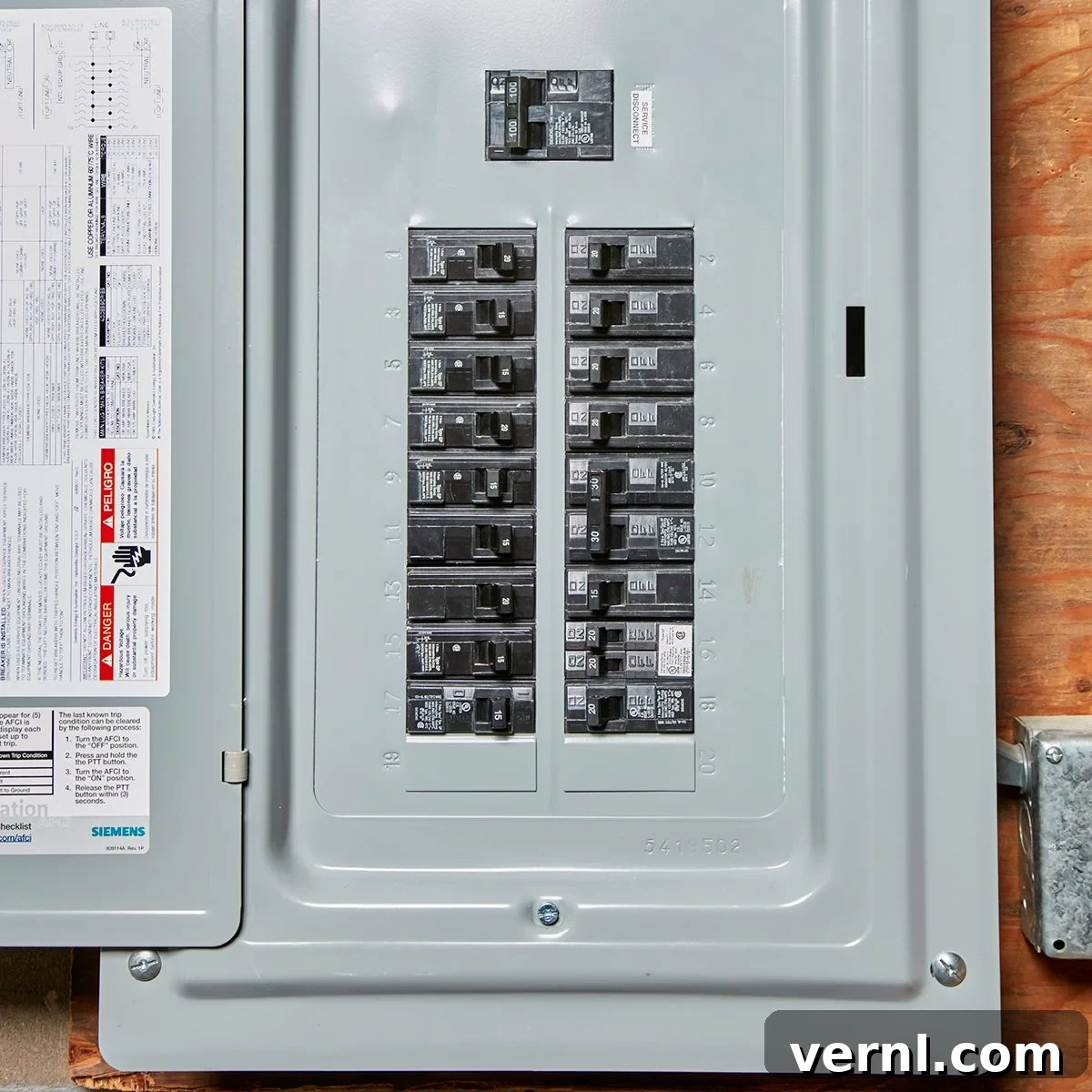
Begin by locating your home’s main electrical panel. This is usually a gray metal box mounted on a wall in a utility room, garage, basement, or sometimes even an exterior wall. Ensure the area around the panel is clear of obstructions and has adequate lighting. Once found, carefully open the front cover. Ideally, the breakers inside would be neatly labeled, clearly indicating which circuit each controls (e.g., “Kitchen Outlets,” “Master Bedroom Lights,” “Basement GFCI”). However, in many homes, especially older ones or those that have seen multiple occupants or electricians, the labeling is often outdated, incomplete, or entirely absent. Don’t be surprised if you find a chaotic arrangement; this is unfortunately common.
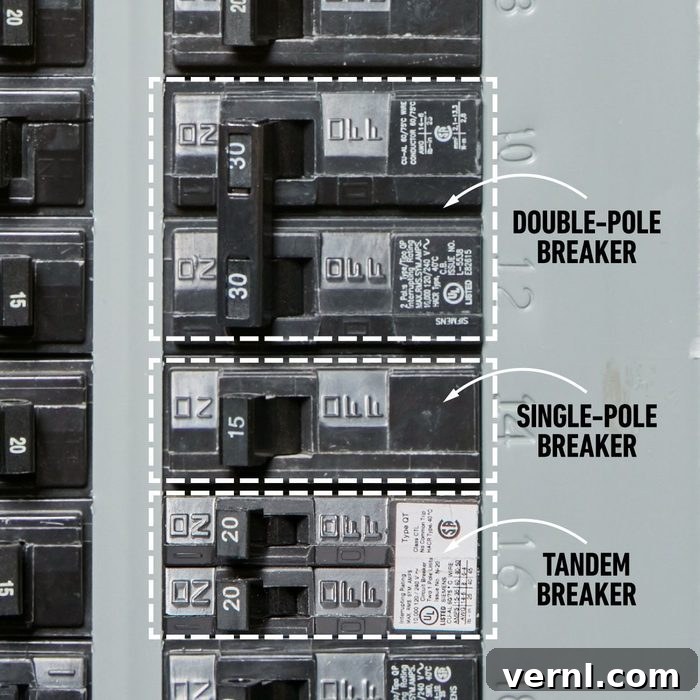
To identify the tripped breaker, look for a switch that is not aligned with the others. Circuit breakers typically have three distinct positions: “On” (fully engaged, usually towards the center or top), “Off” (fully disengaged, usually towards the edge or bottom), and “Tripped” (a middle position, often slightly off-center and sometimes with a visible red or orange indicator). Most of your active breakers will be in the “On” position. A tripped breaker will be noticeably out of alignment, sitting somewhere between the “On” and “Off” positions. It might also feel looser than the other switches. You can also employ some deductive reasoning: if a specific light fixture or receptacle circuit is out, it will typically be controlled by a 15-amp or 20-amp single-pole breaker. These are standard-sized breakers, meaning they control a single hot wire and occupy one slot in your electrical panel. Larger, more power-intensive appliances such as your central air conditioner, electric range, or clothes dryer are typically connected to double-pole breakers. These are larger, wider breakers that occupy two adjacent slots in the panel and control two hot wires simultaneously. While less common, some panels might feature “tandem” or “piggyback” breakers, which cleverly split a single-pole breaker slot into two 15-amp or 20-amp breakers, each controlling a separate circuit. These are used to conserve space in overcrowded panels but have specific limitations on their application. Additionally, you might encounter AFCI (Arc Fault Circuit Interrupter) or GFCI (Ground Fault Circuit Interrupter) breakers, which offer enhanced protection against specific types of faults and might have a small “test” button on their face.
Step 2: Safely Reset the Circuit Breaker
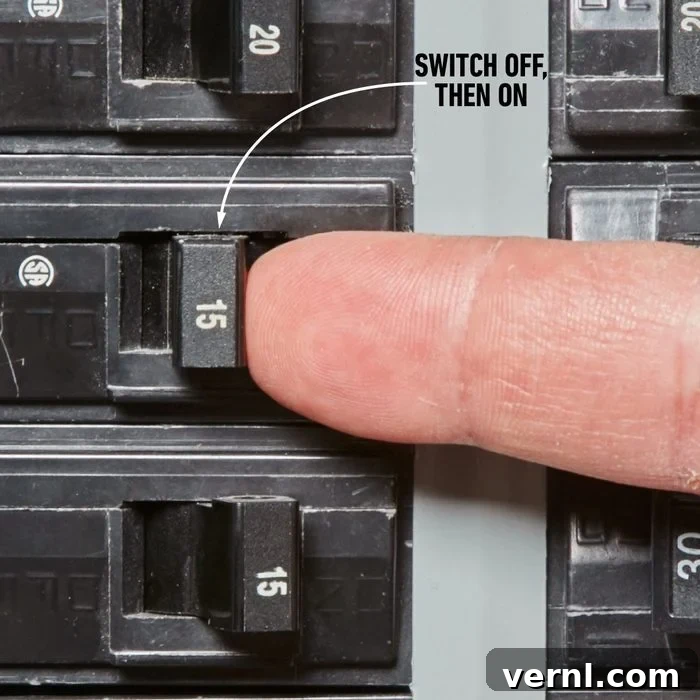
Once you have positively identified the tripped breaker, the resetting process is crucial to follow correctly. First, firmly push the breaker switch all the way to the “Off” position. This step is vital because it fully disengages the internal tripping mechanism, allowing it to reset properly. Attempting to directly flip a tripped breaker back to “On” without first moving it to “Off” will often result in the breaker immediately springing back to its tripped state, as the internal mechanism hasn’t been re-engaged. After you’ve moved it to “Off,” pause for a moment, then firmly push the breaker switch all the way to the “On” position. Listen for a solid click, and observe if it holds in place. As a critical safety precaution, when resetting any breaker, it is always advisable to stand to one side of the electrical panel and turn your face away from the panel. This minimizes your exposure in the extremely rare, but possible, event of an arc flash explosion, which can produce intense heat and light. While infrequent, taking this simple precaution adds an extra layer of personal safety.
If the circuit breaker immediately trips again after you’ve reset it, this indicates an unresolved issue on the circuit. Do NOT repeatedly try to reset it, as this can exacerbate the problem, damage the breaker, or create a fire hazard. Instead, proceed with troubleshooting: go back to the affected area and unplug all appliances and devices that were connected to that circuit. Ensure that even small chargers or less obvious items are unplugged. Once everything is disconnected, return to the electrical panel and attempt to reset the breaker one more time. If the breaker now holds in the “On” position, it strongly suggests you had an electrical overload. In this scenario, you should redistribute the unplugged items to different, less-loaded circuits in your home to prevent future overloads. Consider using power strips with built-in surge protection for sensitive electronics. If, however, the breaker continues to trip even after all devices are unplugged, or if you notice it consistently trips immediately after you plug in a certain appliance, it’s highly indicative of a more serious wiring issue, a short circuit, or a ground fault within the circuit itself or the problematic appliance. In such cases, the safest and most prudent action is to immediately unplug the appliance causing the problem (if identifiable), leave the breaker in the “Off” position, and call a qualified, licensed electrician. Do not continue to use a faulty circuit or appliance until it has been professionally inspected and serviced. Finally, once power is restored, remember to reset any clocks on your appliances, and you’re good to go, with your home’s electrical system safely operational once more.
For those interested in understanding advanced electrical panel configurations and their testing, here is information on how to get 240 volts from a breaker panel for specific heavy-duty appliances and specialized applications.
Frequently Asked Questions About Circuit Breakers
Can a Circuit Breaker Reset Itself?
No, standard residential circuit breakers installed in your home electrical panel are mechanical safety devices and cannot reset themselves automatically. Once a breaker trips due to an overcurrent, it must be manually moved to the “Off” position and then to the “On” position by a person to restore power to that circuit. This manual reset mechanism ensures that you are aware of an electrical issue and can take appropriate steps to address it, rather than the problem being silently masked by an automatic reset, which could lead to repeated faults and potential hazards without your knowledge.
Why Won’t My Circuit Breaker Reset or Stay On?
A circuit breaker that refuses to reset or immediately trips again after being reset is signaling a persistent and potentially serious electrical problem that requires immediate attention. The most common reasons include a continued electrical overload on the circuit (meaning you haven’t identified and unplugged all contributing devices), a short circuit (where hot and neutral wires are directly touching, creating an uncontrolled current path), or a ground fault (where a hot wire is making contact with a grounded metallic component). These issues are often caused by loose or damaged wiring, faulty electrical outlets or switches, or even a defective appliance plugged into the circuit. Less commonly, the circuit breaker itself could be worn out, mechanically faulty, or internally damaged and require replacement. If you’ve tried redistributing loads and the breaker still won’t hold, it’s imperative to stop attempting to reset it. Unless you possess significant experience and expertise with electrical work and can safely diagnose the specific fault, immediately contact a licensed electrician. Tampering with persistent electrical problems without proper knowledge can be extremely dangerous, risks further damage to your home’s electrical system, and can lead to severe personal injury or electrical fires.
How Long Can You Leave a Tripped Circuit Breaker Off?
From a purely safety standpoint, leaving a tripped circuit breaker in the “Off” position indefinitely is perfectly safe. A breaker that is off means no electricity is flowing through that particular circuit, thus eliminating any potential hazards associated with it. There is no harm to the electrical system by keeping a breaker off. However, from a practical perspective, it’s generally best to identify and resolve the problem that caused the breaker to trip as soon as possible. This minimizes disruption to your daily life, restores functionality to affected areas, and ensures all your home’s circuits are fully operational. For circuits that are not currently in use or power non-essential items (like a spare bedroom outlet), it’s absolutely safe to leave them off until such a time as they are needed, or until you can have the underlying issue professionally addressed. The priority should always be diagnosing and fixing the root cause, especially if the circuit powers critical appliances, lighting, or heating/cooling systems in your home.
For more detailed information on advanced electrical systems, preventative maintenance, and specialized troubleshooting, consider consulting resources from reputable electrical safety organizations and experienced professionals. Staying informed about your home’s electrical system is a crucial aspect of responsible homeownership.
[cf]skyword_tracking_tag[/cf]