50-Year Mortgages: Unveiling the Potential and Pitfalls of Extended Home Loans
The concept of 50-year mortgages has recently surged into the spotlight, fueled by discussions surrounding innovative approaches to address housing affordability challenges. The possibility of extending home loan terms beyond the conventional 30-year period has sparked considerable interest and debate among prospective homebuyers, homeowners, and industry experts alike. This extended mortgage term aims to alleviate the burden of high housing costs by reducing monthly payments. However, a deeper examination reveals a complex interplay of financial implications that warrant careful consideration.
In the face of persistently elevated home prices and fluctuating interest rates, the introduction of 50-year mortgages represents a noteworthy shift in the landscape of home financing. This proposal has ignited conversations about the potential ramifications for individual budgets, equity accumulation, and the overall dynamics of the housing market. Understanding the motivations behind this discussion, comparing it to existing loan options, and analyzing expert perspectives are crucial steps in evaluating the viability of this extended mortgage term.
The Rationale Behind Exploring 50-Year Mortgages
The exploration of 50-year mortgages stems from a concerted effort by policymakers to tackle the persistent issue of housing affordability. As home prices continue to climb and interest rates remain volatile, the dream of homeownership becomes increasingly elusive for many individuals and families. The extended mortgage term offers a potential solution by spreading repayment over a longer period, thereby lowering monthly payments and making homeownership more accessible.
Emmett Dempsey, a seasoned Mortgage Broker and Owner of Treasure Coast Mortgage in Florida, emphasizes that “Affordability is the primary driver.” He notes that ongoing elevated interest rates and rising home prices have prompted the exploration of alternative solutions. The Trump Administration’s consideration of 50-year mortgages underscores the urgency in addressing these challenges and exploring potential avenues to facilitate homeownership.
Discussions surrounding extended loan terms often surface during periods of economic uncertainty or when borrowing becomes a significant hurdle for a substantial portion of the population. Extending the mortgage timeline results in lower monthly payments, which can be particularly appealing in a market characterized by high demand and limited housing supply. However, it’s essential to acknowledge the inherent trade-off: the extended repayment period leads to a substantial increase in the total interest paid over the life of the loan.
The Financial Implications: A Deep Dive into the Numbers
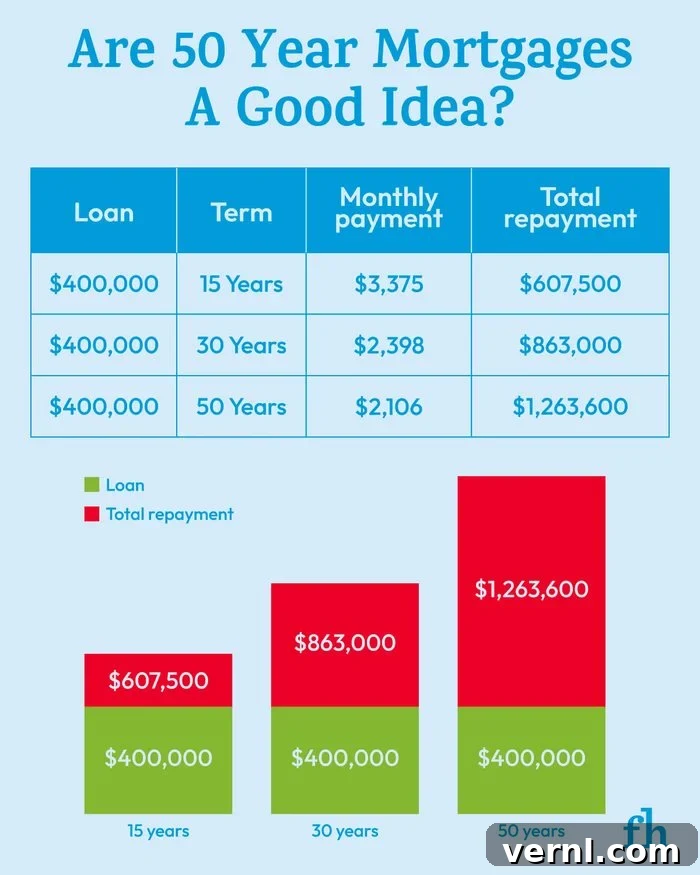
The core principle of a longer loan term lies in distributing repayment over an extended period. While this approach effectively reduces the monthly financial burden, it simultaneously amplifies the total amount paid over time. Traditional 30-year mortgages already accrue substantial interest, and extending the term to 50 years significantly magnifies this effect. A detailed analysis of the numbers illustrates the stark contrast between different loan terms.
Consider a hypothetical scenario involving a $400,000 loan at a fixed interest rate of 6%. A 15-year mortgage term would result in a monthly payment of approximately $3,375 and a total repayment of roughly $607,500. Extending the loan term to 30 years reduces the monthly payment to around $2,398, but the total repayment increases to approximately $863,300. Stretching the loan to 50 years further lowers the monthly payment to about $2,106. However, the total repayment escalates dramatically to around $1,263,600.
| Loan Amount | Term | Monthly Payment | Total Repayment |
|---|---|---|---|
| $400,000 | 15 Years | $3,375 | $607,500 |
| $400,000 | 30 Years | $2,398 | $863,000 |
| $400,000 | 50 Years | $2,106 | $1,263,600 |
This numerical comparison highlights a crucial point: while a 50-year mortgage may offer a slightly more manageable monthly payment, the interest paid over the loan’s lifetime increases exponentially. This increase can have significant long-term financial implications for borrowers.
The principal on a 50-year mortgage decreases at a slower rate, which means borrowers remain in a period of high-interest allocation for an extended period. This prolonged period of high-interest payments can delay equity building, potentially limiting long-term financial flexibility and opportunities compared to traditional mortgage terms. Equity is a crucial asset for homeowners, enabling them to access funds for home improvements, debt consolidation, or other financial needs.
Availability of 50-Year Mortgages: Current Status
Currently, 50-year mortgages are not available in the United States. The discussions surrounding this concept are purely exploratory, and no lenders are currently offering this type of loan. The idea is still in its preliminary stages as policymakers deliberate its potential structure and impact on the housing market. The development and implementation of 50-year mortgages would require significant regulatory changes and lender adoption.
Reactions to the proposal have been diverse. While some individuals are attracted to the prospect of lower monthly payments, experts caution against the long-term financial implications. Extending a loan for such an extended period significantly slows equity growth, which can hinder homeowners’ ability to sell or refinance their properties. This reduced mobility could further exacerbate the existing challenges of limited housing supply.
50-Year Mortgages: A Sound Investment Strategy?
For most borrowers, a 50-year mortgage is unlikely to be a financially advantageous long-term strategy. The initial appeal of a lower monthly payment is overshadowed by the extended interest burden and the sluggish accumulation of equity. Returning to our earlier example, a $400,000 loan repaid over 50 years results in a monthly payment reduction of approximately $300. However, this seemingly modest reduction pales in comparison to the staggering increase in the total loan cost, which more than triples to over $1.2 million over the course of the loan.
The impact of 50-year mortgages would be felt by both first-time homebuyers and existing homeowners. First-time buyers might find it easier to enter the housing market with lower monthly payments, but they would also commit to an extended repayment timeline before making significant progress in reducing their loan balance. Existing homeowners might face challenges in moving to new properties due to insufficient equity for a down payment on their next home.
“Inventory would be more restricted if existing homeowners are unable to sell and have equity for another house,” emphasizes Dempsey. This highlights a critical concern: the potential for 50-year mortgages to further constrain the already limited housing supply, making it more difficult for people to buy and sell homes.
About the Expert
Emmett Dempsey is a licensed Mortgage Broker and Owner of Treasure Coast Mortgage in Florida. With extensive experience in the mortgage industry, Dempsey provides valuable guidance to borrowers, helping them understand their loan options and navigate the complexities of home financing.
Sources
- Federal Housing information on mortgage term standards
- Housing market policy discussions from the U.S. Department of Housing and Urban Development
Related Articles
- [Placeholder Link – 7 Signs You’re Over-Decorating]
- [Placeholder Link – 18 Cheap Decor Ideas That Look Expensive]
- [Placeholder Link – 14 Traditional-Style Home Decor Ideas That are Still Cool]