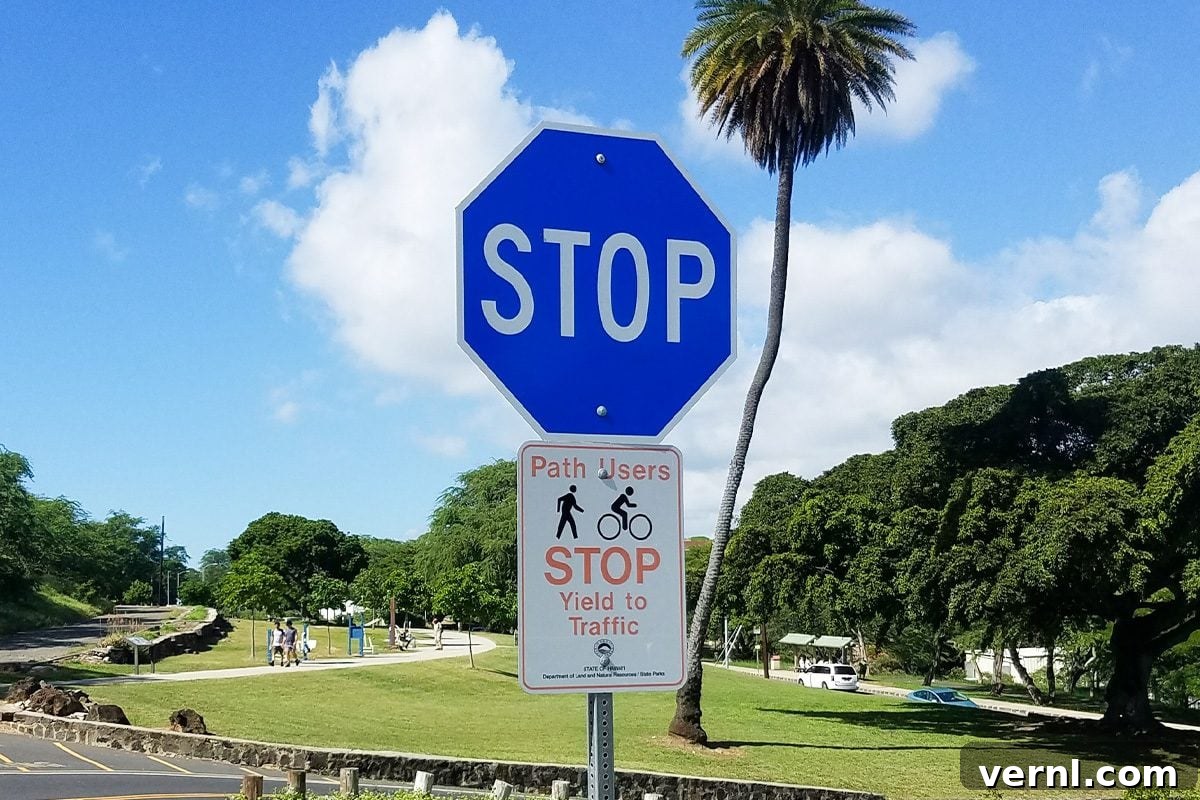
From our earliest childhood lessons on road safety to the everyday routine of our commutes, the classic red octagonal stop sign is an unmistakable symbol. Its vibrant crimson hue and distinct shape universally signal “stop.” We encounter them at countless intersections, crosswalks, and various points along our journeys, guiding us safely through traffic and preventing collisions. But what if you were to encounter something entirely different—a blue stop sign? While certainly a rare sight on official public roadways in the United States, these unexpected signs do exist, both domestically and internationally, prompting questions about their true meaning, purpose, and legal standing.
This comprehensive guide delves into the fascinating and often misunderstood world of blue stop signs. We’ll explore their significance in different contexts, uncover precisely where you might encounter them, and clarify how their purpose can differ dramatically from the traditional red signs we’ve all grown to recognize. Furthermore, we’ll shed light on the official regulations governing traffic control devices, helping you understand the nuances of these less common signals and the importance of uniformity in road signage. To provide expert insight and practical advice, we’ve consulted with Chief Jennifer Gundersen of the South Hadley, Massachusetts Police Department, whose extensive experience in law enforcement offers a valuable perspective on road signage, traffic management, and overall driver safety.
The Unmistakable Standard: Why Red Stop Signs Dominate Global Roads
Before exploring the specifics of blue stop signs, it’s essential to understand the universal dominance and critical role of their red counterparts. In the United States, the Manual on Uniform Traffic Control Devices (MUTCD), issued by the Federal Highway Administration (FHWA), explicitly mandates that all official stop signs be red. This nationwide standardization, a requirement since the 1950s, was far from arbitrary. The color red has long been universally associated with danger, warning, and immediate cessation across cultures, making it an instinctively recognized signal for drivers.
The choice of red for stop signs is also rooted in practical considerations. Its high visibility, particularly during daylight hours, at dawn or dusk, and even under challenging weather conditions such as fog or rain, makes it an ideal color for a critical traffic command. Furthermore, the distinctive octagonal shape is equally deliberate, offering a unique visual cue that allows drivers to identify a stop sign even from a considerable distance or if partially obscured by foliage, snow, or dirt. This unwavering uniformity across all U.S. states and territories is paramount for road safety, ensuring that drivers can instantly recognize and react appropriately to a stop signal, regardless of where they are traveling within the country.
Beyond U.S. borders, the red octagonal stop sign also enjoys widespread international recognition. In 1968, the United Nations developed the Convention on Road Signs and Signals. This ambitious initiative aimed at harmonizing road signage globally to enhance driver safety, particularly for those traveling across international borders. The red octagonal stop sign was explicitly included in these international standards, solidifying its status as a nearly universal directive to bring a vehicle to a complete halt before proceeding. This global consensus underscores the effectiveness and importance of this iconic traffic control device.
Unraveling the Mystery: What Exactly Does a Blue Stop Sign Mean?
When faced with a blue stop sign, the initial reaction for many drivers is confusion. The first question that naturally comes to mind is: what does this unusual sign signify? The answer, as it turns out, largely depends on your geographical location and the specific context in which you encounter it. The interpretation of a blue stop sign can vary significantly between the United States and other parts of the world, presenting a fascinating study in regional traffic signage.
In the U.S.: A Safety Indicator on Private Property
Within the United States, a blue stop sign carries a similar instruction to its red counterpart: it means you should bring your vehicle to a complete stop before proceeding. These signs typically retain the familiar octagonal shape, making their intent clear even with the unconventional color. However, there’s a critical legal distinction: blue stop signs are not official traffic control signs issued by state or federal authorities. Consequently, they are not regulated by the MUTCD and lack the direct legal enforceability of a red stop sign on a public road.
So, if they’re not official, where might you encounter one? Blue stop signs in the U.S. are almost exclusively found on private property. You might see them on the internal road networks of large estates, expansive ranches, private golf courses, exclusive country clubs, extensive corporate campuses, industrial parks, or even within gated residential communities. The primary purpose of these signs is to manage traffic flow and enhance safety within these privately owned domains, signaling to drivers to pause at specific junctions, entrances, or pedestrian crossings. While they aren’t backed by public traffic laws, they serve as a clear directive from the property owner to maintain order and prevent accidents on their premises.
A notable and common example of this practice can be observed in Hawaii. Due to specific state laws that often prohibit the installation of official (red) road signs on private property, many property owners in Hawaii opt for blue stop signs. This allows them to effectively signal to drivers the need to stop at certain points within their private land without violating state regulations, thereby ensuring a measure of traffic control where official signs are disallowed. This demonstrates a practical solution to a legal constraint, prioritizing safety and order.
It’s crucial to remember that while a blue stop sign on private property may not carry the same immediate legal weight as a red one on a public street (e.g., a police officer generally cannot issue a traffic ticket solely for “running” a blue stop sign on private land), ignoring such a sign can still have significant consequences. Property owners have the right to establish rules for their premises, and disregarding a blue stop sign could lead to being asked to leave the property, potential liability in case of an accident, or even trespassing charges depending on the severity and context of the violation. Always respect the directives of private property owners.
Interestingly, sometimes you might even encounter a blue traffic light instead of a green one, which serves a completely different, albeit equally intriguing, purpose, often related to emergency vehicle signaling.
Beyond U.S. Borders: Blue as a Restrictive Indicator
In various other countries, particularly in parts of Asia and Latin America, blue stop signs or blue-colored directive signs can take on an entirely different meaning, fundamentally diverging from the “stop and proceed” instruction familiar in the U.S. In nations such as Japan, South Korea, and Mexico, encountering a blue sign (which may or may not be strictly octagonal, sometimes appearing as a circular or rectangular sign with a red border) can signify restricted access or no-entry zones. Rather than merely instructing drivers to stop temporarily before continuing, these signs often convey a much stricter command: turn around, take an alternative route, and do not continue past this point.
These blue restrictive signs are typically used to delineate areas where vehicular traffic is strictly prohibited, perhaps due to environmental sensitivity requiring protection, military installations, active construction zones, private government facilities, or areas deemed unsafe for public passage. For international travelers, understanding this distinction is paramount, as misinterpreting a blue sign in these regions could lead to unintentionally entering prohibited areas, facing substantial fines, impoundment of vehicles, or even compromising personal safety. It underscores the importance of familiarizing oneself with local traffic signage when driving abroad. Even in countries where these blue restrictive signs are officially used and understood, it’s crucial to note that the red octagonal stop sign continues to be the universally recognized standard for indicating a required stop before an intersection or hazard.
Can You Install a Blue Stop Sign Near Your Home? The Legalities of Private vs. Public Signage
The idea of installing a blue stop sign might appeal to individuals with specific traffic management needs on their property. Perhaps you own a sprawling estate with internal roads, a private cul-de-sac, or a large business campus, and you wish to regulate vehicle speeds or create designated stopping points. The good news is that if you possess a substantial, privately-owned property with a system of roads within its boundaries, you are generally permitted to install a blue stop sign. This falls under the property owner’s right to manage their private domain and ensure safety for those on their land.
However, a critical distinction must be made regarding public versus private land. As Chief Jennifer Gundersen emphatically states, “blue stop signs are not authorized on public ways.” This directive applies universally across Massachusetts and every other U.S. state. Consequently, it is strictly illegal to install a blue stop sign on any municipal road, state highway, county road, or any other publicly maintained thoroughfare. Doing so could result in immediate fines, official requirements to remove the unauthorized sign, and potentially even legal liability if the unofficial signage causes confusion among drivers or contributes to an accident. Public roads must adhere to national standards for the safety and clarity of all drivers.
There’s also a degree of ambiguity surrounding the enforceability of blue stop signs, even on private property. While property owners can enforce their own rules and regulations, the ability of public law enforcement to issue citations specifically for violating a blue stop sign on private land can be limited. Typically, public police cannot enforce private property rules unless a separate law (like reckless driving or trespassing) is broken. However, this lack of direct traffic citation capability does not diminish their importance or the need for compliance. Such signs are almost always placed for valid safety reasons, and ignoring them can lead to dangerous situations, even if a direct traffic citation isn’t forthcoming. For instance, failing to stop at a blue sign on a private golf course could lead to a collision with a golf cart, a pedestrian, or another vehicle, resulting in personal injury or significant property damage for which you could be held liable by the property owner or affected parties.
Safety First: Best Practices When Encountering Any Stop Sign
Whether you encounter the familiar red octagon or the less common blue variant, the underlying principle of a stop sign remains firmly rooted in road safety. It is, fundamentally, a directive to exercise caution, be vigilant, and ensure the path ahead is clear before proceeding. Given the variations in meaning and legal standing for blue stop signs, adopting a consistently cautious and defensive driving approach is always the wisest strategy.
When you see a blue stop sign, especially on private property, interpret it as a strong recommendation, if not an outright command, to come to a complete stop. Take a crucial moment to scan your surroundings thoroughly for other vehicles, pedestrians, cyclists, or any potential hazards that might not be immediately apparent. On unfamiliar private roads, within large complexes, or particularly in foreign countries, be extra vigilant and attentive. Look for accompanying signage, local context clues, or other traffic indicators that might further clarify the blue sign’s precise intent. Proceed only when you are absolutely certain it is safe to do so, adhering to the fundamental principles of defensive driving and prioritizing the safety of yourself and others.
Ultimately, understanding the nuances of different traffic control devices, including the less common blue stop sign, empowers drivers to make safer and more informed decisions on the road. While red signs are the global standard for stopping, recognizing the specific meanings and contexts of blue signs in various situations is key to navigating both private estates and international roadways responsibly and without incident. Always drive with awareness and respect for all road signs, official or otherwise, to ensure a safe journey for everyone.
About the Experts
- Jennifer Gundersen is the Chief of Police for the town of South Hadley, Massachusetts. She has been in this pivotal role since 2019, bringing extensive experience to her position, having commenced her distinguished law enforcement career in 1994.
Sources
- United Nations Economic Commission for Europe. Convention on Road Signs and Signals. (2006)
- Federal Highway Administration. Manual on Uniform Traffic Control Devices (MUTCD). (Latest Edition)