Navigate Highway Signs: A Comprehensive Guide to Driving Without GPS
Remember the days before GPS? Getting from point A to point B involved paper maps, roadside assistance, and a keen understanding of highway signs. While modern technology offers convenient turn-by-turn navigation, knowing how to navigate using road signs remains an invaluable skill. Whether you’re venturing off the beaten path or simply prefer a more traditional approach, this guide will equip you with the knowledge to confidently navigate highway signs without relying on GPS.
Modern GPS systems, cell phones, and in-car navigation platforms have transformed how we travel. These technologies offer real-time directions and adaptive routing, reducing the chances of missing exits or making wrong turns. However, these systems can fail. Signal loss, outdated maps, or a simple preference for analog methods can leave you relying on the signs around you. Additionally, understanding how to navigate without constant technological assistance improves awareness and engagement during road trips.
The Historical Evolution of Highway Naming Systems
The development of highway naming and numbering systems is a fascinating journey. Early road travel was often chaotic, with inconsistent naming conventions making cross-state travel a challenge. As automobile popularity surged, the need for a standardized system became apparent.
Before standardized systems, road names frequently changed at state borders, causing confusion and potential navigational errors. This lack of uniformity posed significant risks to drivers. Imagine traveling on the “Lincoln Highway” only to find it transforming into the “Jefferson Highway” upon crossing state lines! This inconsistency could lead to detours and even accidents.
The modern highway system began taking shape in the 1920s, marked by the introduction of black and white road signs and a nationally adopted numbering system. This standardization represented a significant step forward, providing a more logical framework for long-distance travel. However, the true revolution came in 1956 when President Eisenhower signed the Federal Aid Highway Act. This act paved the way for the interstate highway system, complete with its iconic red, white, and blue route signs.
Understanding Interstate Numbering: A Key to Efficient Navigation
Interstate highway numbers are not assigned randomly; they follow a logical system that can quickly provide drivers with a general sense of direction. This system is designed to assist in quick orientation without constant map references.
East-west routes are assigned even numbers, with lower numbers in the southern regions and higher numbers in the northern regions. For example, Interstate 80 (I-80) runs from Teaneck, New Jersey, to San Francisco, California, following this pattern. Conversely, north-south routes are assigned odd numbers, with lower numbers in the west and higher numbers in the east. I-35, for instance, extends from Laredo, Texas, to Duluth, Minnesota.
Major interstate routes typically end in “0” or “5,” making them easily identifiable and helping drivers quickly determine their general direction of travel. Recognizing these patterns can significantly enhance your ability to navigate efficiently and make informed decisions on the road.
Auxiliary Interstate Routes: Decoding Three-Digit Numbers
Three-digit interstate numbers provide additional information about the route’s function and direction. Understanding these numbers can help you navigate complex metropolitan areas and avoid unnecessary detours.
- Loops: These routes begin with an even number (e.g., I-465) and partially circle a city before reconnecting to the original two-digit route (e.g., I-65). Loops do not fully encircle the city.
- Beltways: Similar to loops, beltways also begin with an even number (e.g., I-495). However, they completely circle a city or metropolitan area before reconnecting to the parent road (e.g., I-95).
- Spurs: These routes begin with an odd number (e.g., I-165) and typically provide direct access to a city’s downtown region or airport without reconnecting to the parent road.
Being aware of these numbering conventions can prevent last-minute lane changes and ensure you stay on the correct path, especially in heavy traffic or unfamiliar areas. This knowledge translates into a safer and more efficient driving experience.
State Highways: Regional Naming and Numbering Conventions
State highways, unlike the interstate system, are planned, funded, and maintained by individual states. Each state often develops its own unique naming and numbering conventions based on its transportation history and traditions.
Due to the lack of national coordination at the state level, some states may reuse road names and numbers already in use by neighboring states. This can lead to confusion if you’re not aware of the regional variations. For example, a road number that signifies a north-south route in one state might indicate an east-west route in another.
Despite these variations, many states follow general patterns. Some use sequential numbering or a system similar to the interstate numbering system, where lower numbers are assigned to routes in the southern part of the state and higher numbers to those in the north.
Other common conventions include:
- Northeastern states often use the prefix “Route” or “SR” (State Route) for state routes.
- States in the central part of the country may use the first initial of their state name, such as “K” for Kansas or “M” for Michigan.
- Western states frequently use prefixes like “SR” for state routes or “SH” for state highways.
Using Highway Numbering to Navigate Effectively
Understanding the highway numbering system can significantly improve your ability to navigate and stay on course. Recognizing and interpreting road signs is crucial for safe and efficient driving.
Common road signage includes:
- Red, white, and blue shield-shaped interstate highway signs.
- Black and white U.S. highway signs.
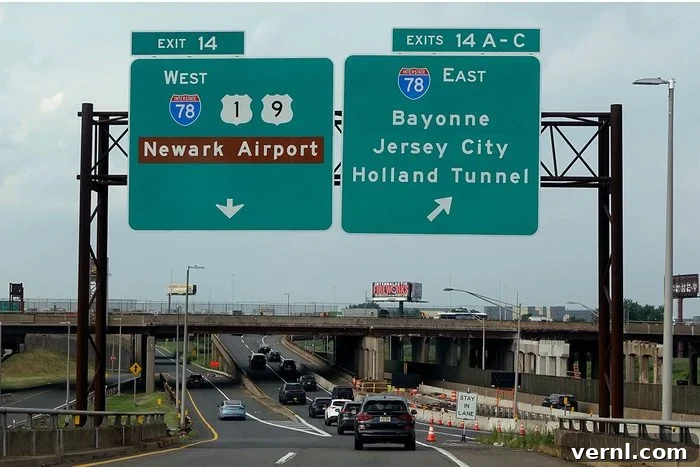
- Green directional informational signs, which display exit numbers, distances to exits, city names, route names or numbers, and directional arrows.
- Mile markers, typically green or black and white, indicate the distance from state borders and can be used to track progress and verify speedometer calibration.
Driving at night or in inclement weather can significantly reduce visibility. Slow down on unfamiliar roads and pay close attention to reflective signs and mile markers. Being proactive in these conditions maximizes safety and mitigates potential hazards.
FAQ: Mastering Non-GPS Navigation
What are the most reliable non-GPS navigation tools?
Before GPS, drivers relied on paper maps and compasses. These tools still offer security and can be surprisingly effective. However, situational awareness is the most reliable non-GPS tool. Observe your surroundings, look for landmarks, and pay attention to road signs. Some cars have built-in compasses to help you orient yourself.
Check shield colors on road signs and remember that most exit signs list nearby towns, junctions, and interchanges. If you’re unsure, stop at a gas station or rest stop to ask for directions. This break can also be an opportunity to refuel and refresh.
Are printed directions still useful?
Absolutely. Keeping a map in your car is a wise precaution. GPS signals can be unreliable, and outdated maps can lead you astray. Relying solely on GPS can also be dangerous.
Trip planning using old-school methods can be more effective. Writing out or printing your directions and reviewing your route beforehand helps you prepare for your trip and stay on course. While GPS provides information in fragments, proactive planning keeps you in control. Minimize distractions by only reviewing directions at rest stops.
In Conclusion
While GPS navigation has become ubiquitous, mastering the art of navigating using highway signs remains an essential skill for all drivers. Understanding the logic behind highway numbering systems, recognizing different types of road signs, and practicing situational awareness can empower you to confidently navigate any road, regardless of technological aids. Embrace the challenge of traditional navigation and enhance your driving experience today!