
Stay Connected: A Comprehensive Guide to Maintaining Internet Access During a Power Outage
In today’s interconnected world, being without internet access can be more than just an inconvenience; it can disrupt work, communication, and access to vital information. With power outages becoming increasingly common, it’s crucial to have a plan in place to stay online. According to reports, a significant percentage of homes experience power outages annually, rendering lights, appliances, and, critically, Wi-Fi routers useless. While some outages are brief, longer disruptions are on the rise, underscoring the importance of preparedness.
Fortunately, several backup internet options exist to help you stay connected during a power outage. This comprehensive guide explores these options, offering insights from experts like J.P. Blackwood of the Ohio Consumers’ Counsel and Nate Sumner, a home internet and technology expert. By understanding your options and taking proactive steps, you can minimize the impact of power outages on your online connectivity.
Assessing the Situation: Determining the Extent of the Power Outage
The first step is to determine the scope of the power outage. Is it a localized issue, such as a blown fuse or tripped breaker, or a widespread event affecting your entire neighborhood? Start by checking lights in various rooms. If none are working, proceed to your breaker box to inspect for tripped breakers. If all breakers are in the correct position and power remains absent, it’s likely part of a larger outage. If you retain cell phone internet service, it typically indicates that the local cell towers are still operational.
Leveraging Your Smartphone as a Temporary Hotspot
For short power outages, utilizing your smartphone as a mobile hotspot can provide a convenient temporary solution. By activating the hotspot feature on your phone, you can connect laptops, tablets, and other devices to the internet using your cellular data. Be mindful that this method can quickly deplete your phone’s battery. To mitigate this, consider using a portable DC backup battery to keep your phone charged, especially during extended outages. This simple solution allows you to maintain essential online activities while awaiting the restoration of power.
Exploring Backup Power Options for Sustained Connectivity
For longer power outages, more robust backup power solutions are necessary to keep your home network online. Several options exist, each with its own advantages and considerations.
Uninterruptible Power Supply (UPS): A Seamless Transition
An Uninterruptible Power Supply (UPS) is designed to provide immediate backup power to connected devices in the event of a power outage. It works by activating its internal battery within milliseconds of a power interruption, preventing the abrupt shutdown of sensitive electronics. For residential use, a small standby UPS model is typically sufficient to power essential equipment. As Nate Sumner advises, ensure the UPS has enough capacity to power your modem and Wi-Fi router. This allows for a seamless transition to backup power, minimizing disruption to your internet connectivity.
Portable Power Stations: Versatile and Rechargeable
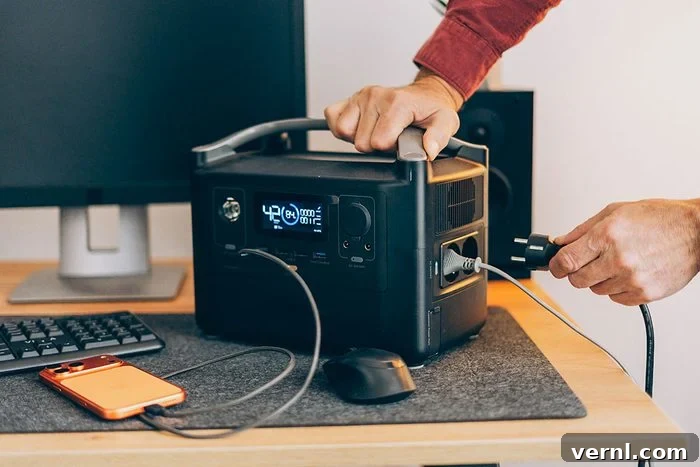
Portable power stations offer a versatile solution for powering various devices during a power outage. These units can be charged in advance and used to power routers, modems, smartphones, tablets, and other essential electronics. J.P. Blackwood highlights the utility of a 150-watt portable power station with AC outlets, DC ports, and USB ports, capable of powering a router or modem for extended periods. Some portable power stations also feature solar panels, enabling recharging during prolonged outages when sunlight is available. This feature adds an extra layer of resilience, ensuring continuous power even when grid power is unavailable.
Generators: Long-Term Power Solutions
Generators provide a more comprehensive power solution, capable of supplying electricity to a portion or the entirety of your home during an outage. Gas-powered generators require gasoline to operate, while solar battery units rely on solar energy. Nate Sumner recommends considering Jackery for those interested in solar battery generator systems. It’s crucial to operate gas generators outdoors and away from your house to prevent carbon monoxide poisoning. As J.P. Blackwood emphasizes, safety is paramount when using generators.
Power Inverters: Utilizing Your Car Battery
A power inverter can transform your car battery’s DC power into AC power, allowing you to power household devices. Connect the inverter to your car battery, start the engine, and then run extension cords to power your router, modem, or other electronics. Depending on the inverter’s capacity, it can also power lamps, televisions, or even refrigerators. J.P. Blackwood finds inverters particularly useful for powering electronic items while camping, highlighting their ease of use. However, never leave a car running inside a garage, as this poses a significant risk of carbon monoxide poisoning.
Exploring Home Internet Backup Options
Some internet service providers (ISPs) offer built-in backup options to maintain connectivity during power outages. Xfinity and Cox, for instance, include battery-powered Wi-Fi extenders in certain home internet plans. These devices automatically detect when the primary internet service is disrupted and seamlessly switch to a cellular internet connection. These extenders typically have a battery life of around four hours, sufficient for riding out short outages. The Ring Alarm Pro from Amazon also includes a power pack that provides approximately eight hours of cellular internet service in case of a power outage. These integrated solutions offer a convenient and reliable way to stay connected without requiring additional equipment or manual intervention.
Essential Preparations for Power Outages
Proactive preparation is key to mitigating the impact of power outages. As J.P. Blackwood advises, “It comes down to thinking ahead and being safe.” Ensure all phones, tablets, computers, and portable power stations are fully charged. Fill generators with gasoline and consider storing extra fuel. Keep your car’s gas tank full, as it can be used to charge devices or run an inverter. Furthermore, Blackwood stresses the importance of having a plan to keep essential medical equipment running during an outage. These preparations will significantly enhance your ability to cope with power disruptions and maintain essential services.
Frequently Asked Questions (FAQ)
Will Fiber or Cable Internet Still Work Without Power?
The answer is, “it depends,” according to Nate Sumner. While fiber and cable internet utilize different cables than power lines, they often share the same telephone poles or underground pathways. If the outage stems from a transformer failure or issues with the distant power grid infrastructure, your internet service may remain unaffected. However, if a fallen tree damages both internet and power lines, both services will be disrupted until repairs are completed. Therefore, it’s essential to understand that the availability of internet service during a power outage is contingent on the specific cause and location of the disruption.
How Long Will Cell Towers Stay Online During a Power Outage?
Most cell towers are equipped with backup batteries that last for approximately 4 to 8 hours, as well as generators that can run for 24 to 72 hours. However, it’s important to note that there is currently no federal regulation mandating or enforcing these backup power policies. As a result, the duration of cell tower uptime during a power outage can vary depending on the specific tower and its operator. While most towers strive to maintain connectivity, there are no guarantees, and service may be interrupted.
About the Experts
- J.P. Blackwood is Legislative and Public Affairs Liaison for the Ohio Consumers’ Counsel, a state agency that represents consumers’ rights for utilities.
- Nate Sumner is an engineer and host of the Nater Tater channel on YouTube, where he shares content about smart home tech, 5G home internet and lifestyle projects on his property.