Uncovering Hidden Dangers: The Silent Threat of Pothole Damage to Your Vehicle
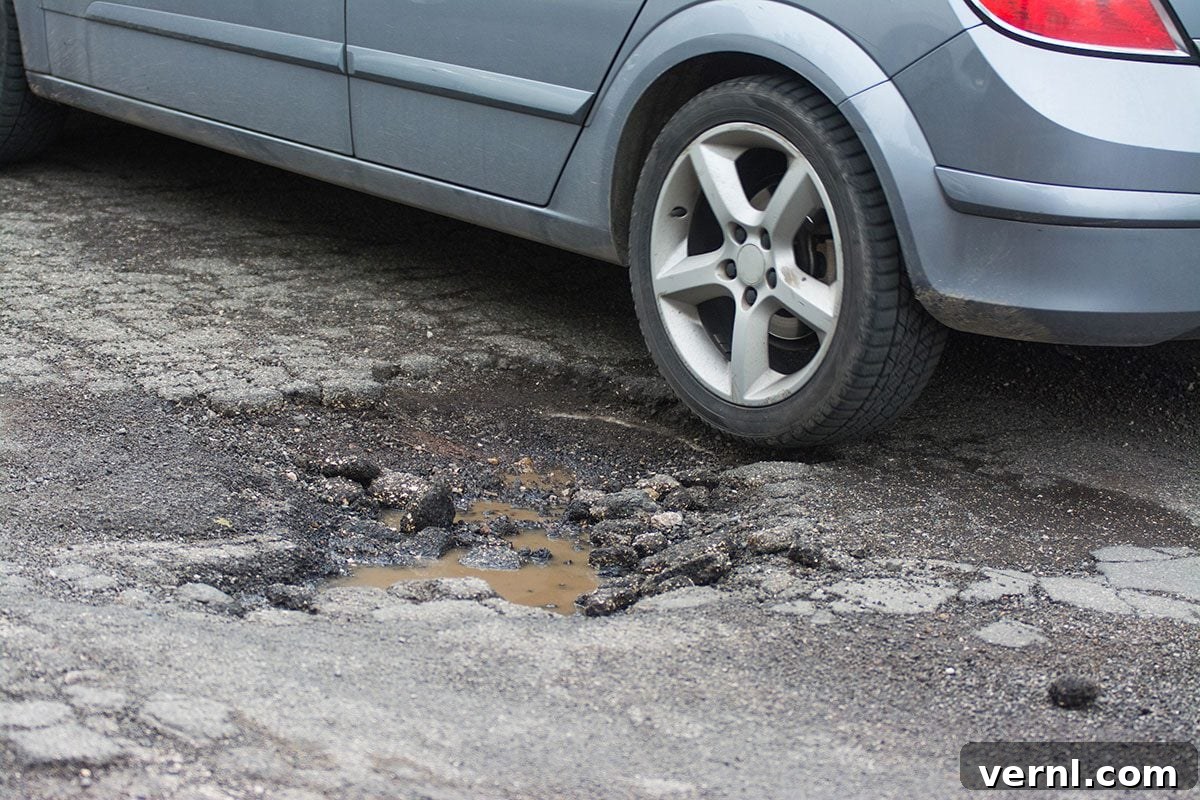
Navigating roads, especially in regions prone to severe weather conditions like Pennsylvania, often means encountering brutal potholes. These aren’t just minor road imperfections; they are insidious hazards that can inflict significant, often hidden, damage to your vehicle. While a visible flat tire or bent rim is an obvious sign, the true danger lies beneath the surface, silently compromising critical components such as your steering, suspension, wheel bearings, and axles. A sudden clunking noise after hitting a pothole isn’t just an annoyance—it’s your car’s urgent warning that something vital is amiss.
With over five decades of experience as a Master ASE and General Motors auto technician, I’ve personally witnessed and repaired the devastating aftermath of countless pothole encounters. This includes replacing thousands of tires, drive axles, constant velocity (CV) joints, and virtually every conceivable steering and suspension component. The scale of this problem is staggering; in 2022 alone, an estimated 44 million drivers incurred costs from pothole-related vehicle damage, highlighting a pervasive and expensive issue for motorists nationwide.
In this comprehensive guide, a seasoned master technician and an automotive parts recycling expert will share invaluable insights. We’ll meticulously detail the specific noises to listen for, offer practical do-it-yourself checks you can perform, and provide essential advice to enhance your vehicle’s safety. Our goal is to empower you to identify and address potential problems early, significantly reducing the risk of catastrophic—and costly—mechanical failures stemming from the impact of treacherous potholes.
The Damaging Impact of Winter Potholes on Vehicle Integrity
The relentless cycle of winter weather is the primary architect of potholes. When water seeps into the microscopic pores and cracks within asphalt, it becomes trapped. As temperatures plummet, this water freezes and expands, exerting immense pressure on the surrounding road material. When temperatures rise, the ice melts, leaving voids. This repeated freeze-thaw process causes the asphalt to heave, contract, deform, and ultimately break apart, creating the familiar craters we dread.
Driving over these depressions, especially at speed, subjects your vehicle to an instantaneous and violent shock. This impact can forcibly push critical steering and suspension components, or even the robust CV axles, well beyond their engineered tolerances. Imagine a control arm, a sturdy link connecting your wheel assembly to the vehicle frame, bending even a fraction of an inch from such a jolt. This seemingly minor deformation can severely disrupt your car’s delicate alignment angles, causing premature and uneven tire wear, compromised handling, and placing immense additional stress on tires, axles, and particularly the wheel bearings.
Compounding this issue is the effect of cold temperatures on rubber components. As rubber stiffens in frigid conditions, tires lose some of their inherent ability to absorb the energy of an impact. This means a greater proportion of the pothole’s force is directly transferred to your car’s suspension system. As ASE and Toyota Master Technician Joe Simes explains, “Rubber shrinks when cold and can place excess pressure on metal parts they are trying to isolate from other metal parts.” Furthermore, the pervasive presence of mud, dirt, and highly corrosive road salt exacerbates any pre-existing weaknesses, such as a compromised CV boot. This combination creates a perfect storm, accelerating wear and significantly increasing the likelihood of critical component failure.
Crucial Car Noises and Signs You Must Never Ignore
Modern vehicles produce a symphony of sounds, particularly during the biting cold of January and February. Many of these are normal operational noises that dissipate as your car warms up. However, there are specific sounds that demand immediate attention, especially if they manifest after you’ve encountered a pothole. Disregarding these warnings can lead to serious safety hazards and expensive repairs.
- Clunking Sounds: If you hear a distinctive clunking noise when driving straight over bumps, speed humps, or entering a raised driveway, it often points to issues within your suspension or steering system. This could indicate damaged, excessively worn, or bent bushings (your car contains dozens of these vital rubber isolators), compromised ball joints, loose or worn tie-rod ends, failing MacPherson struts, or deteriorated shock absorbers. The impact can distort these parts or loosen their mounting points.
- Metallic Knocking or Slapping: A sharp, metallic knock or slapping sound that occurs upon wheel rebound (when the wheel returns to its normal position after hitting a dip or bump) suggests a more severe issue. Potential culprits include a failed MacPherson strut mount, a cracked or fractured coil spring, a degraded coil spring insulator, a bent sway bar or stabilizer link, a cracked anti-roll bar, or a leaking hydraulic damper (shock absorber). These sounds indicate metal-on-metal contact where there shouldn’t be any.
- Deep Thud with Steering Pull: A pronounced deep thud, particularly when accompanied by an immediate and noticeable pull in the steering, is a critical warning. This symptom strongly suggests a bent wheel rim or a loose or shifted sub-frame—the structural component that supports the engine and suspension. Any change in steering behavior after an impact warrants immediate attention.
- Clicking, Grinding, or Popping (Especially When Turning): These specific noises, particularly noticeable when turning or maneuvering at low speeds, are classic indicators of a damaged or worn-out Constant Velocity (CV) joint. Often, the protective CV boot has torn, allowing all the essential lubricating grease to escape and road contaminants to enter, leading to rapid wear. A worn or failing wheel bearing can also produce similar clicking or grinding sounds, especially during turns as lateral loads change.
- Rhythmic Thumping: A consistent, rhythmic thumping sound can be caused by a broken tire belt—an internal structural component of the tire—leading to a bulge or flat spot that thumps with each rotation. Alternatively, it can signal a failing wheel bearing. Simes adds, “A continuous humming, whining or droning coming from your wheels while driving, particularly when cornering, and increasing in intensity with speed, is almost always caused by a bad wheel bearing.” This is due to internal wear creating friction and vibration.
Understanding What a “Clunking” Sound Truly Implies
When your car produces a distinct “clunking” noise, it’s generally indicative of one of two fundamental issues within your vehicle’s mechanics. The first scenario is that two components, which are designed to operate independently and be isolated from one another, are making unintended contact due to displacement or wear. The second, equally concerning scenario, is that a single component has developed excessive free play, causing it to shift or move beyond its design limits during operation.
Consider, for instance, a worn or missing sway bar bushing. This crucial rubber component is designed to absorb vibrations and prevent metal-on-metal contact. If it deteriorates or falls out, the sway bar itself can “clunk” directly against its mounting bracket and the car’s chassis. This becomes particularly noticeable during acceleration, braking, or when navigating uneven road surfaces. As my colleague Karuna Eberl sagely notes, “One thing’s for sure, if you have a suspension noise that suddenly disappears, there’s a good chance the component is broken and disconnected from the rest of your car.” This cessation of noise isn’t relief; it’s a red flag indicating complete structural failure.
The Perilous Path: Why Ignoring Noise Leads to Axle or Bearing Hub Failure
As Joe Simes pointed out, a persistent humming, whining, or droning noise emanating from your vehicle signals a critical underlying problem: a component on or within your car is loose, worn, weakened, or damaged. Axle bearings, wheel hubs, and CV joints are precision-engineered to spin with minimal friction and should exhibit absolutely “zero” side-to-side movement. In modern front-wheel and four-wheel-drive vehicles, wheel bearings are intricate assemblies of meticulously machined, hardened steel ball bearings or straight roller bearings (cylindrical in shape). These balls or rollers are precisely encased within a “cage” that supports them, allowing them to rotate freely and smoothly.
A forceful impact from a pothole can cause devastating internal damage to these sensitive components. It can dent or crack the bearing race—the hardened surface on which the bearings roll—or flatten a bearing roller. As the wheel rotates, this damaged area repeatedly hits the dent or crack, or the flattened spot grinds against the race. This continuous friction and impact cause accelerated wear. With every rotation, microscopic flakes or chips of metal shear off the surfaces of the race or rollers, intensifying the bearing play and creating those characteristic rhythmic growls or hums. This increased play (excessive movement) leads to significant hub bearing wobble and noticeable vibration, which in turn causes abnormal wear on the axle splines.
Once a bearing develops even a minimal amount of play, the wheel hub can no longer maintain the axle in a perfectly centered position. This compromises the vehicle’s stability, causing your car’s steering and braking to become erratic, often pulling noticeably to one side. The internal friction will generate increasing temperatures as the bearing progressively fails. This extreme heat can lead to the crucial axle or CV joint grease leaking out, breaking down, or losing its lubricating properties. Elevated temperatures can also warp the hub assembly itself, damage the CV joint, and potentially trigger a cascade of secondary failures. This all culminates in a severe risk: the hub bearing could completely disintegrate, leading to the unthinkable scenario of the wheel detaching from your vehicle while driving, with catastrophic consequences.
Essential Quick Checks You Can Perform for Pothole Damage
After encountering a significant pothole, it’s crucial to perform some basic checks to assess for immediate damage. These simple inspections, recommended by experts, can provide vital clues to your car’s health and prevent minor issues from escalating. Kazimieras Urbonas, an automotive expert at the prominent automotive part recycler Ovoko, suggests a straightforward auditory test: “Go over a speed bump with the radio off and windows down. Hearing a dull ‘thud’ is normal, but a sharp, metallic ‘clunk’ or a distinct rattling sound can be the first clear sign of significant pothole damage.”
Beyond listening, visual and physical checks are paramount. Test your shocks and MacPherson struts by firmly pushing down (known as “jouncing”) on each corner of the bumper two or three times. A healthy suspension system should allow your vehicle to settle back to rest after just one rebound. If your car continues to bounce excessively, if you hear knocking noises during this test, or if you observe any fluid leaking from a shock absorber or strut, it’s a clear indication that these components need immediate replacement. Defective shocks and struts dramatically increase your stopping distance and make your car dangerously unstable, especially on slippery or icy roads. As Simes warns, “Wheel bearing noise can also mimic engine noise,” underscoring the importance of careful diagnosis.
Simes further advises, particularly if your car is equipped with a tachometer or RPM gauge, to perform an engine-vs-wheel noise differentiation test. “Watch the RPM gauge as it increases when accelerating. Then, take your foot off the accelerator and carefully listen as the RPMs drop. If the noise persists or is still present as the engine speed decreases, it’s highly probable that the sound is originating from a wheel, axle, hub, or bearing assembly, rather than the engine itself.” Finally, always make a habit to visually inspect the underside of your car, particularly around the suspected source of any new noise. Look for shiny spots indicating recent rubbing, rust stains where components might have been stressed or bent, or worn paint marks on parts that are now making unintended contact due to looseness, damage, or deformation.
Understanding When It’s Safe to Drive and When to Pull Over Immediately
After your vehicle has taken a hit from a pothole, it’s imperative to assess its driveability safely. Once you’ve navigated to a straight, flat stretch of road and it’s safe to do so, briefly loosen your grip on the steering wheel and then gently apply the brake pedal. Observe your vehicle’s response. Kazimieras Urbonas offers critical advice: “Pullover and call for a tow of your car immediately if the steering wheel is no longer ‘centered,’ if your vehicle pulls or drifts [especially if erratically] to one side while moving, or exhibits unstable behavior during braking. These are strong indicators that something significant has been bent or severely damaged from the impact. In such cases, it is simply not safe to drive.” Ignoring these signs can lead to a loss of control, putting yourself and others at severe risk.
Proactive Strategies for Preventing Pothole Damage
The most effective defense against the costly and dangerous consequences of pothole damage is proactive prevention. Prioritizing cautious driving habits and regular vehicle maintenance can significantly mitigate risks. The simplest yet most impactful strategies include slowing down considerably before hitting a pothole, maintaining a safe distance from curbs where potholes often accumulate, and safely maneuvering around visible road hazards whenever possible. If you encounter what appears to be a puddle of standing water, always treat it with extreme caution; it could very well be an obscured, deep crater—an “eight-inch monster” as I’ve encountered on more than one occasion—capable of causing severe impact damage to your suspension components.
Joe Simes emphasizes the crucial role of proper tire maintenance: “Maintaining correct tire pressure is one of the most effective ways to cushion your vehicle against pothole impacts and prevent costly damage.” Properly inflated tires provide optimal shock absorption, distributing the impact force more effectively. He further advises, “Visually inspect your tires regularly for abnormal wear patterns, bulges, or cuts, and pay attention to any squeaking noises when turning. Never ignore new or unusual noises that weren’t present before hitting a pothole.” It’s also vital to understand that if you cannot entirely avoid a pothole, abruptly slamming on the brakes just before impact can actually worsen the damage. This action shifts the vehicle’s weight aggressively to the front wheels, increasing the impact force on the front suspension and tires, thereby elevating the possibility of more severe structural damage.
Once the harsh winter season has passed, schedule a comprehensive vehicle inspection with your trusted mechanic. This should include a full suspension alignment check, wheel balancing, and a thorough visual inspection of the undercarriage for any signs of damage or stress. As Urbonas succinctly puts it, “Taking your car in for repairs before things get worse is the best thing you can do to help keep a simple repair from turning into a major expense.” Early detection and intervention are key to safeguarding your vehicle and your wallet.
Frequently Asked Questions (FAQs)
How much does it cost to replace an axle or wheel hub bearing?
The average cost to replace a sealed wheel hub bearing can vary significantly, typically ranging around $350 per wheel. However, this is merely an average. Depending on your vehicle’s specific make and model, the prevailing shop labor rates (which can range from $47 to over $215 per hour, according to AAA), and any additional damage incurred, the total cost per wheel could easily exceed $1,000. For some less complex vehicles, the cost might be under $100 per wheel if you consider parts only. You can save hundreds of dollars on labor by performing the replacement yourself if you have the necessary mechanical skills. Most reputable auto parts stores offer loaner specialty tools and equipment, making DIY repairs more accessible for the determined enthusiast.
What other types of damage can hitting a pothole cause?
Beyond the obvious damage to tires, wheels, and core steering, suspension, and frame/chassis components, hitting a pothole can cause a multitude of less apparent, but equally problematic, issues. This includes bending or dislodging brake dust shields, or even twisting a brake caliper. Such damage can lead to symptoms like the brakes pulling to one side, locking up unexpectedly, overheating, or wearing prematurely. Furthermore, the violent shock can impact sensitive electronic systems and various sensors throughout the vehicle. This includes crucial components like ABS (Anti-lock Braking System) sensors, ride height sensors, stability control sensors, or TPMS (Tire Pressure Monitoring System) sensors. Damage to any of these sophisticated components will almost certainly trigger a warning light on your dashboard, indicating a fault that requires professional diagnosis and repair.
Expert Insights
- Joe Simes boasts over 25 years of extensive experience in the automotive industry. He is an accomplished ASE and Toyota Master Technician, a Pennsylvania Department of Education certified automotive technology instructor, and a PA certified emissions and safety inspection instructor and inspector. Joe currently serves as an automotive technology instructor at the North Montco Technical Career Center in Lansdale, PA. He also held the distinguished positions of former deputy fire chief and training officer for Montgomery County, PA, prior to his retirement from that role. (Interview conducted on March 6, 2026)
- Kazimieras Urbonas is a recognized motoring expert and the Supplier Excellence Manager at Ovoko, one of the world’s largest digital marketplaces specializing in used (recycled) auto parts. His expertise lies in vehicle mechanics and the nuances of wear-and-tear. He is dedicated to helping drivers comprehend the damage inflicted by challenging road conditions and effectively identify reliable replacement components. (Electronic communications exchanged on March 6, 2026)
Sources
- AAA: “Car Repair Labor Rates Explained” Mar 5, 2026
- AAA: “Drivers, Beware: Potholes Pop Up Early This Year” Mar 3, 2026
- FOX Weather: ”Spring pothole season is here: Steps to avoid that tiring annual headache” Mar 5, 2026
- Jim DeLeo, Northeast Division Manager for Hunter Engineering Company Interview Mar 6, 2026
- Look Up A Plate: “8 Alarming Pothole Statistics Every American Needs to Know” Jan 15, 2026
- State Farm: “When potholes become costly” Mar 5, 2026
- The Hartford: “Potholes: The Sneaky Road Hazards That Can Really Leave a Dent in Your Day” Mar 5, 2026
RELATED:
- Do You Know What That Little Button on Your Seat Belt Is For?
- What Those Lines on Your Backup Camera Really Tell You
- Here’s What The Small Panel On Your Car’s Front Bumper Is For