
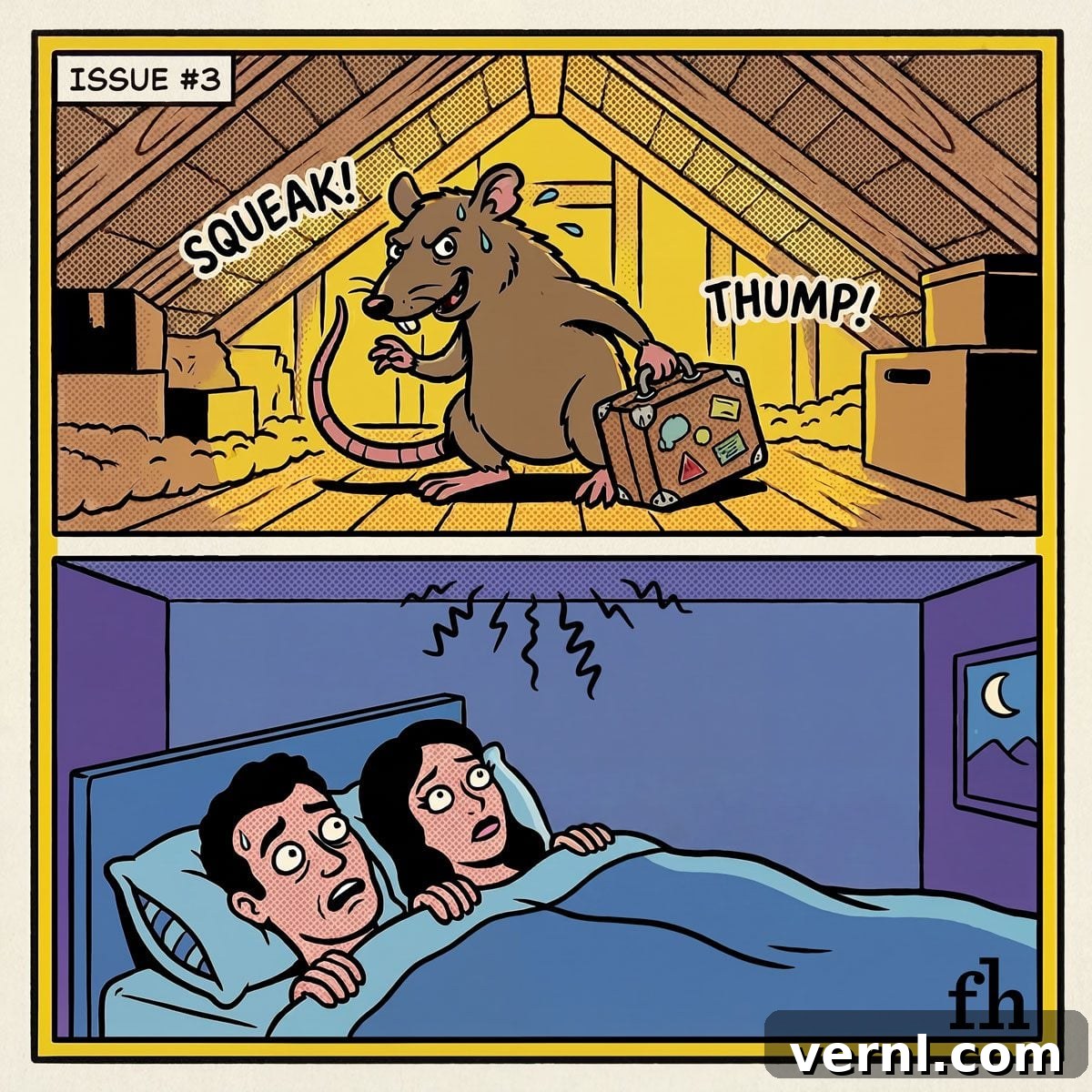
Welcome to Domestic Disasters, where we examine some of the worst home mess-ups and most unpleasant discoveries. We bring those situations to pest-control experts to determine how serious the problems are and what it takes to fix them.
Lindsay and her husband lived on a half-acre property in the Colorado countryside surrounded by fruit trees, wide-open spaces and views of snowcapped mountains. For a while it was idyllic — until the scratching began.
Every night around 3 a.m., abrasive rodent noises in the wall woke them. At first they tried to ignore it, but sleepless nights made the sounds impossible to tolerate. “Whoever he was, he wasn’t being a very good roommate,” Lindsay says. “We had to kick him out.”
What She Tried
Lindsay had previously hired a pest control professional to handle mice. After watching him use wooden snap traps baited with peanut butter successfully, she decided to try the same approach herself for the nighttime intruder.
“I don’t love the idea of killing anything, but I also realized there was no way to cohabitate with it,” she says.
She placed traps in the crawlspace. After a week and a lot of peanut butter, she hadn’t caught anything. “This rodent was smarter than the average mouse,” she says. “He would trip the traps without getting caught.”
Wondering if the animal might be larger than a mouse, she upgraded to a bigger trap. At 2 a.m. that night they heard a definitive snap. When they opened the crawlspace they found a rat.
“It was a big boy, and TMI, that was a messy cleanup,” she says. “But I was able to sleep through the night again.”
Her home has remained rat-free since. But did she handle it the right way?
A Pro Weighs In
We consulted experts to assess Lindsay’s approach and to explain how to prevent rats from entering a home. Rodents are attracted to houses for the same reasons people are, says rat control expert Blair Calder: warmth, dryness, food and protection from predators.
They can gain access through small openings, such as unsealed holes around drainpipes and foundation cracks. Inside, they’re more than a nuisance — they can damage structures and threaten health. Their constant gnawing can harm wood, drywall, vapor barriers and wiring, potentially causing electrical fires, leaks and mold. Rodents can also carry diseases and their droppings may trigger allergies.
“Even if you never see that rat, the problem is still big and requires immediate action,” says pest control expert Nicole Carpenter. “One rat eventually turns into multiple rats if you don’t find where they get in and seal it.”
Did the Homeowners Get it Right?
Largely yes. Lindsay’s main mistake — which she corrected — was using traps that were too small. Rats can remove bait from mouse-sized traps without triggering them and may be injured rather than killed, causing unnecessary suffering. When you’re unsure of the animal’s size, start with a larger trap, Carpenter advises.
Peanut butter is an effective bait, but for clever or curious rats, small pieces of nesting material or a bit of bacon can be even more tempting, notes pest control expert Kyle Turner.
What’s the Most Humane Option?
Live catch-and-release traps are effective for animals of all sizes; however, they must be released several miles away to prevent their return. Ecological considerations matter: many rats in homes are invasive Norway or black rats that harm ecosystems, while native woodrats (packrats) are better candidates for relocation.
Experts say snap traps, when properly sized, are also humane because they are designed to deliver a quick dispatch. “I know it looks brutal, but the snap traps are intended for a quick, painless dispatch,” says Matt Smith. “I’d suggest either the live trap or the snap, depending on the outcome you want.”
Glue boards and poisons are discouraged. “Glue traps are so cruel that in many countries they are illegal,” Calder says. Rodenticides are inhumane and pose risks to children, pets, wildlife and livestock, and their broad ecological impacts are only now becoming clearer.
How The Pros Would Handle It
Professionals begin with a thorough inspection to find and seal potential entry points — a process called exclusion. “That is the actual fix,” Turner says. “Trapping without closing the entry just means you’re catching one at a time indefinitely.”
Pros also typically set multiple traps to speed capture rather than relying on just one.
The Panic Meter

We rank Domestic Disasters on a four-point scale:
- Do It Yourself: The easiest issues to fix on your own.
- Phone a Friend: May need a little outside help.
- Call a Pro: Warrant professional help.
- SOS: Immediate danger of injury or worse.
When handled early, rodent issues often fall in the “Do It Yourself” category. “With a few high-quality traps of the right size, and sealing entry points, you can absolutely handle the situation yourself,” Carpenter says.
Consider calling a professional if you can’t access the rodents’ travel areas, can’t locate entry points, or are uncomfortable managing traps or carcass cleanup. “Some people will almost move at the thought of rodents being in their walls,” Smith says, “while others will keep trying themselves.”
The Cost Differential

An early DIY response — traps and sealing materials — typically runs $20 to $100. Hiring a professional usually costs around $300. If ignored, however, damage can escalate to expensive repairs: rewiring, insulation replacement, odor removal, cleanup, drywall repair and sealing, potentially costing hundreds or thousands of dollars.
The Right Way to Fix Rodent Problems
If you detect signs of rodent activity — droppings, chew marks, or scraping sounds in walls — act quickly. Lindsay’s persistence limited the damage in her case, but there are clear best practices.
Find and Seal Entry Points
Before trapping, inspect for openings such as foundation cracks, gaps in rooflines, spaces under doors, crawl space vents and holes around utility pipes. A mouse needs an opening the size of a dime, and larger rats can squeeze through half-inch gaps. Sealing smaller holes also reduces insects and spiders.
Use steel wool or hardware cloth combined with exterior-grade caulk or expanding foam to close openings. “You can’t use only caulk or foam because mice and rats can chew through anything besides metal,” Carpenter warns.
Choose the Right Trap
Snap traps are inexpensive and effective when sized correctly but can result in messy cleanups. Rat-specific snap traps are widely available; take care to place them away from children, pets and wildlife. Enclosed traps cost more but reduce visual exposure and the chance of non-target animals accessing the device. Some enclosed options kill with a snap bar, others use electricity or air-powered mechanisms.
Place Traps Wisely
Set multiple traps along walls or where you see droppings, because one trap is rarely enough to achieve a quick result. Multiple traps increase the chances of a swift resolution.
How to Prevent Rodents From Getting in Your Home
Understanding rodent behavior helps prevent infestations. Rats and mice seek shelter, food and water. In addition to sealing entry points, reduce their access to attractants: store pet food in sealed containers, keep counters and floors crumb-free, use tight-fitting lids on garbage cans and declutter living spaces so rodents have fewer hiding spots.
“The more stuff you have around, the more places they can hide,” Smith says. “They hate being out in the open where they feel vulnerable.”
What the Homeowner Learned
Lindsay proved she could solve the problem herself, but in hindsight she sees ways she could have been more efficient. “Don’t keep trying something that’s not working,” she advises. “If the one thing you know how to do isn’t working, research a better solution or call an expert sooner.”
Smith adds, “Ultimately, she did take care of the problem. One thing didn’t work, so she tried another. She kept after it.”
Do you have a Domestic Disaster experience you’d like featured on Family Handyman? Email us your experience at [email protected].
About the Experts
- Matt Smith has 15 years in the pest control industry and co-founded Green Pest Management in 2014, serving Delaware, Pennsylvania, New Jersey, Maryland and Tennessee.
- Blair Calder is a nationally recognized rat control expert with over 15 years’ experience and is president of Automatic Trap Company in Sonoma, California.
- Nicole Carpenter has decades of hands-on pest control experience and is president at Black Pest Prevention, based in Charlotte, North Carolina.
- Kyle Turner is the founder, president and CEO of Pro Active Pest Control, serving Sacramento and the Bay Area.