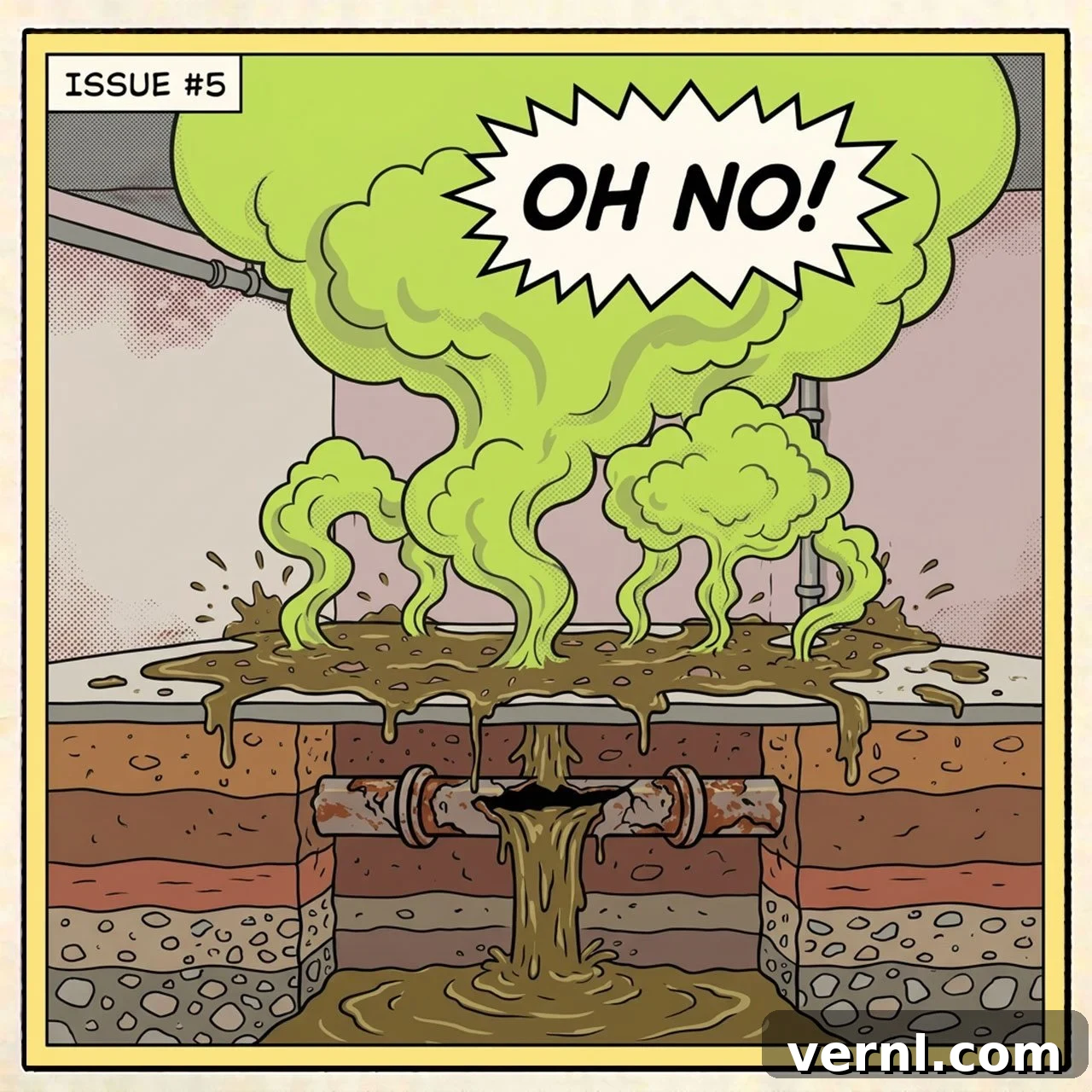
Welcome to Domestic Disasters, where we examine homeowners’ worst mess-ups and grossest finds. We take those situations to the experts to determine how severe the problem is and how costly the repairs will be.
Last year, Lori and her husband Dirk were on vacation in Paris when Lori’s brother called to say sewage had backed up into their basement. “Fortunately, I paid for my cellphone to work in France, so that was a good thing,” she said with a laugh. Unfortunately, the good news ended there. Their cast iron pipes had rusted and collapsed. Every sewer line section needed replacement, requiring removal of most of the basement concrete and excavation in the yard.
What They Tried
The first plumber never showed. By the time the second arrived, Lori was back from vacation. That plumber assumed a blockage and tried to blast water through the lines, which didn’t help. The third company brought a camera but found it too dark to see clearly and started digging.
“We knew it was bad when you could hear the workers using expletives and saying things like, ‘Take a photo of this, so-and-so will never believe it,’” Dirk recalled. “When you hear that, you know it’s never going to be a good outcome.”
A few months and roughly $20,000 later, Lori and Dirk had new PVC sewer lines, a new concrete basement floor, and a yard that had been ripped up by the excavator. Their lives were almost back to normal — except for their savings account and the damaged shade garden.
This wasn’t a DIY situation. Hiring professionals was the right choice. But could the homeowners have prevented the collapse? And did the pros handle the problem correctly?
A Pro Explains What Went Wrong
Until PVC became common in the mid-1970s, cast iron was the typical material for household wastewater pipes. Over decades, hydrogen sulfide and other sewer gases convert to sulfuric acid, which eats away the pipe from the inside. Acidic soil can corrode the exterior as well. Over time a pipe wall that began at a quarter-inch thickness can become severely weakened and effectively hollowed out.
“The day that something disturbs it or the last of the wall lets go, it doesn’t crack, it collapses,” says Mark Kay, editor of SepticTankHub. “Saying it ‘crumbled’ isn’t just dramatic — it’s the textbook definition.”
Pipes in homes with septic systems tend to fail sooner because septic effluent creates a particularly hydrogen-sulfide–rich environment that accelerates internal corrosion.
Did the Homeowners Do the Right Things?
Yes, after the collapse. Replacing the entire run rather than patching a single failed section was the correct decision. Temporarily moving out for cleanup and repairs was also reasonable, since sewage in living spaces poses health risks.
However, Lori and Dirk could have reduced cost and stress with earlier inspections. A camera inspection costing a few hundred dollars in the years before the failure might have detected advanced corrosion while repairs were simpler and cheaper. Early detection also allows homeowners to obtain multiple bids and schedule work at a convenient time.
Did the Pros Handle It Properly?
Mixed. The first plumber’s assumption of a simple blockage and the attempt to force water through the line was not ideal for an older, cast iron system. The safer first step is a diagnostic camera inspection to determine whether the issue is corrosion, blockage, or root intrusion. From that diagnosis, the plumber can recommend the least disruptive, effective repair.
In Lori and Dirk’s case, full replacement was unavoidable. But if deterioration is caught sooner, options such as professional descaling, spot repairs, or trenchless pipe lining can sometimes avoid open excavation.
The Panic Meter

We rank Domestic Disasters on a four-point scale:
- Do It Yourself: Simple fixes you can handle.
- Phone a Friend: Minor assistance needed.
- Call a Pro: Professional help required — this is where corroded cast iron pipes fall.
- SOS: Immediate danger or serious risk to health.
Sewage backups can damage walls, flooring, insulation, personal belongings and structural components if left unchecked. The sooner a professional is called, the better the chance of limiting damage and cost.
The Cost Differential
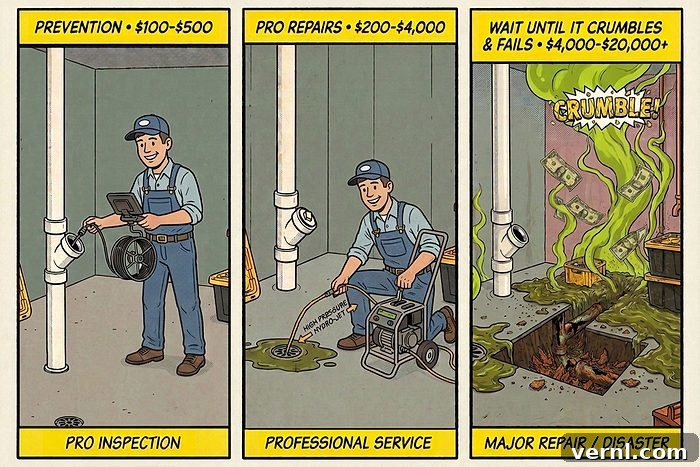
Early detection matters for cost control. A sewer camera inspection typically costs $100 to $500, and some plumbers will credit that amount toward repair work. If camera inspection reveals scale but otherwise sound walls, professional descaling or hydro-jetting (roughly $200 to $800) can extend pipe life.
Spot repairs caught early may run $1,000 to $4,000. Trenchless lining is another less-invasive option, often $80 to $250 per foot. Complete excavation and replacement — as in Lori and Dirk’s case — typically ranges from $4,000 to $25,000 for the pipe work, with additional costs for sewage cleanup and mold remediation. Standard homeowners insurance usually excludes this damage, though optional endorsements for sewer service line and water backup coverage can often be added for $30 to $100 per year.
“This family’s $20,000 under-slab demolition, yard excavation to the septic tank and new pipe and concrete is right in the honest middle of the range,” says Kay. “Painful, but they probably weren’t gouged.”
How to Prevent Crumbling Cast Iron Pipes
Homes built before the mid-1970s commonly have cast iron drains, and many such systems are now reaching the end of their practical lives. The good news is that this is largely preventable with routine inspections and maintenance.
- Schedule a professional camera inspection every few years, even if drains seem fine. If buying an older home, request a sewer scope as part of due diligence.
- Watch for warning signs: multiple drains backing up, recurring clogs, gurgling toilets, muddy spots in the yard, or sewage smells in the basement.
- If the cast iron is still serviceable, get it professionally descaled every two to three years by someone experienced with older pipes.
- Avoid chemical drain cleaners; use enzyme products or a drain snake instead. Persistent backups often indicate a larger problem.
- For homes with septic tanks, pump the tank every three to five years.
- Consider insurance endorsements for sewer service line and water backup coverage.
- When away for extended periods, shut off the main water and consider a leak sensor near the lowest drain.
- Be aware of factors that shorten pipe life: coastal salt, acidic soil, a high water table, and nearby mature tree roots.
- Only flush human waste and toilet paper. Never flush wipes labeled “flushable.”
- If a backup occurs, shut off the house water immediately to reduce sewage entering the system.
- Get two or three repair bids, including a trenchless specialist if applicable.
“Don’t panic if you own a home built before 1975 — just scope that line,” advises a plumbing expert. Drain lines rarely fail without years of warning.
What the Homeowner Learned
Lori’s main takeaway was to expect the unexpected with homeownership. She now understands her policy limits better and recommends maintaining an emergency fund. “A house is big, and there’s a lot of things that can go wrong,” she said. “Make sure you have an emergency fund, because unfortunately something like this can happen when you least expect it.”
About the Experts
- Mark Kay is the founder and editor of SepticTankHub, which helps homeowners find and compare septic and wastewater professionals and provides guides on sewer line problems and maintenance.
- Alfred Pintor is a home maintenance expert and founder of Copper Collar Services, a plumbing and disaster response company.
- Joseph Wade is VP of Operations at Benjamin Franklin Plumbing.
Do you have a Domestic Disaster experience you’d like featured? Email your story to [email protected].