
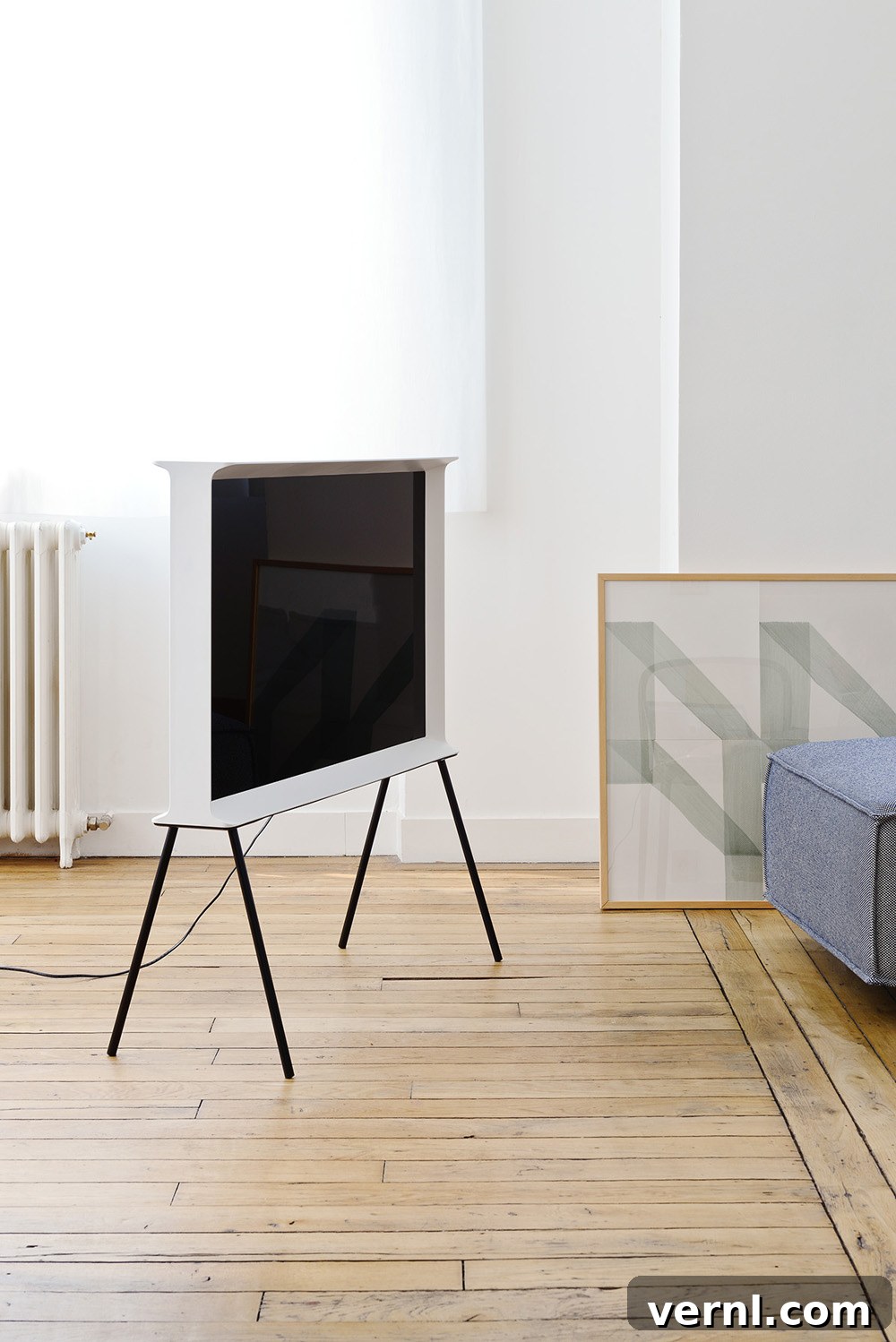
Last week I was invited to an event at the elegant neo-classical River Rooms in Somerset House for the UK launch of the Serif TV. The product represents the end point of a two-year collaboration between the Bouroullec brothers and Samsung. Rather than following the familiar path of ever-thinner, feature-first televisions, the Serif takes a different approach: it is conceived as an object that belongs in the home, a piece of furniture as much as it is a piece of technology. The choice to launch during the London Design Festival, and in a venue steeped in architectural and cultural history rather than at a consumer electronics trade show, underlined the intent to position this television within the world of design and interior objects.
Ronan and Erwan Bouroullec attended the launch and spoke about their creative process, sharing early sketches, prototypes and mock-ups alongside the finished product. Their enthusiasm for the final design was obvious. The display included several sizes and colourways, showing how the same design language scales and adapts to different spaces. Seeing the progression from concept to production offered a clear view of the designers’ priorities: to make a device that feels intentional and considered in the context of a living room, rather than anonymous or purely functional.
The Serif’s contemporary silhouette stands out in a market dominated by plain black rectangles. Its profile intentionally diverges from that anonymous aesthetic and instead embraces presence and personality. The design invites homeowners to think of the television as integrated with their interior design, a deliberate object rather than something meant to be hidden away. One of the charming details is the way the profile resembles a capital “I” with serifs when viewed from the side, which is the origin of its name. This kind of naming feels refreshingly human compared with the alphanumeric model codes common in consumer electronics.
The back panel uses a tactile textile finish that both contrasts and complements the sleek front, reinforcing the idea of the television as part of a domestic palette rather than a standalone gadget. Optional screw-in legs let you place the set on the floor like a freestanding piece of furniture, offering flexibility to site the screen where it suits a room’s flow. These furniture-like options make it easier to imagine the Serif as an integrated element of living spaces, rather than an appliance that must be hidden or wall-mounted to be acceptable.
The Serif also reflects how our relationship with screens has shifted. Televisions are no longer limited to live broadcast viewing; they are hubs for apps, streaming services, social connections and gaming. Modern sets are expected to do much more than display programmes: they play music, run video calls, stream content on demand and interface with a growing ecosystem of connected services. The Serif acknowledges that role while attempting to present it with warmth and character. In other words, it is a smart TV that doesn’t try to disappear but instead becomes a considered element of the home.
Samsung has produced the Serif in three sizes to suit a variety of living spaces: a 40-inch model for larger rooms, a more compact 32-inch option, and the Serif Mini, a 24-inch version for tighter spaces or secondary rooms. Offering multiple sizes makes it easier for buyers to select a screen that fits both their visual needs and their interior layout. The launch schedule indicated availability from early November 2015, timed to coincide with the season when many people consider home upgrades.
Personally, the Serif is already on my wish list. Its combination of thoughtful design, material detail and practical functionality makes it an attractive alternative to the generic designs that have dominated television aesthetics. For anyone interested in a TV that contributes to the character of a room rather than simply occupying it, the Serif presents a compelling option.