
AI is often promoted as a fast, convenient tool that can answer questions and offer solutions. But there’s a critical limitation: it can’t always verify the facts it provides. So should you trust AI’s recommendations? Is it safe to act on them without checking? In AI vs Expert, we compare AI-generated guidance to advice from real cleaning professionals.
It happens to many pet owners: your dog or cat has an accident on the carpet and you need to act quickly. Most people know to blot fresh moisture, but removing stains and odors fully requires the right methods. We compared answers from two large language models to the guidance offered by cleaning experts to see what AI got right, what it missed, and which details are important for safe, effective stain removal.
What Does AI Say About Pet Stain Removal?
We queried two LLMs about pet stain removal: Google AI overview (Gemini) and ChatGPT. Their recommendations overlapped in places but differed in specifics and emphasis.
Google AI Overview
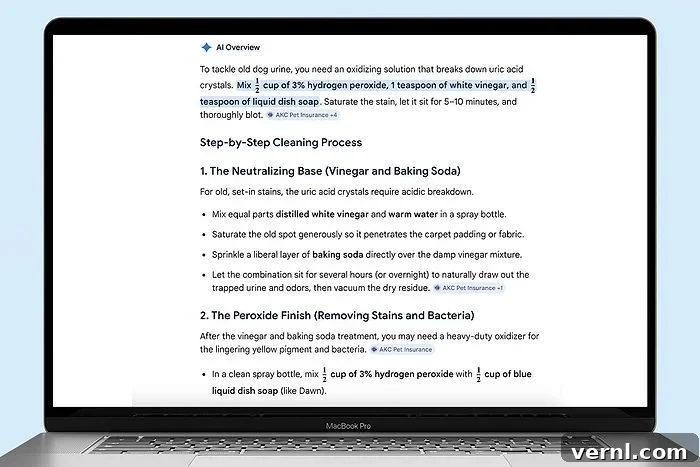
Gemini suggested several DIY recipes, including a mix reportedly sourced from a pet organization: “1/2 cup 3% hydrogen peroxide, 1 teaspoon white vinegar, 1/2 teaspoon liquid dish soap.” It recommended applying the solution, letting it sit for 5–10 minutes, then blotting. Expanded steps included alternative approaches such as spraying equal parts distilled white vinegar and warm water, covering the area with baking soda overnight, then vacuuming.
Another recipe it suggested combined hydrogen peroxide with blue liquid dish soap, instructing users to work the mixture into the affected fibers with a brush and blot dry. Gemini also warned against ammonia-based cleaners, noting that some sources say they can attract pets back to the same spot.
ChatGPT
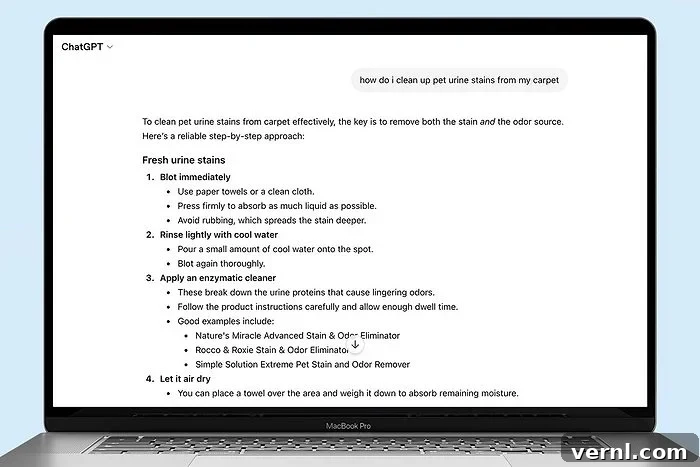
ChatGPT emphasized enzymatic cleaners as a primary solution for pet urine stains and recommended baking soda for odor control. It also suggested a simple mixture for discoloration: “1 cup white vinegar, 1 cup warm water, 2 teaspoons dish soap.” Beyond DIY recipes, ChatGPT listed commercial cleaning products and extraction machines, and likewise cautioned about ammonia-based cleaners drawing pets back to treated areas.
Initial Issues
While the AI recommendations are not necessarily hazardous, they are incomplete and in some cases inconsistent. For example, Gemini’s so-called sourced recipe appears to merge different instructions found on the referenced site rather than reproducing a single verified method. Neither model consistently warned against mixing chemicals like bleach and ammonia, which can produce dangerous gases.
Both assistants also promoted products or machines without adding useful, context-specific guidance. Listing equipment that a user could buy is not the same as explaining how to address the stain safely and effectively with the tools already at hand.
What Do the Experts Say About Pet Stain Removal?
We spoke with two cleaning professionals to compare their practical advice to the AI output. Both experts emphasized science-based approaches and included safety warnings the LLMs either missed or underemphasized.
Bruce Vance
Bruce Vance explained that the main issue with pet urine is uric acid, which oxidizes into uric salts and can change the chemistry of carpet fibers. He agreed that blotting fresh urine is the correct first step and that dish soap and water can help lift fresh stains, while white vinegar can be useful on older spots. However, he strongly warned against scrubbing. Scrubbing can “bloom” carpet fibers—damaging the twists and texture of the material and often requiring a patch to fix.
Vance prefers hydrogen peroxide–based cleaners for urine removal and notes that the common 3% solution found at drugstores is weaker than the 8–12% concentrations used professionally. For consumers, he recommends spotting agents that meet industry standards, and to avoid products that promise treatments like Teflon or Scotchgard if the stain hasn’t been fully removed—those coatings can seal a spot in place.
He also cautioned against using ammonia as a cleaning step because it’s another alkaline product that won’t neutralize urine, and he issued a clear warning never to use bleach on urine spots. Mixing bleach and ammonia or bleach and acids can create toxic gases and is a serious safety hazard.
Leslie Riechert
Leslie Riechert emphasized diluting and flushing fresh urine first. She recommends blotting with paper towels until dry and then rinsing with water repeatedly until discoloration is minimized. Riechert favors enzymatic cleaners because they target the bacteria and proteins in urine; when kept damp under a cloth, enzymes keep working to break down residues.
For older stains and odors she recommends white vinegar to help neutralize smells, followed by thorough rinsing. She also reserves hydrogen peroxide for stubborn stains but notes it may not remove all urine by itself. Like Vance, she strongly advised against ever using bleach on urine spots.
Key Takeaways
Cleaning pet stains is generally low risk compared with other household hazards, but the AI examples show important shortcomings: incomplete instructions, mixed or aggregated recipes, and missing safety warnings. In higher-stakes situations, these shortcomings could be worse. The experts provided clear, evidence-based explanations and included crucial safety guidance.
Chemical Safety
The most concerning gap was the failure of both LLMs to emphasize chemical safety and the dangers of mixing cleaners. Both experts quickly warned that bleach can react dangerously with ammonia and acids to produce toxic gases. Anyone relying solely on AI could overlook these basic but critical hazards.
Product Recommendations vs. Practical Guidance
AI often suggested products and machines for purchase, which risks turning advice into marketing rather than useful instruction. The experts described methods and principles without trying to sell specific items, and they explained why certain approaches work.
Completeness
Experts provided fuller explanations about how cleaners work, how to avoid damaging carpet fibers, and how to treat both fresh and old stains. The LLMs left out several safety warnings, mixed recipes, and failed to provide comprehensive steps for protecting carpet integrity.
About the Experts
- Bruce Vance is a cleaning expert with Town and Country Cleaning Services.
- Leslie Riechert is a cleaning expert and author of The Joy of Cleaning and runs the Green Cleaning Coach website.
Related
- How To Get Rid of Pet Hair in Your Home
- 5 Tips for Getting Dog Smell Out of Your House
- How To Clean a Dog Bed