
Beat the Heat: The Ultimate Guide to Dehumidifiers for a Comfortable Home
As summer relentlessly holds its grip, bringing with it sweltering heat waves, triple-digit temperatures, and oppressive humidity, many of us seek refuge indoors. Especially in regions like Texas, where the heat can dominate from dawn until dusk, the quest for a cool and comfortable home environment becomes a top priority. But even in less extreme climates, millions across the nation contend with the pervasive discomfort of high indoor humidity.
Your home should ideally serve as a sanctuary from this external heat and the accompanying humidity. However, if your living space is plagued by moisture problems, it likely feels far from a refuge. The sensation of heavy, moisture-laden air can make even simple daily tasks feel like a struggle. More critically, high humidity isn’t just a matter of discomfort; it actively contributes to detrimental issues such as rampant mold growth, dust mite proliferation, and can even inflict significant damage upon your home’s structural integrity, impacting elements like framing, drywall, and flooring.
Understanding Your Home’s Humidity Levels
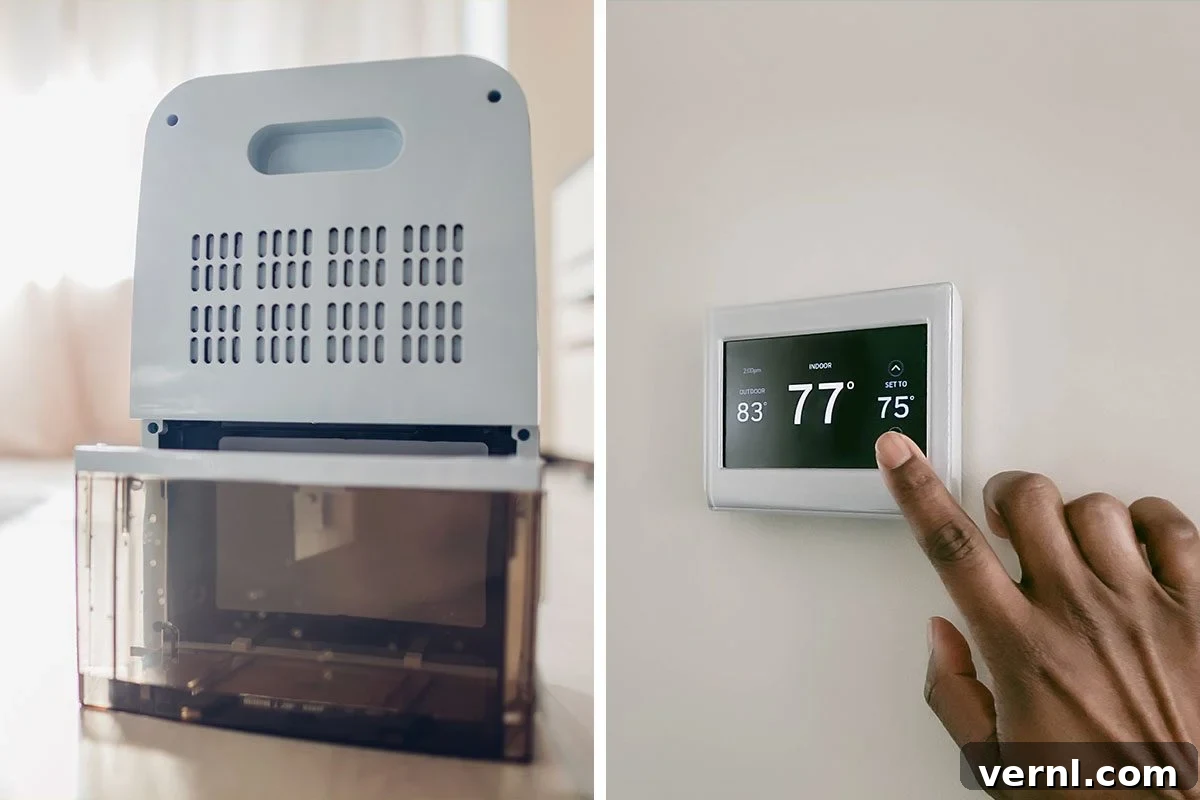
The first step towards creating a more comfortable and healthier home environment is to understand your current indoor humidity levels. Do you know where your home stands? If you’re fortunate enough to have a smart thermostat installed, discerning this information is often a straightforward process, as many models now integrate humidity sensors. For those without a smart thermostat, a simple and inexpensive device called a hygrometer can provide immediate and accurate readings. These handy gadgets are readily available and indispensable for monitoring your indoor climate.
Industry experts agree on an optimal range for indoor humidity. According to Brad Roberson, president of Aire Serv, a Neighborly company specializing in heating, cooling, and air quality solutions, “most people like the humidity level at around 30%.” While the ideal range for comfort and health generally falls between 30% and 50% relative humidity, levels significantly higher than this benchmark warrant attention. If your home’s humidity frequently exceeds 50%, it’s a clear indication that it’s time to consider investing in a dedicated moisture-removal solution, such as a dehumidifier. For smaller, confined spaces, even small dehumidifiers can make a substantial difference.
The Hidden Dangers of High Indoor Humidity
Beyond the immediate feeling of stickiness and general discomfort, elevated indoor humidity poses several serious threats to your health, home, and energy efficiency:
- Health Concerns: High humidity creates an ideal breeding ground for allergens and irritants. Mold and mildew thrive in moist environments, releasing spores that can trigger allergies, asthma attacks, and other respiratory issues. Dust mites, another common allergen, also flourish when humidity levels are consistently above 50%.
- Structural Damage: Persistent moisture can wreak havoc on your home’s structure and furnishings. Wood components like flooring, furniture, and structural beams can warp, crack, or even rot over time. Peeling paint, blistering wallpaper, and musty odors are common indicators of moisture problems. Sensitive electronics can also be damaged by excessive dampness, and metal fixtures may rust.
- Reduced Comfort and Productivity: Humid air feels heavier and warmer than dry air. This makes your living space less comfortable, interfering with sleep, concentration, and overall well-being.
- Increased Energy Costs: Your air conditioning system has to work harder to cool humid air because it must first remove the moisture before it can effectively lower the temperature. This increased workload translates directly into higher energy bills.
What Is a Dehumidifier? Your Ally Against Moisture
A dehumidifier is an indispensable appliance designed specifically to remove excess moisture from the air, thereby creating a more balanced, comfortable, and healthy indoor environment. By reducing relative humidity, these devices combat the negative effects of dampness, from preventing mold growth to enhancing personal comfort. While many air conditioners offer some level of dehumidification, a dedicated dehumidifier is far more efficient and effective at tackling significant moisture problems without overcooling your home.
Brad Roberson identifies three primary types of dehumidifiers, each suited for different applications and scales of moisture control:
- Whole-Home Dehumidifiers: These robust systems are designed for comprehensive moisture control across an entire house. Integrated directly into your existing HVAC system or operating with their own dedicated ductwork, whole-home dehumidifiers efficiently draw in humid air, extract moisture, and then distribute drier air throughout your entire living space. They offer the convenience of automation, often feature higher capacities, and generally operate more quietly as they are typically installed out of sight. They are an excellent long-term solution for consistent indoor humidity management.
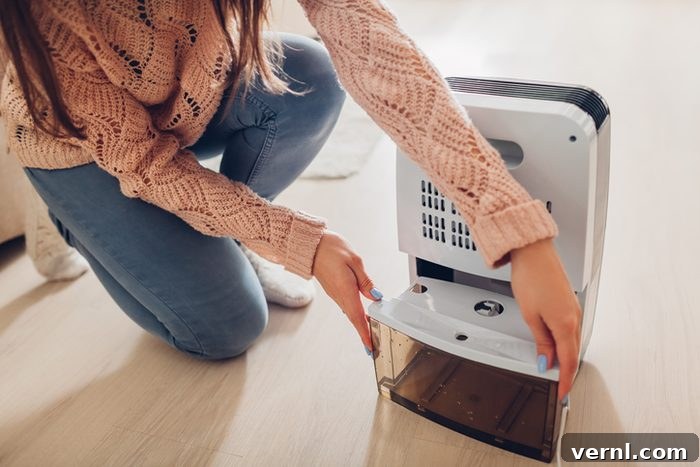
- Portable Dehumidifiers: As their name suggests, these are standalone units that can be moved from room to room as needed. Portable dehumidifiers are ideal for managing humidity in specific areas like damp basements, bedrooms, or laundry rooms. Unlike whole-home units which typically connect to a drain line for continuous water removal, most portable models collect the removed water in an internal reservoir or bucket that requires manual emptying. However, many models offer an option for continuous drainage via a hose, which can be a significant convenience. They come in various capacities, measured in pints of water removed per day, allowing you to choose a model appropriate for the size and dampness of your room.
- Desiccant Dehumidifiers: These specialized dehumidifiers operate using a different principle. Instead of cooling coils, they employ highly absorbent materials, such as silica gel or calcium chloride, to chemically bind to and remove water molecules from the air. Desiccant dehumidifiers are particularly effective in colder environments where traditional compressor-based dehumidifiers may struggle due to freezing coils. They are often utilized in small, enclosed spaces like closets, pantries, RVs, boats, or unheated basements where temperatures might drop below 60°F (15°C).
- Basement/Crawl Space Dehumidifiers: While often a type of portable or whole-home unit, these are specifically designed for the challenging conditions of basements and crawl spaces. They are typically more robust, built to handle higher humidity levels, and often feature low-temperature operation capabilities to prevent coil freezing in cooler underground environments. Many come with continuous drainage options and can be controlled remotely or via a digital humidistat for hands-off operation.
How Does a Dehumidifier Work? Delving into the Mechanics
The operational principle behind most standard (refrigerant or compressor-based) dehumidifiers is fascinatingly similar to that of an air conditioner, albeit with a different end goal. Here’s a breakdown of the process:
- Air Intake: A fan inside the dehumidifier draws warm, humid air from the room into the unit.
- Coil Cooling: This moist air passes over a set of cold coils, known as evaporator coils. These coils are kept extremely cold by a refrigerant circulated within them, much like the coils in a refrigerator.
- Condensation: As the warm, humid air comes into contact with the frigid surface of the evaporator coils, the moisture (water vapor) in the air rapidly condenses into liquid water droplets. This is the same principle that causes water droplets to form on the outside of a cold glass on a hot day.
- Water Collection: These condensed water droplets drip off the coils and are collected in an internal reservoir or bucket. For continuous operation, many dehumidifiers offer a drain line connection, allowing the water to be automatically routed to a floor drain or sump pump, eliminating the need for manual emptying.
- Air Reheating (Optional but Common): After losing its moisture, the now drier, cooler air typically passes over a second set of coils, known as condenser coils. These coils contain the warm, compressed refrigerant. The air is slightly reheated to approximately its original temperature before being expelled back into the room. This process ensures that the dehumidifier doesn’t significantly lower the room’s ambient temperature while still delivering dry air.
- Air Expulsion: Finally, the fan expels the warm, drier air back into the room, reducing the overall humidity level.
Desiccant dehumidifiers operate on a different mechanism. Instead of cooling coils, they utilize a rotating rotor impregnated with a desiccant material, like silica gel. Humid air passes through one section of the rotor, where the desiccant absorbs the moisture. Simultaneously, a separate stream of heated air passes through another section of the rotor, regenerating the desiccant by stripping away the absorbed moisture, which is then collected as liquid water or vented as vapor. These units are often favored in colder environments where standard compressor dehumidifiers might ice up.
Does a Dehumidifier Cool a Room? Clarifying a Common Misconception
This is a frequent question with a crucial answer: No, a dehumidifier does not function as an air conditioner and is not designed to actively lower the temperature of a room. As Brad Roberson aptly puts it, “A dehumidifier cannot cool down a room as it is not an air conditioner.” In fact, during their operation, most refrigerant-based dehumidifiers expel slightly warmer air due to the heat generated by their internal components, which can marginally increase the room’s temperature.
How Dehumidifiers Enhance Comfort and Aid Your AC
While dehumidifiers don’t directly cool the air, they play a vital role in making you feel significantly cooler and more comfortable, especially on hot and humid days. This enhanced comfort stems from two primary mechanisms:
- Improved Evaporative Cooling: Sweating is our body’s natural and incredibly efficient cooling mechanism. When sweat evaporates from our skin, it carries away heat, creating a cooling sensation. However, in high humidity, the air is already saturated with moisture, making it much harder for sweat to evaporate. By removing excess moisture from the air, a dehumidifier allows your sweat to evaporate more readily, enabling your body to cool itself more effectively. This physiological effect makes a room at 80°F (27°C) with 30% humidity feel far more comfortable than the same room at 80°F with 70% humidity.
- Reduced Load on Your Air Conditioner: Your air conditioning system performs a dual function: it cools the air and it removes moisture (dehumidifies). When the indoor air is excessively humid, your AC has to work harder on both fronts. It expends a significant amount of energy and effort first to condense and remove the moisture from the air before it can effectively lower the temperature. By running a dehumidifier, you pre-dry the air. This dramatically reduces the dehumidifying workload on your AC unit, allowing it to operate more efficiently and focus its energy primarily on cooling. The result is better overall cooling performance, reduced strain on your AC system, and potentially significant energy savings on your utility bills. You might even find you can set your thermostat a few degrees higher and still feel comfortable, further cutting energy costs.
“The temperature will not be lower,” Roberson explains, “but it will be more comfortable.” This distinction is critical: a dehumidifier tackles the “sticky” heat that an AC alone often struggles with, leading to a much more pleasant living environment.
Choosing the Right Dehumidifier for Your Home
Selecting the ideal dehumidifier involves considering several key factors to ensure it effectively meets your needs:
- Capacity (Pints/Day): Dehumidifier capacity is measured by how many pints of water it can remove from the air in 24 hours. The appropriate capacity depends on the size of the room (square footage) and the level of humidity.
- 25-30 Pints: For small, slightly damp rooms (up to 500 sq ft).
- 30-50 Pints: For medium to large, moderately damp rooms (500-1500 sq ft).
- 50-70 Pints: For very damp or wet large rooms, basements, or entire floor levels (1500-2500+ sq ft).
- For extremely wet conditions (e.g., standing water), even higher capacities may be necessary.
- Drainage Options:
- Manual Emptying: Most portable units have a water bucket that needs to be emptied periodically. Consider the bucket size and how often you’re willing to empty it.
- Continuous Drainage: Many models offer the option to attach a hose for continuous drainage into a floor drain, sink, or sump pump. This is highly recommended for basements or areas with persistent high humidity to avoid frequent manual emptying. Some may even have an internal pump to drain water uphill.
- Features and Controls:
- Humidistat: An essential feature that allows you to set your desired humidity level. The unit will then cycle on and off automatically to maintain that level, saving energy.
- Auto Shut-off: Turns the unit off when the water bucket is full to prevent overflow.
- Low-Temperature Operation: Crucial for basements or colder environments where temperatures can drop below 60°F (15°C) to prevent coil freezing.
- Fan Speeds: Multiple fan speeds offer flexibility in noise level and moisture removal rate.
- Timer: Allows you to program the unit to turn on or off at specific times.
- Portability: Look for sturdy caster wheels and handles if you plan to move the unit frequently.
- Digital Display/Controls: User-friendly interface for easy operation and monitoring.
- Energy Efficiency: Look for models with an Energy Star certification. These units are designed to operate more efficiently, saving you money on electricity bills over time.
- Noise Level: Dehumidifiers produce some noise. Check decibel ratings if the unit will be in a living area or bedroom. Desiccant dehumidifiers tend to be quieter than compressor models.
- Budget: Dehumidifiers range widely in price based on capacity, features, and type. Determine your budget but consider the long-term benefits of a more efficient or feature-rich model.
Maintenance and Best Practices for Your Dehumidifier
To ensure your dehumidifier operates efficiently and lasts for years, regular maintenance is essential:
- Clean the Air Filter: Most dehumidifiers have a washable or replaceable air filter. Clean it every 2-4 weeks (or more often in dusty environments) to ensure optimal airflow and prevent dust buildup, which can hinder performance and lead to higher energy consumption.
- Empty the Water Bucket: If you’re not using continuous drainage, empty the water reservoir regularly. Clean the bucket periodically with a mild detergent and water to prevent mold or mildew growth within the bucket itself.
- Clean Coils and Grilles: Over time, dust can accumulate on the dehumidifier’s coils and air intake/exhaust grilles. Use a soft brush or vacuum cleaner attachment to gently clean these areas, ensuring unobstructed airflow.
- Proper Placement: Place the dehumidifier in an area where it can work most effectively – typically in the dampest room or central location. Ensure it’s not obstructed by walls, furniture, or curtains, allowing for at least 6-12 inches of space around all sides for proper airflow.
- Monitor Humidity: Use your hygrometer to regularly check indoor humidity levels to ensure the dehumidifier is maintaining the desired range (30-50%). Adjust settings as needed.
- Seasonal Use: While often needed most in summer, dehumidifiers can also be beneficial in damp spring or fall months. Run it continuously in very humid conditions, or intermittently to maintain comfort levels.
- Safety First: Always unplug the unit before performing any cleaning or maintenance. Ensure the power cord is in good condition and not a tripping hazard.
Reclaim Your Home Comfort and Health
In the face of relentless heat and suffocating humidity, your home doesn’t have to surrender to discomfort. A dehumidifier stands as a powerful tool, capable of transforming your living space into the comfortable, healthy refuge it’s meant to be. By actively removing excess moisture, these appliances not only enhance your physical comfort by making the air feel lighter and cooler, but they also protect your family’s health by curbing mold and dust mite growth, and safeguard your home’s structural integrity from moisture damage.
Furthermore, by alleviating the moisture-removal burden on your air conditioner, a dehumidifier contributes to significant energy savings, making your home more efficient and cost-effective to cool. Take control of your indoor environment this season. Embrace the power of a dehumidifier, and rediscover the true meaning of home comfort, regardless of what the weather outside brings.