
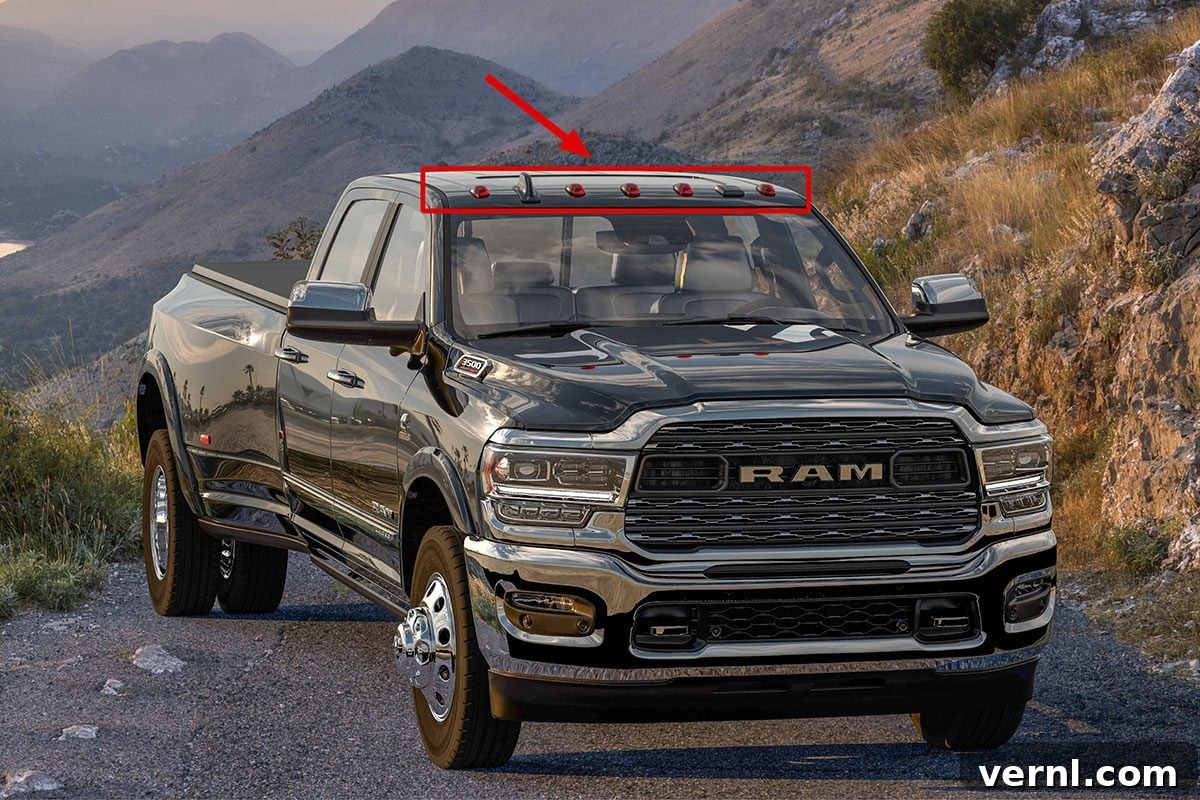
Decoding Truck Lights: Why Do Big Rigs Have Orange Lights on Top?
Have you ever noticed the increasing presence of large trucks on our roads, from heavy-duty pickups to massive commercial vehicles? It’s not just an observation; data confirms this significant trend. A compelling 2024 study from Cornell Law School revealed that a staggering 80 percent of new vehicles sold in the United States were classified as light trucks. These are vehicles weighing anywhere from 4,000 to 10,000 pounds, a category that encompasses a wide range of popular models dominating today’s automotive market and reshaping our roadways.
Beyond these “lighter” heavyweights, an even greater mass hurtles down our highways daily in the form of colossal commercial trucks, often exceeding the 10,000-pound threshold by tens of thousands of pounds. With such substantial mass in motion, it’s intuitively clear that these vehicles necessitate a distinct set of safety regulations compared to smaller passenger cars. The sheer kinetic energy involved in a collision with a large truck demands a proactive approach to safety. If you’ve ever spotted a truck sporting a row of distinctive orange or amber lights prominently positioned above its windshield, you’ve witnessed one of these crucial, yet often misunderstood, safety mandates in action.
These lights are far more than mere decorative elements; they play a vital, active role in ensuring road safety for everyone. In the following sections, we’ll delve into the specific purpose of these enigmatic lights and explore what their constant presence signifies on the road, shedding light on a critical aspect of commercial vehicle safety and the evolving landscape of our public thoroughfares. Understanding these seemingly small details can greatly enhance our awareness and safety as we share the road with these powerful machines.
The Critical Role of Orange Truck Lights: More Than Meets the Eye
That distinctive trio, or sometimes a cluster, of orange or amber lights prominently displayed atop a truck’s cab serves a very specific and crucial function. Contrary to common belief, these aren’t designed to enhance the visibility of the road for the truck driver, nor are they simply aesthetic additions. Instead, they are universally known as “clearance lights” or “identification lights,” and their primary purpose is to convey essential information about the vehicle’s dimensions to other road users. They act as a vital visual beacon, signaling exactly how large the truck is, particularly its width and height, an indispensable detail for judging safe distances and making informed decisions on the road.
Understanding DOT Regulations for Identification Lamps
The requirement for these lights is not arbitrary; it’s a stringent mandate from the Department of Transportation (DOT), underscoring their importance in preventing accidents and enhancing overall road safety. Specifically, federal regulations dictate that commercial vehicles exceeding 80 inches in width – a standard that applies to a vast majority of large trucks, many heavy-duty pickups, and even some trailers and recreational vehicles – must be equipped with these critical indicators. The DOT mandates “three amber front and three red rear identification lamps spaced between 6 and 12 inches apart at the center of the front and rear of the vehicle, as high as practicable.”
This precise specification ensures uniformity and maximum visibility across the entire commercial fleet. The amber lights face forward, serving as an unambiguous warning to oncoming traffic about the vehicle’s substantial size, particularly its width at the highest point. Conversely, the red lights face rearward, providing the same crucial information to drivers approaching from behind, especially vital for judging passing distances or following safely. Placing them “as high as practicable” further ensures that these lights are visible over the roofs of smaller vehicles, helping to prevent hidden hazards in dense traffic, over hills, or during adverse weather conditions. This regulation isn’t a recent development either; the DOT has required these cab roof lights on larger trucks since as far back as 1989, a testament to their long-recognized and enduring importance in the evolving landscape of commercial transport and road safety.
Why Are Clearance Lights So Important for Safer Roads?
The necessity of clearance lights becomes acutely clear when considering the physics and practicalities of sharing the road with exceptionally large vehicles. Trucks, by their very nature, possess substantial blind spots that can conceal entire cars, exhibit slower acceleration and braking capabilities than passenger vehicles, and require significantly more space for turning and maneuvering, especially at intersections or on curved roads. Without clear indicators of their full dimensions, other drivers could easily misjudge distances, leading to dangerous situations such as:
- Preventing Sideswipes and Overtaking Risks: A driver attempting to overtake or merge might dangerously underestimate the truck’s true width, risking a catastrophic sideswipe collision. The lights provide a clear visual boundary.
- Enhanced Visibility in Challenging Conditions: In darkness, heavy rain, dense fog, or blinding snow, a truck’s massive outline can be severely obscured. Clearance lights provide a distinct, illuminated perimeter, making its presence, size, and location unmistakable to others.
- Navigating Diverse Environments: Whether on narrow city streets, bustling highways, or winding rural roads, accurate spatial awareness around large trucks is paramount. These lights provide that vital visual cue, helping drivers maintain appropriate distances and anticipate potential hazards.
- Mitigating Under-ride Accidents: By clearly delineating the top and side edges of the truck or trailer, particularly at night, these lights help prevent smaller vehicles from accidentally driving underneath the trailer or rear of the truck, a particularly catastrophic and often fatal type of collision.
As heavy-duty trucks, larger SUVs, and commercial vehicles continue to gain popularity and proliferate on our roads, the prevalence and significance of these small but mighty amber and red lights only grow. They are a silent guardian, constantly communicating vital safety information to every driver, cyclist, and pedestrian sharing the public thoroughfare, embodying a fundamental principle of proactive road safety.
The Unstoppable Growth of Trucks: An Automotive and Societal Shift
The increasing visibility of identification lights is directly linked to a broader, undeniable trend in the automotive industry: vehicles, particularly trucks and SUVs, are getting significantly bigger. It’s an open secret that for a significant segment of consumers in the U.S., the adage “bigger is always better” holds true. This cultural preference extends from consumer electronics to personal vehicles, heavily influencing automakers’ design and marketing strategies. This mentality has incentivized manufacturers to push the boundaries of vehicle size, designing trucks that are as large as engineering capabilities and market demand will allow. This push isn’t solely driven by aesthetics; large trucks offer tangible practical appeal, especially for individuals or businesses engaged in frequent hauling, towing, or requiring ample cargo and passenger space for work, family, or recreational activities.
Regulatory Incentives Fueling the Growth Spurt
Beyond consumer preference, there’s a significant, more technical incentive at play, encouraging automakers to continually beef up their truck and SUV offerings. Federal requirements concerning vehicle fuel efficiency, specifically the Corporate Average Fuel Economy (CAFE) standards, are often based on a vehicle’s physical footprint – the area enclosed by its four tires. Counterintuitively, by making a truck physically larger – wider, longer, and heavier – automakers can potentially place it into a different vehicle classification with less demanding fuel economy standards. This regulatory loophole means that while a physically larger truck might consume more fuel overall in real-world driving, it can still meet its specific category’s “efficiency” targets more easily than a smaller vehicle would in its own, stricter category. This system inadvertently provides an economic rationale for manufacturers to produce bigger vehicles, creating a complex interplay between regulation, design, and market demand.
Consequences of the Growing Vehicle Size: Safety, Environment, and Infrastructure
The unchecked growth in truck and SUV dimensions carries significant implications across various domains, affecting not just drivers but all road users and the environment.
Increased Safety Risks for Vulnerable Road Users
The physical statistics are stark and concerning. According to comprehensive data from Consumer Reports, the hood height of passenger trucks has increased by at least 11 percent on average since the year 2000. Over a similar period, from 2000 to 2018, new pickups also grew an average of 24 percent heavier. These increases in size and mass are not benign. Taller, heavier vehicles inherently pose a far greater danger in collisions, particularly to occupants of smaller passenger vehicles, and critically, to pedestrians and cyclists. The elevated front ends and larger, more numerous blind spots significantly increase the risk of severe injury or fatality in front-end and turning accidents involving these vulnerable road users. This disproportionate impact is a pressing concern that demands immediate attention as urban environments become denser and shared road spaces grow more complex.
Environmental and Infrastructure Strain
Larger vehicles, despite regulatory incentives that might suggest otherwise, generally consume more fuel and produce higher emissions over their lifecycle compared to smaller cars. This contributes directly to increased carbon footprints and localized air pollution, exacerbating climate change and public health issues. Furthermore, the sheer weight and increased dimensions of these vehicles place additional, accelerated strain on public infrastructure, leading to faster wear and tear on roads, bridges, and parking structures. Finding suitable parking spaces in increasingly dense urban areas also becomes a persistent and frustrating challenge for drivers of these oversized vehicles, often leading to violations or congestion.
Navigating the Future of Road Safety with Bigger Vehicles
As trucks continue to simultaneously boom in size and popularity, the existing regulatory framework and road infrastructure are increasingly strained, failing to fully adapt to this rapid change. It’s becoming evident that new safety regulations will likely have to be created, or existing ones significantly revised, to adequately protect smaller vehicles and the growing number of pedestrians and cyclists with whom these massive vehicles share the road. This might include stricter crash test standards specifically for larger vehicles impacting smaller ones, mandates for advanced driver-assistance systems (ADAS) that specifically address blind spots around large trucks, or even urban planning adjustments to accommodate wider and longer vehicles while prioritizing pedestrian and cyclist safety.
The conversation around truck size and safety is complex and multifaceted, requiring a careful balance between consumer demand for utility and perceived safety, industry incentives, and the broader societal need for safe and equitable road sharing. Understanding the function of seemingly minor details like amber clearance lights is just one crucial piece of a much larger puzzle in navigating this evolving automotive landscape responsibly and safely for all.
Sources:
- Cornell Law School, “The Unchecked Rise of Trucks and SUVs in America” 2024
- Consumer Reports, “The Hidden Danger of Big Pickup Trucks” 2024
- Federal Motor Carrier Authority Online Filings, “DOT Lighting Requirements for Trucks: What You Need To Know” 2024
RELATED ARTICLES:
- Do You Know What That Little Button on Your Seat Belt Is For?
- What Those Lines on Your Backup Camera Really Tell You
- Here’s What The Small Panel On Your Car’s Front Bumper Is For