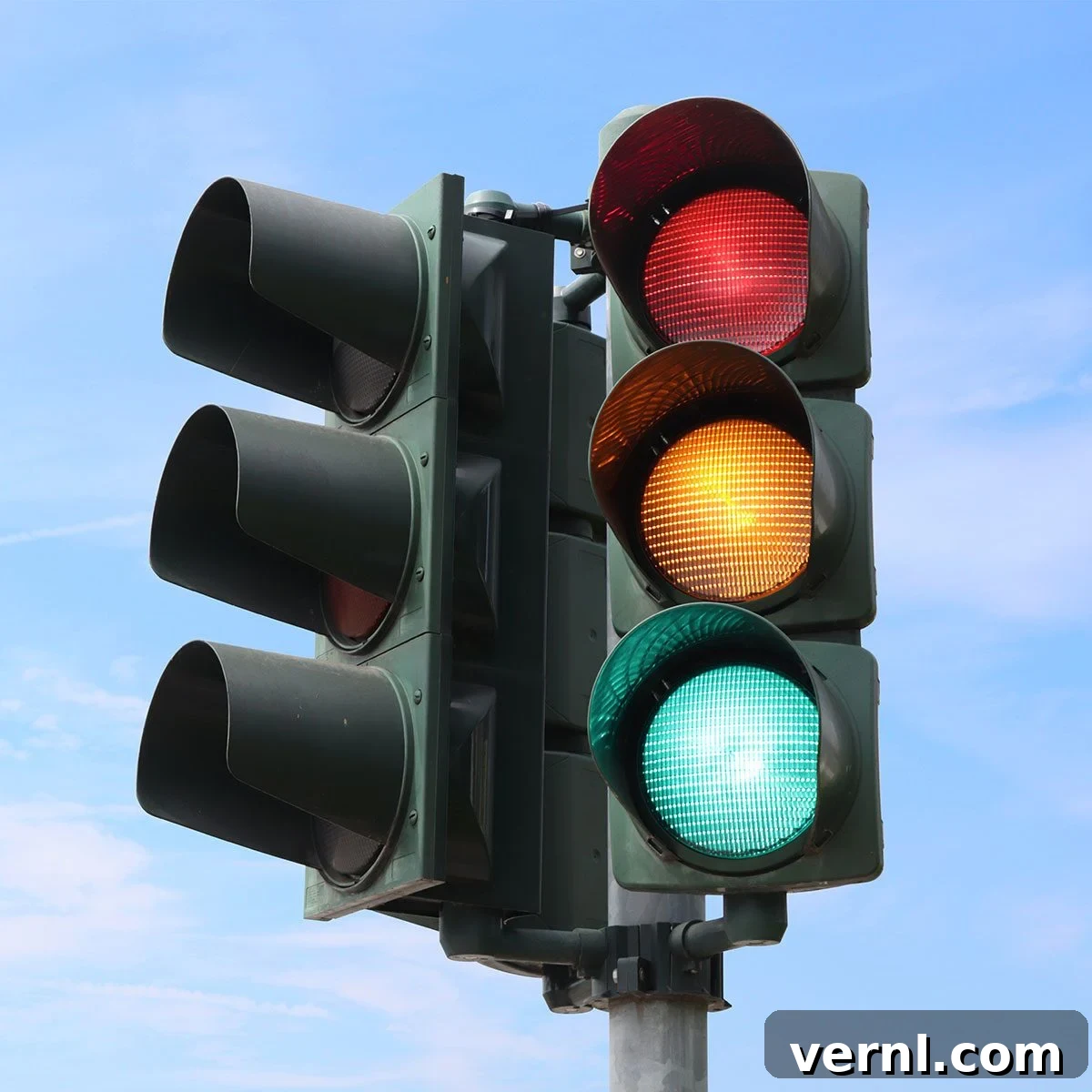
For over a century, traffic lights have been an indispensable part of urban and rural landscapes, guiding millions of vehicles and pedestrians safely. Their origins trace back to the 1800s in Britain, where early traffic officers utilized rotating gas lamps displaying red and green to manage the flow of predominantly horse-drawn carriages. Today, while the fundamental red and green signals remain universally understood, the complexity of modern intersections and diverse traffic demands has introduced a wide array of other traffic light symbols. Drivers, cyclists, and pedestrians alike now encounter flashing lights, directional arrows, lane-specific controls, and specialized signals for different road users. Understanding these nuances is crucial for navigating roads safely, efficiently, and legally. This comprehensive guide will decode the various traffic light symbols you’re likely to encounter, particularly within North America, helping you drive with greater confidence and awareness. While the core meanings are largely standardized in this region, it’s worth noting that some variations exist globally, such as Japan’s occasional use of a blue light instead of green, a reflection of linguistic and cultural distinctions.
Solid Traffic Light Signals: The Core Rules of the Road
The foundation of traffic control rests on the universally recognized solid red, green, and amber lights. These primary signals govern the basic ebb and flow of traffic at intersections.
Red Light: The Unambiguous Command to Stop
A solid red light is perhaps the most critical and least ambiguous traffic signal. Its meaning is absolute: STOP. When approaching an intersection with a red light, you are legally required to bring your vehicle to a complete halt behind the stop line, crosswalk, or before entering the intersection. You must remain stopped until the light changes to green. Disregarding a red light is a serious traffic violation, often leading to hefty fines, points on your driving record, and significantly increases the risk of severe collisions. In many jurisdictions, red light cameras are employed to enforce this rule, automatically issuing citations to drivers who fail to stop. Always prioritize safety over haste; a few extra seconds of waiting can prevent a lifetime of regret.
Green Light: Proceed with Caution
A solid green light generally signals permission to PROCEED through an intersection. If you are going straight, you can maintain your current speed, provided it is safe to do so and the intersection is clear. However, a green light does not grant absolute right-of-way in all situations. Drivers must still exercise caution, be prepared to stop for emergency vehicles, and always yield to pedestrians who may still be in the crosswalk. Furthermore, a green light does not automatically permit turns; specific arrow signals or the absence of oncoming traffic might be required, a detail we will explore further.
Amber (Yellow) Light: Prepare to Stop, or Proceed if Safe
The amber, or yellow, light serves as a critical transition signal, indicating that the green light is about to turn red. Its interpretation often sparks debate and confusion among drivers. The generally accepted rule is that you should STOP if it is safe to do so. This means if you can comfortably bring your vehicle to a halt before the intersection’s stop line without sudden braking or risking a rear-end collision, you should stop. If you are already within the intersection or so close that stopping safely is impossible, you should continue through. The intent of the yellow light is to allow vehicles already in the intersection to clear it safely and to warn approaching drivers to prepare for a stop. Misinterpreting this signal, often by accelerating to “beat the light,” is a dangerous practice that contributes to many intersection accidents. As humor columnist Dave Barry once quipped, some drivers might interpret a yellow light as a challenge to make it through before it turns red, but in reality, entering an intersection on a solid red light, even if it was yellow moments before, can still result in a ticket and, more importantly, a hazardous situation.
Flashing Traffic Light Signals: Warning and Conditional Movement
Beyond the solid colors, flashing lights introduce conditional directives, requiring drivers to exercise heightened awareness and judgment.
Flashing Red Light: Treat as a Stop Sign
When you encounter a flashing red light, it functions identically to a STOP SIGN. You must come to a complete stop at the designated line, carefully check for cross-traffic and pedestrians in all directions, and only proceed when the intersection is clear and safe. Flashing red lights are commonly seen at less-trafficked intersections during off-peak hours, or in situations where traffic signals are malfunctioning due to power outages or maintenance. They emphasize the need for drivers to take full responsibility for ensuring the safety of their maneuver.
Flashing Yellow Light: Proceed with Caution
A flashing amber or yellow light signals a requirement to SLOW DOWN AND PROCEED WITH CAUTION. Unlike a flashing red, it does not mandate a full stop, but it serves as a strong warning of an unusual or potentially hazardous traffic condition ahead. This could include an upcoming school crossing, a construction zone, a sharp curve, or an intersection with an obscured view. The flashing yellow light instructs drivers to be extra vigilant, reduce their speed, and be prepared to stop if circumstances demand it. If you’re unsure about the situation, it’s always safest to slow down significantly and even prepare to stop until the path ahead is clear.
Flashing Yellow Lights at a Pedestrian Crosswalk: Stop for Pedestrians
One of the more recent additions to traffic control, particularly in urban and suburban areas, are flashing yellow lights specifically designed for pedestrian crosswalks. Often referred to as Rectangular Rapid Flashing Beacons (RRFBs), these bright, rapidly flashing yellow lights are activated by pedestrians wishing to cross the road. When these lights flash, drivers are legally required to STOP and wait until the pedestrian has completely cleared the crosswalk. This signal ensures pedestrian safety by creating a clear, protected crossing period. Many drivers, unfamiliar with this newer symbol, are caught off guard, making it essential to recognize and obey these lights promptly to protect vulnerable road users.
Arrow Traffic Light Signals: Guiding Turns and Lane Movements
Arrows incorporated into traffic lights provide specific instructions for turning movements, enhancing safety and efficiency at complex intersections.
Red Arrow: No Turn Permitted
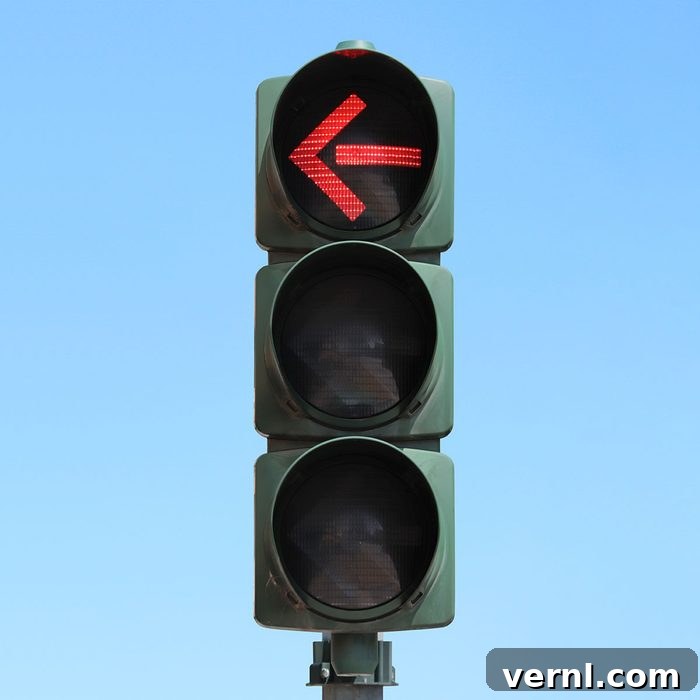
A red arrow, pointing in a specific direction (typically left or right), means that you MUST NOT TURN in that direction. This signal overrides any general green light that might be present for straight-through traffic. You are required to remain stopped until the red arrow changes to a green arrow or a solid green light allowing the turn. Red arrows are crucial for managing traffic flow at busy intersections, preventing conflicts with opposing traffic or pedestrians.
Green Arrow: Protected Turn
A green arrow signifies a PROTECTED TURN in the direction the arrow points. This means that you have the right-of-way for that specific turn, and conflicting traffic (such as oncoming vehicles or cross-traffic) should be stopped by their respective signals. Drivers can confidently proceed with their turn, though always maintaining vigilance for unexpected hazards. In intersections without specific arrow symbols, a solid green light often permits a left turn, but only after yielding to all oncoming traffic. To clarify this, many intersections will feature a supplementary sign under the traffic light explicitly stating, “Yield to Oncoming Traffic,” emphasizing the driver’s responsibility.
Amber (Yellow) Arrow: Prepare for Red Turn Restriction
An amber or yellow arrow indicates that the protected green arrow for that specific turn is about to end and will soon turn red. Similar to a solid yellow light, you should PREPARE TO STOP if you can do so safely. If you are already in the process of making the turn or have entered the intersection when the arrow turns yellow, you should complete your turn safely. Accelerating to beat a yellow arrow is as dangerous as rushing a solid yellow light, as it can lead to being stuck in the intersection or colliding with vehicles that are about to receive their green light.
Advanced Traffic Control: Specialized Signals Decoded
Beyond the standard intersection lights, various specialized signals manage traffic flow in unique situations, enhancing safety and efficiency across different road environments.
Lane Control Signals: Dynamic Traffic Management
On multi-lane highways, particularly those with reversible lanes, in tunnels, or on bridges, illuminated lane control signals dynamically manage traffic flow. These overhead signals dictate which lanes are open, closed, or about to change direction:
- A red X: This absolute signal indicates that the lane is CLOSED to traffic traveling in your direction. You must exit this lane immediately and safely merge into an open lane.
- A yellow X (or sometimes a flashing yellow X): This is a warning that the lane is ABOUT TO CLOSE or that the direction of traffic in the lane is about to reverse. You must prepare to vacate the lane and move into an adjacent open lane as soon as it is safe to do so.
- A green circle or arrow: This signifies that the lane is OPEN for travel in your direction.
These signals are vital for optimizing traffic flow during peak hours, construction, or emergencies, and compliance is mandatory for maintaining smooth and safe travel.
Bicycle Lane Symbols: Integrating Cyclist Safety
With the increasing popularity of cycling, many cities have implemented dedicated bicycle lanes and corresponding traffic signals to ensure the safety of cyclists. These signals often feature a bicycle symbol within the light display:
- When the bicycle symbol is red: Cyclists must STOP. Simultaneously, cars in adjacent lanes may be permitted to turn right, ensuring no conflict with bicycles.
- When the bicycle symbol is green: Cyclists have the right-of-way and can PROCEED through the intersection. During this phase, cars are typically prohibited from turning across the bicycle lane, providing a protected crossing for cyclists.
These specialized signals are crucial for integrating bicycle traffic safely into the urban environment and require both drivers and cyclists to be aware of their specific instructions.
Pedestrian Walk Symbols: Guiding Foot Traffic
At most busy intersections, pedestrian signals are synchronized with vehicle traffic lights to inform pedestrians when it is safe to cross. These signals typically include:
- A green or white depiction of a person walking: This “WALK” symbol indicates it is safe to begin crossing the street.
- A red depiction of a person standing: This “DON’T WALK” symbol means pedestrians should not enter the crosswalk.
The interpretation of these symbols becomes slightly more nuanced when they are flashing. If the “Don’t Walk” symbol is flashing, it means that the pedestrian crossing time is ending. If you are already in the intersection, you should continue to the other side safely. However, if you are still on the curb, you should remain there and wait for the next “Walk” signal. Just as with yellow vehicle lights, pedestrian flashing signals can be interpreted differently, but adhering to the intended meaning is paramount for pedestrian safety and avoiding potential collisions with turning vehicles.
Frequently Asked Questions About Traffic Lights
Do traffic lights have sensors?
Indeed, many modern traffic lights are equipped with various types of sensors to optimize traffic flow and efficiency, though their presence and functionality can vary significantly. These sensors help detect the presence of vehicles, adjust signal timing, and manage traffic congestion. Common types of traffic light sensors include:
- Inductive Loops: These are wires embedded in the pavement, forming electromagnetic fields that detect large metallic objects (like cars) passing over them. They are very common and can be seen as rectangular or circular cuts in the asphalt near intersections.
- Traffic Cameras: Often mounted on poles above the intersection, these cameras use video detection software to monitor traffic queues and detect vehicle presence. They are distinct from enforcement cameras (red light cameras) and are purely for traffic management.
- Infrared Detectors: These sensors detect the heat emitted by vehicles, allowing them to sense traffic presence and movement, especially useful in varying light conditions.
- Radar Sensors: Utilizing radar technology, these detectors emit microwave signals to measure vehicle speed and presence over a wider area, offering more sophisticated traffic analysis.
- Magnetometers: Similar to inductive loops but smaller and often installed discreetly under the pavement, these detect changes in the Earth’s magnetic field caused by the presence of a vehicle.
To maximize your chances of being detected by these sensors and ensuring the light changes efficiently, it is crucial to pull up your vehicle as close as possible to the white stop line at the intersection. For motorcycles or bicycles, positioning yourself directly over the loop or within the camera’s detection zone is particularly important, as their smaller size can sometimes make detection challenging.
Is taking a right on red always legal?
Making a right turn on a red light has been a legal practice in most of North America since 1973, primarily implemented to conserve fuel by reducing vehicle idling at intersections. However, this is not an absolute right and comes with strict conditions and exceptions. You can generally make a right turn on red AFTER COMING TO A COMPLETE STOP, only if the path is clear, and you yield to all cross-traffic and pedestrians. Crucially, there are three primary situations where a right turn on red is prohibited:
- You encounter a clearly posted sign at the intersection explicitly stating “NO TURN ON RED” or similar prohibitions. Always look for these signs before proceeding.
- The traffic light displays a red arrow pointing to the right. In this specific scenario, the red arrow takes precedence, and you must wait for it to turn green before initiating your turn, even if a solid red ball is also present.
- The intersection is equipped with bicycle lane traffic light symbols, and the bicycle symbol is green while your vehicle light is red. This indicates that cyclists have the right-of-way, and turning right would create a conflict, thus it is prohibited.
Tip for Travelers: While right on red is widespread, some states and Canadian provinces also permit a “left turn on red” under very specific circumstances. Typically, this is allowed when turning from a one-way street onto another one-way street after coming to a complete stop and yielding to all traffic. States like California, New York, Florida, and many others permit this maneuver. If you find yourself waiting for the light to change in such a scenario and hear impatient honking from behind, it’s a good indicator you might be in a region where this rule applies. Always verify local traffic laws when driving in unfamiliar territories to ensure compliance and safety.
Related Guides for Enhanced Driving Knowledge
- Do You Know What That Little Button on Your Seat Belt Is For?
- What Those Lines on Your Backup Camera Really Tell You
- Here’s What The Small Panel On Your Car’s Front Bumper Is For