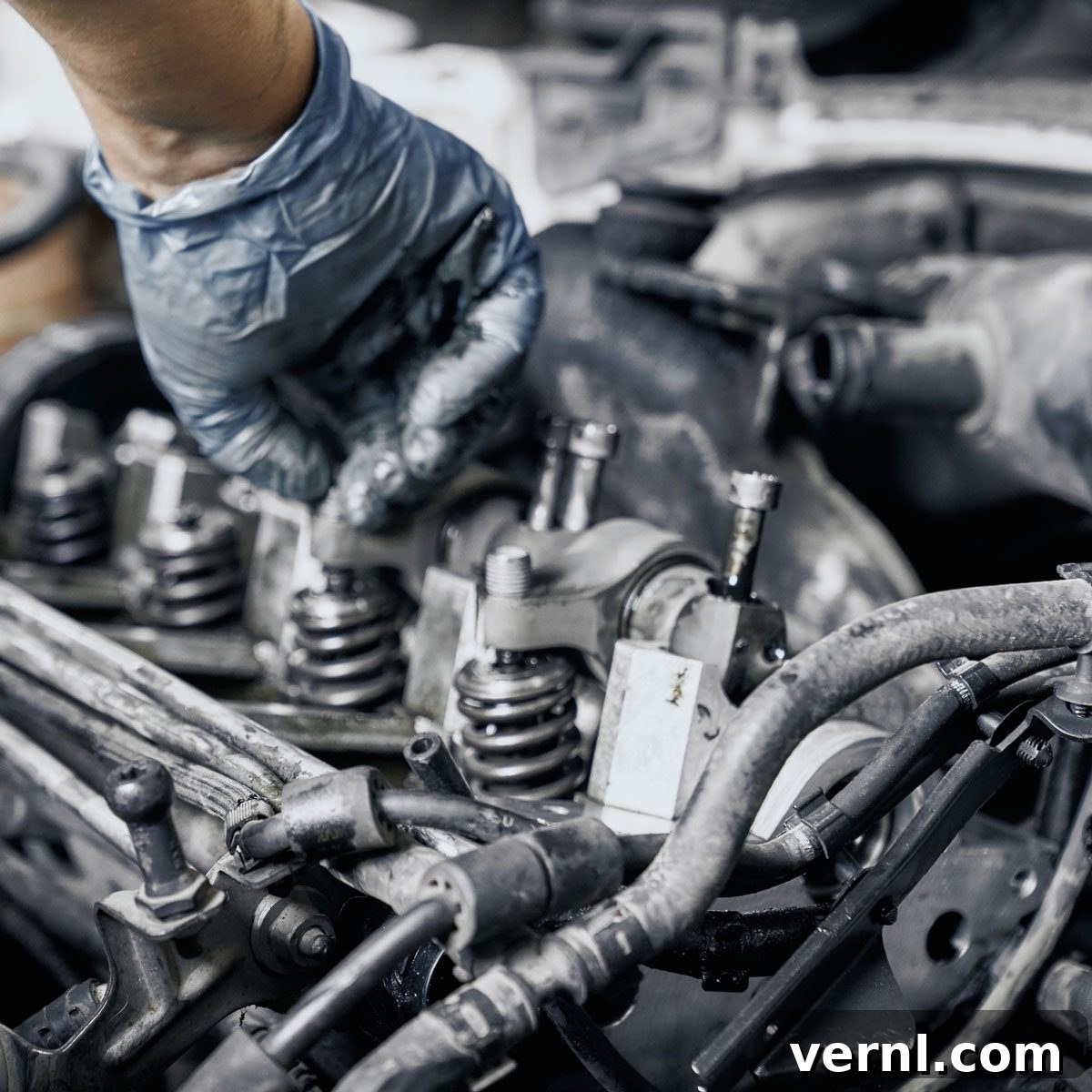
Hearing an unusual metallic knocking or pinging sound coming from your vehicle’s engine is a clear warning sign that should never be ignored. Often described as a light rattle, a distinct tap, or a sharp metallic “ping,” this noise indicates a serious internal combustion problem that can lead to significant and costly engine damage if not addressed promptly. Understanding the root causes and implementing timely solutions is crucial for maintaining your vehicle’s health and avoiding expensive repairs down the road.
What Is Engine Knocking?
Engine knocking, also widely known as pinging or detonation, is an audible symptom of abnormal and premature combustion occurring within one or more of your engine’s cylinders. In an ideal engine cycle, the fuel-air mixture ignites precisely when the spark plug fires, pushing the piston down smoothly. Knocking, however, signifies an uncontrolled explosion of the fuel mixture before the spark plug’s intended ignition point, or an additional, uncontrolled ignition event after the spark has fired. This uncontrolled combustion creates a shockwave inside the cylinder that collides with the rising piston, generating the characteristic metallic knocking sound you hear.
A well-tuned internal combustion engine relies heavily on incredibly precise timing to deliver optimal power, fuel efficiency, and minimize wear. The fundamental process involves the rotating crankshaft, which alternately drives the pistons up into their respective cylinders and is then driven back down by the immense force of the expanding gases following combustion. The entire sequence is a carefully orchestrated dance of components: the descending piston draws a meticulously measured mixture of fuel and air into the cylinder. The ascending piston then compresses this mixture to an optimal level, maximizing the power that will be released at the exact moment of ignition.
This intricate process repeats thousands of times per minute in each cylinder of your engine block. Due to sophisticated engineering, each spark plug is energized and fires at a specific position in the crankshaft’s rotation, just as the piston is nearing its peak. Your vehicle’s engine control unit (ECU) manages this precise timing, ensuring that the force from all cylinders works harmoniously to push the crankshaft in a continuous, forward direction, preventing any opposing forces that could lead to inefficient operation or damage. When knocking occurs, this delicate balance is violently disrupted, turning a smooth, powerful process into a destructive internal conflict.
Why Does Engine Knocking Occur? Unraveling the Detonation Dilemma
Engine knocking fundamentally occurs when the fuel-air mixture in a cylinder ignites spontaneously and prematurely, prior to the spark plug firing, or detonates violently after the spark. This out-of-sequence ignition event creates a powerful, uncontrolled explosion. Imagine the piston is still traveling upward, compressing the fuel-air mixture towards the top of its stroke (known as Top Dead Center or TDC). If the mixture ignites too early, the expanding gases exert a downward force on the piston while it’s still trying to move up. This opposing force slams the piston against the crankshaft, creating the distinct “knock” or “ping” sound.
This violent clash doesn’t just produce an annoying sound; it generates immense mechanical stress and heat within critical engine components. The misfired piston, instead of delivering smooth, controlled power, applies a backward thrust to the crankshaft, working against the engine’s intended momentum. This not only causes the audible knock but also leads to a noticeable hesitation and a significant loss of power and fuel efficiency. Over time, persistent knocking can cause severe and irreversible damage, including:
- Piston Damage: The constant bombardment can pit, crack, or even completely melt sections of the piston crown.
- Cylinder Wall Damage: The shockwaves and abnormal piston movement can score or wear down the cylinder walls, leading to compression loss and excessive oil consumption.
- Crankshaft Bearing Wear: The bearings that support the crankshaft are subjected to extreme, irregular forces, accelerating wear and potentially leading to bearing failure, which can be catastrophic.
- Connecting Rod Stress: The connecting rods, which link the pistons to the crankshaft, can bend or even break under the immense, misdirected forces.
Repairing such extensive damage, often requiring an engine rebuild or replacement, can be incredibly expensive, making early detection and intervention paramount. Modern vehicles are equipped with sophisticated computer-controlled injection systems and knock sensors. These sensors detect the early vibrations of knocking and signal the engine control unit (ECU) to automatically adjust ignition timing or enrich the fuel mixture to suppress the knocking. While this prevents immediate catastrophic failure, it comes at a significant cost: reduced engine performance, decreased fuel efficiency, and increased emissions. The loss of fuel efficiency is often a tell-tale sign that your engine is struggling with a knocking issue and requires your immediate attention, even if you don’t always hear the loud knock due to the ECU’s intervention.
6 Common Conditions That Cause Engine Knocking
Engine knocking is a multifaceted problem, often stemming from a variety of underlying issues that disrupt the delicate balance of combustion. Identifying the specific cause is the first step towards an effective resolution. Here are the six most common conditions that trigger engine knocking:
-
Incorrect Octane Fuel
One of the most frequent culprits behind engine knocking is the use of fuel with a lower octane rating than your engine was specifically designed to burn. Octane is a measure of a fuel’s resistance to auto-ignition (igniting spontaneously under pressure without a spark). Higher octane fuels are more stable and can withstand greater compression before combusting, which is critical for high-performance engines with higher compression ratios. When lower octane fuel is subjected to the high pressures and temperatures within an engine designed for premium fuel, it can ignite prematurely. This uncontrolled ignition, happening before the spark plug fires, is a classic definition of engine knocking, leading to the damaging opposing forces within the cylinder.
-
Reduced Cylinder Volume Due to Carbon Buildup
Over time, incomplete combustion can lead to an accumulation of carbon deposits on various internal engine components, particularly the piston crowns and cylinder heads. This carbon buildup occupies valuable space within the combustion chamber, effectively reducing its overall volume. When the fuel-air mixture is compressed into this now-smaller space, the pressure inside the cylinder increases significantly beyond its design parameters. This elevated pressure, combined with normal operating temperatures, makes the fuel-air mixture far more susceptible to spontaneous ignition, even if the correct octane fuel is being used. The resulting premature combustion manifests as engine knocking.
-
Carbon Buildup Causing “Hot Spots”
Beyond simply reducing cylinder volume, carbon deposits can also act as unintended ignition sources. Carbon is an excellent insulator and can retain heat, often glowing red-hot during engine operation. These glowing carbon deposits create “hot spots” within the combustion chamber. When the fresh fuel-air mixture enters the cylinder and is compressed, it can come into contact with these incandescent carbon particles. This contact can trigger an immediate, localized ignition of the fuel mixture, independent of the spark plug. This scenario represents a double-whammy: the carbon not only reduces cylinder volume and increases pressure but also directly provides the “spark” needed for premature ignition, amplifying the knocking problem significantly.
-
Improper or Worn Spark Plugs
Your vehicle’s engine requires specific spark plugs that precisely match its particular engineering tolerances and operating conditions. Spark plugs are designed with a “heat range,” which dictates how quickly they dissipate heat from the combustion chamber. Installing a spark plug with an incorrect heat range (e.g., a “hotter” plug in an engine that needs a “colder” one) can cause the plug to retain too much heat. This excessively hot spark plug electrode can then act as a hot spot, similar to carbon deposits, pre-igniting the fuel-air mixture before the spark actually fires. Furthermore, worn-out spark plugs with degraded electrodes or incorrect gaps can lead to a weak, inconsistent spark or misfires, disturbing the smooth combustion process and potentially leading to knocking.
-
Disrupted Fuel-to-Air Mixture
The optimal performance of an engine hinges on a precise stoichiometric (ideal) ratio of fuel to air. A poorly functioning fuel injector—whether it’s clogged, leaking, or delivering an incorrect spray pattern—can significantly disrupt this critical mixture entering the cylinder. An overly lean mixture (too much air, not enough fuel) can cause combustion chamber temperatures to rise dramatically and burn inefficiently. Conversely, an overly rich mixture (too much fuel) can lead to excessive carbon buildup. Both scenarios alter the dynamics of the gas mixture under pressure, making it more prone to premature or uncontrolled ignition, thus creating the potential for engine knocking. Issues with oxygen sensors or mass airflow sensors can also contribute to an incorrect fuel-to-air ratio.
-
Valve Impingement or Sticking Valves
The intake and exhaust valves at the top of the cylinder head are precisely timed to open and close, regulating the flow of air, fuel, and exhaust gases. Carbon buildup on the valve stems or seats can prevent the valves from sealing completely or moving freely. When a valve cannot close properly, it leads to a loss of compression within the cylinder, which can destabilize the combustion process. Restricted airflow due to carbon on the intake valves can also alter the fuel-air mixture, making it less efficient and more prone to abnormal combustion. In severe cases, sticking valves or valves that don’t close fully can cause serious mechanical issues that indirectly contribute to or exacerbate knocking by creating chaotic conditions within the cylinder.
How to Fix Engine Knocking: Practical Solutions and Prevention
Addressing engine knocking promptly is vital to prevent severe damage and restore your vehicle’s performance. The solutions often depend on the root cause, but many effective strategies can be implemented to resolve or prevent this issue. Here’s a breakdown of the most common fixes:
-
Upgrade to Higher Octane Fuel and Utilize Carbon-Cleaning Additives
The simplest and often most effective first step in resolving engine knocking, particularly if your vehicle is prone to it, is to upgrade to gasoline with a higher octane rating. Higher-octane fuels possess greater resistance to auto-ignition and can withstand more pressure and heat before combustion. If your owner’s manual recommends premium fuel, always use it. Even if it doesn’t, a temporary switch to a higher octane might resolve minor knocking. Furthermore, choose gasoline that includes advanced carbon-cleaning additives, or periodically add a high-quality, concentrated fuel system cleaner to your tank. These additives are specifically formulated to scour carbon deposits from fuel injectors, piston crowns, cylinder heads, and valves. This helps to restore cylinder volume, eliminate hot spots, and improve fuel spray patterns, directly tackling causes 2, 3, and 5 mentioned above. Consistent use of such cleaners can prevent future buildup and maintain optimal engine conditions.
-
Perform a Comprehensive Engine Tune-Up
A thorough engine tune-up is crucial for addressing several potential causes of knocking. This service typically includes replacing old, worn-out spark plugs with new ones that match your engine’s precise specifications. Ensuring the correct spark plug heat range and electrode gap is paramount for consistent and efficient ignition. If your vehicle uses spark plug wires, replacing them alongside the plugs ensures that the high voltage from the ignition coils reaches the plugs without impedance. For modern engines with coil-on-plug systems, inspecting or replacing faulty ignition coils can also be part of a comprehensive tune-up. A fresh set of spark plugs guarantees a strong, accurate spark, optimizing the combustion process and preventing pre-ignition.
-
Prioritize Regular Oil Changes and Monitor Oil Levels
Engine oil plays a far more critical role than just lubrication; it also helps to cool engine components and carries away contaminants. Regularly changing the oil in your vehicle according to the manufacturer’s recommendations is essential. Worn-out, degraded oil loses its lubricating properties and its ability to dissipate heat effectively. Furthermore, low oil levels can exacerbate friction and heat buildup within the engine. Poor lubrication, especially for timing-related components in the cylinder head (like valve lifters or variable valve timing (VVT) actuators), can lead to operational inefficiencies that indirectly contribute to knocking. Fresh, clean oil ensures all moving parts operate smoothly and within their design parameters, promoting cooler engine temperatures and preventing deposit formation that could contribute to knocking.
-
Address Fuel System Issues
If fuel-to-air mixture disruption is suspected, a deeper dive into the fuel system is necessary. This might involve cleaning or replacing clogged fuel injectors, inspecting the fuel pump for proper pressure and flow, and checking fuel filters. Ensure that the vehicle’s oxygen sensors and mass airflow sensor are functioning correctly, as these components are vital for the ECU to calculate the optimal fuel-air ratio. A professional diagnostic scan can often pinpoint issues with these sensors or fuel delivery components.
-
Consider Professional Carbon Cleaning
For engines with significant carbon buildup that pour-in additives cannot fully address, a professional carbon cleaning service might be necessary. This often involves specialized equipment and chemicals used to clean the intake manifold, intake valves, and combustion chambers. For direct-injection engines, which are particularly susceptible to intake valve carbon buildup (as fuel doesn’t wash over them), walnut blasting or chemical cleaning of the intake valves is a common and effective solution to restore proper airflow and prevent hot spots.
When to Seek Professional Help
While some knocking issues can be resolved with simple steps like changing fuel grade or using additives, persistent or severe engine knocking warrants immediate professional attention. A qualified mechanic can perform a comprehensive diagnostic scan, which can reveal fault codes related to ignition timing, fuel system anomalies, or knock sensor readings. They can also conduct compression tests, inspect spark plugs, perform boroscope inspections of the combustion chambers for carbon buildup, and accurately diagnose complex issues like failing fuel injectors or camshaft/crankshaft sensor malfunctions. Ignoring persistent knocking is a gamble that almost always leads to significantly higher repair costs and potential engine failure.
In conclusion, engine knocking is a critical indicator of underlying issues that threaten your vehicle’s longevity and performance. By understanding its causes and taking proactive steps—from using the correct fuel to performing regular maintenance and seeking professional help when needed—you can protect your engine, ensure smooth operation, and enjoy many more miles on the road.