
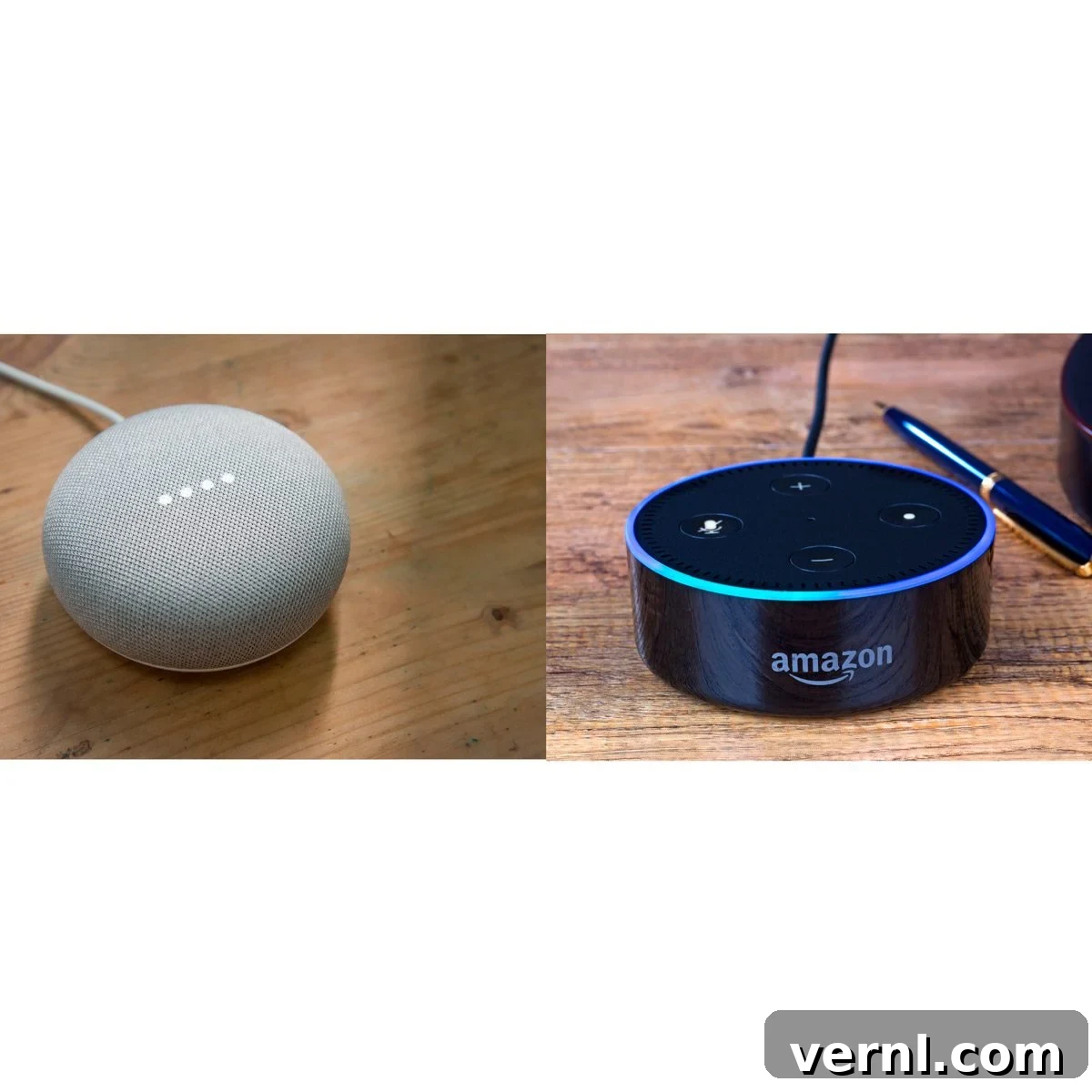
In the rapidly evolving world of smart home technology, miniature smart speakers have become indispensable gadgets for countless households. Whether you’re seeking to add a voice assistant to your kitchen counter, bring intelligent control to your office space, or simply enhance various areas of your home, the choice often narrows down to two formidable contenders: the Google Home Mini and the Amazon Echo Dot. This dilemma is a common one, as both devices offer similar core functionalities and competitive pricing. However, beneath their seemingly identical exteriors lie distinct features and ecosystem integrations that can significantly sway your decision. This comprehensive guide aims to dissect the nuances of each device, helping you determine which tiny titan best suits your lifestyle and smart home aspirations.
The Battle of the Miniature Smart Speakers: Google Home Mini vs. Amazon Echo Dot
The rise of smart speakers has revolutionized how we interact with technology, bringing convenience and connectivity directly into our homes. At the forefront of this revolution are Amazon and Google, constantly innovating to make their voice assistants more accessible and integrated. The Echo Dot and Home Mini represent their entry-level offerings, designed to be unobtrusive yet powerful, providing a gateway into their respective smart ecosystems. While both excel at delivering weather updates, playing music, and controlling smart devices, a closer look at their specifications, user experience, and underlying platforms reveals a clearer picture of their individual strengths.
Price Point: An Even Playing Field?
For many consumers, the initial consideration between two comparable products often boils down to cost. In the case of the Google Home Mini versus the Amazon Echo Dot, their pricing is remarkably similar, making them both highly accessible entry points into the smart speaker market. Amazon typically sells the Echo Dot for around $29.99, while Google offers the Google Home Mini for approximately $29. This near-identical price tag suggests that neither device holds a significant cost advantage over the other, pushing consumers to look beyond the sticker price for differentiating factors. It’s also worth noting that both devices frequently go on sale, particularly during major shopping events like Black Friday or Prime Day, often bundled with other smart home products or offered at even deeper discounts. For budget-conscious buyers, keeping an eye out for these promotional periods can yield even greater value. However, given their standard pricing, the decision ultimately rests on functionality, ecosystem preference, and user experience rather than a stark monetary difference.
First Steps: Setup and User Experience
Getting your new smart speaker up and running is typically a straightforward process for both the Google Home Mini and the Amazon Echo Dot, designed with user-friendliness in mind. For the Google Home Mini, the journey begins by plugging in the speaker, which then prompts you to download the Google Home app on your smartphone or tablet. Once the app is installed and launched, a setup notification should appear almost immediately, guiding you through a series of clear, on-screen instructions to connect the device to your home’s Wi-Fi network. This process is intuitive, leveraging Google’s expertise in software design to ensure a smooth onboarding experience.
Similarly, the Echo Dot’s setup procedure is remarkably user-friendly and app-centric. After powering on the device, you’ll need to download the Amazon Alexa app. Within the app, navigate to the “Devices” tab and tap the “+” button, typically located in the top right-hand corner. From there, you’ll be guided through connecting your Echo Dot to your Wi-Fi network and linking it to your Amazon account. Both apps are designed to walk you through each step, making the initial configuration accessible even for those new to smart home technology. They also allow for personalization during setup, such as naming your device and assigning it to a specific room, which becomes crucial for multi-device smart home control. The overall goal for both is to minimize friction, allowing users to start interacting with their voice assistant as quickly as possible.
Plus: Check out this cheat sheet for Google Home commands.
Design and Dimensions: More Than Just a Puck
When comparing the Google Home Mini and the Amazon Echo Dot, their physical designs share a striking resemblance, both adopting the popular “puck” shape that has become synonymous with compact smart speakers. In terms of dimensions, they are very close, with the Echo Dot being only marginally taller. The Google Home Mini measures 3.86 inches in diameter and 1.65 inches in height, weighing in at a light 6.1 ounces. The Echo Dot, on the other hand, comes in at 3.9 inches in diameter and 1.7 inches in height, with a slightly heavier build at 10.6 ounces. While these differences are minimal, they contribute to subtle variations in how each device feels and integrates into your space.
Aesthetically, both devices are designed to blend seamlessly into various home decors. The Echo Dot, particularly the third-generation model, features a hockey puck-like shape with fabric-covered sides that exude a soft, modern feel. It also includes visible physical buttons on its top surface for volume control, microphone muting, and activating Alexa. The Google Home Mini also embraces a puck-shaped design, but it distinguishes itself by encasing its touch-sensitive controls beneath its fabric top, creating a more minimalist and uninterrupted surface. This design choice results in a sleeker, more subtle appearance, with discreet LED indicators that light up when you interact with the device.
Color options also play a role in personalization. The Echo Dot is typically available in classic hues such as charcoal, heather gray, or sandstone, offering versatile choices that complement a range of interior palettes. The Google Home Mini, conversely, offers a slightly more vibrant selection, including chalk (light gray), charcoal (dark gray), aqua (light blue), and coral (pinkish-orange). These color choices allow users to either blend the device into its surroundings or use it as a subtle accent piece.
Both smart home automation devices require a constant power connection to function, meaning they are not inherently portable without a third-party battery dock. The method of power connection differs: the Echo Dot utilizes a barrel connector for its power supply, a common adapter type. The Google Home Mini, however, employs a more universal USB power supply. This USB connectivity might offer a slight advantage for some users, as it allows for greater flexibility in power sources, potentially enabling the device to be powered by a USB port on a computer or even a portable power bank, although this is not its primary intended use.
Next, read: Amazon Alexa vs Google Home.
Connectivity and Features: Ecosystem Integration is Key
When it comes to the breadth of features and connectivity options, the Amazon Echo Dot often presents a more extensive offering, largely due to Amazon Alexa’s longer presence in the market and continuous development. The Echo Dot, powered by Alexa, boasts a rich suite of capabilities including enhanced calling features, personalized routines that automate multiple smart home actions with a single command, whisper mode for discrete late-night interactions, and Alexa Blueprints, which empowers users to create and publish their own custom Alexa skills. This robust ecosystem of features often makes the Echo Dot a strong contender in terms of raw functionality and customization options.
However, both devices are highly capable of connecting to and controlling a wide array of popular smart home products. They seamlessly integrate with leading brands like Philips Hue lighting systems, various smart locks, the Nest Learning Thermostat (though Google Home Mini naturally has a tighter integration with Nest products), and many more. Both devices are also adept at accessing a vast library of “skills” (Alexa) or “actions” (Google Assistant), which extend their functionality to include practical applications such as making restaurant reservations, providing step-by-step cooking recipes, delivering up-to-the-minute weather reports, and much more. The continuous expansion of these third-party integrations ensures that both smart speakers remain versatile hubs for a connected home.
One notable area where the Google Assistant, and by extension the Google Home Mini, holds a distinct advantage is in its ability to find and synthesize information from the web. Leveraging Google’s decades-long dominance in search engine technology, the Google Assistant is often praised for its superior capacity to answer complex questions, provide detailed explanations, and access a vast database of knowledge online. This makes the Home Mini particularly strong for general queries, research, and quick factual look-ups, outperforming Alexa in many instances when it comes to web-based information retrieval.
The home is becoming a hub of smart devices designed to make your life easier. Check out some of the coolest home tech products available.
Ultimately, the choice between the Echo Dot and Google Home Mini in terms of connectivity and features often comes down to the digital ecosystem you have already established within your home. Are you deeply invested in Amazon’s ecosystem with devices like the Fire TV, Kindle, or Ring security cameras? Or do you lean towards Google’s suite of services, utilizing Google Chromecast for streaming, Google Photos for media management, or Google Calendar for scheduling? For Apple enthusiasts, it’s worth noting that Alexa offers direct connectivity to your Apple Music account, providing a seamless listening experience. These existing loyalties and device integrations can significantly influence which smart speaker will provide the most cohesive and convenient experience in your unique smart home environment.
Audio Performance: Small Speakers, Big Sound?
When evaluating miniature smart speakers, expectations for audiophile-grade sound quality should be tempered. However, both the Google Home Mini and the Amazon Echo Dot aim to deliver respectable audio performance for their compact size and price point. The Google Home Mini features a 1.57-inch (40mm) driver and boasts 360-degree sound, meaning audio is projected outwards in all directions, creating an immersive listening experience within a small to medium-sized room. This design ensures that the sound is consistent regardless of where the listener is positioned relative to the speaker.
The Amazon Echo Dot, on the other hand, comes equipped with a 1.6-inch speaker. The third-generation Echo Dot, in particular, introduced its largest driver yet, which Amazon claimed produced “70 percent better sound” compared to its predecessors. This significant upgrade allowed the Echo Dot to deliver a noticeably improved audio experience. When directly comparing the Google Home Mini vs. Echo Dot for sound quality, the Echo Dot often emerges as the stronger performer. It typically offers a slightly deeper, richer sound profile with more discernible bass, which can make a difference when listening to music or podcasts. While neither device is designed to replace a dedicated sound system, the Echo Dot’s enhanced driver often provides a more satisfying and fuller audio output for casual listening.
The Google Home Mini, while perhaps not as rich in bass as the Echo Dot, excels at delivering louder audio with a punchy bass response that can be quite effective for its size. Its 360-degree sound distribution ensures that the sound fills the immediate area effectively. For everyday tasks like voice assistant responses, news briefings, or background music in a small space, both speakers perform admirably. However, if your primary use case involves regular music playback and you prioritize a slightly more robust sound profile, the Echo Dot might have a subtle edge in overall fidelity.
Ease of Interaction: Voice Commands and Physical Controls
Here are the basics on how to set up your Amazon Echo.
Both the Google Home Mini and the Amazon Echo Dot are engineered to excel at picking up voice commands, providing a seamless hands-free experience. Their integrated far-field microphones are designed to detect your voice even from across a room, as long as you speak clearly and there isn’t excessive background noise. Factors like loud music, a running dishwasher, or ongoing conversations can, of course, affect recognition accuracy, but under normal conditions, both devices are highly responsive.
When it comes to design and physical interaction, the Echo Dot often presents a more intuitive user interface. It features a distinct LED status ring around its top edge, which illuminates in various colors to indicate its status—listening, processing a request, or muted. Additionally, the Echo Dot includes clearly defined physical buttons on its top surface for volume control, microphone muting, and activating Alexa without a voice command. These tactile buttons provide immediate, unambiguous feedback and can be particularly desirable for users who prefer physical controls over touch-sensitive ones, making it a more user-friendly home automation device for quick adjustments.
In contrast, the Google Home Mini adopts a more minimalist approach with its controls. While it features a discreet rear switch for microphone muting—an essential privacy feature common to both devices—its volume controls are subtly integrated as touch-sensitive areas on either side of the device. These touch controls require a light tap or swipe to adjust the volume, which, while sleek, can sometimes be less intuitive or responsive than physical buttons. The Mini uses subtle LED dots beneath its fabric exterior to indicate its status, which are less prominent than the Echo Dot’s light ring but still effective. For users who value a clean aesthetic and are comfortable with touch gestures, the Mini’s design is appealing, but those who prefer the certainty of physical buttons may find the Echo Dot’s interface more user-friendly.
Learn the good, the bad, and the myths about this best-selling tech device.
Which Smart Speaker Is Right For You? Making the Final Choice
Choosing between the Google Home Mini and the Amazon Echo Dot ultimately hinges on your personal preferences, existing smart home ecosystem, and how you intend to use the device. Both are excellent entry-level smart speakers that offer tremendous value for their price, bringing the convenience of a voice assistant into your home.
- Choose the Amazon Echo Dot if:
- You are already deeply integrated into the Amazon ecosystem with devices like Fire TV, Ring security cameras, or prefer Amazon Music.
- You prioritize a slightly richer and deeper sound quality for casual music listening.
- You value physical buttons for volume control and mic muting, along with clear visual feedback from an LED ring.
- You want access to a vast and constantly growing library of Alexa Skills and enjoy features like routines, calling, and whisper mode.
- Choose the Google Home Mini if:
- You are invested in the Google ecosystem, utilizing services like Google Calendar, Google Photos, YouTube Music, or have Chromecast devices.
- You frequently ask your smart speaker general knowledge questions or rely on its ability to find detailed information from the web.
- You prefer a minimalist design with subtle touch controls and a clean aesthetic.
- You appreciate louder audio with punchy bass, delivered via 360-degree sound, for filling a small room.
In essence, both devices capably perform the core functions of a smart speaker—playing music, answering questions, and controlling smart home devices. Your decision will be less about which one is inherently “better” and more about which one aligns more seamlessly with your existing technology, your preferred voice assistant’s personality, and your aesthetic and control preferences. Whichever you choose, you’ll be bringing a powerful and versatile voice assistant into your home, poised to simplify your daily life and elevate your smart home experience.
Every product is independently selected by our editors. If you buy something through our links, we may earn an affiliate commission.