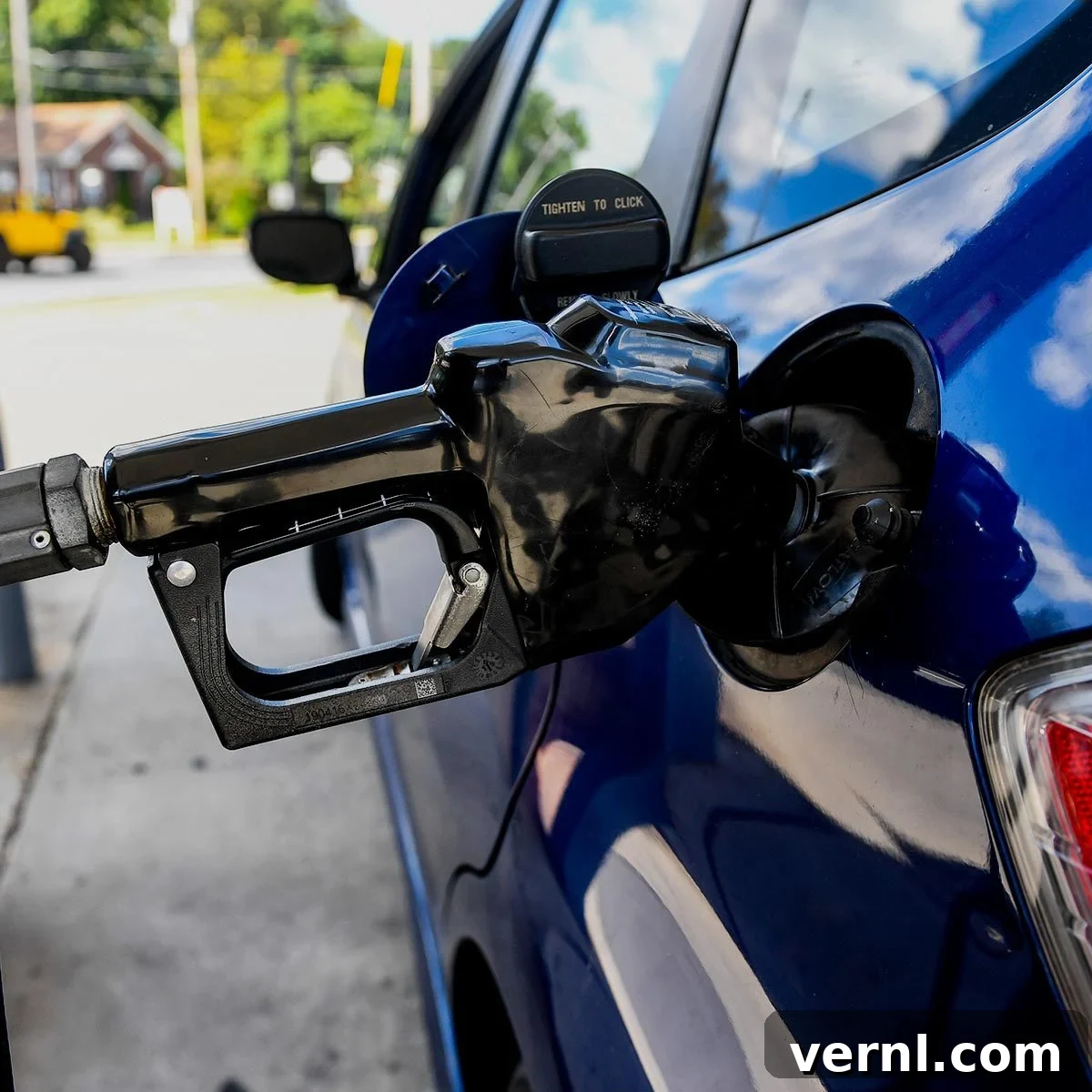
Understanding Your Gas Pump: The Science Behind the Automatic Shut-Off
Every gas-powered car owner knows the familiar routine at the fuel station. You pull up to the pump, swipe your card or head inside to pay, insert the nozzle into your vehicle’s fuel tank, and activate the flow of gasoline. For many, the next step involves locking the trigger in the “on” position, allowing you to attend to other tasks while your tank fills. This seamless process culminates with the satisfying click as the pump automatically shuts off, signaling a full tank and sending you on your way.
During those few minutes of waiting, have you ever paused to ponder the marvel of engineering at work? How does that seemingly simple nozzle, with no visible electronics, precisely know the exact moment your tank is full? It’s a question that sparks curiosity, and as auto insurance specialist Melanie Musson points out, “You’d think there’d be an electronic sensor, but that’s not how it works.” The truth lies in an ingenious mechanical system, powered by principles of fluid dynamics and vapor pressure, a design both robust and surprisingly delicate. Understanding this mechanism is not just a matter of curiosity; it’s crucial for maintaining your vehicle and avoiding common pitfalls like damaging the pump or, more importantly, your car’s complex emissions system by ignoring the subtle signs warning you not to top off your tank.
The Ingenious Mechanism: How Your Gas Pump Knows When to Stop
The standard gas pump nozzle operates on a brilliant principle of fluid dynamics, often referred to as the Venturi effect. While some might jokingly credit an imaginary physicist like Ace Ventura, the real discoverer was 18th-century Italian physicist Giovanni Venturi. His groundbreaking work revealed that when a fluid (like air or liquid) flows through a tube that narrows into a constriction, its velocity increases, and crucially, its pressure decreases. Engineers ingeniously applied this fundamental principle to design a fuel nozzle that relies on air pressure to control the fuel flow and ensure an automatic shut-off, preventing spills and overfilling.
The core of this design involves a clever internal structure within the nozzle. Running the entire length of the nozzle is a small, narrow sensing tube. This tube has a tiny opening strategically located near the very tip of the nozzle. When you begin pumping gas, the fuel flows out of the main nozzle opening, and simultaneously, air is continuously drawn into and through this narrow sensing tube. The flow of air creates a slight vacuum or reduced pressure within the tube, which in turn acts upon a diaphragm or membrane located further up in the nozzle handle. This pressure differential is what keeps the fuel valve open, allowing gasoline to flow freely into your tank.
The magic happens precisely when your fuel tank reaches its capacity. As the gasoline level rises and eventually immerses the tip of the nozzle, it blocks that small opening of the sensing tube. With the opening submerged in liquid fuel, air can no longer be drawn into the tube. This interruption of airflow immediately eliminates the vacuum inside the sensing tube. The sudden change in pressure causes the diaphragm or membrane to snap back to its original position, triggering a mechanical linkage that forcefully closes the main fuel valve. The pump instantly shuts off, signaling that your tank is full, without the need for any complex electronic sensors or power.
Melanie Musson succinctly clarifies this marvel: “There’s a hole at the end of the nozzle that pulls in air, which offsets the pressure of the gasoline going through the nozzle. When the gasoline in the tank reaches the hole in the nozzle, the pressure changes because gasoline is different from air. That increase in pressure causes the membrane that allows gas to flow freely to move, which closes the valve, stopping the gasoline.” This robust, entirely mechanical system is favored for its reliability and safety in an environment where electrical components could pose a risk.
Frequently Asked Questions About Fueling Your Vehicle
Is It Harmful to Top Off Your Gas Tank After the Pump Shuts Off?
It’s a common habit, often done out of a desire to get “every last drop” or to round up to an even dollar amount. However, this seemingly innocuous act of topping off your gas tank after the pump has automatically shut off is highly discouraged by automotive experts for several critical reasons. Full disclosure: many drivers, including myself at times, are guilty of this. But, as automotive expert Evaldas Zabitis clearly states, we shouldn’t be.
Zabitis highlights two primary concerns: “Gas stations often warn you not to top off your gas tank, not only because of accidental fuel spills but also because it can damage the fuel nozzle. These nozzles depend on a delicate vacuum system to shut off when the tank is full. When you top off your gas tank, that vacuum system may become flooded and malfunction.” Repeatedly forcing more fuel into the tank can overstress and degrade the sensitive components within the nozzle, potentially leading to a faulty pump that either shuts off too early or fails to shut off at all.
Beyond the pump itself, topping off is significantly detrimental to your vehicle. Alex Black, another car care expert, emphasizes this point: “Newer cars possess an evaporative emissions (EVAP) system for capturing the vapors from the gas and avoiding pollution. Flooding the charcoal canister through overfilling can cause costly repairs.” The EVAP system is a complex network designed to prevent harmful gasoline vapors from escaping into the atmosphere. A crucial component of this system is the charcoal canister, which is filled with activated carbon. Its sole purpose is to absorb fuel vapors, storing them until the engine is running under specific conditions, at which point the vapors are purged into the engine to be burned.
When you overfill your tank, liquid gasoline, rather than just vapor, can be forced into the charcoal canister. This “flooding” can permanently damage the activated carbon, rendering the canister ineffective. A damaged charcoal canister will often trigger your vehicle’s “Check Engine” light, indicating a fault in the emissions system. Ignoring this warning can lead to increased harmful emissions, reduced fuel efficiency, and ultimately, an expensive repair bill, as replacing the charcoal canister can be a significant cost, often ranging from hundreds to over a thousand dollars depending on the vehicle model.
Why Does My Gas Tank Overflow or Shut Off Early When It’s Not Full?
While the gas pump’s automatic shut-off system is designed for precision, there are instances where it might behave erratically, leading to frustrating early shut-offs or, in rare cases, actual overflows. When this happens, it’s not always the pump’s fault; sometimes, the issue lies with your vehicle’s system or even the fueling technique.
One potential reason, as Zabitis mentions, could indeed be a faulty nozzle at the gas station. Over time, the internal components of a pump nozzle can wear out or become damaged, leading to incorrect pressure readings and premature shut-offs. If you consistently experience early shut-offs at different pumps, however, the problem likely resides with your car.
Evaldas Zabitis points to a more common and often overlooked culprit: “One of the most common reasons is a clogged EVAP system. If the tank’s air can’t escape fast enough as fuel flows in, pressure builds up, causing fuel to back up near the nozzle and trigger an early shutoff.” As fuel enters the tank, the air already present must be displaced. The EVAP system includes vent lines that allow this air to escape efficiently. If these vent lines or the charcoal canister itself become clogged – often due to liquid fuel from overfilling, but sometimes from debris, dirt, or even spider nests – the air cannot escape quickly enough. This creates back pressure within the filler neck, mimicking the conditions of a full tank and prematurely activating the nozzle’s shut-off mechanism.
A third possible cause of blowback or early shut-off, according to Zabitis, relates to the physical design of the vehicle’s filler neck: “In some cases, a filler neck is narrower than normal. This is quite common in cars from overseas. The nozzle blocks the entire filler neck, restricting the airflow and activating a shutoff valve long before the tank is full.” In such situations, the limited space around the nozzle restricts the air from escaping, again creating localized back pressure that triggers the pump’s sensor. If you suspect this is the case, trying to fuel at a slower rate or adjusting the angle of the nozzle might help.
Understanding these potential issues can help you diagnose and address the problem, whether it means trying a different pump, changing your fueling habits, or seeking professional automotive service for a potentially clogged EVAP system. Proper diagnosis by a mechanic is essential if you suspect an EVAP system fault, as simply ignoring the issue can lead to more significant problems down the line.
About the Experts
- Melanie Musson is an auto industry expert with AutoInsurance.org, providing insights on vehicle ownership and related topics.
- Evaldas Zabitis is an automotive expert who writes for carVertical, a global and decentralized car history registry, offering in-depth analysis on vehicle mechanics and maintenance.
- Alex Black has been a car expert for more than 15 years. He is the Chief Marketing Officer for EpicVIN, specializing in vehicle history and consumer education.