
When you’re searching for a new heat pump for your home, prioritizing its energy efficiency is paramount. With heating and cooling accounting for a significant chunk—around 48 percent of the total energy consumed in an average household—investing in an efficient system isn’t just a smart financial move; it’s a commitment to environmental responsibility. To confidently choose a heat pump that delivers optimal performance and savings, you need to understand its Heating Seasonal Performance Factor, or HSPF rating.
The concept of HSPF was born from a crucial period in history: the 1973 oil crisis. This event underscored the urgent need for greater energy independence and efficiency. In response, the Air Conditioning, Heating and Refrigeration Institute (AHRI) developed the HSPF as a standardized method for measuring the energy efficiency of heat pumps. Further solidifying these efforts, the Energy Policy and Conservation Act (EPCA) of 1975 was enacted to curb national energy consumption. Subsequent amendments to this act empowered the Department of Energy (DOE) to establish stringent energy efficiency standards for various appliances, ultimately leading to the HSPF rating becoming the national benchmark for heat pump efficiency. Today, the HSPF rating serves as a critical indicator, guiding consumers toward heat pumps that promise substantial energy savings and reduced environmental impact.
What Exactly Is HSPF?
At its core, HSPF is a measure of a heat pump’s heating efficiency over an entire season. As Mark Woodruff, Senior Product Manager of Ducted Outdoor Products for industry leaders like Trane Residential and American Standard Heating & Air Conditioning, explains, HSPF is “a ratio of the heat output to electricity use over an average heating season, and the higher the HSPF the greater the energy efficiency.”
More specifically, this rating quantifies how many British Thermal Units (BTUs) of heat energy a heat pump can produce for every kilowatt-hour (kWh) of electricity it consumes to generate that heat. For instance, a heat pump boasting an HSPF rating of 8.2 will generate 8.2 BTUs of heat for every single kWh of electrical energy input. In simpler terms, the HSPF provides a direct reflection of how significantly a heat pump will influence your heating bill throughout the colder months. When evaluating new heat pumps, you’ll find that HSPF ratings typically range from 8.2 to 13. It’s worth noting that the current minimum standard set by the DOE is 8.2, but this benchmark is consistently evolving, having been set to rise to 8.8 in 2023, reflecting an ongoing push for greater efficiency across the industry.
Why Is HSPF Rating Crucial for Homeowners?
Choosing a heating system is a significant decision, and “when shopping for a new heating system, efficiency is of utmost importance,” Woodruff asserts. The benefits of a high-HSPF heat pump extend far beyond just keeping your home warm. An efficient system not only translates into lower monthly energy expenditures but also significantly reduces your household’s overall environmental impact. This dual advantage makes HSPF a pivotal factor in your purchasing decision.
Thanks to the establishment of HSPF and similar efficiency standards, American homes are notably consuming fewer fossil fuels today compared to the 1970s. This reduction is remarkable, especially considering that modern homes typically house more and larger energy-consuming appliances and devices. The cumulative effect of these standards has resulted in saving an astounding 2.52 quadrillion BTUs derived from fossil fuels. Economically, this translates into substantial collective savings, with Americans collectively saving an estimated $2.5 to $12.2 billion on their energy bills since these vital standards were first implemented. Prioritizing HSPF is a direct investment in your wallet and the planet’s future.
Understanding How HSPF Impacts Your Heating Bill
While a higher HSPF rating clearly indicates better efficiency, understanding its precise impact on your heating bill requires a bit of calculation. To directly compare the energy efficiency of different HSPF ratings, it’s helpful to convert the HSPF number into a percentage. This conversion provides a more intuitive understanding of how much more heat energy a unit provides relative to the electricity it consumes.
To perform this conversion, you start by dividing the HSPF number by 3.414. This specific number represents the amount of BTUs contained in one kilowatt-hour (kWh) of electricity. The result of this division tells you how many BTU-worth units of heat energy the heat pump outputs for every BTU-worth unit of energy it consumes. For example, a heat pump with an HSPF of 8.2 will output approximately 2.4 times (or 240 percent) the amount of BTUs than the energy it consumes, because 8.2 divided by 3.414 equals roughly 2.4. Similarly, a heat pump with an HSPF of 9 will output about 2.63 times (or 263 percent) the amount of BTUs than its energy consumption, as 9 divided by 3.414 yields approximately 2.63.
Once you’ve converted the HSPF ratings into these efficiency percentages, you can easily determine the difference in energy efficiency between two models. For instance, if you compare an HSPF 9 heat pump (263 percent efficient) with an HSPF 8.2 model (240 percent efficient), you’ll find that the HSPF 9 unit is 23 percent more energy-efficient (263% – 240% = 23%). This practical calculation empowers you to make an informed decision, clearly seeing the direct efficiency gains associated with higher HSPF ratings.
Is a Higher HSPF Rating Worth the Investment?
It’s generally true that heat pumps with higher HSPF ratings come with a greater upfront cost. This leads many homeowners to question whether the long-term savings on their heating bill will justify the initial expense. The answer largely depends on several factors, most notably your local climate and the annual energy demand required to heat your home.
Consider this illustrative example: a heat pump with an HSPF of 9, which is 23 percent more efficient than an 8.2 HSPF unit, might cost an additional $1,000 upfront. If you reside in a colder region where annual heating costs for an 8.2 HSPF heat pump are around $2,460, upgrading to a 9 HSPF model could reduce that to approximately $2,000. In this scenario, your annual savings of $460 mean that the initial $1,000 investment would be recouped in just over two years. Conversely, if you live in a milder climate that demands less heating, the payback period for the higher-efficiency unit would be significantly longer, as the annual savings would be smaller.
Beyond the financial calculus, many homeowners are increasingly motivated by environmental considerations. Even if the monetary payback takes longer, a higher HSPF heat pump offers a tangible way to achieve a reduced carbon footprint. As Woodruff points out, “Saving a few dollars every month on energy costs is something every homeowner can appreciate. And if you could lower your home’s heating bill and lessen your impact on the environment at the same time, it’s a win-win.” This dual benefit of saving money and helping the planet makes a higher HSPF an attractive option for environmentally conscious consumers.
Understanding Heat Pump Technology and HSPF
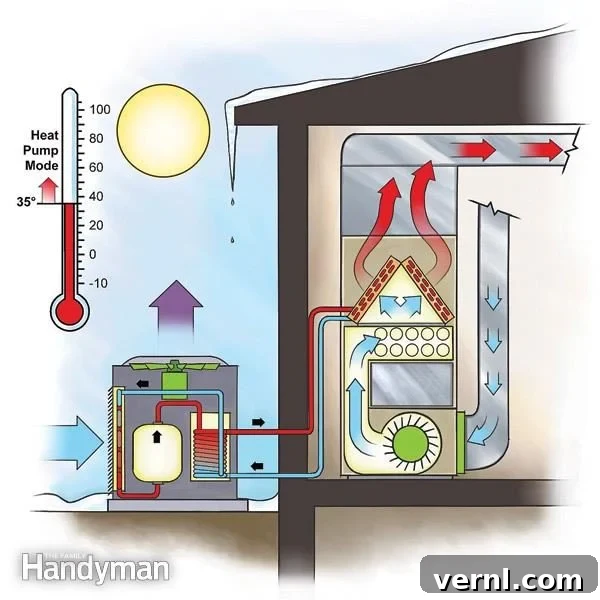
To truly appreciate the HSPF rating, it’s helpful to understand the fundamental principle behind heat pump technology. Unlike traditional furnaces that generate heat by burning fuel, heat pumps simply transfer existing heat from one place to another. In heating mode, they extract thermal energy from the outdoor air (even in cold temperatures) and move it indoors. This process is incredibly efficient because the heat pump isn’t creating heat; it’s merely moving it. The HSPF rating essentially quantifies how efficiently a particular unit performs this heat transfer over an entire heating season, taking into account varying outdoor temperatures and operational cycles. A higher HSPF indicates a system that can extract and transfer more heat with less electrical input, especially during the colder periods when efficiency is most critical.
Choosing the Right HSPF Rating for Your Home
Selecting the optimal HSPF rating for your heat pump involves balancing your budget with your long-term energy savings and comfort goals. Your geographical location and typical winter temperatures are paramount. Homes in colder climates with longer heating seasons will typically see a quicker return on investment from a higher HSPF unit due to the greater number of operating hours and more substantial energy savings. Conversely, homes in warmer regions might find that a unit closer to the minimum HSPF standard provides sufficient efficiency without the higher upfront cost.
Other considerations include the quality of your home’s insulation and windows, as a well-sealed home will retain heat more effectively, allowing even moderately efficient heat pumps to perform optimally. It’s always recommended to consult with a certified HVAC professional. They can conduct a thorough energy audit, assess your home’s specific heating load, and recommend an HSPF rating that aligns best with your climate, home characteristics, and budget. They can also advise on potential local rebates or incentives for installing high-efficiency heat pump systems, which can further offset the initial investment.
Beyond HSPF: Holistic Approaches to Heat Pump Efficiency
While HSPF is an indispensable metric for gauging a heat pump’s heating efficiency, it’s just one piece of the puzzle in achieving comprehensive home energy savings. The actual performance and cost-effectiveness of your heat pump system are influenced by several other critical factors. Proper sizing of the unit is crucial; an undersized heat pump will struggle to heat your home, running constantly and inefficiently, while an oversized unit will short-cycle, leading to uneven temperatures and increased wear and tear. Both scenarios result in wasted energy and reduced comfort, regardless of the HSPF rating.
The integrity of your home’s ductwork also plays a significant role. Leaky ducts can lose a substantial amount of conditioned air before it ever reaches your living spaces, negating the efficiency of even the highest-rated heat pump. Regular maintenance, including cleaning coils and changing filters, ensures your system operates at peak performance throughout its lifespan. Furthermore, integrating your heat pump with a smart thermostat allows for optimized scheduling and temperature control, adapting to your lifestyle and further maximizing energy savings. By considering these elements alongside the HSPF rating, homeowners can ensure their heat pump system delivers unparalleled efficiency and comfort for years to come.