
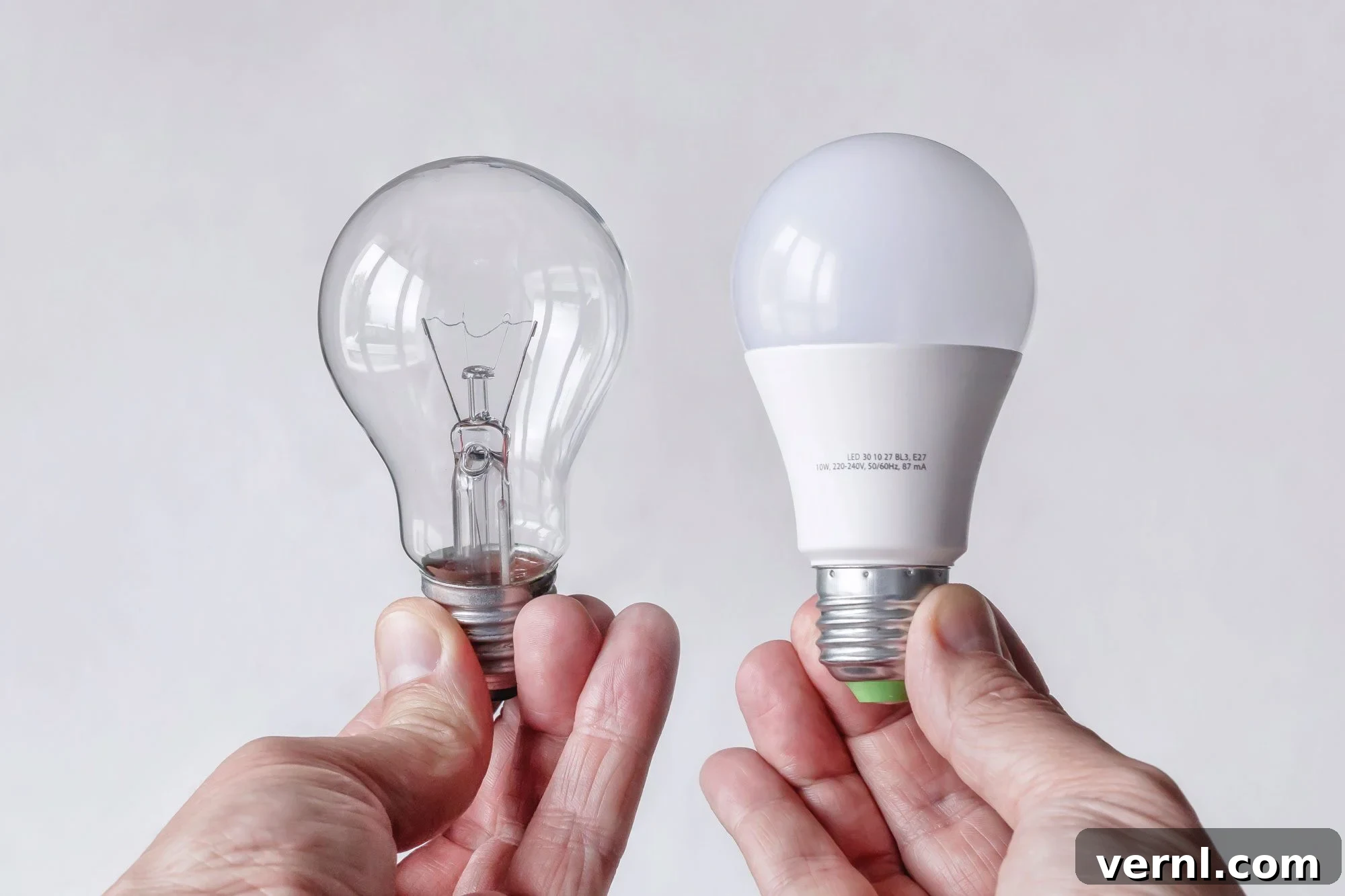
Navigating the world of light bulbs today can feel overwhelming. The simplicity of choosing between a 100-watt or a 60-watt incandescent bulb is long gone. Now, hardware stores and home improvement centers present a dazzling array of lighting options, from specialty shapes and vibrant colors to advanced smart bulbs that respond to your voice or phone. Even as a licensed electrician with thousands of light installations under my belt, the sheer volume of choices can sometimes be bewildering.
If you’re accustomed to traditional incandescent bulbs, you’ve likely noticed their diminishing presence on shelves. This isn’t accidental; incandescents are being phased out, making way for the superior light-emitting diode (LED) technology. While this transition marks significant progress in lighting efficiency, many homeowners remain curious about the fundamental differences between these two prevalent lighting types. Understanding these distinctions is key to making informed decisions for your home’s illumination.
To shed light on this topic, we consulted with three distinguished lighting experts, each possessing decades of invaluable experience in both incandescent and LED technologies. Their insights will guide us through a comprehensive comparison, ensuring you have all the essential information needed to choose the best lighting solutions for your needs.
Understanding Incandescent Lighting: The Classic Glow
Incandescent lights are a cornerstone of modern history, operating on a principle discovered over a century ago: light production through intense heat. Terry McGowan, Director of Engineering at the American Lighting Association, aptly describes the early incandescent bulb as a “hot wire in a bottle.” This charmingly simple description perfectly captures its essence, which has largely remained consistent since its inception.
At its core, an incandescent bulb consists of a glass globe enclosing a thin, coiled wire known as a filament. When electricity flows through this filament, its inherent resistance causes it to heat up dramatically. This extreme heat makes the filament glow brightly, emitting the characteristic warm, yellowish light we associate with incandescents. It’s a testament to a foundational engineering principle that harnessed the power of thermal radiation for illumination.
How Incandescent Lighting Works: A Closer Look at the Filament
The operational mechanism of incandescent lighting relies on a basic principle of electrical resistance. In your home’s electrical system, wires are designed to conduct electricity with minimal resistance. However, the filament within an incandescent bulb is specifically engineered to offer high resistance to electrical current. When you activate the light switch, the electrical current journeys through your home’s wiring until it reaches the bulb. Here, the filament acts like a significant bottleneck or “brake,” impeding the smooth flow of electricity.
As the electrical energy encounters this resistance, it can’t simply disappear. Instead, it transforms into other forms of energy: primarily heat, and as a beneficial byproduct, light. This phenomenon is vividly demonstrated by the red-hot wires in a pop-up toaster, which glow intensely as they toast bread—a perfect analogy for the incandescent bulb’s function. The filament heats to such an extreme temperature that it incandescence, emitting visible light. This heat-centric method, however, is precisely what limits its efficiency, as a vast majority of the energy is lost as heat rather than converted into light.
Pros and Cons of Incandescent Lighting: A Historical Perspective
For generations, incandescent lighting held an undisputed place in homes worldwide, largely due to its distinct advantages, coupled with significant drawbacks that ultimately led to its decline.
Pros:
- Warm, Comforting Light: Perhaps the most cherished attribute of incandescent bulbs is the warm, inviting glow they emit. Their color temperature typically falls in the range of 2700K to 3000K, closely mimicking natural candlelight or a sunset, which many find aesthetically pleasing and relaxing. This soft, full-spectrum light renders colors beautifully, often leading to a high Color Rendering Index (CRI).
- Low Initial Cost: Historically, incandescent bulbs were inexpensive to produce and purchase. Their simple design and readily available materials kept manufacturing costs low, making them an accessible lighting option for everyone.
- Instant On and Full Brightness: Incandescents illuminate instantly to full brightness without any warm-up period, offering immediate light upon flipping the switch.
- Excellent Dimming Capability: They dim smoothly and effectively with conventional dimmer switches, often shifting to an even warmer hue as they dim, enhancing ambiance.
Cons:
- Poor Energy Efficiency: This is the most significant drawback. As George Yianni, Chief Technology Officer at Philips Hue Lighting, highlights, incandescent bulbs are incredibly inefficient. Only 5-10% of the energy they consume is converted into visible light; the remaining 90-95% is wasted as heat. This makes them major contributors to household energy bills and carbon footprints.
- Short Lifespan: Compared to modern lighting technologies, incandescents are remarkably short-lived. Yianni notes a typical lifespan ranging from a mere 750 to 2,000 hours. This necessitates frequent replacements, adding to maintenance costs and waste.
- Federal Efficiency Standards: Due to their inherent inefficiency, incandescent light bulbs no longer meet current federal efficiency standards in many regions, including the U.S. As of August 2023, their sale is largely restricted, primarily limited to specialized applications like oven lights or specific industrial uses where their heat tolerance is an advantage, as McGowan points out.
- High Operating Cost Over Time: While their upfront cost was low, the combination of high energy consumption and frequent replacements means incandescent bulbs cost significantly more to operate over their lifespan compared to more efficient alternatives.
Exploring LED Lighting: The Future of Illumination
Light-emitting diodes, or LEDs, represent a revolutionary shift in lighting technology. Far from the “hot wire in a bottle” concept, LEDs operate on an entirely different principle: electroluminescence. As Dara Greaney, founder of LED Light Expert, explains, it’s a unique method of creating light unlike any other we’ve seen. Instead of a filament, LEDs utilize tiny chips made from semiconductor materials, typically combinations of metal and metal alloys. These chips are coated with a substance called a phosphor, which glows brilliantly when an electric current passes through the diodes.
A key distinguishing feature of LED technology is its minimal heat generation. Greaney emphasizes that approximately 90% of the energy consumed by LEDs is converted directly into light, with very little lost as heat. This fundamental difference not only makes LEDs incredibly energy-efficient but also contributes to their long lifespan and versatility.
How LED Lighting Works: A Semiconductor Marvel
The inner workings of an LED are rooted in solid-state physics. Unlike the thermal process of incandescence, LEDs produce light through the movement of electrons within a semiconductor material. The tiny LED chips themselves can be directly integrated into a light fixture’s housing, eliminating the need for delicate glass globes or fragile glowing filaments.
As McGowan describes, when electricity flows through these semiconductor diodes, light is emitted directly from their surface. This happens as electrons move between different energy levels within the semiconductor material, releasing photons (light particles) in the process. The color of the light emitted is determined by the specific materials used in the semiconductor and, crucially, by the phosphor coating applied to the LED chip. By precisely mixing phosphors that produce red, green, or blue light, manufacturers can manipulate LEDs to generate a wide spectrum of colors, including various shades of white light, allowing for unprecedented control over illumination.
Pros and Cons of LED Lighting: Efficiency, Innovation, and Adaptation
LED lighting has rapidly evolved from niche applications to become the dominant technology in residential and commercial spaces, primarily driven by its remarkable efficiency and adaptability.
Pros:
- Unmatched Energy Efficiency: This is the single greatest advantage of LEDs. They produce significantly more light (measured in lumens) per unit of energy (measured in watts) than any other lighting type available. McGowan states that modern LED light sources with good color characteristics commonly achieve 120-150 lumens per watt—a staggering tenfold improvement over incandescents. This translates to substantial energy savings and lower electricity bills.
- Exceptional Lifespan: LEDs boast an incredibly long operational life. George Yianni confirms that LEDs typically last between 25,000 to 50,000 hours, dramatically outperforming incandescent bulbs’ 750 to 2,000 hours. This longevity drastically reduces the frequency of bulb replacements, saving time, money, and contributing to less waste.
- Smart Home Integration and Versatility: Yianni highlights that “LED lights can be smart, allowing you further customization and energy efficiency.” Smart LED bulbs can be controlled via apps, voice commands, or automated schedules. They offer advanced features like tunable white light (adjusting color temperature), dynamic color changes, and precise dimming. Dimming a smart LED bulb to 70% brightness, for instance, can cut its already low energy use by an additional 51%. Setting them to colors other than white can reduce energy consumption by up to 79%, while also creating unique moods and atmospheres. Their compact size and robust construction also make them incredibly versatile for a vast array of applications, from general household lighting to intricate displays and outdoor fixtures.
- Improved Color Quality: While early LEDs were criticized for producing harsh, “cold” or “blue” light, the technology has advanced significantly. Greaney notes that today’s LEDs offer a wide range of warm color temperatures and excellent Color Rendering Index (CRI) ratings, capable of rendering colors as beautifully as or even better than incandescents.
- Durability: LEDs are solid-state devices with no filaments or glass envelopes that can easily break. They are highly resistant to shock, vibration, and temperature fluctuations, making them ideal for demanding environments.
- Environmental Benefits: Lower energy consumption means reduced greenhouse gas emissions. Their long lifespan also reduces waste sent to landfills.
Cons:
- Higher Initial Cost: The upfront purchase price of LED bulbs can be higher than traditional bulbs. However, this cost is typically offset many times over by energy savings and reduced replacement costs throughout their lifespan.
- Directional Light: LEDs naturally produce highly directional light, meaning the light is concentrated in a specific beam. While this is advantageous for spotlights or task lighting, it can be a disadvantage for general room illumination where diffused light is desired. However, as Greaney explains, frosted covers and diffusers are commonly used in LED bulb designs to spread the light evenly, mitigating this issue effectively.
- Dimmer Compatibility: Older dimmer switches designed for incandescent bulbs may not be fully compatible with LEDs, sometimes causing flickering, buzzing, or inconsistent dimming. This often requires upgrading to LED-compatible dimmers.
- Heat Management: While LEDs produce much less heat than incandescents, they are sensitive to excessive heat at their junction point. Proper heat sinks are crucial for dissipating heat away from the diode to ensure their long lifespan. Poorly designed or cheap LEDs can fail prematurely due to inadequate heat management.
Incandescent vs. LED: A Direct Comparison
While both incandescent and LED technologies serve the fundamental purpose of producing light, their methods, efficiencies, and overall performance diverge significantly. Here’s a head-to-head comparison highlighting their key differences:
- Energy Efficiency: This is arguably the most critical distinction. LEDs are revolutionary in their efficiency, producing ten times or more light (lumens) per watt of energy consumed compared to incandescents. This translates to vastly lower electricity bills and a reduced environmental footprint for LED users.
- Lifespan: LEDs offer unparalleled longevity. According to Yianni, a typical LED bulb can last an astonishing “25,000 to 50,000 hours,” whereas incandescent bulbs typically last only “750 to 2,000 hours.” This means an LED bulb can outlive dozens of incandescent bulbs, drastically reducing replacement frequency and maintenance.
- Heat Output: Incandescent bulbs generate a tremendous amount of heat as a byproduct of light production, with over 90% of their energy wasted in this form. LEDs, conversely, are remarkably cool to the touch, converting over 90% of their energy into light with minimal heat emission. This makes LEDs safer to handle and reduces cooling costs in homes.
- Versatility: The flexibility and durability of LED technology mean they are suitable for an incredibly diverse range of applications, including general room lighting, intricate signage, compact flashlights, decorative Christmas lights, and integrated electronics. Their small size and robust nature allow for innovative lighting designs. While incandescent lights are largely being phased out, they do retain niche applications where their heat generation is an advantage, such as inside ovens or as specific “bug lights” designed to attract insects.
- Color Rendering: Historically, incandescents were praised for their excellent Color Rendering Index (CRI), making colors appear natural and vibrant. As Greaney states, “colors look great” with incandescents. However, LED technology has made immense strides in this area, with high-CRI LEDs now widely available, often matching or even surpassing incandescent quality. This traditional advantage of incandescents is quickly diminishing.
- Durability: Incandescent bulbs are fragile due to their glass envelope and delicate filament, making them susceptible to breakage from impacts or vibrations. LEDs, being solid-state devices, are far more robust and resistant to physical shock.
- Environmental Impact: LEDs offer significant environmental advantages due to their lower energy consumption and longer lifespan, which reduces the need for manufacturing and disposal. Incandescents, with their high energy waste and frequent replacements, contribute more significantly to energy consumption and landfill waste.
Which Is Better: Incandescent or LED Lighting?
In nearly every practical application, LED lighting emerges as the unequivocal superior choice. Incandescent lighting, with its warm glow, holds a nostalgic and emotional appeal, having been a staple in our homes for generations. This familiarity and the pleasing color temperature it produced were once its strongest advantages.
However, as Dara Greaney aptly points out, LED lighting has undergone a profound transformation. The early iterations, often characterized by a stark, sterile “blue” light that was off-putting to many, are largely a thing of the past. Modern LED technology offers an expansive spectrum of color temperatures, from very warm whites (2200K) to bright, cool daylight (6500K), along with excellent Color Rendering Index (CRI) ratings that accurately display true colors. When choosing an LED, simply look for a high CRI on the label (90+) and select a warm temperature (2700K-3000K) if you prefer the traditional cozy ambiance of incandescent bulbs. You’ll find that today’s LEDs can perfectly replicate or even enhance that beloved glow.
But the most compelling reasons to embrace LEDs lie in their foundational strengths: their extraordinary energy efficiency and remarkable longevity. Offering more than ten times the efficiency of incandescents, coupled with an astonishingly long operational life that can span decades, LEDs represent a monumental leap forward. Their dizzying array of styles, shapes, colors, and smart features ensures there’s an LED solution for every need, making them the clear and sustainable winner for modern home illumination.
About Our Esteemed Lighting Experts
Terry McGowan serves as the Director of Engineering at the American Lighting Association. With a distinguished career that includes previous work at GE Lighting, McGowan now operates his own successful lighting design and consulting business. He is also actively involved with prestigious organizations such as the International Dark Sky Association and the American Lighting Bureau, contributing significantly to advancements and standards in the lighting industry.
George Yianni is the Chief Technology Officer at Philips Hue, where he played a pivotal role in the development of the innovative smart Hue lighting system. Before his current position, Yianni served as a project manager and architect for Phillips Lighting, focusing on critical areas such as lighting controls and connectivity, instrumental in shaping the future of smart home lighting.
Dara Greaney is the visionary CEO and founder of LED Light Expert, a prominent e-commerce lighting retailer. His extensive expertise spans across lighting design and advanced LED technology, underpinned by a deep commitment to promoting sustainability and maximizing energy efficiency in lighting solutions.