
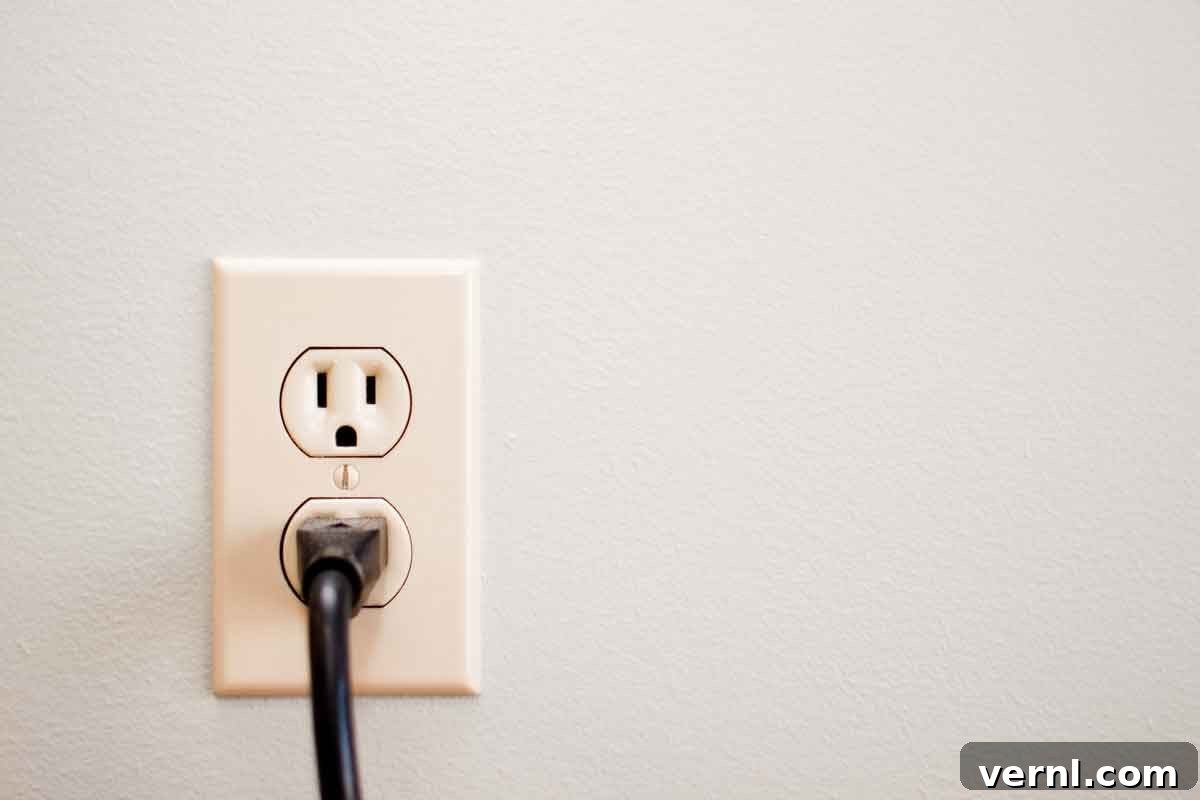
Have you ever taken a closer look at an electrical outlet and noticed that one slot is distinctively larger than the other? This design isn’t arbitrary; it’s a fundamental safety feature engineered to protect you and your electrical appliances. While it might sometimes feel like an inconvenience, requiring you to fiddle with an electrical plug until it slides in correctly, the vertical prongs on a plug and the corresponding slots in an outlet play a critical role. They ensure the safe operation of your everyday plug-in devices, from hairdryers and food processors to vacuum cleaners and table lamps.
In this comprehensive guide, we will delve into the essential reasons behind the varying sizes of outlet slots, what “polarization” truly signifies for your safety, and the crucial distinctions between two-prong and three-prong outlets. Understanding these details is not just about convenience; it’s about safeguarding your home and loved ones from potential electrical hazards.
The “Face” of an Outlet: A Design for Safety
The familiar configuration of two vertical slots above a round hole on a typical U.S. electrical outlet might resemble a surprised emoji, but this standardized layout is far from coincidental. It represents a national electrical standard meticulously designed to ensure plugs are inserted snugly and, most importantly, safely.
In the United States, a standard 120-volt outlet is configured with two vertical slots and a single round hole positioned centrally below them. When you face the wall outlet, with the round hole at the bottom, you’ll observe that the right slot – designated as the “hot” slot – is marginally smaller than the left slot, which serves as the “neutral” connection. The small, round hole is reserved for the equipment grounding prong found on a three-prong plug, a critical component for enhanced safety.
If a plug features only two prongs, with one larger than the other, it indicates a “polarized” type. These plugs, commonly found on lamps or other smaller electrical items, are designed to ensure correct orientation but do not incorporate a grounding prong. The deliberate sizing of these prongs is a silent guardian, working tirelessly to maintain electrical integrity and prevent dangerous situations.
Understanding Polarization: Why One Prong Is Bigger
The disparity in prong size on polarized non-grounding type plugs is a fundamental aspect of electrical safety. The larger prong is the neutral prong, while the smaller one is the hot prong. This design ensures that the hot wire, which carries the live electrical current, is always connected to its intended smaller slot, and the neutral wire connects to its larger counterpart. But why is this specific orientation so important?
Electricity operates within a circuit – a closed, continuous path through which electrons flow from a power source to an appliance and back. To simplify, an outlet’s power flows from the “hot” side to the “neutral” side. When a plug is correctly inserted into the outlet, it completes this circuit. This allows electricity to flow safely from the home’s electrical system to the connected appliance, energizing its motor, heating element, light filament, or other operational components. Polarization ensures that the current always follows the intended path, minimizing risks.
Without polarization, there’s a risk that the appliance’s internal wiring could be “hot” even when the appliance is switched off, simply because the hot and neutral connections could be reversed. While the appliance might still function, this incorrect wiring could pose a significant shock hazard, especially if internal components are touched or if the appliance experiences a fault. The larger neutral prong prevents this reversal, ensuring that the neutral wire, which typically carries current back to the source at near-zero potential, is always correctly aligned, thereby reducing the risk of shock when handling the appliance.
Two-Prong Outlets Vs. Three-Prong Outlets: The Grounding Difference
The most significant and arguably most crucial distinction between two-prong and three-prong receptacle outlets lies in the presence of the third, round hole, which accommodates the grounding wire. This grounding prong and its corresponding wiring serve two paramount safety functions, fundamentally changing the safety profile of the electrical connection.
The Purpose of Grounding
For any appliance or piece of equipment encased in metal – think refrigerators, washing machines, toasters, or computers – the metal chassis or frame is intentionally connected to an equipment grounding wire within the power cord. This equipment grounding wire extends from the appliance’s metal casing to the grounding prong on its plug.
When the plug is inserted into a three-prong receptacle outlet, this grounding prong connects to an equipment grounding wire within the branch circuit wiring. This wire then travels all the way back to your main electrical panel. At the main panel, this equipment grounding wire is connected to the home’s grounding system, which is physically bonded to the Earth, often via a ground rod or water pipes. This elaborate connection ensures that under normal operating conditions, the appliance is “grounded,” meaning its metal casing is maintained at a safe, zero-potential level relative to the Earth, significantly reducing the hazard of electrical shock.
Protection Against Ground Faults
The true genius of the grounding system becomes apparent during an electrical fault. Imagine a scenario where a hot (live) wire inside an appliance accidentally breaks loose and touches the metal frame or case. Without grounding, the entire metal casing would instantly become energized with 120 volts, creating an extremely dangerous ground-fault condition and a severe shock hazard for anyone who touches it.
However, with a properly grounded three-prong system, if a hot wire contacts the metal casing, the equipment grounding wire immediately provides a low-resistance path for this excessive fault current. This current rapidly flows back through the grounding wire to the main electrical panel. The sudden surge of current triggers and “blows” the fuse or “trips” the circuit breaker designed to protect that specific circuit. This action instantaneously interrupts the flow of electricity, de-energizing the circuit and the faulty appliance.
This entire protective sequence unfolds in mere milliseconds – faster than the blink of an eye. This rapid response is precisely what prevents someone from receiving a potentially fatal electrical shock, making the grounding wire an indispensable component of modern electrical safety.
Two-Prong Outlets: Understanding Historical Context and Risks
Two-prong outlets were the standard in many homes built before the 1960s. While they lack the dedicated grounding path of their three-prong counterparts, they are not inherently unsafe if they are wired correctly and remain in good working order, according to the National Electrical Code. It is always recommended to test any two-prong outlet with a circuit tester to confirm its safety for use with small, two-prong household appliances and other low-power items.
A critical safety rule is that a three-pronged attachment plug must never be forced into a two-prong receptacle outlet. Furthermore, you should never break off the grounding prong from a three-prong plug to make it fit a two-prong outlet. This dangerous practice completely bypasses the essential safety function of the grounding system, creating a severe and immediate shock hazard. Doing so renders the appliance’s primary safety mechanism useless, leaving users vulnerable to electrocution if an internal fault occurs.
While a properly functioning, non-grounding type two-prong receptacle outlet is not a hazard in itself, it inherently carries higher risks compared to a grounded three-prong outlet. These risks include:
- Increased risk of electrical fire: Without a grounding path, fault currents might seek alternative, uncontrolled paths, potentially overheating wires or components.
- Higher potential for electric shock: In the event of an internal fault where a live wire touches the appliance casing, there’s no safe path for the current to dissipate, making the casing live and dangerous to touch.
- Potential for damage to sensitive electronic items: While less direct, a lack of proper grounding can sometimes contribute to voltage fluctuations or lack of surge protection effectiveness, potentially harming electronics.
Most hazards associated with two-prong outlets arise from their incorrect use. They are generally safe for devices designed with two-prong attachment plugs, such as cell phone chargers, table lamps, and radios. However, they are completely unsuitable for any appliance or device equipped with a three-wire attachment plug. Despite the availability of numerous electrical “adapters” designed to convert three-prong plugs for two-prong outlets, their misuse can create incredibly serious shock hazards. These adapters often provide a pig-tail wire meant to be connected to the outlet cover screw, theoretically grounding the adapter. However, this method is rarely effective or reliable, as many old two-prong outlets are not truly grounded behind the wall. Always prioritize safety and consider upgrading older two-prong outlets for modern devices.
Three-Prong Outlets: The Gold Standard for Safety
The three-prong receptacle outlet, with its integrated grounding wire, represents the modern standard for electrical safety in homes. It provides a robust defense against dangerous electrical shocks and prevents potential fires. To illustrate its importance, consider the example of a coffee pot:
If a hot wire within a metal-encased coffee pot were to come loose and contact the pot’s metal body, the entire metal case would become electrically energized. Without a grounding wire, anyone reaching for the coffee pot could complete a circuit to ground through their body, resulting in a potentially deadly electrical shock. The current would pass through them, seeking the path of least resistance to the Earth.
However, with a three-prong outlet, the metal case of the coffee pot is connected directly to the grounding wire. If the hot wire touches the metal casing, the fault current immediately flows through the grounding wire, back to the electrical panel, and safely trips the circuit breaker. This swift action isolates the faulty appliance and prevents the metal casing from becoming a shock hazard, safeguarding anyone who might touch it. Three-prong outlets are not just about powering devices; they are a critical layer of protection that significantly enhances home electrical safety.
Frequently Asked Questions About Electrical Outlets
Is it safe to use an adapter to change a non-polarized plug?
No, it is generally not safe to modify or use an adapter to change a non-polarized plug into a polarized one, or vice-versa, by physically altering the plug or using rudimentary adapters. Polarized plugs are designed with differing prong sizes (one wider than the other) to ensure correct hot and neutral wiring, which is critical for safety in many appliances. If an appliance’s plug is non-polarized, and you attempt to force polarization using an adapter or by altering the plug, you risk reversing the hot and neutral connections. This can lead to the appliance’s internal components being energized even when switched off, creating a shock hazard. For appliances that require polarization, the safest and most recommended approach is to replace the entire cord and plug with a correctly polarized one, ensuring it matches the appliance’s internal wiring requirements. Always consult a qualified electrician if you are unsure about wiring or plug configurations.
Can I replace a polarized outlet with a non-polarized one?
No, this is absolutely not a safe practice and is strongly discouraged. Polarized outlets are specifically designed to ensure that the neutral and hot wires are connected correctly, aligning perfectly with polarized plugs that fit accordingly (one prong wider than the other). The purpose of polarization is to maintain safety by consistently directing current flow through the intended path and minimizing the risk of the appliance casing becoming live. Replacing a polarized outlet with a non-polarized one, where the neutral and hot wires can be inserted interchangeably, creates a significant risk of incorrect current flow. This reversal can energize parts of an appliance that should be neutral, leading to a serious electrical shock hazard. Furthermore, it could cause damage to connected devices, potentially leading to overheating or even fire. Always replace an outlet with the same type or upgrade to a safer, grounded type if your wiring permits, and always consult a qualified electrician for such modifications.
What is a GFCI outlet and how does it enhance safety?
A GFCI (Ground Fault Circuit Interrupter) outlet is a specialized type of electrical receptacle designed to protect against electric shock by detecting imbalances in electrical current. Unlike standard circuit breakers or fuses that protect against overcurrent, a GFCI monitors the flow of electricity along the hot and neutral wires. If it detects even a small difference (as little as 5 milliamps) in current returning through the neutral wire compared to what left through the hot wire, it assumes current is leaking out of the circuit – likely through a person or water – and it trips, cutting off power in a fraction of a second. This rapid response time is much faster than standard breakers and is crucial in preventing fatal electric shocks, particularly in areas where water is present, such as bathrooms, kitchens, garages, and outdoor locations. GFCI outlets are mandated by electrical codes in these specific areas for enhanced safety.
How can I tell if my existing two-prong outlet is safely grounded?
Most two-prong outlets in older homes are not truly grounded. The only definitive way to determine if a two-prong outlet is safely grounded is to test it. You can use a simple outlet tester (a small, inexpensive device available at hardware stores) designed for this purpose. However, a more reliable method is to use a multimeter to check for continuity between the neutral slot and a known ground (like a metal water pipe or the screw of a properly grounded electrical box, if accessible). Alternatively, a non-contact voltage tester can help identify if the “hot” side is correctly identified. Crucially, even if the outlet appears to be grounded via the outlet box, the actual wiring in the wall may not extend a true ground path back to your main electrical panel. For accurate assessment and any necessary upgrades, it is highly recommended to consult a licensed electrician who can inspect your home’s wiring and provide safe solutions, such as installing GFCI outlets where grounding wires are absent or upgrading the wiring itself.