Understanding Car Battery Fluid: Your Essential Guide to Battery Health
The heart of your vehicle’s electrical system, a modern car battery, efficiently generates power thanks to a vital component: battery fluid. This essential mixture, known as electrolyte, consists of sulfuric acid and distilled water. It’s the medium through which the electrochemical reactions occur, creating the electricity needed to start your engine and power your vehicle’s accessories.
Depending on the specific type of battery installed in your vehicle, the battery fluid can slowly evaporate over time. This natural process means that certain batteries will periodically require topping off as a critical part of routine battery care. Whether you’re maintaining your current battery or considering an upgrade, especially if you’re looking to replace your RV batteries, understanding battery fluid maintenance is key to prolonging battery life and ensuring reliable performance.
What Type of Battery Powers Your Car?
The automotive industry primarily utilizes two main battery designs today: maintenance-free (MF) and non-maintenance-free (NMF) batteries. Each type has distinct characteristics that dictate its maintenance requirements and applications.
Non-Maintenance-Free (NMF) Batteries: The Wet-Cell Workhorses
Non-maintenance-free batteries, commonly referred to as “wet-cell” batteries, are easily identifiable by the presence of removable filler caps located on the top of the battery casing. These caps, typically six individual ones or two larger caps each covering three cells, allow direct access to the battery cells. This design mandates that the battery fluid in NMF batteries be regularly inspected and topped off as needed. While increasingly less common in new passenger vehicles, NMF batteries are still readily available for purchase online and at auto parts stores. They are particularly popular and widely used in more demanding applications such as marine vessels, motorsports, utility vehicles, and certain heavy-duty equipment where robust, serviceable power is essential.
Maintenance-Free (MF) Batteries: Modern Convenience
In contrast, maintenance-free batteries are characterized by their completely sealed design, lacking any removable filler caps. Instead, a large, flat, unremovable cover securely encases the battery housing, often clearly labeled with the words “Maintenance Free.” This design signifies that the battery is engineered to operate without the need for periodic fluid checks or topping off, as it’s designed to minimize water loss. Today, virtually all new cars come standard with maintenance-free batteries due to their convenience and reduced upkeep. While these batteries do not require fluid replenishment, it is still advisable to test your battery periodically to monitor its charge, cold-cranking amps, and overall performance, ensuring it continues to meet your vehicle’s demands.
Safety First: Handling Car Batteries and Electrolyte
Regardless of whether you have a non-maintenance-free or maintenance-free battery, both types contain sulfuric acid, a highly corrosive substance that can cause severe chemical burns upon contact. Your safety should always be the top priority when working near a car battery, performing maintenance, or even jump-starting a vehicle. Always adhere to strict safety protocols:
- Personal Protective Equipment (PPE): Always wear appropriate personal protective equipment. This includes heavy-duty gloves (preferably acid-resistant rubber gloves) to protect your hands and, most critically, eye protection such as safety glasses or goggles to shield your eyes from splashes. A face shield offers even greater protection.
- Ventilation: Work in a well-ventilated area to disperse any hydrogen gas that may be emitted, especially during charging, as it is highly flammable.
- No Sparks or Open Flames: Never smoke or allow any open flames, sparks, or potential ignition sources near a battery. The hydrogen gas can ignite and cause an explosion.
- Proper Tools: Use insulated tools to prevent accidental short circuits, which can cause sparks and damage. Avoid using metal tools that could bridge the terminals.
- First Aid for Acid Exposure: In the unfortunate event of contact with battery fluid, immediate action is crucial. Flush the affected skin area with copious amounts of clean water for at least 15-20 minutes. If acid gets into your eyes, flush them immediately and continuously with water for at least 20-30 minutes and seek immediate medical attention. Keep a supply of clean water or an eyewash station readily available.
- Neutralize Spills: Have baking soda readily available. It can be mixed with water to create a paste or solution to neutralize acid spills on surfaces.
Why Do Some Batteries Require Topping Off?
The fundamental reason certain batteries, specifically non-maintenance-free types, require periodic fluid replenishment lies in their chemical makeup and operational design. This phenomenon is primarily due to the process of electrolysis and evaporation.
The Electrochemical Process and Water Loss
As an NMF battery undergoes its charge and discharge cycles, the sulfuric acid and water electrolyte facilitates the chemical reactions that store and release electrical energy. During the charging phase, particularly when the battery is near full capacity or being overcharged, some of the water in the electrolyte undergoes electrolysis. This process separates water (H2O) into hydrogen (H2) and oxygen (O2) gases, which then escape through the battery’s vents. This continuous gassing leads to a gradual reduction in the water level within the battery cells, necessitating refilling to maintain optimal performance.
Conversely, maintenance-free batteries are engineered with advanced internal designs, often incorporating lead-calcium or lead-calcium-tin alloys for their grids and specialized gas recombination systems. These innovations significantly reduce gassing and water loss, allowing the battery to maintain stable fluid levels throughout its lifespan without external intervention. Consequently, MF batteries cannot be checked or refilled, even if one wished to.
The Impact of Temperature on Battery Fluid
Environmental temperature plays a significant role in accelerating the evaporation process in NMF batteries:
- Summer Heat: High ambient temperatures dramatically speed up the chemical reactions within the battery. This accelerated activity, coupled with increased rates of electrolysis, causes water to evaporate more quickly. Prolonged exposure to extreme heat can deplete battery fluid levels much faster, leaving the internal plates exposed.
- Winter Cold: While cold weather doesn’t directly cause evaporation, it significantly impacts battery performance. Low temperatures increase the internal resistance of the battery and thicken engine oil, making it harder for the starter motor to turn the engine. To compensate and restore battery power, the alternator works harder and charges the battery at a higher rate and for longer durations. This “overcharging” effect, particularly after a cold start, can overheat the battery and accelerate the electrolysis process, causing more rapid decomposition and evaporation of the battery fluid.
Ignoring low battery fluid levels in an NMF battery has severe consequences. When the electrolyte level drops below the top of the internal plates, those exposed areas will dry out and begin to sulfate irreversibly. This phenomenon, known as sulfation, involves the formation of hard lead sulfate crystals on the plates, which significantly restricts current flow, reduces the battery’s capacity, and ultimately leads to premature battery failure.
How to Determine if Your Battery Needs Topping Off
Identifying whether your battery fluid is low is crucial for preventing damage and ensuring continued reliability. Here are several indicators to look for:
- Battery Indicator “Eye” (for some batteries): Many batteries, particularly maintenance-free types, feature a clear indicator “eye” on their top surface. This eye typically glows green when the battery’s water level is adequate and it’s fully charged. If the eye appears dark, it usually signifies that the battery needs fluid or is deeply discharged. A yellow indicator often means the fluid level is critically low or the battery is defective. It’s important to note that many battery manufacturers recommend replacing maintenance-free batteries that show low fluid levels via the indicator, as they cannot be refilled.
- Performance Warning Signs: A battery with critically low fluid levels will almost always exhibit noticeable performance issues. These signs should never be ignored:
- Slow Crank/No Crank Condition: The most common symptom. The engine may crank slowly, sound weak, or fail to crank at all. This indicates insufficient power due to reduced electrolyte contact with the plates.
- Dimming Lights: Headlights and interior lights may appear noticeably dimmer than usual, especially when the engine is off or starting.
- Alternator or Battery Warning Light: The battery warning light or “ALT” (alternator) light flickering on or remaining illuminated on your dashboard is a clear sign of a charging system or battery problem, which can stem from low fluid levels.
- Other Electrical Problems: Malfunctioning power windows, radio presets resetting, or other intermittent electrical issues can also point to a struggling battery.
- Check Engine Light: In some modern vehicles, a critically low battery voltage can trigger the Check Engine Light, signaling a systemic electrical issue.
- Physical Inspection of Non-Maintenance-Free Batteries: The most direct way to check NMF batteries is by opening the fill caps and visually inspecting the electrolyte levels.
A 12-volt car battery contains six individual “cells,” each housing a set of “plates” (electrodes). When you look down the fill hole of each cell, you’ll see the top edges of these plates. They typically appear grayish and are arranged much like a row of heavy-duty construction paper folded in an accordion style. These plates, made of lead and lead dioxide, react chemically with the sulfuric acid electrolyte to produce the electrical current. For optimal function, these plates must be fully submerged in the electrolyte. The fluid should ideally be about 1/2- to 3/4-inch above the top of the internal plates, or roughly 1/2- to one-inch from the very top of the battery case (just below the bottom edge of the fill hole opening). If the fluid level is below this recommended range, it indicates that the battery needs to be topped off.
Step-by-Step Guide: How to Safely Top Off a Battery
If your inspection reveals that your non-maintenance-free battery’s fluid level is low, follow these precise steps to safely and effectively top it off:
- Ensure the Battery is Fully Charged: Before adding any fluid, make sure the battery is as close to a full charge as possible. Adding water to a discharged battery can dilute the existing electrolyte too much, making it harder to charge properly later and giving a false reading for the correct fluid level. If you’re unsure of the state of charge and there’s no indicator eye, use a voltmeter to check the voltage across the terminals (a fully charged 12-volt battery should read approximately 12.6 volts or higher with the engine off). Alternatively, you can use a battery hydrometer to check the specific gravity (pH) of the battery fluid in each cell. A fully charged battery should have a specific gravity reading of 1.265 or higher.
- Engine Off and Cool: Always ensure the vehicle’s engine is completely off and has had time to cool down. Working on a hot engine or a running vehicle is unsafe.
- Clean the Battery Case: Before removing the filler caps, thoroughly clean the top of the battery case. Use a stiff brush and a mild solution of 1/4-cup baking soda mixed with one-quart of clean water. This alkaline solution will neutralize any spilled acid residue and help to remove dirt and grime. Rinse the area thoroughly with clean water afterward. Cleaning prevents dirt, debris, or neutralized acid from falling into the battery cells once the caps are removed.
- Carefully Remove Filler Caps: For batteries with individual caps, simply unscrew them. If your battery has a larger, three-cell cap, use a flat, non-metallic plastic scraper or pry tool to carefully lift it off. It is absolutely crucial to avoid using anything made of metal, as this could accidentally create a spark or short circuit across the terminals, which is extremely dangerous.
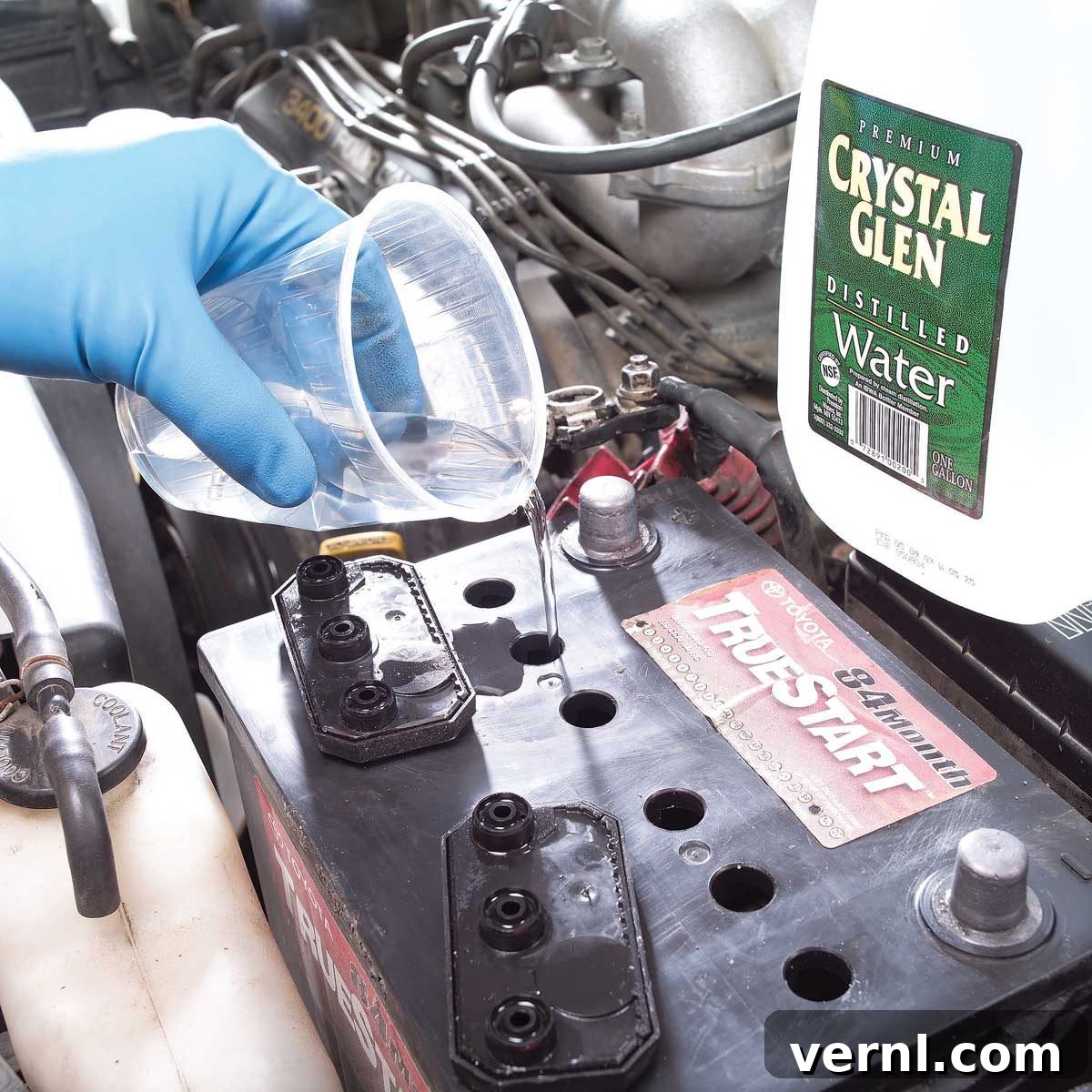
- Add Distilled Water Slowly and Carefully: Using a small, clean plastic measuring cup, a plastic funnel, or a turkey baster to control the flow, carefully and slowly pour distilled water into each cell fill hole. Avoid splashing the fluid, as it can contain residual acid. Crucially, ONLY use distilled water. Tap water contains minerals (like calcium, magnesium, and iron) and other impurities that can contaminate the electrolyte, interfere with the battery’s chemical reactions, cause internal corrosion, and significantly shorten the battery’s lifespan.
- Measure Carefully to the Correct Level: Fill each cell until the fluid level is approximately 1/2- to 3/4-inch above the top of the plates, or just to the bottom edge of the fill hole. Do not overfill! Overfilling can dilute the electrolyte too much, reducing its effectiveness and potentially causing it to expand and overflow during charging, which can damage the battery case and surrounding engine components. Conversely, underfilling leaves the plates exposed, leading to harmful sulfation.
- Securely Re-cap the Fill Holes: Once each cell is filled to the appropriate level, securely replace all the filler caps. Ensure they are tightened properly to prevent any leakage or the entry of dirt and debris.
After topping off, it’s a good practice to clean the battery terminals and cable connections with a wire brush and a battery terminal cleaner spray, then apply a layer of anti-corrosion grease or terminal protector. This helps ensure optimal electrical conductivity and prevents future corrosion.
Maximizing Battery Lifespan and Responsible Disposal
Even with diligent maintenance and regular topping off of non-maintenance-free batteries, no battery lasts forever. The typical lifespan of a car battery varies significantly based on several factors, including climate, driving conditions, frequency of use, and overall battery quality. Generally, you can expect to replace your vehicle’s battery every three to five years. In extremely hot climates, battery life can be considerably shorter due to accelerated chemical reactions and water loss.
Signs that your battery is nearing the end of its life, even after proper maintenance, include difficulty starting the car consistently, dimming lights despite a full charge, or a noticeable decrease in cold-cranking amp (CCA) readings when tested. When the time comes to replace your battery, it is imperative to dispose of your old car battery safely and responsibly. Car batteries contain lead and sulfuric acid, both of which are hazardous materials. Most auto parts stores, service centers, and recycling facilities accept old car batteries for proper recycling, preventing environmental contamination and recovering valuable materials.