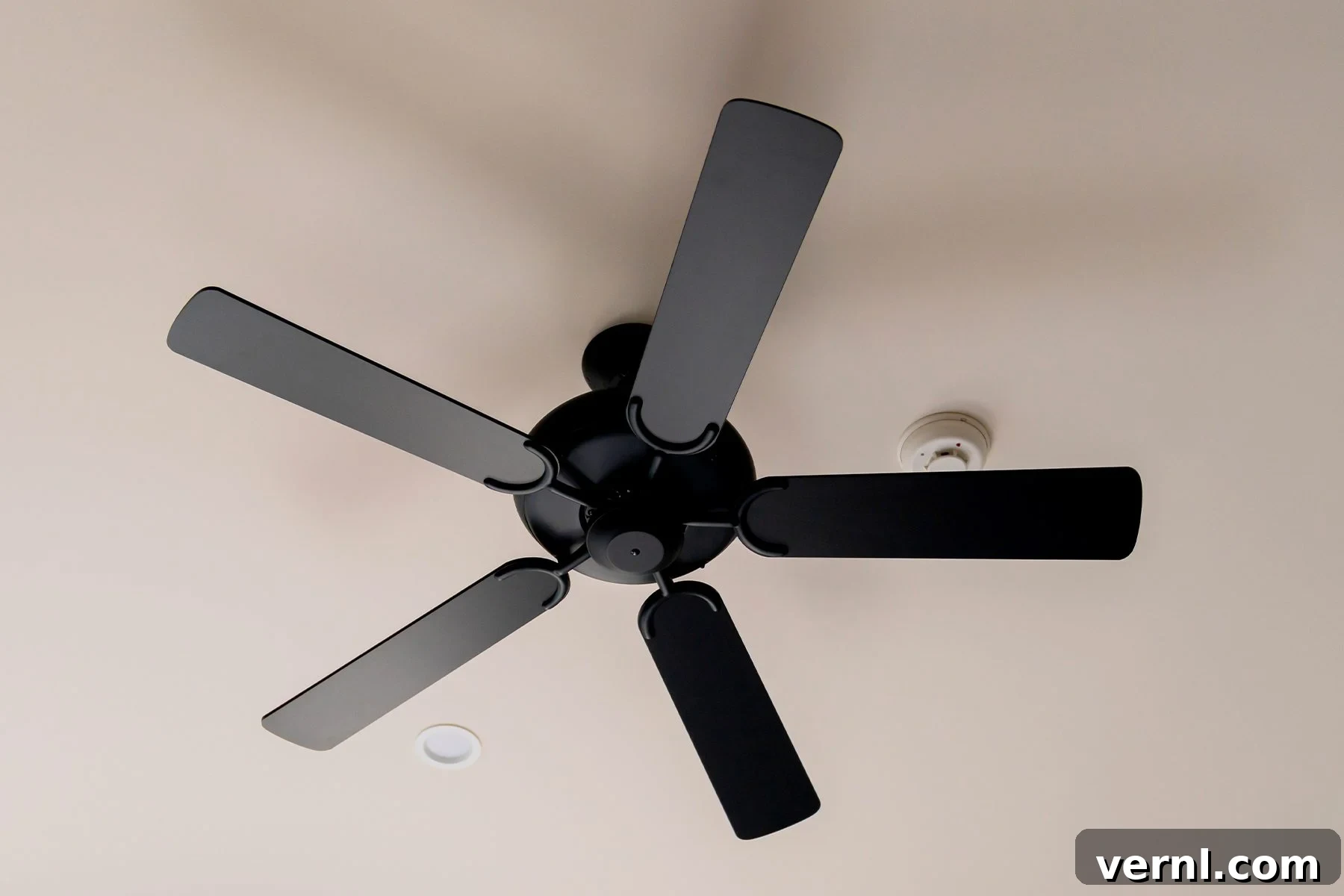
Transforming your home’s comfort and energy efficiency is simpler than you might think, especially with the strategic use of a ceiling fan. In residences featuring high ceilings, such as expansive living rooms or open-plan areas, a ceiling fan transcends its role as a mere decorative fixture—it becomes a powerful instrument for sophisticated climate control. The fundamental principle at play is rooted in basic physics: hot air naturally rises and frequently becomes trapped near the ceiling, creating distinct temperature zones within a single room. A well-placed and properly utilized ceiling fan, with its dynamic spinning blades, actively works to combat this phenomenon, facilitating the circulation of air throughout the entire living space.
What many homeowners might not fully appreciate is that the effectiveness of their ceiling fan largely hinges on its rotational direction. By adjusting the ceiling fan direction, you can deliberately create either a refreshing downdraft to cool the room during the warmer months or a gentle updraft to redistribute accumulated warm air in winter. This seemingly small adjustment can significantly impact your family’s comfort levels and potentially lead to substantial reductions in your monthly energy expenditures throughout the year. Understanding precisely how to set your fan’s spin direction is the cornerstone of unlocking its full potential and ensuring your home remains a sanctuary of comfort, regardless of the external seasonal changes.
Does the Direction of Your Ceiling Fan Truly Matter?
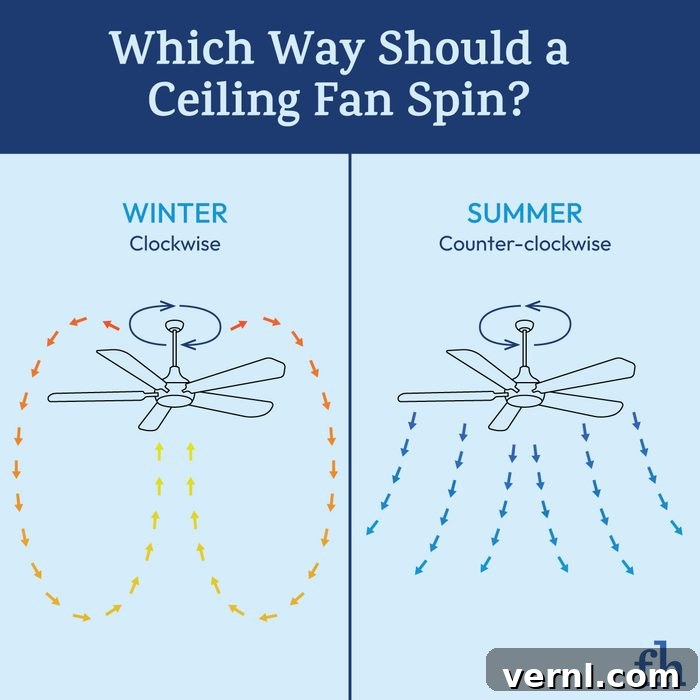
Absolutely, the direction in which your ceiling fan spins can make a profound difference in your home’s thermal comfort and energy consumption. As HVAC professional Simon Bernath aptly explains, “In the summer, you mainly want to feel the breeze and so you should set the fan to ‘push’ air down. In the winter months, you’re mainly trying to create gentle air circulation but without feeling a breeze.” This distinction is critical for optimizing your fan’s performance. The magic behind this lies in how the fan blades interact with the air. Ryan Meagher, a contractor and business development manager, offers a helpful analogy: “You can think about this similarly to how an airplane creates lift to fly. If the fan is moving in one direction it will create a lifting effect for the air that is passing through the blades. If you switch the direction it will create a downward flow of air.”
This principle underscores the vital role of angled blades. Most modern ceiling fans are designed with blades that are intentionally angled to maximize air movement. Without this specific angling, merely spinning blades would do little more than stir the air inefficiently. When the fan rotates, these angled blades either scoop air upwards or push it downwards, creating the desired air currents that help regulate room temperature. The cooling sensation from a fan during hot summer days is widely recognized and appreciated, often allowing occupants to feel comfortable even with a slightly higher thermostat setting. However, the often-overlooked warming effect it can provide in winter is equally valuable. By facilitating efficient air circulation, a ceiling fan helps maintain a comfortable room temperature while simultaneously contributing to significant energy savings by easing the workload on your primary heating and cooling systems.
Remember, the effectiveness of adjusting ceiling fan direction is entirely dependent on your fan having angled blades. Fortunately, the vast majority of ceiling fans on the market today incorporate this crucial design feature, ensuring you can harness the full benefits of directional airflow.
Optimal Ceiling Fan Direction for Summer Cooling
When the summer heat becomes oppressive, your ceiling fan can be your best ally for creating a comfortable indoor environment. As Simon Bernath advises, “In the summer, you mainly want to feel the breeze, so you should set the fan to ‘push’ air down, usually with the blades spinning counterclockwise.” This counterclockwise rotation is the standard setting for summer cooling in most ceiling fans because it creates a direct downdraft, forcing air straight down onto the occupants below.
This downdraft produces what is known as a “wind chill effect.” It doesn’t actually lower the room’s ambient temperature, but rather accelerates the evaporation of moisture from your skin, making you *feel* cooler. This sensation allows you to set your air conditioner thermostat a few degrees higher—typically by about four degrees Fahrenheit—without sacrificing comfort. For instance, instead of setting your AC to 72°F (22°C), you might comfortably maintain 76°F (24°C). This small adjustment can lead to a considerable reduction in energy consumption, as air conditioning systems are among the most energy-intensive appliances in a home.
To ensure your fan is creating this beneficial downdraft, you want the blades to spin so that their leading edges are higher than their trailing edges. Imagine the blade cutting through the air; the side that hits the air first should be slightly elevated, allowing it to scoop the air and push it downwards towards the floor. Always verify your fan’s specific rotation, as while counterclockwise is the general rule, blade angling can vary slightly between models. When operating correctly in summer mode, your ceiling fan provides a welcome respite from the heat, making your living spaces feel breezy and fresh.
Optimal Ceiling Fan Direction for Winter Warming
Conversely, during the colder winter months, your ceiling fan can play a crucial role in distributing warmth and enhancing your heating system’s efficiency. A ceiling fan needs to spin in a “reverse direction” during the winter, which in the majority of cases means rotating clockwise. The primary objective in winter is to gently circulate the warm air that naturally rises and collects near the ceiling, pushing it back down into the living areas where it can be felt.
Warm air is less dense than cool air, so it gravitates upwards, often creating a significant temperature differential within a room. It’s common for the air near the ceiling to be three to four degrees warmer than the air at floor level, especially in rooms with high ceilings. A ceiling fan that spins clockwise—with the leading edges of the blades positioned lower than the trailing edges—will draw cooler air up towards the ceiling. As it does so, it gently forces the trapped warmer air near the ceiling down and out along the walls, distributing it more evenly throughout the room without creating a noticeable direct breeze.
This process, known as destratification, helps to eliminate cold spots and ensures that the heat generated by your furnace or fireplace is utilized more effectively. By continuously mixing the air, your heating system won’t have to work as hard to maintain a comfortable temperature at occupancy level. This leads directly to reduced energy consumption and lower heating bills, providing a subtle yet powerful boost to your home’s overall thermal management during the chilly season. The goal isn’t to feel a direct draft, but rather a more consistent, gentle warmth permeating the entire space.
Does Room Location Influence Ceiling Fan Strategy?
While a ceiling fan offers benefits in nearly any room, its optimal use can indeed vary based on the room’s characteristics and its role within your home’s layout. A ceiling fan works most efficiently if strategically used in a central or high-traffic room, as some of the conditioned air it circulates can then naturally extend its influence to adjacent areas of the house. However, you are by no means limited to central rooms; ceiling fans can be installed in bedrooms, kitchens, home offices, and even outdoor patios. In each instance, adjusting the ceiling fan direction and speed can be tailored to derive the most benefit, depending on the room’s specific attributes and your primary heat source.
HVAC professional John Jordan provides insightful nuances regarding room-specific strategies: “In large open spaces with high ceilings, the clockwise winter setting is particularly effective because it prevents heat from being trapped too high above living areas.” This is especially true for vaulted ceilings or grand foyers where warm air can accumulate significantly out of reach. Conversely, Jordan explains, “in smaller rooms or spaces without strong central heating, you might find that keeping the fan on low in counterclockwise mode even in winter can help distribute localized heat from space heaters or sunlight more efficiently.” This counterintuitive approach in winter can be effective for moving radiant heat from a sunny window or a small portable heater around a confined space. Furthermore, for those in “humid climates, running the fan counterclockwise year-round can enhance evaporation and cooling without the need for constant A/C adjustments,” providing a consistent, low-cost dehumidifying and cooling effect.
Consider bedrooms, where a gentle, counterclockwise breeze can promote restful sleep in summer, or a slow clockwise rotation can prevent cold spots in winter. In a home office, a ceiling fan can help maintain a comfortable working temperature, enhancing focus and productivity without the distraction of an overly powerful HVAC system. The key is to experiment with direction and speed, paying attention to the unique airflow dynamics of each individual room.
How to Effortlessly Change Your Ceiling Fan’s Direction
Adjusting the direction of your ceiling fan is a straightforward process, though the method may vary slightly depending on your fan’s model and age. Most standard ceiling fans are equipped with a physical switch located on the motor housing itself, which allows you to toggle between summer (downdraft) and winter (updraft) modes.
- Safety First: Before attempting to change the direction, always ensure your ceiling fan is completely turned off and its blades have come to a full stop. It’s also advisable to turn off the power at the wall switch or circuit breaker for added safety, especially if you need to reach high.
- Access the Switch: For ceiling-mounted fans, you will most likely need a sturdy step ladder to safely reach the motor housing. Carefully climb the ladder, ensuring it is stable on a flat surface.
- Locate the Switch: Look for a small switch, often a black or brass slider, located on the main body of the fan, usually near where the blades attach or on the side of the motor housing. This is typically a forward/reverse switch.
- Toggle the Direction: Gently slide the switch to the opposite position. There are usually only two settings. If your fan has an associated light kit, the switch might be somewhat concealed behind it.
- Test the Fan: Once the switch is repositioned, safely descend the ladder. Turn the power back on and operate the fan at a low speed to observe the new direction of rotation. For summer, you should feel a distinct breeze beneath the fan (counterclockwise). For winter, you should see the blades spinning but feel minimal direct airflow (clockwise).
More contemporary and upscale ceiling fan models often come with convenient remote controls or even smart home integration. These advanced systems typically feature dedicated buttons that allow you to change the spin direction and adjust fan speed with ease, eliminating the need for a ladder. In some installations, the wall switch that controls the fan might also be directional, offering three settings: one for forward (usually summer), one for reverse (usually winter), and one for off.
If you own an older fan that lacks a dedicated reverse switch, you’re not necessarily out of options, though solutions might be more involved. Some very old models might allow you to manually reverse the pitch (angle) of the fan blades using a wrench or screwdriver. However, this depends entirely on whether your fan’s specific design accommodates such an adjustment, and it’s less common. In such cases, or if you prefer the convenience of modern features, upgrading to a newer model with easy directional controls might be a worthwhile investment for enhanced comfort and energy savings.
Maximizing Your Ceiling Fan’s Energy Efficiency for Year-Round Savings
Beyond simply creating comfort, understanding and utilizing your ceiling fan’s directional settings is a powerful strategy for significantly enhancing your home’s energy efficiency and reducing utility bills. Ceiling fans consume far less energy than air conditioning units or central heating systems. By using them strategically, you can alleviate the workload on your HVAC system, leading to tangible savings.
In summer, the wind chill effect created by a counterclockwise fan allows you to raise your thermostat setting by approximately 4 degrees Fahrenheit without compromising your comfort. For every degree you raise your thermostat, you can potentially save 1-3% on your cooling costs. Over a hot summer, these small adjustments can translate into substantial savings on your electricity bill. Similarly, in winter, a clockwise-spinning fan that gently pushes warm air down from the ceiling means your furnace doesn’t need to run as frequently or as long to maintain your desired temperature. This reduces the energy needed for heating, which is often the largest energy expense in colder climates.
A crucial tip for maximizing efficiency: always remember to turn off your ceiling fan when you leave a room. Unlike an air conditioner or heater, which changes the ambient temperature of a space, a ceiling fan cools people, not rooms. If no one is present to feel the breeze, the fan is merely consuming electricity without providing any benefit. Integrating this simple habit into your routine can further amplify your energy savings.
Beyond Temperature Control: Additional Benefits of Ceiling Fans
While temperature regulation and energy efficiency are primary advantages, ceiling fans offer a host of other benefits that contribute to a more comfortable and pleasant living environment:
- Improved Air Circulation: Even on mild days, a ceiling fan operating at a low speed can help circulate stale air, preventing stuffiness and making a room feel fresher. This is particularly beneficial in rooms that might not have cross-ventilation from windows.
- Aesthetic Appeal: Modern ceiling fans come in an immense variety of styles, finishes, and sizes, allowing them to serve as sophisticated design elements that complement your home’s decor. They can add a touch of elegance or a contemporary flair, becoming a focal point in any room.
- Reduced Moisture: In humid environments or areas prone to dampness (like kitchens or bathrooms), the increased air movement from a fan can help dry surfaces and reduce moisture buildup, potentially mitigating mold and mildew growth.
- Ambient Lighting: Many ceiling fans incorporate light kits, providing both illumination and airflow from a single fixture. This dual functionality is space-saving and convenient, offering adjustable light levels to suit various needs.
- White Noise: For some, the gentle hum or whir of a ceiling fan can act as a soothing source of white noise, helping to drown out distracting sounds and promote better sleep, particularly in bedrooms.
Conclusion: Optimize Your Comfort and Savings with Proper Ceiling Fan Direction
Ceiling fans are far more than just stylish additions to your home; they are dynamic tools for achieving year-round comfort and significant energy savings. By understanding and correctly utilizing your ceiling fan direction—counterclockwise for a cooling downdraft in summer and clockwise for a gentle warming updraft in winter—you can dramatically enhance your living environment. This simple adjustment allows you to feel cooler in the heat and warmer in the cold, often enabling you to nudge your thermostat settings by a few degrees and reduce the strain on your more energy-intensive HVAC systems. Whether you have high ceilings that trap warm air, live in a humid climate, or simply wish to make your home more comfortable and efficient, mastering your ceiling fan’s directional settings is an easy, impactful step. Take a moment to check your fan’s rotation today and start enjoying the full benefits of this versatile home appliance.
About the Experts
- Simon Bernath is the founder of FurnacePrices.ca, which has been providing information about HVAC systems and home energy use to homeowners and small businesses across North America for over 10 years.
- Ryan Meagher is the Business Development Manager for BVM Contracting, a Toronto-based company founded by his father.
- John Jordan is the President of Integrity Heating & Cooling Inc., which has been serving the Chicago area for over 25 years.