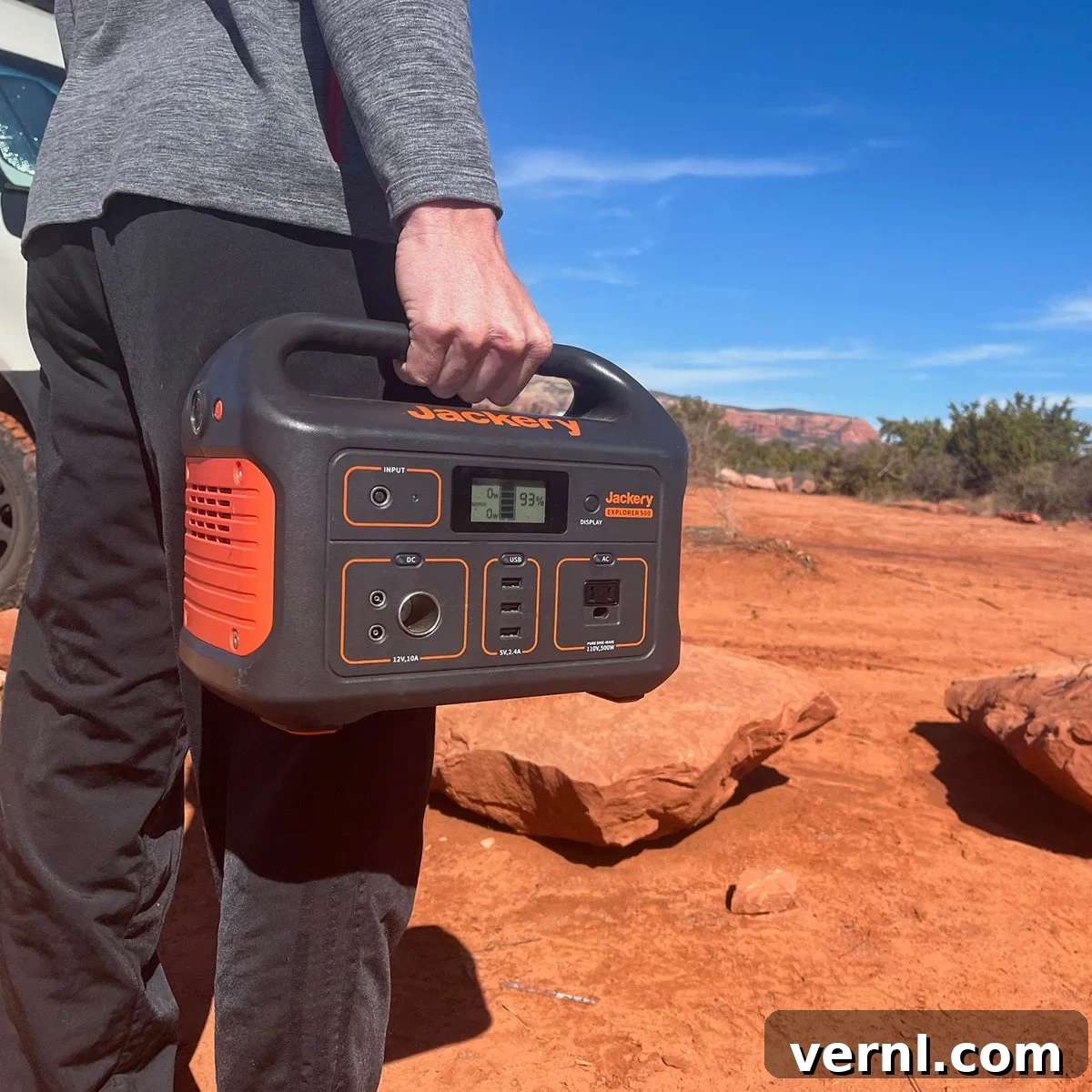
Jackery Explorer 500 Portable Power Station Review: Your Reliable Off-Grid Companion
In the evolving world of mobile living and outdoor adventure, reliable electricity transforms from a convenience into an absolute necessity. For those embracing the freedom of van life or extended camping trips, powering essential devices and appliances—from charging smartphones and laptops to running a vital refrigerator—presents a unique challenge. While modern campervans, including my own Winnebago Revel, often come equipped with standard 120-volt household outlets, USB ports, and 12-volt outlets, the integrated battery capacity, such as my van’s 320-Ah system, still has its limits. This reality means meticulous power management becomes paramount, a stark contrast to the carefree energy consumption typical of a traditional home.
Thankfully, the market offers a growing array of portable power solutions designed to extend your off-grid capabilities. Among these, the Jackery Explorer 500W Portable Power Station stands out as a highly popular and effective choice. As a proud owner who has relied on this unit since 2022, I’ve put it through its paces in various demanding scenarios, cementing its status as an indispensable part of my mobile power setup.
This compact yet powerful portable generator served as my sole independent power source during an epic 12-week car camping journey across the United States. Beyond the road, its versatility proved invaluable during unexpected weather-related power outages while living in a conventional home. Today, the Jackery Explorer 500 acts as a crucial supplement to my campervan’s stock electrical system, providing an extra layer of power security and flexibility.
This comprehensive Jackery Explorer 500 review will delve deep into the device’s capabilities, features, and practical applications. By the end, you’ll have a clear understanding of whether this portable power station aligns with your specific energy needs and lifestyle, whether you’re a seasoned van lifer, a weekend camper, or seeking an emergency home backup solution.
What is the Jackery Explorer 500 Portable Power Station?
Jackery has firmly established itself as a leading brand in the portable power industry, particularly favored by outdoor enthusiasts and individuals embracing off-grid lifestyles. Renowned for its reliable portable battery generators and complementary portable solar panels, Jackery offers a diverse product lineup. Their range spans from ultra-compact 250-watt portable chargers ideal for small gadgets to robust 3000-watt power stations capable of handling heavy-duty appliances.
The Jackery Explorer 500 portable power station, specifically, is positioned within the brand’s mid-to-lower range, offering an excellent balance of power, portability, and affordability. Despite its accessible pricing and manageable size, it is engineered to continuously output 500 watts of power, with impressive 1000-watt surge capabilities. This means it can safely handle devices that require a quick burst of higher wattage to start up, such as certain tools or appliances. Designed for multi-appliance charging, its lightweight and highly portable nature make it an exceptional all-rounder for anyone from casual campers to serious adventurers requiring flexible, on-demand electricity.
At its core, a portable power station like the Jackery Explorer 500 is essentially a large, rechargeable battery pack housed within a protective casing, equipped with various output ports (AC, DC, USB) and an internal inverter to convert DC battery power into AC household power. Unlike traditional fuel generators, it operates silently, produces zero emissions, and requires no maintenance beyond recharging, making it an environmentally friendly and user-friendly alternative for diverse power needs.
Jackery Explorer 500 Features Overview
Let’s explore the standout features that make the Jackery Explorer 500 Portable Power Station a compelling choice for portable electricity.
Understanding Power Specifications: 518 Watt-hours, 500W Inverter, 1000W Surge
To fully appreciate the capabilities of the Jackery Explorer 500, it’s helpful to understand the key power specifications:
- Watt (W): This measures the instantaneous rate at which electrical energy is transferred or consumed. One watt equals one joule (J) per second. In practical terms, a higher wattage output means the power station can run more power-hungry devices or a greater number of devices simultaneously.
- Watt-hour (Wh): This unit quantifies the total amount of energy stored in the battery, equivalent to one watt of power being used for one hour. The 518Wh capacity of the Jackery Explorer 500 indicates its total energy storage, dictating how long it can power devices before needing a recharge. For instance, a 50-watt device could theoretically run for approximately 10 hours (518 Wh / 50 W = 10.36 hours).
- Surge: This refers to the maximum amount of power, in watts, that a power station can momentarily deliver for very short durations. Many electrical devices, especially those with motors (like a small blender or power tool), require a higher initial burst of power to start up than they do to run continuously. The Jackery Explorer 500’s 1000W surge capability ensures it can handle these initial power spikes without immediately shutting down.
With a 518Wh capacity, the Jackery Explorer 500 is designed to continuously output up to 500 watts of power per hour. If the total power demand from connected devices exceeds 500 watts for a sustained period, or briefly surpasses the 1000-watt surge limit, the unit is programmed to automatically shut down to prevent damage. This is a crucial safety and protection feature.
While a 500-watt unit might be considered on the lower end compared to some modern portable generators that boast Watt-hour ratings exceeding 3,000Wh, it’s important to consider the trade-offs. More powerful units typically come with a significantly higher price tag, increased bulk, and heavier weight, making them less practical for quick trips or applications where portability is key. For my specific needs, which primarily involve charging smaller electronics and supplementing my van’s system, the 500Wh capacity with a 1000W surge strikes an ideal balance between sufficient power and convenient portability. It effortlessly handles essential items like cell phones, laptops, earbuds, and headlamps.
Versatile Multi-Appliance Charging
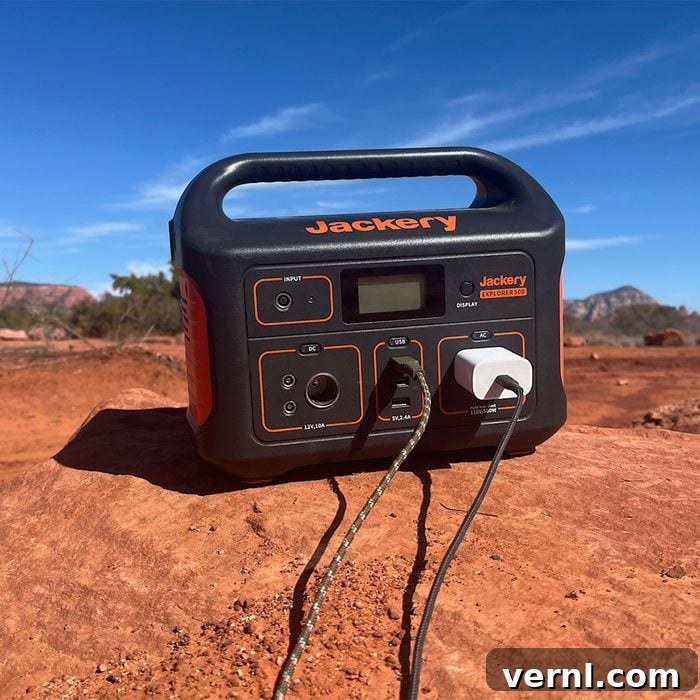
The Jackery Explorer 500 is engineered for comprehensive device compatibility, featuring a wide array of output ports to accommodate various charging needs simultaneously. It includes one standard 120-volt AC outlet, three USB-A ports, one 12-volt DC outlet (often referred to as a cigarette lighter port or car charging port), and two 6-millimeter DC outlets. This diverse port selection allows for incredible flexibility.
As I write this, my Jackery is a bustling hub of activity: my laptop is drawing power from the AC outlet, my iPhone is rapidly charging via one of the USB-A ports, and my Bluetooth earbuds are topping up in another USB-A port. This simultaneous charging capability is a game-changer for managing multiple devices efficiently, especially when off-grid.
My primary wish for a future iteration of the Jackery 500 would be the inclusion of a second 120-volt AC outlet. There are certain devices, particularly those with integrated charging blocks that can’t be detached (unlike many iPhone chargers), which solely rely on the AC outlet. When multiple such AC-dependent devices need power, they have to be charged sequentially, which can be a minor inconvenience. However, for most users with primarily USB-chargeable devices, the current setup is more than adequate.
Convenient Pass-Through Charging
One of the highly practical features of the Jackery Explorer 500 is its pass-through charging capability. This allows you to power or charge connected devices while the power station itself is being recharged. This functionality is incredibly beneficial for maximizing efficiency, particularly in mobile setups. For instance, I can plug my laptop into the Jackery and then plug the Jackery into a 12-volt outlet in my van. This setup enables both the power station and my laptop to charge concurrently while I drive, ensuring I arrive at my destination with all my essential electronics fully powered.
Flexible Recharging Options
When the Jackery Explorer 500 requires a recharge, you’re presented with three convenient options, offering flexibility regardless of your location:
- AC Wall Outlet: You can plug the unit into a standard household AC outlet. The Jackery Explorer 500 includes a two-part AC charger, as the unit itself doesn’t directly support AC input but converts it via the adapter.
- 12-Volt DC Car Outlet: The included 12-volt DC car charger allows you to recharge the Jackery directly from your vehicle’s cigarette lighter port. This is my preferred method while on the road, as it allows me to efficiently charge the power station during transit.
- Compatible Jackery Solar Panel: For an eco-friendly and truly off-grid charging solution, the Jackery Explorer 500 is compatible with Jackery’s range of portable solar panels (sold separately). This option harnesses solar energy to replenish the battery, making it ideal for extended stays in remote locations.
A critical consideration for potential buyers involves the charging times. According to Jackery’s official product specifications, a full recharge from 0% takes approximately 7.5 hours when using either the AC wall adapter or the 12-volt DC car charger. Recharging via a compatible solar panel, under optimal full-sun conditions, extends this time to about 9.5 hours.
In today’s fast-paced tech world, these charging durations can be considered somewhat lengthy. Many newer portable power stations, including some competitors in a similar class, now boast recharge times of less than three hours across various charging methods. While I personally haven’t found the recharge time to be a significant frustration over my two years of ownership—primarily because I often charge the unit passively while driving—it’s an important factor to weigh in your decision-making process, especially if rapid turnaround is a high priority for your use case. Jackery might consider improving these speeds in future iterations of the Explorer 500 to remain competitive.
Advanced Battery Management System (BMS) Protection
Safety and longevity are paramount for any portable power device. The Jackery Explorer 500 is equipped with a sophisticated Battery Management System (BMS) that actively monitors and protects the unit. This intelligent system, combined with a pure sine wave inverter and integrated temperature sensors, safeguards against a comprehensive range of potential issues. These include protection from short circuits, overcharge, overvoltages, and extreme temperatures (both freezing and overheating). This robust protection ensures reliable and safe operation, extending the lifespan of the power station and protecting your connected devices.
Wide Operational Temperature Range
The Jackery Explorer 500 is designed to operate effectively across a respectable temperature spectrum, capable of both accepting and delivering charges within a range of 14 degrees Fahrenheit to 104 degrees Fahrenheit (-10°C to 40°C). While this might not be the absolute broadest working temperature range offered by all portable power stations currently on the market, it certainly covers the vast majority of environments and conditions encountered by most users. For typical camping, road trips, or home emergency use, this range provides ample reliability and ensures performance in a variety of climates.
Intuitive Backlit LCD Display
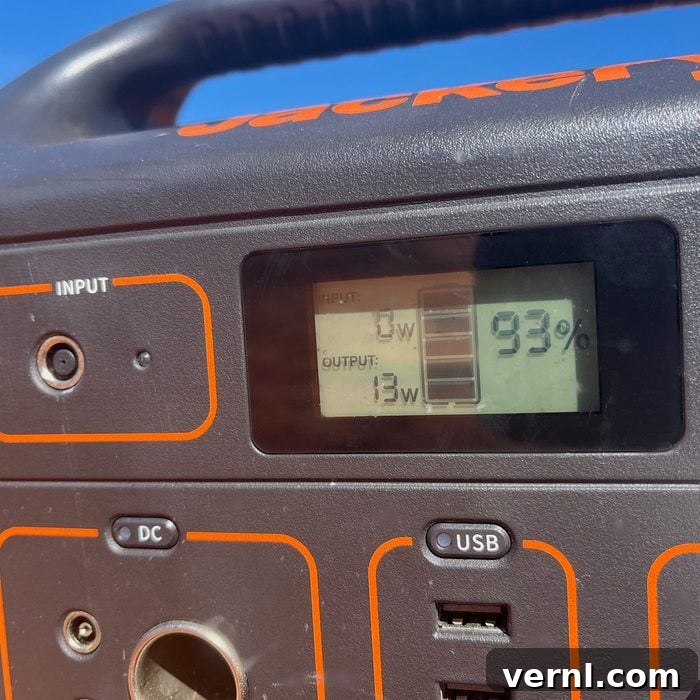
User-friendliness is a hallmark of the Jackery Explorer 500, exemplified by its simple yet highly functional backlit LCD screen. This clear display provides essential real-time information at a glance, allowing you to easily monitor the power station’s current charge status, as well as the input wattage (when charging) and output wattage (when powering devices). This direct feedback is invaluable for efficient power management, helping users understand their consumption and remaining battery life.
Integrated Flashlight and Ergonomic Carry Handle
Portability is a key design principle of the Jackery Explorer 500. Weighing approximately 13 pounds (around 5.9 kg), it is remarkably lightweight for its capacity, making it easy to move around. The integrated, sturdy handle located on the top of the unit further enhances its transportability. Additionally, the power station features a built-in flashlight, a thoughtful inclusion that proves incredibly handy. This light can be a lifesaver during nighttime activities at camp, while navigating dark spaces, or when simply needing illumination during a power outage or when transporting the unit to an off-grid campsite.
Real-World Testing: My Experience with the Jackery Explorer 500
My interaction with the Jackery Explorer 500 transcends a typical “I tried it for a week” review; it’s more accurately described as an “I rely on this every single day of my life” scenario. Over the past two years, my Jackery 500 has become an unfailingly dependable companion, an extension of my van’s electrical system, and a crucial enabler of my off-grid lifestyle. I confidently count on it to perform its essential function: to alleviate the strain on my van’s main battery, thereby significantly extending my independent power duration.
My primary use for the Jackery revolves around charging a variety of small-to-medium electronics. This includes daily essentials like my cell phone, my laptop, my DSLR camera battery, Bluetooth earbuds, and my GPS watch. I also use it to recharge my dog’s e-collar and the tiny portable charger I always carry on outdoor adventures to keep my phone topped up. While each of these items individually requires a relatively small amount of power, their collective and repetitive recharging over several days accumulates to a substantial power draw.
The strategic use of the Jackery Explorer 500 directly translates into longer periods of off-grid autonomy. By diverting the charging load of these personal devices to the Jackery, I conserve my van’s integrated 320-Ah battery for crucial, higher-power essentials like the heater, refrigerator, ventilation fan, and water pump. This mindful power distribution means I can comfortably stay in remote locations for significantly longer durations without needing to start the engine or seek external power hookups.
Depending on the number of devices I’m charging and the frequency of use, the Jackery 500 generator typically lasts anywhere from a few days up to a full week on a single charge. One of its most impressive and appreciated characteristics is its minimal self-discharge rate: if left dormant and fully charged, it retains 100% of its charge for extended periods, ready for immediate use whenever needed. This passive retention of charge is a significant advantage, providing peace of mind and ensuring reliability.
Recharging the Jackery in Practice
My primary method for recharging the Jackery Explorer 500 is through the 12-volt DC outlet in my van. This is done conveniently while I’m driving between destinations. With the van’s engine running, both the Jackery and the van’s integrated 320-Ah battery efficiently recharge. By the time I reach my next campsite or stopping point, both power sources are replenished and ready for continued use.
While the Jackery can also be recharged via a 120-volt AC wall outlet or a Jackery solar panel, I currently only utilize the 12-volt option on the road. I own the 220-watt Jackery SolarSaga solar panel but opted against bringing it into my van for the sake of conserving precious space. This is a decision I’m increasingly beginning to reconsider. The thought of setting up the portable power station with a solar panel outside my camp, basking in the sun, and enjoying an even greater, self-sustaining charging capability without needing to run the van’s engine or seek alternative power sources, is undeniably appealing for truly extended off-grid stays.
As it stands, if the Jackery Explorer 500 runs out of charge while I’m stationary at a campsite, I simply put it away and switch to using the integrated van outlets for charging my devices until I’m back on the road and can recharge the Jackery.
Pros of the Jackery Explorer 500
- Robust Power Capacity: Features a 518Wh capacity with a 500W inverter and an impressive 1000W surge capability, ideal for a wide range of devices.
- User-Friendly Design: Exceptionally simple to learn and operate, even for those new to portable power stations.
- Portability: Equipped with an ergonomic, easy-carry handle and a lightweight design (approx. 13 lbs), making it highly portable.
- Versatile Recharging: Offers three convenient ways to charge: 120-volt AC wall outlet, 12-volt DC car outlet, or compatible solar panels.
- Extensive Output Ports: Includes three USB-A ports, one 12-volt DC outlet, one 120-volt AC outlet, and two 10A DC outlets, supporting multiple devices simultaneously.
- Pass-Through Charging: Capable of charging connected devices while the power station itself is being recharged, enhancing efficiency.
- Efficient On-the-Go Charging: Recharges effectively while driving when plugged into a 12-volt outlet, maximizing convenience for road warriors.
- Excellent Charge Retention: The battery does not drain significantly when the generator is dormant, ensuring it’s ready when you need it.
- Quiet Operation: Operates at a low noise level (around 37.9 decibels), making it much quieter than traditional fuel generators.
- Integrated Illumination: Features a built-in flashlight/lantern for added utility in low-light conditions.
- Long-Lasting Battery: Maintains approximately 80% charge capacity even after completing 500+ full charge cycles, indicating good battery longevity.
- Comprehensive Safety: Built-in Battery Management System (BMS) provides robust protection against circuit shortages, power surges, overcharge, and over-voltages.
Cons of the Jackery Explorer 500
- Single AC Outlet: Only one 120-volt AC outlet limits simultaneous powering of multiple AC-dependent devices.
- Bulkiness for Van Life: While relatively small, its footprint can still be a consideration in very compact living spaces like small vans.
- No USB-C Port: Lacks modern USB-C ports, which are increasingly common for fast charging newer devices.
- Slow Solar Recharging: Takes almost 10 hours to fully charge via solar panels under ideal, complete full sun conditions, which is slower than some competitors.
- Shorter Warranty Period: The warranty offered is somewhat shorter compared to some other premium portable power stations on the market.
Frequently Asked Questions (FAQ)
Is it OK to leave the Jackery Explorer 500 plugged in all the time?
Information regarding continuous charging can be somewhat contradictory across different manufacturers. Traditional advice for battery longevity often suggests unplugging devices once they reach a full charge to prevent potential long-term stress on the battery. Jackery’s official website confirms that their products are indeed equipped with overcharge protection, a crucial feature. However, they still encourage users to unplug the generators once a full charge is achieved. Interestingly, the owner’s manual for the Explorer 1000 Power Station explicitly states that unplugging is not necessary due to the built-in protection. To err on the side of caution and maximize battery health over many years, it’s generally best practice to unplug the power station once it indicates a full charge. From my personal experience with the Jackery 500, it exhibits excellent charge retention; it does not lose any significant charge when sitting idle for weeks, whether plugged in or not.
Do Jackery solar panels work on cloudy days?
Yes, Jackery solar panels, like most photovoltaic panels, are capable of generating electricity on cloudy days and even during winter months. However, it’s important to manage expectations regarding performance. The power output will be significantly less compared to a day with full, direct sunlight during summer. On cloudy days or days with a low UV index, you should anticipate your Jackery generator to charge much more slowly than the stated optimal charging times.
Can you leave Jackery solar panels out in the rain?
The water resistance of Jackery solar panels depends on the specific model you own. For instance, the Jackery SolarSaga 60W and SolarSaga 100W panels are not designed to be waterproof and should absolutely not be left exposed to rain or wet conditions. More advanced models, such as the Jackery SolarSaga 200W, 300W, and 80W, carry an IP67 or IP68 rating, which technically indicates dust and weather resistance. Despite these ratings, Jackery generally does not recommend leaving them out in the rain for prolonged periods. Furthermore, it’s crucial to remember that the Jackery portable power stations themselves are not waterproof. Therefore, even if your panels could handle some rain, the connected power station would still be at risk, rendering the point of leaving them out moot.
What can a 500W portable power station typically run?
A 500W portable power station like the Jackery Explorer 500 is well-suited for a wide array of devices. It can efficiently charge most smartphones (5-10W), tablets (10-18W), and laptops (45-65W) multiple times. For small appliances, it can run mini-fridges (40-60W) for several hours, power LED lights (10-20W) for a full night, or run a portable fan (20-40W). It’s also great for drones, cameras, CPAP machines (without humidifier/heater), and small blenders that don’t exceed the 500W continuous output or 1000W surge capacity. It’s generally not designed for large, high-wattage appliances like microwaves, coffee makers, or electric kettles, which would quickly drain or overload the unit.
What Other Reviewers Had to Say About the Jackery Explorer 500
The Jackery Explorer 500 has garnered widespread positive feedback from users across various platforms. On Amazon, for instance, it boasts an impressive average rating of 4.7 stars from nearly 9,000 reviews, indicating a high level of customer satisfaction.
Many five-star reviewers praise its reliability and ease of use. R. Ridley, a satisfied customer, writes, “Great product. Love this and am very glad I got it…it is everything as advertised. I bought this as a backup power source for if/when we lose power. I have a CPAP and wanted to make sure the 500 could handle it, so I have tested it multiple times over this week. With only CPAP on, tube heat off, and humidity tank off, I got great power several nights.” This highlights its utility for crucial medical devices during outages.
Another verified Amazon purchaser, Troyellen, shared a unique and practical use case: “Had our first storm this year and while at work, my car locks froze up tight. Luckily I got a ride home. Went back the next day with my Jackery 500 and a hair dryer and had my locks thawed and opened in just a few minutes. Hate to think how much it would have cost to call a locksmith out to open my car. Amazed at how handy this product is.” Such testimonials underscore the Explorer 500’s versatility beyond standard charging needs.
While there isn’t an overwhelming number of in-depth expert reviews specifically focused on the Jackery Explorer 500 from dedicated gear testers, the general consensus among those who have evaluated it is that it’s a solid, dependable unit. However, recurring suggestions for improvement echo my own observations and those of many users. The most common request is for faster charging capabilities, particularly when utilizing solar panels. A full charge taking seven to ten hours can feel quite protracted in today’s rapid-charging technological landscape. Another frequent point of feedback is the desire for an additional 120-volt AC outlet, given that the current model only features one. I wholeheartedly agree with both of these suggestions; incorporating faster charging technology and an extra AC port would significantly enhance the utility and competitiveness of future iterations of the Jackery Explorer 500.
Product Comparison: Jackery Explorer 500 vs. Goal Zero YETI 500
If you’re in the market for a portable power station, you’ve likely encountered other prominent brands alongside Jackery, such as Bluetti, Anker, Goal Zero, EcoFlow, and BougeRV. To provide a balanced perspective, let’s compare the Jackery Explorer 500 Portable Power Station directly with a similar and highly popular competitor: the Goal Zero YETI 500 Portable Power Station.
From a pure specifications standpoint and considering value for money, the Goal Zero YETI 500 often presents itself as the more powerful and feature-rich option between the two, particularly when priced similarly. While I genuinely love my Jackery 500 and remain highly satisfied with its performance—having no immediate plans to replace it—my role as a gear reviewer necessitates steering readers towards the best possible purchase. In a head-to-head comparison at the same price point, the Goal Zero YETI generator often emerges as the superior investment for several key reasons:
- Extended Lifespan: The Goal Zero YETI typically offers more than quadruple the charge cycles, indicating a significantly longer battery lifespan.
- Rapid Recharging: It boasts substantially faster recharging times for the power station itself, a critical advantage for users needing quick turnarounds.
- Enhanced Port Options: The YETI often includes a broader selection of output ports, potentially including USB-C or additional AC outlets.
- Broader Temperature Resilience: It typically features a greater working temperature range, offering more reliability in extreme climates.
- Extended Assurance: Goal Zero usually provides a longer warranty period, offering greater peace of mind.
- Water Resistance: The Goal Zero YETI 500 often carries an IPX4 rating for water resistance, providing a degree of protection against splashes.
The trade-offs with the Goal Zero YETI are relatively minor in the grand scheme. It weighs approximately 3 pounds more than the Jackery Explorer 500, making it slightly heavier to transport. Additionally, its watt-hour capacity is 499Wh, which is marginally less than the Explorer’s 518Wh. However, these small differences are often outweighed by the YETI’s advantages, especially its superior battery longevity and faster charging.
Despite these comparisons, if you happen to find the Jackery Explorer 500 on a significant sale on Amazon or elsewhere, I would still highly recommend it—you certainly won’t regret the purchase. It’s a fantastic unit in its own right. It’s also important to note that I haven’t personally tested the Goal Zero YETI 500 in real-life, day-to-day scenarios, so my comparison is based on published specifications and general market perception.
Final Verdict: Is the Jackery Explorer 500 Right for You?
As a dedicated consumer and daily user, I am unequivocally more than satisfied with the Jackery Explorer 500 Portable Power Station. For nearly two years, this unit has consistently performed without a single failure or letdown. My personal favorite features continue to be its impressive variety of charging ports, the practical integrated flashlight, the invaluable ability to recharge it conveniently while driving my van, and its exceptional capacity to hold a charge even when left dormant for extended periods.
While it’s true that the market now offers portable generators with higher power outputs or faster charging speeds at a similar price point, I firmly believe that the Jackery Explorer 500 remains a very solid purchase. It’s a reliable, user-friendly, and efficient power solution that meets the needs of a broad audience. For individuals seeking a dependable portable power station for camping, road trips, light off-grid living, or as an essential emergency backup for home use, I am confident that most people will be very happy with their Jackery Explorer 500. Its balance of capacity, portability, and robust features makes it an excellent choice for everyday power needs.
Where to Buy the Jackery Explorer 500 Portable Power Station
The Jackery Explorer 500 Portable Power Station is readily available for purchase through several reputable retailers, offering convenience and competitive pricing. You can buy the unit directly from the official Jackery website, which typically lists it at its standard price of $499. It is also available on Walmart’s website. For potential savings, I highly recommend checking Amazon, where the Jackery Explorer 500 is frequently featured on sale, often at a lower promotional price, making it an even more attractive investment for portable power.