Master the Sailor’s Knot: Your Ultimate Guide to Essential Rope Tying Skills
Unlock the secrets of secure fastenings and discover why the humble knot remains an indispensable tool in countless scenarios. From the high seas to the backyard campfire, mastering basic knots is a foundational skill that offers practicality, efficiency, and safety. In this comprehensive guide, we’ll dive deep into the world of knot tying, focusing on the fundamental “Sailor’s Knot,” most commonly recognized as the Square Knot or Reef Knot, and explore its versatile applications.
The Timeless Art of Knot Tying: More Than Just Ropes
Knot tying is an ancient art, a practical skill, and a crucial safety measure that has served humanity for millennia. From the earliest navigators traversing vast oceans to modern-day adventurers scaling mountains or setting up camp, the ability to securely fasten, join, or loop ropes has been indispensable. It’s a skill that transcends hobbies, touching upon survival, utility, and even a form of meditative practice. While there are thousands of different knots, understanding a select few can equip you for a myriad of situations.
Among the myriad of knots, the “Sailor’s Knot” stands out as a universally recognized and incredibly useful knot. While “sailor’s knot” is a general term often referring to any knot used by sailors, it most frequently points to the Square Knot (also known as the Reef Knot) due to its historical significance and widespread utility in maritime activities. This guide will help you understand, tie, and master this essential knot, along with exploring its widespread applications and introducing other vital knots that every enthusiast should know.
What is the Sailor’s Knot? Understanding the Square (Reef) Knot
When most people refer to a “Sailor’s Knot,” they are typically thinking of the Square Knot, also known as the Reef Knot. This symmetrical knot is one of the most recognized and essential knots in existence, celebrated for its simplicity and effectiveness in specific contexts. Its primary function is to join two ends of a rope of *equal diameter* securely, forming a flat knot that can be easily untied when not under heavy load.
A Brief History and Its Maritime Roots
Historically, sailors relied heavily on the Reef Knot to ‘reef’ or shorten sails, hence its alternate name. When a ship encountered strong winds, sailors would tie the lower part of the sail to the boom using reef points, securing them with a series of Reef Knots. Its flat profile was ideal as it wouldn’t snag on rigging or cause unnecessary bulk. Beyond sailing, this knot has found its way into countless applications, from first aid (securing bandages) to everyday household tasks.
When to Use the Square Knot
- Joining Two Ropes: Ideal for connecting two ropes of the same thickness for non-critical applications.
- Securing Bundles: Excellent for tying up packages or securing items that won’t bear a significant load.
- First Aid: Commonly used to tie off bandages or slings.
- Decorative Purposes: Its symmetrical appearance makes it appealing for certain crafts.
Important Note: While versatile, the Square Knot is not suitable for situations where human safety is at stake or where ropes are under extreme tension. It can slip if pulled unevenly or if the ropes are of different materials/diameters. For critical loads or joining ropes of different sizes, other knots like the Sheet Bend are preferred.
Step-by-Step Guide: How to Tie the Sailor’s Knot (Square Knot)
Learning to tie the Square Knot is incredibly straightforward and can be mastered in moments. Follow these simple steps to confidently tie one of the world’s most useful knots:
- Start with Two Rope Ends: Hold one end of a rope in your left hand and the other end in your right hand. Imagine these are the two ropes you want to join, or two ends of the same rope you want to secure.
- First Crossover (Left Over Right): Take the end of the rope in your left hand and pass it over and then under the end of the rope in your right hand. Pull snug, creating a simple overhand knot.
- Second Crossover (Right Over Left): Now, take the new “left” working end (which was originally in your right hand) and pass it over and then under the new “right” working end (which was originally in your left hand).
- Tighten and Inspect: Pull both working ends and both standing parts simultaneously to tighten the knot. The finished knot should look symmetrical and flat, with the two loops interlocking neatly. The two working ends should emerge parallel to their respective standing parts.
The mnemonic “Right over left, then left over right” (or vice versa) is often used, but ensure you reverse the order for the second step. If you repeat the same crossover direction twice, you’ll end up with a “Granny Knot,” which is unstable and prone to slipping – something we definitely want to avoid!
Watch and Learn: Tying the Square Knot in Under a Minute!
Sometimes, seeing is believing. This quick video tutorial provides a clear visual demonstration, allowing you to learn how to tie a perfect Square Knot in just seconds. Follow along with your own piece of rope!
Practice makes perfect! After watching the video, grab a piece of rope and try it yourself. The more you practice, the more intuitive the movements will become.
Common Mistakes to Avoid While Tying Knots
Even with simple knots like the Square Knot, small errors can lead to unsafe or ineffective fastenings. Be mindful of these common pitfalls:
- The Granny Knot: As mentioned, repeating the same crossover direction twice (e.g., right over left, then right over left again) creates a Granny Knot. This knot is unstable, unreliable, and will slip under tension. Always ensure your second crossover reverses the direction of the first.
- Not Dressing the Knot: “Dressing” a knot means arranging its components so that each part lies correctly and tightly without crossing or binding. A well-dressed knot is stronger and less likely to deform or untie.
- Not Setting the Knot: After dressing, “setting” the knot involves pulling all parts firmly to ensure it’s tight and secure.
- Using the Wrong Knot for the Job: This is perhaps the most critical mistake. While the Square Knot is useful, it’s not a universal solution. Never use it for critical loads or to join ropes of different diameters or materials.
Beyond the Square Knot: Other Essential Knots for Every Enthusiast
While the Square Knot is a fantastic starting point, the world of knots is vast and fascinating. To truly enhance your rope skills, consider learning these other indispensable knots:
1. The Bowline Knot: The King of Loops
Known as the “king of knots,” the Bowline creates a fixed, non-slip loop at the end of a rope. It’s incredibly reliable and easy to untie even after being under significant load. Essential for mooring, rescue, or creating a secure loop that won’t constrict.
2. The Clove Hitch: Quick to Attach
The Clove Hitch is a quick and simple knot used to attach a rope to a post, rail, or spar. While not always the most secure under varying tension, its ease of tying and untying makes it popular for temporary fastenings like mooring small boats or securing items in a temporary fashion.
3. The Sheet Bend: Joining Dissimilar Ropes
Unlike the Square Knot, the Sheet Bend excels at joining two ropes of different diameters or materials. It’s incredibly secure and resistant to slipping, making it a go-to knot for extending a rope or connecting different types of lines.
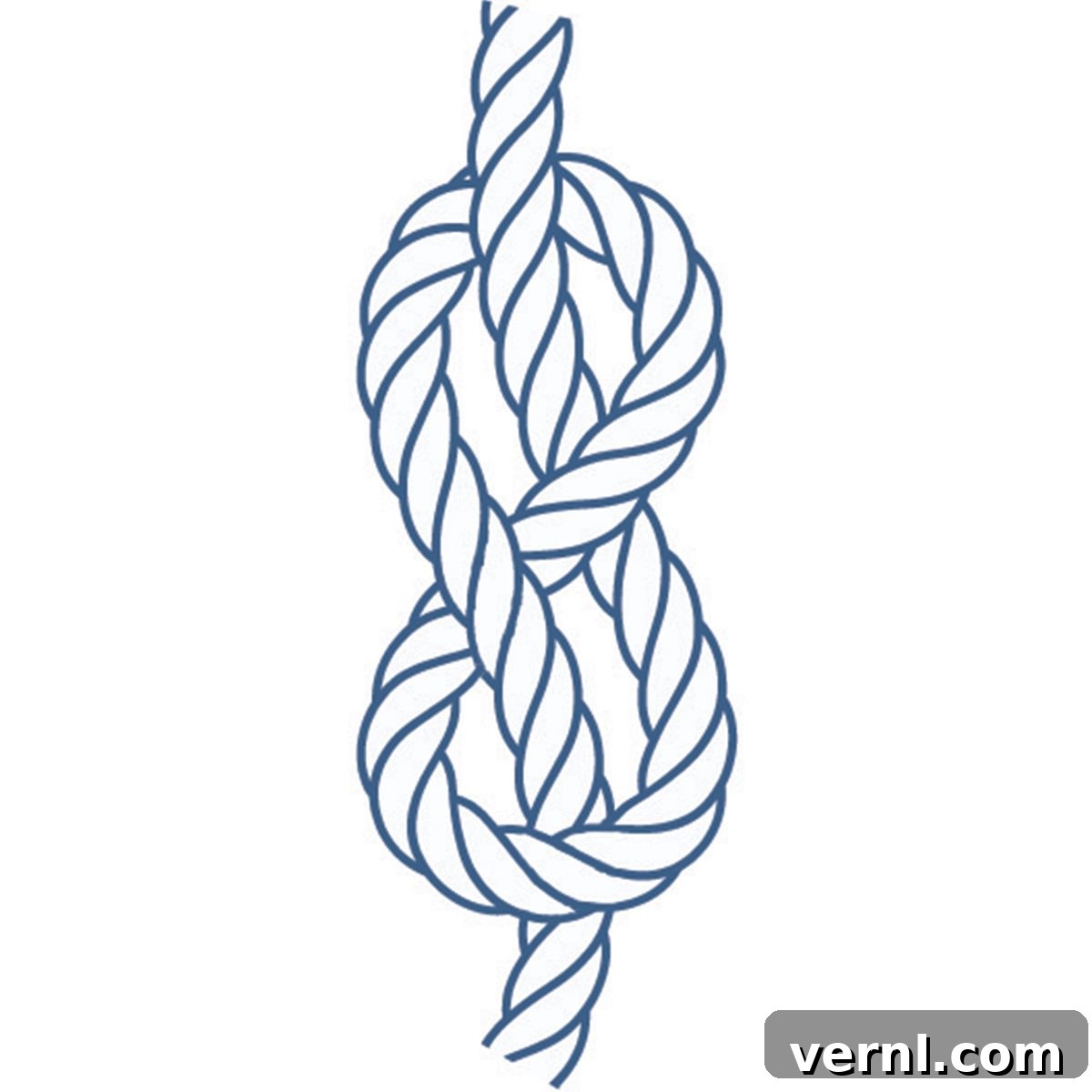
4. The Figure-Eight Knot: The Ultimate Stopper
The Figure-Eight Knot is primarily used as a stopper knot to prevent a rope from slipping through a block, eyelet, or pulley. It’s easy to tie, distinctive, and less prone to jamming than an overhand knot, making it a staple in climbing, sailing, and general utility.
Why Knot Tying is an Essential Skill for Everyone
Beyond the practical applications, mastering knots offers numerous benefits:
- Safety: In emergencies, a correctly tied knot can be the difference between safety and danger, whether securing a load, creating a rescue line, or administering first aid.
- Efficiency: Knowing the right knot for the right task saves time and effort, ensuring that your setup is stable and effective.
- Versatility: From camping and hiking to boating, fishing, rock climbing, and even household chores, knot-tying skills are universally applicable.
- Problem-Solving: It develops spatial reasoning, fine motor skills, and an understanding of physics and friction.
- Self-Reliance: Being able to solve problems involving ropes empowers you with a sense of capability and self-sufficiency.
Tips for Mastering Knot Tying
- Practice Regularly: Repetition is key. Carry a short piece of rope with you and practice tying knots whenever you have a moment.
- Use Different Ropes: Practice with various rope types, thicknesses, and materials. This will prepare you for real-world scenarios where rope characteristics differ.
- Understand the “Why”: Don’t just memorize steps; understand why each knot works and its specific strengths and weaknesses.
- Teach Others: Explaining a knot to someone else is a great way to solidify your own understanding.
- Invest in a Good Knot Book or App: Visual aids and detailed explanations can be invaluable.
Knot Your Average Skill: Embrace the Art!
The ability to tie a basic Sailor’s Knot, like the Square Knot, is far more than a parlor trick; it’s a foundational skill that opens the door to a world of practical applications and enhanced safety. By understanding its structure, practicing its formation, and recognizing its limitations, you equip yourself with a valuable tool for countless scenarios. From securing your gear on a camping trip to tying off a boat, the confidence that comes with knowing your knots is truly empowering.
We encourage you to grab a piece of rope and start practicing today. The journey of mastering knots is a rewarding one, connecting you to ancient traditions and empowering you with modern utility. Happy knotting!
Further Your Knot Tying Knowledge
Ready to expand your repertoire beyond the Square Knot? Explore these other essential knots and deepen your understanding of rope work:
Do You Know How to Tie These 5 Essential Knots?