Mastering Soil Volume: Your Essential Guide to Accurate Estimation for Landscaping and Gardening
When embarking on any significant landscaping or gardening project, one of the most critical steps is accurately determining the amount of soil you’ll need. While a few bags of potting soil might suffice for a handful of flower pots, tackling larger endeavors such as constructing a new raised garden bed or re-grading a section of your yard demands a far more substantial quantity. Miscalculating can lead to costly delays, unnecessary waste, or frustrating trips back to the garden center.
The common question, “How much soil do I need?” often confuses beginners. Unlike groceries, where products are typically sold by weight, soil, especially when ordered in bulk, is measured and sold by volume. Understanding this fundamental difference is the cornerstone of successful project planning. This comprehensive guide will walk you through everything you need to know about estimating soil volume, ensuring your gardening and landscaping projects are rooted in precision and efficiency.
Understanding Soil Volume: The Language of Landscaping
In the world of landscaping and gardening, soil is primarily sold by cubic feet and cubic yards, not by weight. This is a crucial distinction because the weight of soil can fluctuate significantly based on moisture content, compaction, and organic matter. Volume, however, provides a consistent measure of the space the soil will occupy.
Joe Raboine, director of residential hardscapes at Belgard, succinctly defines one cubic yard as a three-dimensional cube measuring three feet by three feet by three feet (3 ft. x 3 ft. x 3 ft.). Visualizing this can help you conceptualize the scale of bulk soil orders. A cubic yard is a substantial amount, often enough to fill the bed of a standard pickup truck. Knowing these units is the first step towards accurate estimation.
The Fundamental Formula: Calculating Soil Volume
While most projects won’t involve a perfect cubic yard, the principle of volume calculation remains straightforward. To estimate the soil volume for any given area, all you need is a reliable tape measure and a basic understanding of geometry.
“The basic formula is simple: Length x Width x Height = Volume,” explains Michael Dean, co-founder of Pool Research. This formula yields the volume in cubic units corresponding to the units of your measurements. For instance, if you measure in feet, your result will be in cubic feet.
Converting Units: From Cubic Feet to Cubic Yards
Since bulk soil is often priced and delivered in cubic yards, an essential step is converting your cubic feet measurement into cubic yards. There are 27 cubic feet in one cubic yard (3 ft. x 3 ft. x 3 ft. = 27 cubic feet). Therefore, once you have your volume in cubic feet, you simply divide that number by 27 to get the equivalent in cubic yards. To further clarify, one cubic yard also equals 1,728 cubic inches (12 in. x 12 in. x 12 in. = 1,728 cubic inches for one cubic foot, and 27 cubic feet * 1,728 cubic inches/cubic foot = 46,656 cubic inches in a cubic yard).
Understanding these conversions is key to bridging the gap between your measurements and the supplier’s units, preventing costly errors. Always ensure all your dimensions (length, width, height) are in the same unit (e.g., all in feet or all in inches) before applying the formula.
Practical Examples: Estimating Soil Volume in Real-World Scenarios
Let’s apply the length x width x height formula to a couple of common landscaping scenarios to illustrate the process clearly.
Large-Scale Yard Project: A New Lawn or Ground Cover
Imagine you’re preparing a large section of your yard, measuring 40 feet long by 50 feet wide, and you plan to add a new layer of soil six inches deep for a fresh lawn or ground cover.
Following Raboine’s method, the first step is to calculate the volume at a depth of one foot, as this simplifies the initial calculation:
1. **Dimensions:** 40 feet (length) x 50 feet (width) x 1 foot (depth)
2. **Calculate Cubic Feet (at 1-foot depth):** 40 ft * 50 ft * 1 ft = 2,000 cubic feet
3. **Convert to Cubic Yards (at 1-foot depth):** 2,000 cubic feet / 27 = 74.07 cubic yards (rounded to 74 cubic yards)
Now, to adjust for the desired six-inch depth, which is half of one foot, simply divide these figures in half:
| Dimensions | Cubic Feet | Cubic Yards |
| 40 feet long x 50 feet wide x 1 foot deep | 2,000 | 74 |
| 40 feet long x 50 feet wide x 6 inches deep | 1,000 | 37 |
So, for a 40 ft x 50 ft area needing 6 inches of soil, you would require approximately 37 cubic yards.
Raised Garden Bed: Precision for Contained Spaces
Consider a more contained project, such as building a raised garden bed with specific dimensions: 84 inches long x 36 inches wide x 28.25 inches deep. There are two primary approaches to calculate the required soil volume, both yielding the same result.
**Method 1: Calculate in Inches, then Convert**
Raboine’s preferred method involves finding the volume in cubic inches first, then systematically converting down to cubic feet and finally cubic yards.
1. **Dimensions:** 84 inches (length) x 36 inches (width) x 28.25 inches (depth)
2. **Calculate Cubic Inches:** 84 in * 36 in * 28.25 in = 85,428 cubic inches
3. **Convert to Cubic Feet:** Since 1 cubic foot = 1,728 cubic inches, divide the total cubic inches by 1,728: 85,428 cubic inches / 1,728 = 49.43 cubic feet (rounded to 49.4 cubic feet)
4. **Convert to Cubic Yards:** Since 1 cubic yard = 27 cubic feet, divide the total cubic feet by 27: 49.43 cubic feet / 27 = 1.83 cubic yards (rounded to 1.8 cubic yards)
| Dimensions | Cubic Inches | Cubic Feet | Cubic Yards |
| 84 inches long x 36 inches wide x 28.25 inches deep | 85,428 | 49.4 | 1.8 |
**Method 2: Convert Dimensions to Feet First**
Michael Dean suggests converting the initial dimensions from inches to feet *before* running the volume formula. This simplifies the calculation by keeping all units consistent from the start.
1. **Convert Dimensions to Feet:**
* Length: 84 inches / 12 inches/foot = 7 feet
* Width: 36 inches / 12 inches/foot = 3 feet
* Depth: 28.25 inches / 12 inches/foot = 2.354 feet (rounded to 2.3 feet for simplicity in this example, though using more decimals for accuracy is recommended)
2. **Calculate Cubic Feet:** 7 ft * 3 ft * 2.3 ft = 48.3 cubic feet
3. **Convert to Cubic Yards:** 48.3 cubic feet / 27 = 1.78 cubic yards (rounded to 1.8 cubic yards)
| Dimensions | Cubic Feet | Cubic Yards |
| 7 feet long x 3 feet wide x 2.3 feet deep | 48.3 | 1.8 |
As you can see, both methods yield approximately the same result, accounting for slight rounding differences. The key is consistency in unit conversion.
Irregular Shapes: Breaking Down Complex Areas
What if your project isn’t a simple rectangle? For areas like an L-shaped garden bed, a curved border, or a kidney-shaped pond, the strategy is to break the complex shape down into simpler, measurable components (rectangles, squares, triangles, or even segments of circles). Calculate the volume for each individual component and then sum them up for the total required volume. For instance, an L-shaped bed can be divided into two or three rectangles, making the calculation manageable.
Common Scenarios Requiring Bulk Soil Estimation
Accurately estimating soil volume is essential across a spectrum of gardening and landscaping applications:
- Raised Garden Beds: These are among the most common reasons for bulk soil orders. Ensuring you have enough quality soil for optimal plant growth requires precise calculations for depth, length, and width.
- New Lawn Installation: Whether you’re seeding a new lawn or laying sod, preparing the ground often involves adding a layer of nutrient-rich topsoil to ensure proper drainage and root development.
- Amending Existing Soil: Many gardens suffer from poor soil quality. Adding significant amounts of compost, organic matter, or specialized soil mixes to improve fertility and structure can drastically enhance plant health. This often involves tilling in a specific depth of new material over an entire area.
- Filling Depressions or Leveling Ground: Uneven terrain can be a tripping hazard and can lead to drainage issues. Filling low spots or creating a level base for patios, sheds, or play areas demands a precise volume of fill dirt or topsoil.
- Creating New Flower Beds or Borders: Defining new planting areas often means building up the soil level or completely replacing existing soil with a custom blend suitable for your chosen plants.
- Tree and Shrub Planting: While individual holes might not require “bulk” in the typical sense, a project involving multiple large trees or shrubs might warrant a bulk delivery to ensure each plant has ample amended soil in its planting hole.
Why Accurate Soil Estimation Matters
Beyond simply getting the right amount, precision in soil volume estimation offers several significant benefits:
- Cost Savings: Over-ordering soil means paying for material you don’t need, and potentially incurring disposal fees. Under-ordering means additional delivery charges and project delays. Accurate estimates directly impact your budget.
- Time Efficiency: Repeated trips to the garden center or waiting for additional deliveries can significantly prolong your project timeline. Having the right amount delivered at once keeps your project on track.
- Resource Management: Reducing waste is not only good for your wallet but also for the environment. Ordering only what you need minimizes unused material.
- Project Success: The right amount of soil, especially at the correct depth, is crucial for the health and vitality of your plants, lawn, or overall landscape design.
Leveraging Soil Calculator Tools for Simplicity
If mathematics isn’t your strongest suit or you simply prefer a quicker, error-free approach, a plethora of free soil calculator tools are available online. Many soil and landscape retailers integrate these calculators directly into their websites, making it convenient for customers to determine their needs.
Michael Dean specifically recommends the Omni Calculator. These tools typically allow you to input your dimensions in various units—centimeters, inches, feet, or meters. Many advanced calculators can even provide a cost estimate if you enter a price per unit (e.g., per cubic yard or per bag), allowing for better budget planning. Simply enter your length, width, and desired depth, and the calculator will instantly provide the volume in your preferred units. This is particularly helpful for checking your manual calculations or for quickly figuring out irregular shapes that can be broken down into simpler segments.
Accounting for Soil Settling and Future Needs
It’s important to remember that soil can settle over time. Factors like compaction from rain, watering, and the decomposition of organic matter can cause the soil level to drop by as much as 10-20% within the first year or two. Therefore, it’s often a wise strategy to slightly over-order (e.g., by 5-10%) your initial estimated volume, especially for deep beds or new installations, to account for this natural settling.
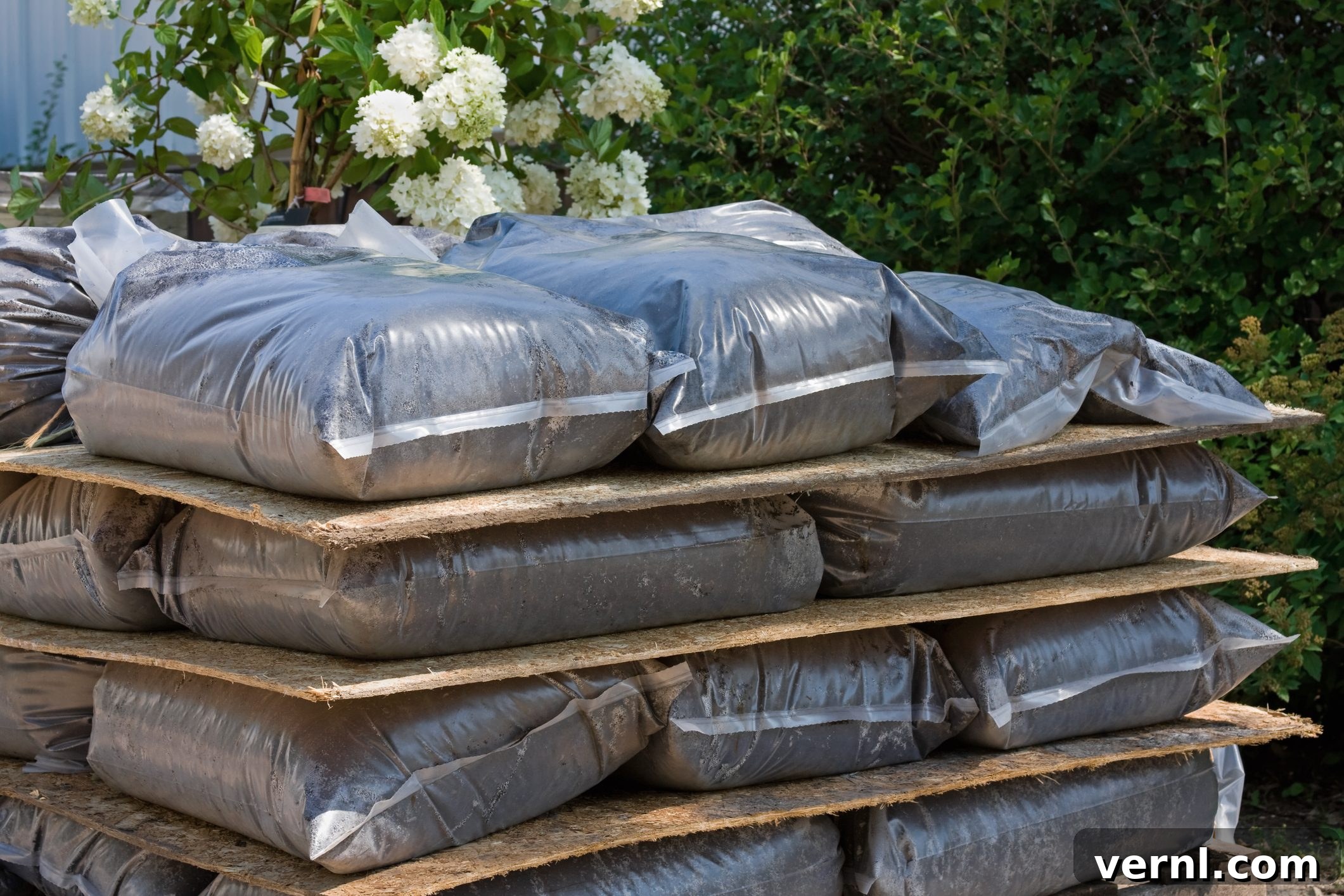
This inevitable settling means you may need to top up your soil after a year or two. This is where smaller quantities, such as bags from a local garden center, become incredibly convenient for maintenance. A standard bag of garden soil from The Home Depot or similar retailers usually contains between one and two cubic feet of soil, perfect for minor adjustments and replenishments. Always keep an eye on your soil levels and be prepared to add more as needed to maintain optimal growing conditions.
Tips for Ordering and Receiving Bulk Soil
Once you’ve calculated your required volume, here are a few additional tips for ordering and receiving your bulk soil delivery:
- Shop Around: Compare prices from several local landscape supply companies. Prices for topsoil, garden soil, or specialized mixes can vary significantly.
- Clarify Soil Type: Be specific about the type of soil you need (e.g., screened topsoil, garden mix, compost blend). The quality and composition of “topsoil” can differ widely between suppliers.
- Confirm Delivery Details: Discuss delivery access with your supplier. Ensure the delivery truck has clear, safe access to your desired drop-off location. Mark the spot clearly to avoid mishaps.
- Prepare the Drop Zone: Lay down a tarp or designate a clear, accessible area for the soil to be dumped. This protects your driveway or lawn and makes cleanup easier.
- Consider Accessibility: Think about how you will move the soil from the drop zone to your project area. Wheelbarrows, shovels, and potentially help from friends or family will be essential.
- Check Upon Arrival: Briefly inspect the delivered soil for quality, consistency, and any unwanted debris.
Conclusion: Building a Foundation for Success
Accurate soil volume estimation is a fundamental skill for any homeowner or gardener undertaking significant landscaping and gardening projects. By understanding the basics of cubic measurements, mastering the simple Length x Width x Height formula, and leveraging readily available online tools, you can confidently calculate your soil needs. This precision not only saves you money and time but also contributes to the successful and thriving outcome of your outdoor endeavors. So grab your tape measure, do your calculations, and prepare to lay the perfect foundation for your next green project.