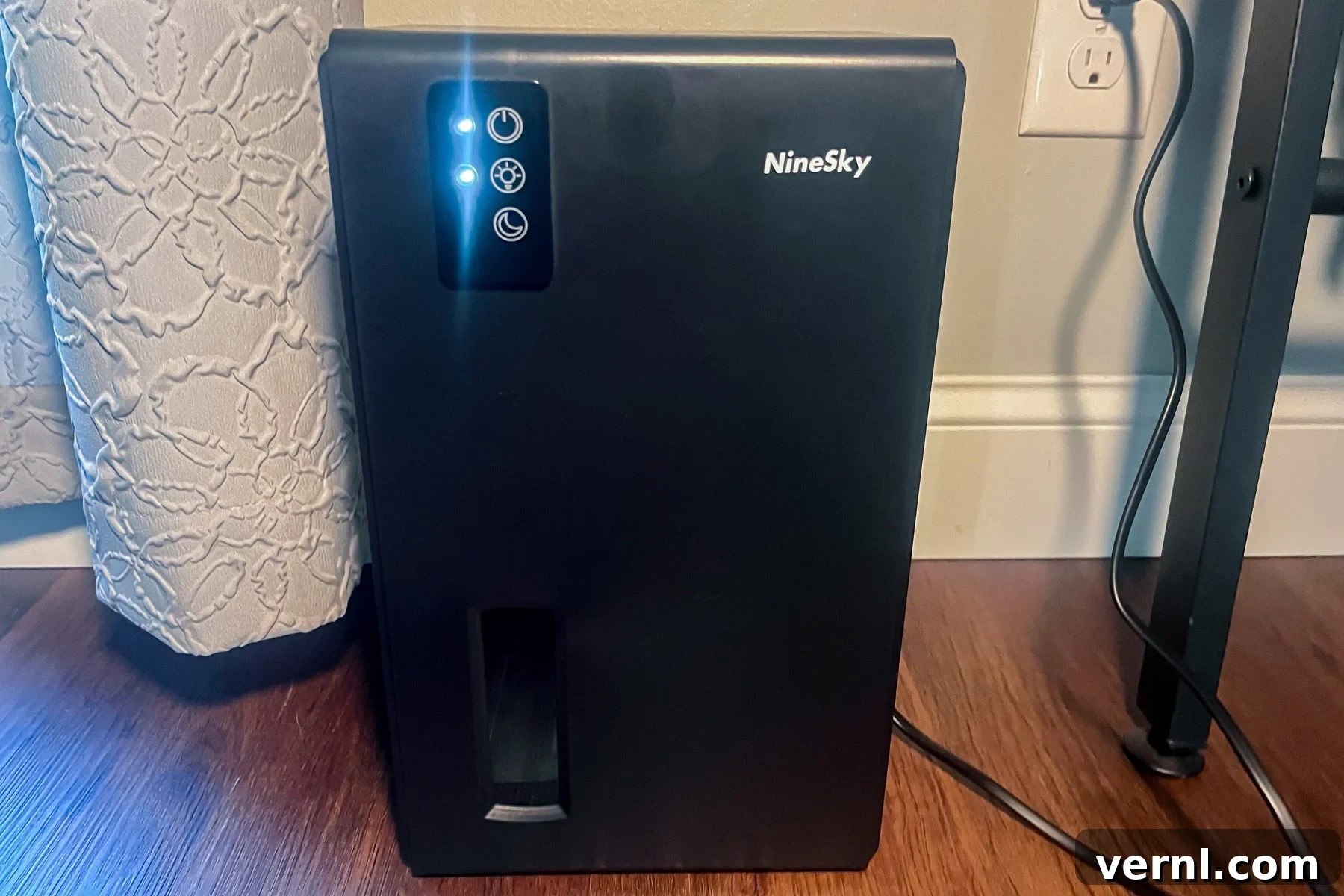
Navigating the vast online marketplace for a reliable dehumidifier can feel overwhelming. With countless models making similar claims, discerning the right choice for your home, apartment, or RV is a genuine challenge. Consider the Ninesky Dehumidifier, for instance. At first glance, it appears almost identical to many competitors, promising the same benefits. Yet, a quick search across Reddit threads and Amazon customer reviews unveils a surprising, albeit small, following for this particular compact dehumidifier. This sparked our curiosity: Is the Ninesky Dehumidifier genuinely deserving of its growing reputation and the buzz surrounding it?
To uncover the truth, I put the Ninesky Dehumidifier through a rigorous month-long test in my home during the notoriously humid North Carolina summer. Having personally evaluated and utilized over a dozen humidity-controlling devices, I possess a comprehensive understanding of what makes a dehumidifier stand out. My objective was to critically assess its performance against the competition, delve into its features, and ultimately determine whether investing in this particular model is a wise decision for our readers seeking effective home humidity solutions.
Unpacking the Ninesky Dehumidifier: What You Need to Know
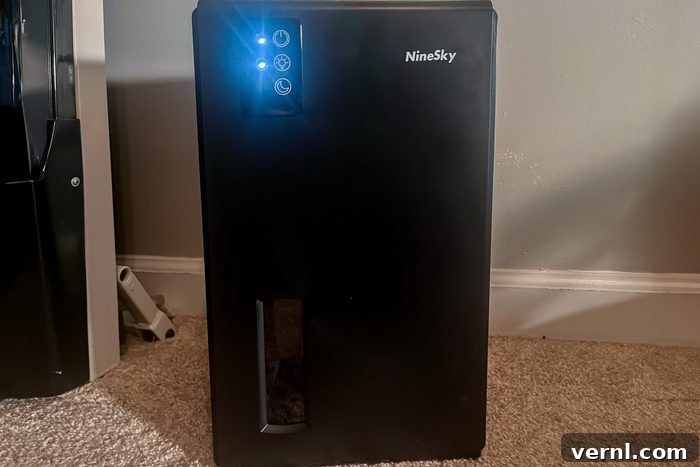
The Ninesky Dehumidifier is marketed by Ninesky Goods, a company that boldly asserts over 50 years of experience within the dehumidifier industry. This claim immediately raises a red flag, which we’ll explore in detail. The Ninesky product line includes three distinct models: a 30-ounce, an 85-ounce, and an 88-ounce capacity dehumidifier. For the purpose of this in-depth review, our focus is specifically on the 85-ounce version, which boasts an array of advertised features such as “ultra-quiet” operation, customizable LED mood lighting, an essential auto shut-off safety feature, and two adjustable fan speed modes designed for versatile use.
However, transparency is paramount in our reviews, and it’s essential to address the legitimacy of Ninesky Goods. My investigation revealed significant inconsistencies and a distinct lack of verifiable information that would corroborate the company’s claims. There is no tangible online evidence—such as news articles, a Wikipedia presence, or independent business profiles—to support their assertion of five decades in the industry. Beyond direct commerce links like Amazon, information about the company is virtually nonexistent. Furthermore, their official website conspicuously lacks fundamental pages like an “About Us” or “History” section. A closer look at their customer testimonials reveals images that are unmistakably generated by artificial intelligence (AI), frequently appearing across various other websites utilizing similar design templates. This practice severely undermines credibility and trustworthiness.
Adding to the confusion, the Ninesky Goods website also makes an odd reference to “durable linens,” despite the fact that no products under the Ninesky brand name currently include or relate to linens. This marketing disconnect suggests either a lack of focus or a templated website not fully customized to their product range.
Perhaps most concerning for consumers is the inconsistency in product specifications. The dehumidifier is advertised with an 85-ounce water tank on the website and Amazon headline, yet the physical product box and detailed Amazon product specifications state a 95-ounce tank capacity. This discrepancy is not an isolated incident and can be observed across their other models as well. While it’s plausible that models have been updated without a complete overhaul of all marketing materials, the absence of clear communication makes it impossible for consumers to ascertain the accurate capacity. This lack of precision is a significant drawback when consumers are trying to make informed purchasing decisions based on advertised features.
Despite these concerns regarding the brand’s provenance and marketing practices, it’s worth acknowledging that Amazon’s marketplace is replete with products from lesser-known or new brands, many of which perform surprisingly well. Therefore, we deemed it crucial to proceed with this comprehensive review. Our primary aim is to provide prospective buyers with a thorough understanding of the Ninesky Dehumidifier’s actual performance and features, while also ensuring they are fully aware of the questionable branding and marketing tactics employed should they still choose to purchase this particular model. For those prioritizing brands with an established and transparent track record, our Frigidaire Dehumidifier review might offer a more reassuring alternative.
Deep Dive into Ninesky Dehumidifier Features
Analyzing the 85-Ounce Water Tank Capacity
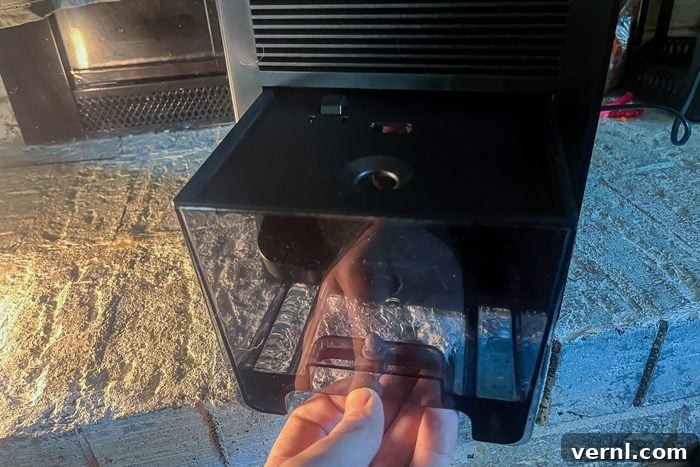
One of the primary considerations for any home dehumidifier is its water tank capacity and the area it can effectively cover. Ninesky claims its dehumidifier can efficiently remove excess moisture from spaces up to 800 square feet, positioning it as an ideal solution for small apartments, bedrooms, or recreational vehicles (RVs). As highlighted earlier, a significant inconsistency arises with the advertised tank size: the company states 85 ounces, yet the packaging and other product details on Amazon indicate 95 ounces. This notable discrepancy leaves consumers questioning the actual capacity.
To address this confusion, I attempted an unofficial, albeit unscientific, test. Lacking a precise measuring cup for such large volumes, I emptied the full water tank into a bowl placed on a digital scale. While one fluid ounce roughly approximates one ounce in weight, this can vary based on liquid density and other environmental factors, making this an imprecise measurement. Regardless, my measurements consistently fell short of both the 85 and 95-ounce claims, registering closer to the 65-75 ounce range. It’s crucial to understand that this is not a definitive scientific finding, but it strongly suggests that the advertised capacity may be overstated.
Despite these concerns about the accuracy of the stated capacity, it’s important to emphasize that the dehumidifier undeniably performs its core function. When the Ninesky Dehumidifier is active, there is a palpable difference in the air quality and humidity levels within the room compared to when it’s off. While the precise water removal might not match the upper bounds of its claims, it still effectively reduces ambient humidity. My primary concern remains the lack of transparency and precision from the company regarding these fundamental product specifications. For those also battling airborne irritants, consider pairing your dehumidifier with a quality air purifier like the NuWave OxyPure Air Purifier or the Blueair Air Purifier.
Evaluating the “Ultra-Quiet” Operation
The Ninesky Dehumidifier heavily markets itself as featuring “ultra-quiet” technology, a desirable trait for any appliance, especially one intended for living spaces or bedrooms. However, during my testing, this claim proved to be somewhat exaggerated. As I write this review, with the unit operating in the same room, its presence is definitely audible. While it’s certainly not excessively loud or disruptive like a construction tool, the sound it emits is comparable to the steady hum of a laptop or gaming console fan that has been running for an extended period. For users sensitive to background noise, it’s unlikely to be considered “ultra-quiet.” I have certainly experienced other quiet dehumidifiers that operate with a much lower auditory footprint.
The unit also includes a dedicated “night mode,” designed to reduce the fan speed to its lowest setting, purportedly for an even quieter operation suitable for sleeping environments. Unfortunately, during my usage, I noticed no significant difference in the noise level between the standard operating mode and the night mode. The reduction, if any, was imperceptible, meaning users shouldn’t expect a dramatic decrease in sound for nighttime use.
Reliability of the Auto Shut-off Feature
A crucial safety and convenience feature in any dehumidifier is its auto shut-off mechanism, preventing overflows when the water tank is full. I’m pleased to report that the Ninesky Dehumidifier’s auto shut-off function performed flawlessly and exactly as advertised. The company suggests the unit can remove up to 34 ounces of water per day. In my experience, depending on the ambient humidity levels in my testing environment, the tank typically took about a day and a half to two days to reach full capacity and activate the shut-off. This consistent performance provides peace of mind, as some less reliable dehumidifiers are known to fail in this regard, leading to messy spills.
While the auto shut-off is reliable, one potential enhancement would be the inclusion of a drainage hose option. This feature would be invaluable for users who wish to operate the dehumidifier continuously without the need for manual emptying, especially in consistently humid areas or in spaces like basements. However, on a positive note, the water tank is commendably easy to remove, empty, and reinsert, making the manual maintenance process straightforward and hassle-free. For those in need of continuous drainage on a budget, our guide on creating a DIY self-draining dehumidifier offers an ingenious solution.
The Aesthetics of LED Mood Lighting
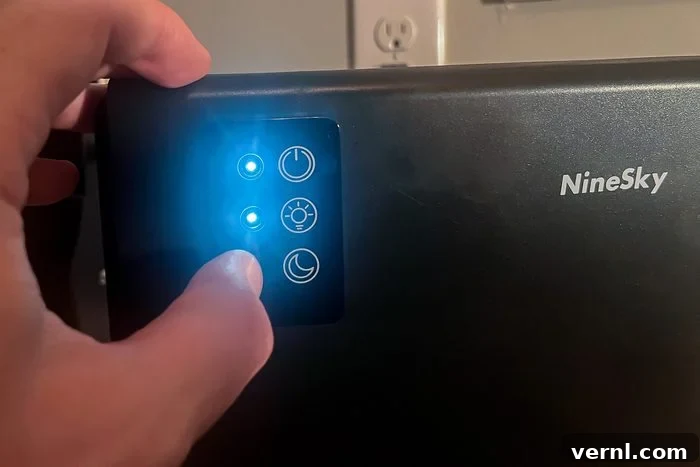
Let’s be candid about the LED mood lighting feature: my personal preference leans away from decorative lighting on appliances like dehumidifiers. Therefore, I won’t unduly criticize the Ninesky Dehumidifier for its inclusion. From my perspective, these lights rarely offer sufficient brightness to genuinely transform an environment or serve a functional purpose beyond pure aesthetics. They often seem like an unnecessary addition.
However, for individuals who appreciate such embellishments, the Ninesky Dehumidifier provides a selection of seven vibrant colors. Users have the option to cycle through these colors automatically, or to lock the lighting onto a single preferred hue. A notable design element is the unit’s sleek black shell, which effectively allows the LED colors to “pop” and appear more vivid compared to their display on lighter-colored dehumidifiers. So, if mood lighting is indeed “your cup of tea,” this feature is present and reasonably well-executed, offering a touch of customizable ambiance.
Our Rigorous Testing Methodology for the Ninesky Dehumidifier
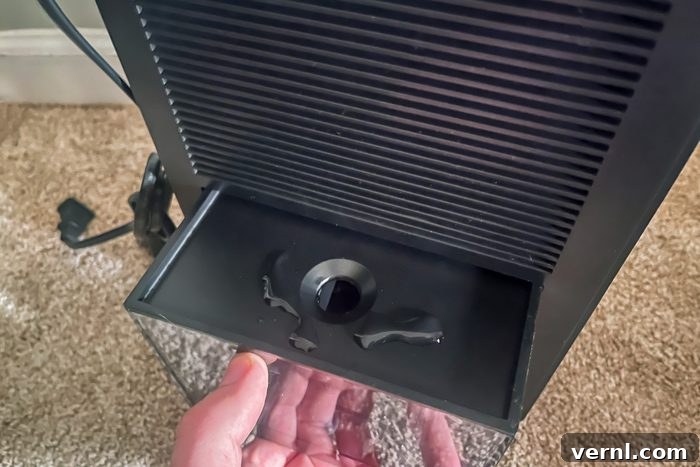
As Family Handyman‘s dedicated resident dehumidifier tester and expert, my experience encompasses evaluating more than a dozen small, rechargeable, and specialized crawl space dehumidifiers. This extensive background provides a robust framework for assessing new models and comparing their performance against established benchmarks, particularly in combating the persistently high humidity characteristic of North Carolina’s climate.
For this specific review, I strategically placed the Ninesky Dehumidifier in my home office. This particular room was chosen because it consistently experiences a rapid increase in humidity levels compared to other areas of the house, offering a challenging yet representative environment for testing. Throughout the testing period, which spanned a full month, I meticulously monitored several key performance indicators. These included the unit’s operational sound levels, the speed at which it extracted moisture from the ambient air, the overall ease of use (covering aspects like control accessibility and tank emptying), and critically, any unexpected issues or malfunctions that arose during continuous operation. This comprehensive approach allowed for a thorough and objective evaluation of the Ninesky Dehumidifier’s capabilities and reliability in a real-world setting.
Pros of the Ninesky Dehumidifier
- Highly Affordable: Offers a budget-friendly option for basic humidity control.
- Compact Design: Its small footprint makes it suitable for tight spaces.
- Lightweight: Easy to move between rooms without straining.
- Two-Speed Operation: Provides flexibility for varying humidity levels (standard and night mode).
- LED Mood Lighting: An aesthetic bonus for users who appreciate customizable ambiance.
- Easy-to-Remove Water Tank: Simplifies the maintenance and emptying process.
- Effective Moisture Removal: Despite capacity discrepancies, it demonstrably reduces humidity.
- Reliable Auto Shut-off: Prevents spills and ensures safe operation when full.
Cons of the Ninesky Dehumidifier
- Not as Quiet as Advertised: Operates with an audible hum, not truly “ultra-quiet.”
- Unclear Tank Capacity: Significant discrepancy between advertised and actual (or stated) capacity.
- Questionable Brand Legitimacy: Lack of verifiable company history and inconsistent marketing.
- No Continuous Drain Option: Requires manual emptying, which can be inconvenient for continuous use.
- Limited Area Coverage: Best suited for very small rooms, not large spaces.
- Inconsequential Night Mode: Minimal discernible difference in noise level.
Frequently Asked Questions (FAQ) About the Ninesky Dehumidifier
Why is the power light blinking on my Ninesky dehumidifier?
A blinking power light on your Ninesky dehumidifier typically indicates an operational issue that requires attention. Most commonly, this could signal a problem with the power supply itself, such as an unstable connection or insufficient power. If you’ve ruled out power fluctuations, the blinking light might point to an internal fan issue. This could mean the fan requires cleaning or maintenance, or it might be nearing the end of its operational lifespan. Always refer to your user manual for specific troubleshooting steps, and if the issue persists, consider contacting customer support if available, or preparing for a replacement.
Should I keep my Ninesky dehumidifier on all night?
Yes, it is generally acceptable to keep your Ninesky dehumidifier running all night, especially if you reside in a particularly humid climate or are targeting persistent moisture issues in a room. While the Ninesky model isn’t the quietest dehumidifier I’ve tested—and its “night mode” offers minimal noise reduction—its operational hum is typically low enough not to disturb sleep for most individuals. For optimal comfort, consider placing the unit on the opposite side of the bedroom, further away from your sleeping area. Continuous operation can be highly effective in maintaining consistent, comfortable humidity levels throughout the night, contributing to better sleep quality and a healthier indoor environment.
What size room is the Ninesky Dehumidifier suitable for?
The Ninesky Dehumidifier, with its advertised 85-ounce (or 95-ounce) capacity, is primarily designed for smaller spaces. Based on its performance and capacity claims, it is best suited for rooms up to approximately 200-300 square feet. This makes it an ideal choice for compact bedrooms, bathrooms, small home offices, RVs, or walk-in closets where humidity tends to build up. For larger living areas, open-plan spaces, basements, or entire apartments, this model will likely struggle to make a significant impact on overall humidity levels.
What Other Reviewers and Industry Experts Are Saying
As of the most recent data, the Ninesky Dehumidifier, specifically the 85-ounce model, maintains an average rating of 4.3 out of 5 stars on Amazon. This rating is based on a substantial number of customer reviews, with nearly 1,100 of the total 1,468 reviews being five-star ratings, indicating a generally positive reception among a significant portion of its user base.
Positive feedback often highlights its effectiveness for its price point and ease of use. For example, five-star Amazon reviewer Krista enthusiastically states, “This has been on all day in my room and I am very happy with what I see. I love that it’s as easy as just plugging in and seeing it do its work. I’m very happy with this for the price that I paid.” This sentiment reflects a common appreciation for its simplicity and perceived value.
However, not all feedback is glowing. A segment of reviewers expressed considerable disappointment with the dehumidifier’s overall functionality and impact, particularly in slightly larger small rooms. A one-star Amazon reviewer named Rando critically remarked, “It will not even dent the humidity of a room. I bought it hoping it would at least moderate the humidity in a 200 sq. ft. bedroom, and it has practically no effect. Don’t waste your time and money, buy something bigger and more powerful that will actually do the job.” This stark contrast in opinions underscores the importance of setting realistic expectations for a compact, budget-friendly unit, and considering the specific size of the space it needs to dehumidify. It suggests that while adequate for very small areas, its performance might be insufficient for even moderately sized rooms if humidity is severe.
Ninesky Dehumidifier vs. GE Dehumidifier: A Comprehensive Comparison
When considering a significant home appliance purchase like a dehumidifier, comparing models across different price points and functionalities is essential. The GE Dehumidifier typically costs approximately four times as much as the Ninesky Dehumidifier, leading many consumers to question if the substantial price difference is justified. The answer, as is often the case, hinges entirely on your specific needs, the size of your living space, and your budget.
If your primary concern is addressing high humidity in a larger living area, an expansive apartment, or specifically require a robust basement dehumidifier, then the GE model is unequivocally the superior choice. It boasts a much higher capacity, rated for effective coverage up to an impressive 4,500 square feet, and features a substantial 50-pint (or approximately 800-ounce) water container. This dwarfs the Ninesky’s capacity and makes it suitable for significantly larger and more demanding environments.
Beyond sheer capacity, the GE Dehumidifier offers a critical feature that the Ninesky lacks: a continuous drain option. This allows the unit to be hooked up to a hose, eliminating the need for manual tank emptying, which is a major convenience for continuous operation. While the GE is not as lightweight as the Ninesky, it compensates with built-in wheels, enabling effortless relocation from room to room. Furthermore, the GE model typically includes an advanced adjustable fan that intelligently sets its speed based on the room’s current humidity levels, providing optimized and energy-efficient operation. In contrast, the Ninesky Dehumidifier operates at a fixed speed within its day or night modes, offering less adaptability.
Energy efficiency is another differentiating factor. The GE Dehumidifier proudly carries an Energy Star certification, assuring consumers of its power-saving design. The Ninesky, while claiming to be “energy-efficient,” lacks any specific third-party certification or quantifiable evidence to substantiate this claim. For those seeking a powerful dehumidifier with many of the GE’s advantages but at a slightly more competitive price point, the Midea Dehumidifier often presents an excellent alternative, offering a strong balance of features and value.
Final Verdict: Is the Ninesky Dehumidifier Right for You?
After extensive testing and thorough analysis, it’s clear that the Ninesky Dehumidifier is not positioned as the absolute best or most feature-rich option available on the market. In terms of core functionality, it performs similarly to other compact dehumidifiers of its size and price range. However, it does come with a notable caveat: it tends to be slightly louder than comparable models, contradicting its “ultra-quiet” marketing claims. Despite these drawbacks, the Ninesky Dehumidifier successfully made my home office noticeably more comfortable by effectively reducing humidity levels, and it does so at a very attractive price point.
Ultimately, the Ninesky Dehumidifier is a decent option, but it caters to a specific kind of buyer. If you are seeking a high-performance unit for large spaces, require whisper-quiet operation, or prefer a brand with an unimpeachable track record, you will likely need to explore more expensive, premium alternatives. However, if your needs are modest—if you require a compact, lightweight, and affordable dehumidifier for a very small room, a bathroom, or an RV, and you are willing to tolerate a moderate level of operational noise, then the Ninesky Dehumidifier could be a perfectly acceptable choice. It gets the job done for basic humidity reduction without breaking the bank, as long as your expectations are realistic regarding its performance and noise output.
Where to Purchase the Ninesky Dehumidifier
The Ninesky Dehumidifier is currently available exclusively through Amazon. While the list price typically hovers around $90, it’s frequently found on sale. At the time of this review’s writing, the unit was available for less than $60, making it a particularly budget-friendly option for those looking to address humidity in small spaces.