Secure Your Wi-Fi: A Comprehensive Guide to Protecting Your Home Network
In today’s connected world, where the average US household juggles over 20 Wi-Fi connected devices, from smartphones to smart home systems, securing your Wi-Fi network is more critical than ever. The proliferation of these devices significantly expands the attack surface, making homes increasingly vulnerable to Wi-Fi security breaches.
“If your Wi-Fi is compromised, every connected device is at risk,” warns wireless technology expert Andy Hurt. “A common mistake is neglecting to update Wi-Fi settings, a vulnerability that attackers frequently exploit.” This neglect creates an easy entry point for malicious actors to gain access to sensitive information and connected devices.
The reality is alarming. A significant portion of smart home device users, approximately a third, have reported falling victim to a data breach or scam, according to Consumer Affairs. While cybersecurity expert Jacob Anderson advises against succumbing to undue panic fueled by sensationalized social media alerts, he emphasizes the genuine need to reinforce Wi-Fi security. The good news is that enhancing your security posture doesn’t require specialized knowledge or expensive tools. “The fix usually takes minutes and costs nothing,” Hurt assures.
This guide provides a clear and concise roadmap to easily increase your Wi-Fi security, protecting your personal data and connected devices from potential threats.
Why Wi-Fi Security is Paramount
An unsecured Wi-Fi network is essentially an open invitation for hackers to access your personal files, hijack smart devices, and steal sensitive data, including credit card information, passwords, and personal photos. The consequences of such breaches can be devastating, ranging from financial loss to identity theft.
As Anderson explains, “Once inside your network, attackers can redirect you to fraudulent app stores, tricking you into installing fake apps designed to steal even more data and monitor your activity.” He recounts instances of seemingly legitimate apps, disguised as popular brands like Amazon, that were actually sophisticated audio eavesdropping tools. This highlights the insidious nature of modern cyber threats and the importance of vigilance.
Beyond data theft, an unsecured Wi-Fi network can be exploited for illegal activities. Cybercriminals can use your network to commit cybercrimes, which will then be traced back to your home Wi-Fi. This can lead to serious legal repercussions. “Law enforcement could potentially execute a search warrant at your address and treat you as a suspect,” warns digital forensics and cybercrime expert Calum Baird. This underscores the potential legal ramifications of neglecting Wi-Fi security.
Understanding Your Wi-Fi Network Security Key
Your Wi-Fi network security key, commonly known as your Wi-Fi password, is the first line of defense for your home network. It acts as a gatekeeper, controlling access to your network and encrypting the data transmitted between your devices and the internet.
Baird stresses the importance of safeguarding your Wi-Fi security key: “Be sure not to provide it to anyone you’re unsure of, unless you’re willing to take the risk. This typically includes contractors who may be visiting your home.” Sharing your password indiscriminately exposes your network to potential threats.
Locating Your Wi-Fi Security Key
The default password for your Wi-Fi network is typically printed on a sticker located on your router, the device provided by your internet service provider (ISP). This sticker is often found on the bottom of the router. Once you’ve located the default password, consumer privacy expert Paul Bischoff advises, “You should set your own Wi-Fi security key.”
Identifying Wi-Fi Vulnerabilities
Several factors can compromise the security of your Wi-Fi network. One of the most common vulnerabilities is using the default password. As Baird points out, “If there’s no password enabled, anyone can join, and that’s very risky.” Leaving your network open to anyone within range significantly increases the risk of unauthorized access and malicious activity.
Outdated routers also pose a significant security risk. Older routers often utilize outdated security protocols, such as WEP or WPA encryption. “WPA2 encryption is ideal or, if you have the option, WPA3 is even better,” says Baird. When connecting to a Wi-Fi network, the dialogue box typically displays the encryption method being used. Prioritize connecting to networks using WPA2 or WPA3 encryption.
Two red flags to watch out for include unknown devices connected to your network and the presence of two Wi-Fi networks with the same name in the dropdown menu of available networks. Anderson explains that the latter indicates a potential impersonation attempt. Someone may be trying to create a fake network to intercept your data.
Securing Your Wi-Fi Network: A Step-by-Step Guide
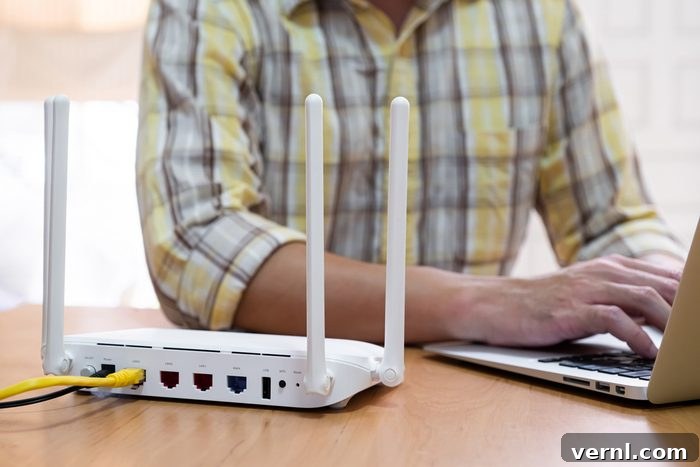
Fortunately, bolstering your home Wi-Fi security doesn’t require specialized skills. “No Pro needed, and these configurations take less than 15 minutes to implement,” says Hurt. The key is to access your router’s control dashboard, which can be done through your internet service provider’s (ISP) website. The sticker on your Wi-Fi router typically contains the Internet Protocol (IP) address and username/password needed to access the dashboard. Once logged in, you can implement the following security measures:
1. Enhance Encryption
Prioritize security by disabling WEP or WPS. Navigate to your router settings and set the encryption to WPA2-AES or WPA3. “Older options like WEP are unsafe [and] convenience features can weaken security,” Hurt emphasizes. Choosing the latest encryption standards significantly strengthens your network’s defense against unauthorized access.
2. Change Default Credentials
Change both the Wi-Fi network password and the router admin login password. Anderson recommends using a completely random alphanumeric key that is at least 12 characters long. Alternatively, Baird suggests creating a memorable password that is easy to remember and share with trusted individuals. While you’re at it, “you can also change the SSID (network name) to something memorable and fun if you want,” says Baird. A personalized network name can make it easier to identify your network and differentiate it from potential impersonation attempts.
3. Keep Router Firmware Updated
Enable automatic updates for your router firmware or regularly check for updates manually. “Many people assume updates happen automatically,” says Hurt. “Wi-Fi security fails most often because people assume it is already handled.” Regularly updating your router firmware is crucial for patching security vulnerabilities and ensuring optimal performance.
4. Implement a Guest Network
Configure a separate Wi-Fi network for visitors on a different “subnet” to protect your main devices. Ensure that you use a strong password for this guest network as well. A guest network isolates visitor traffic from your primary network, preventing potential security breaches from compromising your personal devices and data.
5. Set Access Controls with MAC Filtering
Utilize MAC filtering to prevent unauthorized devices from connecting to your Wi-Fi network. The router’s dashboard will have a function for setting up a list of trusted MAC addresses, according to Anderson. MAC filtering allows only devices with pre-approved MAC addresses to connect, adding an extra layer of security to your network.
Frequently Asked Questions (FAQ)
Is 5GHz more secure than 2.4GHz Wi-Fi?
Not inherently. Security primarily depends on the encryption used. However, 5GHz has a shorter range, making it more difficult for hackers to access from a distance, explains Hurt. While 5GHz may offer a slight security advantage due to its limited range, focusing on strong encryption is paramount.
Is wired Wi-Fi more secure than cellular Wi-Fi?
Again, security depends mostly on the security measures you implement on your network. In general, Wi-Fi is more secure because you have more control over its configuration compared to cellular data networks, says Anderson. “On your cellular data network device, look into using a reputable VPN connection,” he advises. “Apple devices have this available as a standard feature.” Using a VPN encrypts your internet traffic, protecting your data from potential eavesdropping on cellular networks.
Does your Wi-Fi provider impact Wi-Fi security?
Yes. “Providers that supply modern routers and automatic updates help, but users still need strong passwords and good settings,” says Hurt. While modern routers and automatic updates contribute to security, the onus is still on users to implement strong passwords and configure proper settings. Choosing a reputable provider that prioritizes security is a good starting point.
About the Experts
- Calum Baird is a digital forensics and incident crime response consultant at Systal Technology Solutions, and a former detective specializing in digital forensics and cybercrime investigations for Police Scotland.
- Jacob Anderson has extensive experience in software development, cybersecurity and artificial intelligence. He has been president of Beyond Ordinary Software Solutions since 2000.
- Andy Hurt is a wireless technology expert at SIMO, a software-as-a-service data connectivity company that targets wireless devices, such as tablets, laptops, or IoTs, that are currently unconnected or poorly connected on cellular networks.
- Paul Bischoff is a consumer privacy advocate at Comparitech, a pro-consumer website providing information, tools, reviews and comparisons to help its readers improve their cybersecurity and privacy online.