
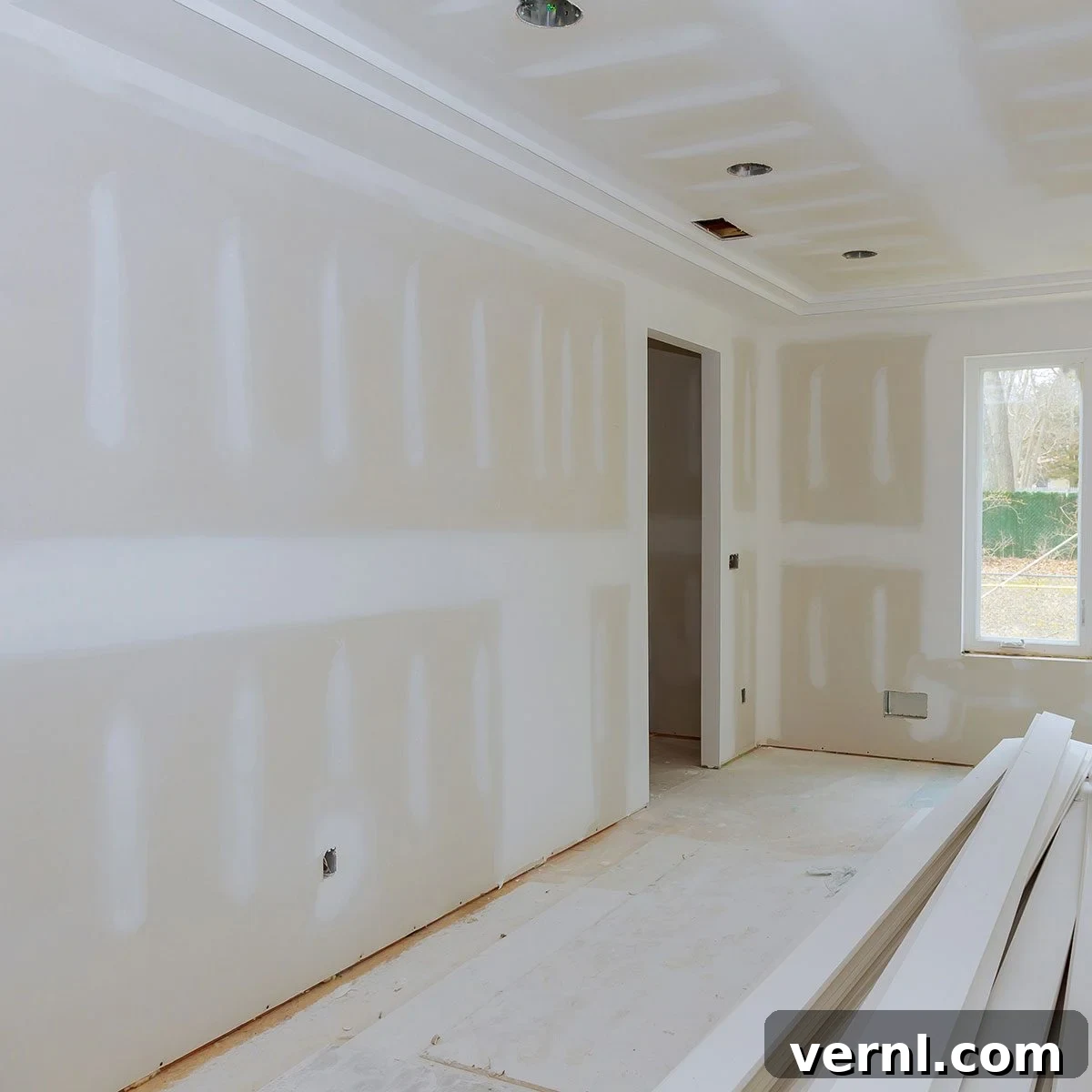
Drywall vs. Sheetrock: Demystifying the Terminology of Modern Wall Construction
Step onto any construction site, browse through countless home improvement blogs, or watch a few DIY renovation videos, and you’ll quickly notice a curious phenomenon: a single building material referred to by a myriad of names. From the moment it arrives on a job site, stacked high on delivery trucks, to its final installation and finishing, this ubiquitous wall covering seems to change its identity with each crew that handles it. The delivery drivers might call it “Sheetrock,” the installers deftly hanging it might refer to it simply as “drywall,” and the finishers meticulously applying joint compound often use the term “wallboard.” This article aims to clarify the origins of these various names, delve into whether there are any significant differences between them, and offer practical insights into this essential modern building material.
Understanding the proper terminology for construction materials is not just about linguistic precision; it’s about grasping the history, evolution, and practical applications that have shaped the industry. While some terms are truly interchangeable, others carry specific brand implications or historical context. We will explore where each of these names comes from, what distinguishes them, and why the choice of words, especially regarding quality, can be surprisingly important.
What Exactly Is Drywall? The Foundation of Modern Interiors
Drywall, at its core, is a composite material used to create interior walls and ceilings. It consists of a hardened gypsum plaster core sandwiched between two sheets of heavy paper, providing a smooth, durable surface ready for painting or wallpapering. This innovative material revolutionized construction by offering a more efficient and cost-effective alternative to traditional plaster walls.
The Birth of a Revolution: From Plaster to Plasterboard
Before drywall, interior walls were predominantly covered with wet plaster. This method, while capable of producing incredibly smooth and robust surfaces, was a labor-intensive process. It required multiple coats, significant drying times between applications, and the expert hand of a skilled plasterer. The demand for faster, more standardized construction methods spurred innovation, leading to the invention of modern drywall.
The earliest precursor to modern drywall emerged in 1894, thanks to Civil War veteran Augustine Sackett. His groundbreaking innovation involved creating alternating layers of gypsum plaster and paper, allowing them to harden into solid, pre-fabricated sheets. These sheets could then be directly fastened to wall studs, significantly reducing installation time and complexity compared to wet plaster. Gypsum, a naturally occurring mineral, is crucial to drywall’s composition due to its ability to harden into a strong, durable, and fire-resistant material when processed.
Initially, Sackett’s invention was known as “Sackett Board.” However, as its use spread, it acquired several descriptive nicknames. “Plasterboard” accurately described its gypsum plaster content, “wallboard” clearly indicated its intended use as a wall covering, and “drywall” emerged to specifically differentiate it from the traditional, moisture-dependent wet plastering process. This last term, “drywall,” gained traction due to its emphasis on the material’s dry application, highlighting its efficiency and convenience.
Sheetrock: A Brand Name That Became a Household Term
While “drywall” serves as the generic term for this type of wall covering, “Sheetrock” holds a unique position in the industry. Sheetrock is, in fact, a registered brand name for a specific line of drywall products manufactured by the United States Gypsum Company (USG). Its widespread recognition is akin to how “Kleenex” is often used generically for facial tissues or “Q-tips” for cotton swabs – a testament to its market dominance and the quality associated with the brand.
The Evolution of a Brand Leader: USG and Sheetrock
The journey of Sheetrock began with the Sackett Plaster Company. In 1902, Sackett Plaster merged with several other businesses to form the United States Gypsum Company, now universally known as USG. This consolidation paved the way for further innovation and standardization in the gypsum product market.
A significant design improvement to Sackett Board occurred in 1913. According to USG’s own history, “the two interior plies of paper in the board were eliminated, leaving a solid gypsum core between the top and bottom sheets, and was rebranded as Adamant Board.” This “Adamant Board” was essentially the modern drywall we recognize today, boasting a more robust and uniform composition. However, despite its technical superiority, sales of Adamant Board initially struggled to take off.
Recognizing the need for a more appealing and memorable name, USG sales representative D.L. Hunter suggested a re-brand. The name “Sheetrock” was born, a clever portmanteau combining “sheet” (referring to its sheet-like form) and “rock” (alluding to the gypsum’s mineral composition and durability). This rebranding proved incredibly successful. A century later, “Sheetrock” has become so deeply embedded in the lexicon of construction and home improvement that many people use it synonymously with any type of drywall, regardless of the manufacturer. At Family Handyman, we maintain “drywall” as our preferred generic term to ensure clarity and accuracy.
When Did Drywall Revolutionize Residential Construction?
While drywall offered clear advantages, its widespread adoption wasn’t instantaneous. It first gained significant traction in commercial construction, notably showcased at the 1933-34 Chicago World’s Fair, where it demonstrated its efficiency for large-scale projects. However, it wasn’t until the 1940s that drywall truly began to find its way into American homes, a period that coincides with a personal story of mine.
The Post-War Housing Boom and the Rise of Drywall
The catalyst for drywall’s residential boom was World War II. The rapid mobilization of the American economy and population led to an urgent demand for fast, affordable housing for industry workers and returning veterans. Traditional plastering methods were simply too slow and labor-intensive to keep up with the pace of development. The government, through entities like the Defense Homes Corporation, actively encouraged and even mandated the use of wallboard over plaster in new housing projects to accelerate construction.
Several locations across the U.S. lay claim to hosting the first residential drywall installations. One such prominent example is Colonial Hills in Ohio. This neighborhood was fast-tracked for development specifically to provide residences for workers during World War II. As part of this urgent construction effort, the government insisted on the use of wallboard, which was largely Sheetrock at the time, to expedite the building process. The result was a community that stands as a strong candidate for being one of the first residential neighborhoods constructed primarily with Sheetrock.
Seventy years later, while working as a contractor in Colonial Hills, I had the pleasure of meeting a remarkable woman from the neighborhood. She shared with me that she lived in one of those very first homes in America built with Sheetrock. For a construction enthusiast like myself, that opening line was absolutely captivating. Reader, I confess, I was smitten, and I ultimately married her! This personal connection only deepens my appreciation for the history and impact of this humble material.
How Does Sheetrock Differ From Other Generic Drywall Brands?
Despite my cherished personal connection to Sheetrock, it’s important to state that, for general purposes, there isn’t a vast functional difference between Sheetrock and any other brand of well-made drywall. However, that qualifier — “well-made” — is absolutely critical. The market for building materials can sometimes be flooded with inferior products, and drywall is no exception. Poorly manufactured drywall can be brittle, prone to crumbling, and can even harbor more serious, unseen issues.
The Critical Importance of Quality: A Cautionary Tale
The late 2000s offered a stark reminder of the dangers of substandard drywall. A crisis emerged when low-quality drywall produced in China emitted toxic gases that severely impacted thousands of consumers in the U.S. These toxic off-gassings led to a range of severe problems, including significant health and respiratory issues for residents, along with accelerated corrosion of household plumbing, electrical systems, and appliances. Ultimately, the Environmental Protection Agency (EPA) investigated and found that these Chinese-made sheets were manufactured with elevated levels of sulfur and other problematic chemicals, which reacted with moisture and humidity to release noxious fumes. This incident underscored the absolute necessity of purchasing drywall from reputable manufacturers.
Beyond Standard: Different Types of Drywall for Specific Needs
Just as we noted that Sheetrock is to drywall as Kleenex is to facial tissue, the truth is that for everyday applications, you might not notice a significant difference between a leading brand name and a generic equivalent. However, much like how a runny nose quickly reveals the inadequacy of low-quality, sandpaper-like tissue, a critical application might expose the shortcomings of generic, inferior drywall. High-quality drywall brands, like USG’s Sheetrock, Certainteed, or Georgia-Pacific’s ToughRock, invest heavily in research, development, and stringent quality control, offering enhanced performance characteristics for various applications. Understanding these specific types is crucial for making informed decisions:
- Standard Drywall: Typically 1/2-inch thick, this is the most common and versatile type, suitable for general wall and ceiling applications in most residential and commercial spaces.
- Moisture-Resistant Drywall (Greenboard): Identified by its green paper facing, this type has additives in its core and a water-repellent paper that helps resist moisture and mildew. It’s often used in bathrooms, laundries, and utility rooms, but it’s important to note that it is moisture-resistant, not waterproof, and should not be used in areas of direct water contact, such as shower enclosures.
- Fire-Rated Drywall (Type X): Thicker (usually 5/8-inch) and denser than standard drywall, Type X contains special non-combustible fibers, typically glass fibers, in its gypsum core. These fibers allow it to hold up longer under fire conditions, offering increased fire resistance. It is often mandated by building codes for garages, furnace rooms, multi-family dwellings, and between dwelling units.
- Sound-Damping Drywall: Engineered with a unique viscoelastic layer or multiple laminated layers, this specialized drywall is designed to significantly reduce sound transmission between rooms, making it ideal for home theaters, bedrooms, or offices where noise control is a priority.
- Mold-Resistant Drywall: Featuring a fiberglass mat facing instead of paper, along with a specially treated core, this type offers superior resistance to mold and mildew growth. It’s an excellent choice for any area prone to high humidity or potential moisture issues, offering greater protection than greenboard.
- Abuse-Resistant/Impact-Resistant Drywall: Designed for high-traffic areas, these panels feature a denser core and often fiberglass mesh reinforcement for increased durability and resistance to dents and punctures.
- Lightweight Drywall: Often referred to as “lightweight” or “ultralight,” these panels use advanced gypsum technology to be lighter than standard drywall while maintaining similar strength and performance, making them easier to lift and install, especially on ceilings.
Given the variety and the critical role drywall plays in structural integrity and indoor air quality, it’s always prudent to opt for the known quantity of a reputable brand like USG Sheetrock, Certainteed, or Georgia-Pacific’s ToughRock. All “sheetrock” is not the same, and investing in quality upfront can prevent significant problems and expenses down the line.
Installation Best Practices: Maximizing Drywall Performance
Even the highest quality drywall requires proper installation to perform optimally and achieve a flawless finish. The process involves several key stages: accurate measurement and cutting of panels to fit stud spacing and openings; securely fastening the sheets to the wall studs or ceiling joists using screws or nails; applying joint tape over the seams and screws; and then layering multiple coats of joint compound (mud) to create a smooth, seamless surface. Each step, from the initial hanging to the final sanding, demands precision and attention to detail. Proper finishing techniques are essential not only for aesthetics but also for the integrity of the wall, ensuring durability and a stable base for paint or other wall coverings.
Conclusion: The Enduring Legacy of Drywall
From Augustine Sackett’s ingenious invention to USG’s market-dominating Sheetrock brand, drywall has fundamentally transformed the construction industry. What started as a quicker alternative to wet plaster has evolved into a diverse category of specialized products designed to meet various performance demands, from fire resistance and moisture control to soundproofing and impact durability. While the terminology may sometimes be confusing, understanding the distinction between a generic material like drywall and a prominent brand like Sheetrock is key to appreciating the material’s history and selecting the right product for your project.
Ultimately, whether you call it drywall, Sheetrock, or wallboard, this material remains an indispensable component of modern interior spaces. Its widespread adoption, fueled by efficiency and evolving technology, continues to shape how we build and inhabit our homes and workplaces. And for me, personally, it’s not just a construction material; it’s a part of a cherished personal history, linking me to the very beginnings of its residential revolution. Choosing a quality product and ensuring proper installation will guarantee that your walls and ceilings are not only beautiful but also safe and durable for years to come.