
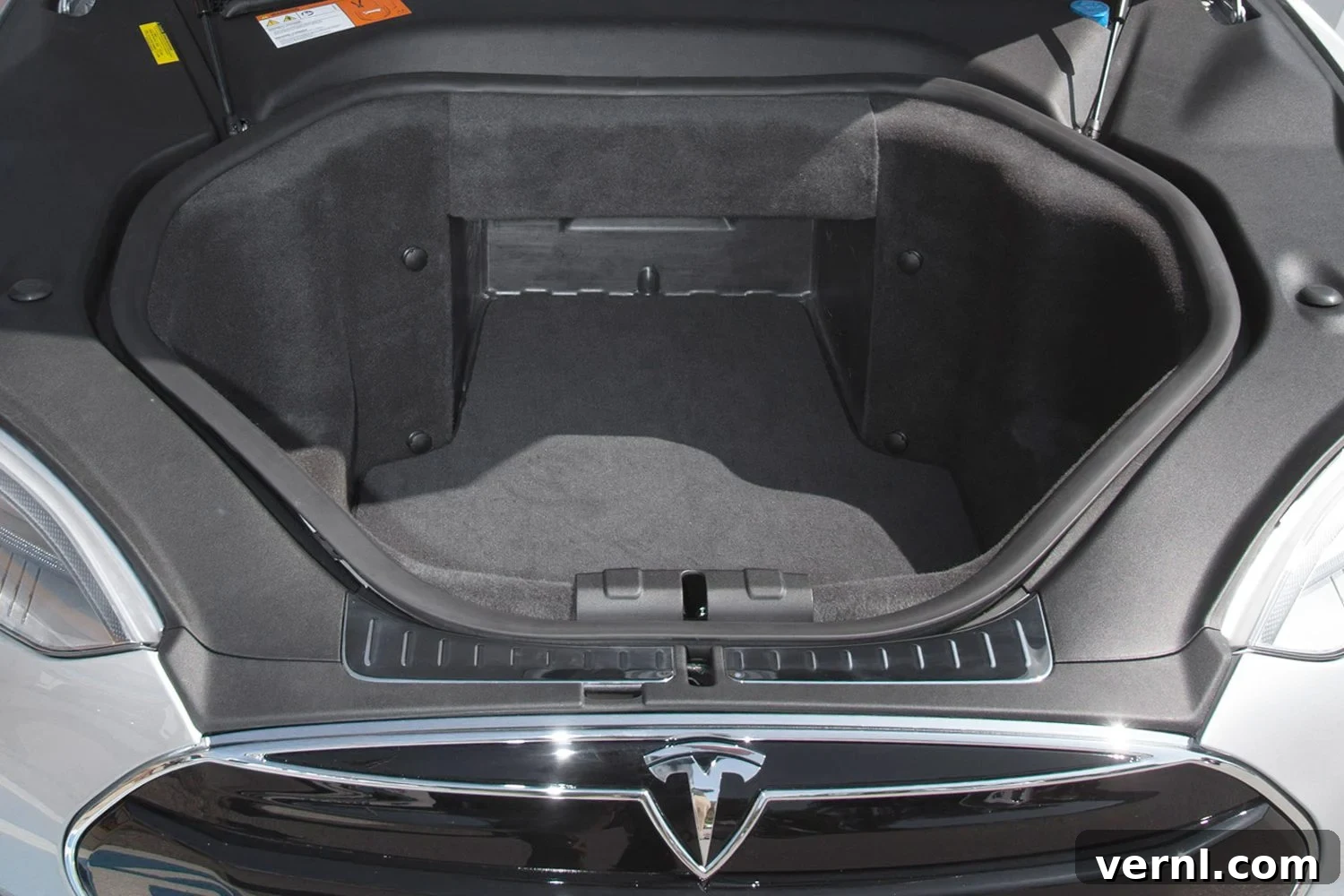
In the evolving landscape of automotive design, the concept of a front trunk, affectionately known as a “frunk,” stands as a testament to innovation and practicality. While often associated with modern electric vehicles (EVs), the idea of utilizing the front space for storage rather than an engine isn’t entirely new. Historically, vehicles like the rear-engine Volkswagen Beetles, Chevrolet Corvairs, and iconic Porsche 911s, and even the visionary futuristic Tucker 48, all featured a storage compartment where a traditional engine would typically reside.
The term “frunk” itself, however, gained widespread recognition when Tesla introduced it in 2012 to describe the additional cargo space at the front of their groundbreaking electric vehicles. Since then, the clever portmanteau has caught on, becoming a standard term across the burgeoning EV market. As Chris “Moose” Pyle, an automotive expert with JustAnswer, explains, “Electric vehicles do not have engines, so there is a large cavity under the hood, making a frunk a trunk but on the front of the vehicle. It is another place to store things outside the cab and out of the weather.” This ingenious use of otherwise vacant space has transformed EV design, offering drivers unprecedented levels of versatility and convenience.
Formed by combining the words “front” and “trunk,” frunks are now a distinguishing feature in many EVs, particularly gaining prominence in electric truck models. Many modern frunks are substantially larger and more thoughtfully designed than their predecessors, making them incredibly practical for diverse needs, from hauling a week’s worth of groceries after a trip to Costco to securely stowing large suitcases for a road trip. Delve into the fascinating world of frunks as we explore everything you might want to know about this increasingly essential feature in today’s electric vehicles.
What Exactly Is a Frunk? Exploring the Front Trunk Phenomenon
At its core, a frunk is simply a portmanteau of “front” and “trunk,” referring to the storage compartment located at the front of a vehicle. This design is primarily feasible and ubiquitous in electric vehicles because they lack the bulky internal combustion engines that traditionally occupy this space. Instead of an engine block, radiator, and exhaust system, EVs typically house electric motors, inverters, and other power electronics, which are often more compact or can be strategically placed elsewhere in the chassis, leaving the “hood” area free for cargo.
The origins of the term “trunk” itself are quite intriguing and date back to the 19th century. During this era, people commonly used “travel trunks” – large, sturdy chests – to transport personal belongings and goods, often strapped to the back of horse-drawn carriages. This practice evolved with the advent of automobiles; in the 1930s, some car owners would actually attach these physical steamer trunks to the rear of their vehicles for extra storage. Over time, automakers began to integrate these storage solutions directly into the vehicle’s body, creating dedicated compartments. The name “trunk” simply stuck, enduring through generations of automotive design to describe the primary rear storage area. Now, with the rise of EVs, the “frunk” brings this historical concept full circle, repurposing unused space to meet modern demands for practicality and efficiency.
Why the Modern Driver Needs a Frunk: Practicality and Innovation in EV Storage
Just like its counterpart in the rear, a frunk serves as an exceptionally versatile storage space, perfect for everything from daily errands to adventurous road trips. It’s ideal for carrying groceries, keeping muddy sports gear separate from the passenger cabin, stashing emergency tools, or maintaining a readily accessible first aid kit. However, the utility of a frunk extends far beyond mere extra space; it offers unique advantages that enhance the EV ownership experience.
In their early iterations, EV frunks were often perceived as somewhat smaller than the traditional rear trunks found in internal combustion engine (ICE) vehicles. Yet, as ICE vehicles began shrinking to meet fuel economy standards, their trunks also became more compact. This convergence has made modern EV frunks increasingly comparable in size, and often superior in practical design, to today’s conventional trunks. Manufacturers quickly realized that adding a practical, accessible storage area at the front significantly boosted the overall appeal of EVs, helping to “normalize” these advanced vehicles for car buyers accustomed to decades of traditional car layouts.
Today’s frunks are not only growing in size but are also becoming sophisticated cargo solutions, especially in newer full-size EV pickup trucks which can comfortably accommodate two large coolers. This evolution is driven by a host of innovative features, transforming the frunk into a highly functional compartment:
- Modular Dividers: Many frunks now include removable dividers, allowing owners to customize the space for smaller items or remove them entirely to create one large, unobstructed cargo area for bulkier goods.
- Water-Resistant Inserts: Removable, composite water-resistant inserts with integrated drain holes make cleanup incredibly easy. This feature is perfect for wet or dirty items like swimsuits, fishing gear, or even ice for a tailgate party, preventing spills from affecting the vehicle’s interior.
- Integrated Power Outlets: The inclusion of USB and 120-volt chargers transforms the frunk into a mobile power station, ideal for charging small electronics, powering portable tools, or even running camping equipment.
- Specialized Storage: Some models feature convenient slide-out drawers or integrated toolboxes, providing secure and organized storage for essential items.
- Hidden Compartments: For added security and discretion, many frunks incorporate hidden storage areas, perfect for valuables or emergency supplies.
- Impressive Payload Capacity: With some frunks boasting a 400-pound payload capacity, they are robust enough to handle significant loads, greatly expanding the vehicle’s utility.
- Built-in Interior Lighting: To make loading and unloading cargo at night or in dimly lit conditions effortless, many frunks come equipped with integrated interior lighting.
While the weatherproof nature of many frunks is a distinct advantage, it does present one minor drawback: a lack of air circulation. This characteristic makes long-term storage of certain items, such as perishable food, water, clothing that needs to breathe, or even a battery jump starter, potentially problematic due to condensation or stagnant air. Owners should be mindful of what they store for extended periods in such conditions.
Seamless Access: How to Open and Close Your EV Frunk
Operating a frunk is generally as straightforward as opening a conventional hood, often even more convenient thanks to modern technology. In most EVs, the frunk can be opened by pulling on a lever or cable located inside the cabin, much like a traditional hood release. However, depending on the specific year, make, and model of your electric vehicle, you might have several advanced options at your disposal:
- Key Fob: Many vehicles allow you to pop the frunk with a dedicated button on your key fob, offering quick and easy access before you even reach the car.
- In-Cabin Switch: A discreet switch inside the vehicle, often near the driver’s seat or on the dashboard, provides another convenient way to open the frunk.
- Touchscreen Controls: For technologically advanced EVs, the frunk can often be opened through the vehicle’s central infotainment touchscreen, integrating control into a centralized interface.
- Smartphone App: A growing number of manufacturers offer dedicated smartphone applications that allow owners to remotely open the frunk, adding a layer of smart connectivity and convenience.
Closing and securely latching a frunk lid follows a similar procedure to closing a regular hood, ensuring it is properly seated for safety and aerodynamics:
- Begin by lowering the lid gently until it’s approximately six inches above the primary latch mechanism.
- Release your hands, allowing the lid to drop under its own weight until it catches the safety latch. This prevents the lid from fully opening inadvertently.
- With the palms of your hands, firmly press down two or three times on the front edge of the lid until you hear and feel it securely latch into place. Avoid slamming the lid, as this can potentially damage the mechanism or the vehicle’s body.
- Finally, pull up lightly on the lid to ensure it is securely latched and locked, preventing it from rattling or opening unexpectedly while driving.
A notable consideration for EV owners is what happens if the vehicle’s 12-volt battery dies, especially if your EV lacks a physical lever or cable to open the frunk. Unlike internal combustion cars where the 12V battery might start the engine, in EVs, this battery powers auxiliary systems, including the electronic latches. To address this, some manufacturers strategically place an external connector, often hidden behind a removable bumper plug, allowing you to provide auxiliary power to the 12V system. This enables you to access the frunk or open the doors even if the main 12V battery is depleted.
Beyond Storage: The Multifaceted Benefits of an EV Frunk
While the primary advantage of a frunk is undoubtedly its additional storage capacity, its design and placement offer several less obvious, yet equally significant, benefits for both driver and passenger safety, as well as vehicle performance.
Enhanced Safety through Advanced Crumple Zones
One of the most crucial, though often overlooked, benefits of a frunk relates to vehicle safety. In a frontal collision, the frunk area behaves like an additional crumple zone. This means it is engineered to deform and absorb a significant amount of the energy generated during a crash. By effectively dissipating kinetic energy, the frunk helps to reduce the forces transmitted to the passenger cabin, thereby protecting the occupants. This added layer of energy absorption can drastically mitigate injuries in the event of a frontal impact, making EVs with well-designed frunks inherently safer in certain collision scenarios. As Xavier Sabastian, an auto expert with Way.com, highlights, “In some cases, a well-designed frunk can also make pedestrians safer by reducing the force of impact in a collision with a pedestrian.” This design philosophy underscores a holistic approach to safety that extends beyond vehicle occupants.
Improved Vehicle Handling and Stability
Beyond safety, strategic use of the frunk for cargo can also contribute to more uniform vehicle weight distribution, which in turn improves handling and overall stability. By distributing weight towards the front of the vehicle, particularly for larger items, drivers can experience better balance, especially in high-performance EVs or when navigating challenging road conditions. This optimized weight distribution can lead to a more predictable and responsive driving experience. However, it is paramount never to exceed your vehicle’s Gross Vehicle Weight Rating (GVWR). The GVWR encompasses the total permissible weight of the vehicle itself, its occupants, fuel (or battery weight equivalent for EVs), and all cargo. This critical information is typically found on the tire and loading information label located on the driver’s side door jamb or detailed within the owner’s manual. Adhering to the GVWR ensures both safety and optimal vehicle performance.
Enhanced Security and Aesthetics
Frunks also offer enhanced security for valuables. Being a sealed, often lockable compartment, they provide a secure place to store items out of sight, reducing the risk of theft compared to leaving items visible in the passenger cabin. Aesthetically, the absence of a conventional engine under the hood allows designers more freedom, often leading to sleek, streamlined front-end designs that contribute to the modern, clean look characteristic of many electric vehicles. The frunk, therefore, isn’t just about utility; it’s an integral part of the EV’s overall design and appeal.
Frequently Asked Questions About Frunks
Are frunks typically smaller than traditional rear trunks?
Generally, yes, frunks tend to be somewhat smaller than a vehicle’s primary rear trunk, especially in terms of depth. This is largely because the front portion of a typical vehicle tapers for aerodynamic efficiency and aesthetic reasons, naturally limiting the available space. However, as Frank Scandura, owner of Frank’s European Service, notes, “Their size is dictated by the size of the vehicle, the amount of electronics stored behind the panels and other vehicle constraints.” As EV technology evolves, some larger EV trucks and SUVs are pushing the boundaries, offering frunks that rival or even surpass the practicality of many traditional trunks, particularly in terms of width and innovative features.
Do frunks have any significant impact on vehicle safety?
Absolutely, and in a very positive way. Frunks play a beneficial role in vehicle safety. As previously discussed, they effectively act as an additional crumple zone in the event of a frontal collision. This extra zone can absorb a substantial amount of impact force, thereby significantly protecting the driver and passengers by reducing the energy transferred to the cabin. As Xavier Sabastian from Way.com emphasizes, “In some cases, a well-designed frunk can also make pedestrians safer by reducing the force of impact in a collision with a pedestrian,” by offering a more yielding surface than a rigid engine block. This multi-layered approach to safety highlights the thoughtful engineering behind modern EV design.
What are the most common uses for a frunk?
Frunks are incredibly versatile. Common uses include storing charging cables and adapters, keeping groceries separate and cool (if insulated), securing muddy or wet gear after outdoor activities, holding emergency kits (first aid, roadside tools), or stashing valuables away from plain sight. For EV pickup trucks, the frunk becomes a robust, lockable toolbox or an ideal cooler for tailgating events.
Can I put anything in my frunk?
While highly versatile, it’s not advisable to put *anything* in your frunk. Due to limited air circulation in many frunks, perishable food items, live animals, or anything sensitive to temperature fluctuations or lack of ventilation should be avoided for long-term storage. Always adhere to your vehicle’s weight limits (GVWR) and ensure items are securely placed to prevent movement during transit. Refer to your owner’s manual for specific recommendations and restrictions.
Are all frunks waterproof?
Many modern frunks, especially those in electric trucks and utility vehicles, are designed to be water-resistant or even fully waterproof, often featuring drain plugs for easy cleaning. However, this is not a universal feature across all EV models. It’s important to check your specific vehicle’s specifications or owner’s manual to determine the water-resistance level of your frunk before storing items sensitive to moisture.
About the Automotive Experts
- Chris “Moose” Pyle is a highly respected master-certified technician with over two decades of extensive automotive experience. He has been sharing his expert knowledge as a contributing expert for JustAnswer since 2006, providing invaluable insights into vehicle mechanics and operation.
- Frank Scandura, the proprietor of Frank’s European Service in Las Vegas, Nevada, brings an impressive 45 years of automotive expertise to the field. His deep understanding of vehicle systems is further showcased through dozens of articles he has authored for AutoTechIQ, a trusted resource dedicated to educating car owners and connecting them with reputable repair shops.
- Xavier Sabastian is an accomplished author and recognized auto expert associated with the innovative Way.com auto app, where he contributes his profound knowledge to help users navigate the complexities of car ownership and maintenance.