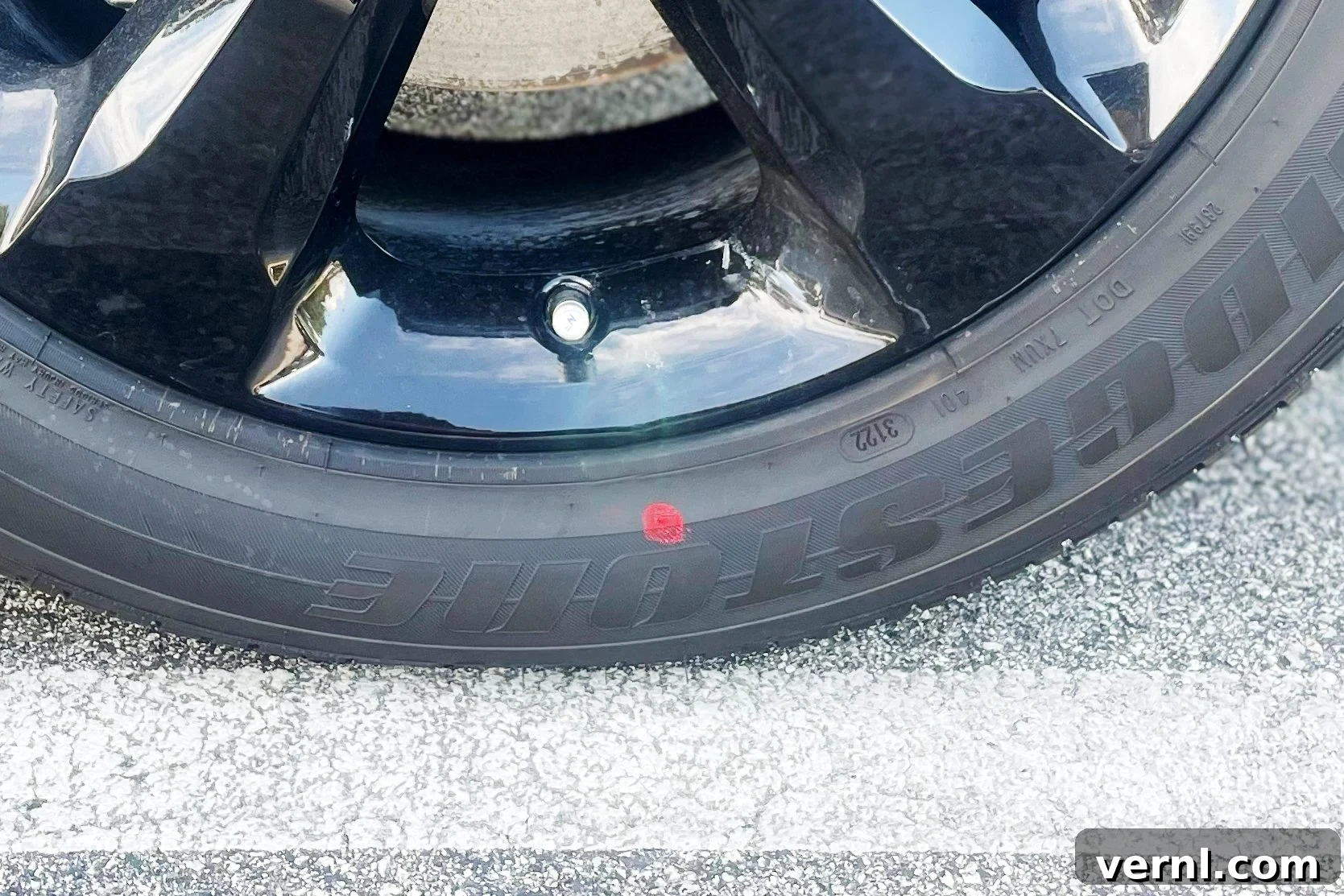
Decoding Tire Paint Dots: Understanding Balance, Performance, and Safety
Have you ever noticed small red or yellow paint dots adorning the sidewalls of new tires and wondered about their significance? Are they an indicator of a sale, a defect, or perhaps the tire’s origin? The answer to these common questions is simpler and far more critical to your driving experience than you might imagine.
Contrary to popular myths, these seemingly innocuous dots are not about aesthetics, discounts, or manufacturing locations. Instead, they serve as vital markers, assisting professional tire technicians in achieving optimal tire balance. Given the inherent challenges in manufacturing a tire that is perfectly round and uniformly weighted, these paint dots highlight specific irregularities that, if unaddressed, can lead to significant performance and safety issues. Proper balancing of a tire and wheel assembly is paramount for a comfortable ride, enhanced safety, and the longevity of your vehicle’s components. Understanding the difference between tire alignment versus balance is also crucial for overall vehicle health.
Note: When we refer to a “tire/wheel assembly,” we are discussing the complete unit comprising the black rubber tire (the part that makes contact with the road and wears out) mounted onto the circular metal wheel (the structural component to which the tire is attached). This distinction is important because balancing often involves compensating for imperfections in both components.
The Science Behind Tire Markings: Red and Yellow Dots Explained
Tire manufacturers invest heavily in precision engineering, yet due to the complex nature of rubber compounds and construction processes, minor variations in weight distribution and structural integrity are inevitable. These paint dots are the manufacturer’s way of communicating these critical points of irregularity to the installer, ensuring that the tire can be mounted and balanced effectively.
Understanding the Yellow Dot: The Lightest Point
The yellow dot on a tire identifies the point on its circumference where the tire material is lightest. This “light spot” is a result of minor variations in the rubber’s density and thickness during the manufacturing process. For optimal balance, this lightest point on the tire should be aligned with the heaviest point of the wheel. The wheel’s heaviest point is almost universally where the valve stem is located. The valve stem, being a solid metal or rubber-clad metal component, adds a disproportionate amount of weight to that specific area of the wheel. By aligning the tire’s lightest spot with the wheel’s heaviest spot, technicians can naturally counteract some of the inherent imbalance, reducing the amount of additional weight needed during the balancing procedure.
Understanding the Red Dot: The Lowest Point (Radial Runout)
The red dot signifies a different, yet equally critical, inconsistency: the point of maximum radial runout. Radial runout refers to the measurement of how “out of round” a tire is. In simpler terms, it marks the tire’s flattest or lowest point, where the tire’s circumference is slightly smaller or compressed. This irregularity, often caused by the tire’s construction, is addressed by aligning it with the wheel’s highest point, which is typically indicated by a colored dot, a sticker, or a notch on the wheel itself. Minimizing radial runout is crucial for a smooth ride and consistent contact with the road surface.
Precedence When Both Dots Are Present
In cases where a tire features both a yellow and a red dot, the red dot generally takes precedence. This is because radial runout (the “out of round” condition indicated by the red dot) has a more significant impact on ride quality and potential vibration than static imbalance (the weight variation indicated by the yellow dot). By addressing the radial runout first, technicians aim to achieve the smoothest possible rotation, after which any remaining static imbalance can be corrected with wheel weights.
Why Tire Dots Are Crucial for Performance and Safety
These seemingly minor inconsistencies, highlighted by the paint dots, can lead to pronounced vibrations when the tire/wheel assembly is in motion. Unbalanced tires have a ripple effect, negatively impacting various aspects of your vehicle’s performance, safety, and longevity.
- Compromised Ride Quality: The most immediate and noticeable effect of unbalanced tires is a vibrating steering wheel or seat, especially at higher speeds. This persistent vibration makes for an uncomfortable and fatiguing driving experience.
- Reduced Fuel Economy: A vibrating, hopping tire expends more energy than a smoothly rotating one. This additional resistance and friction can subtly but surely increase your vehicle’s fuel consumption, translating into more frequent trips to the gas station.
- Decreased Braking Effectiveness: An unbalanced tire may lose consistent contact with the road surface, particularly when hopping. This intermittent contact reduces the tire’s grip and the friction generated during braking, potentially increasing your stopping distance and compromising emergency braking capabilities.
- Steering and Control Issues: A vehicle with unbalanced tires can feel less responsive and more challenging to control, particularly during rapid maneuvers or at highway speeds. This lack of stability can be a significant safety hazard.
- Accelerated Component Wear: The constant vibrations from unbalanced tires transmit stress throughout the vehicle. This can lead to premature wear of crucial suspension components, steering parts, and even wheel bearings, resulting in costly repairs down the line.
Consider the “contact patch” or “footprint” – the small area of the tire that actually touches the road at any given moment. This vital connection point is typically no larger than the palm of your hand. When a tire is unbalanced and begins to “hop” or vibrate, this minuscule contact patch loses full, consistent engagement with the road surface. This diminished contact directly translates to reduced traction, compromised steering, and significantly less friction when braking, highlighting the severe safety implications of neglecting tire balance.
The Essential Process of Wheel Balancing
Wheel balancing is a specialized service performed by technicians to correct any uneven weight distribution within the tire and wheel assembly. The process involves spinning the complete assembly on a dedicated balancing machine that precisely identifies where additional weights need to be strategically placed to counteract any imbalances. The goal is to ensure the tire rolls smoothly and consistently, eliminating vibrations and maximizing performance.
Failing to address an out-of-balance tire can lead to a host of problems beyond just an uncomfortable ride. Uneven tread wear is a common symptom, manifesting as dangerous bald spots or scalloping patterns on the tire surface. This not only shortens tire lifespan but also compromises traction and safety, especially in wet or slippery conditions. Furthermore, the constant stress from an unbalanced assembly can accelerate the failure of expensive suspension components, adding to your vehicle’s maintenance costs.
Types of Wheel Balancing: Static, Dynamic, and Match Balancing
There are several methods tire professionals employ to balance tires, each addressing different types of imbalance:
- Static Balancing: This method addresses imbalance along a single plane, typically focusing on up-and-down motion (tire hop). It’s a simpler form of balancing, often suitable for narrower wheels. The machine identifies heavy or light spots, and weights are placed on the inside or outside rim to correct this vertical imbalance.
- Dynamic Balancing: More sophisticated than static balancing, dynamic balancing accounts for imbalance on two planes. It identifies both vertical and lateral (side-to-side wobble) imbalances. This is the most common method used today for modern wheels and tires. The balancing machine spins the tire/wheel assembly at high speeds, pinpointing the exact locations and amounts of weight needed to correct both static and dynamic imbalances. Weights are typically applied to both the inside and outside edges of the rim.
- Match Balancing: Considered the most precise method, match balancing (also known as force matching) takes into account the inherent variations in both the tire and the wheel. It specifically aims to align the tire’s low point (red dot) with the wheel’s high point (often marked by the manufacturer or determined by the balancing machine) and the tire’s light point (yellow dot) with the wheel’s heaviest point (valve stem). By matching these natural inconsistencies, match balancing minimizes the need for corrective weights, resulting in a more perfectly balanced assembly and an exceptionally smooth ride. This is particularly beneficial for high-performance vehicles or those seeking the utmost in ride comfort.
Tires represent a significant investment in your vehicle. When purchasing and having your new tires mounted and balanced, it is always advisable to inquire with your tire installation professional about their balancing capabilities. Specifically, ask if their equipment supports match balancing. This advanced technique can yield superior results, especially if your wheels lack any manufacturer markings for their heavy or high points. Ensuring this level of precision upfront can save you from potential headaches and costs associated with vibrations and premature wear later on.
Common Causes of Tire Imbalance
Even perfectly balanced tires can eventually become unbalanced over time due to various factors. Understanding these causes can help you take proactive measures and recognize when professional intervention is needed:
- Tire Wear: As tires wear down, the rubber compound is removed unevenly across the tread. This change in mass distribution naturally alters the original balance of the tire/wheel assembly, making it lighter in some areas than others.
- Improper Inflation: Consistently over or under-inflating tires can lead to irregular tread wear patterns. An incorrectly inflated tire deforms abnormally, affecting its overall balance and leading to premature wear on specific sections of the tread.
- Poor Alignment: An improperly aligned vehicle can cause abnormal tire wear, such as feathering, cupping, or shoulder wear. These uneven wear patterns directly contribute to an unbalanced tire assembly.
- Loss of Wheel Weights: The small lead or steel weights attached to the rim can sometimes become dislodged due to impacts, corrosion, or improper adhesion during installation. Losing even one weight will immediately throw the tire/wheel assembly out of balance.
- Improper Tire or Wheel Repair: If a tire or wheel has been repaired incorrectly, or if a patch inside a tire significantly alters its internal weight distribution, it can lead to imbalance. Similarly, poorly executed rim repairs can also change the wheel’s balance.
- Leaky Valve Stem Replacement: While the valve stem is a small component, its replacement or improper installation can sometimes slightly alter the weight distribution if a different type or heavier stem is used, or if the original balancing compensation for its weight is lost.
- “Flat-Spotting” from Cold Mornings or Prolonged Parking: When a vehicle sits for an extended period, especially in cold temperatures, the section of the tire in contact with the ground can develop a temporary flat spot. While often resolving after a few miles of driving, severe or persistent flat spots can contribute to vibration.
- Impact Damage: Striking a pothole, bouncing into a curb, or other road hazards can damage the wheel, bending or deforming it. Even a slight bend in the rim can significantly affect the wheel’s concentricity and lead to severe imbalance.
To extend the life of your tires and ensure even wear, regular maintenance is paramount. This includes consistently checking tire pressure according to your vehicle manufacturer’s recommendations and rotating your tire/wheel assemblies every 5,000 to 8,000 miles. Tire rotation helps distribute wear evenly across all four tires, prolonging their service life and maintaining balance. However, if you detect any unusual vibrations while driving – especially in the steering wheel, seat, or floorboards – it’s a clear indication that your tires may be out of balance. In such cases, it is crucial to consult with automotive professionals immediately to have your tires inspected and re-balanced. Prompt attention can prevent further damage, ensure your safety, and optimize your vehicle’s performance.
Conclusion: The Unseen Heroes of a Smooth Ride
The small red and yellow paint dots on your tires, often overlooked, are far more than just random markings. They are a silent language between tire manufacturers and installation technicians, facilitating the precise balancing crucial for your vehicle’s performance, safety, and comfort. Understanding their meaning demystifies a critical aspect of tire maintenance and empowers you as a driver.
Proper tire balancing directly contributes to a smoother, quieter ride, extends the lifespan of your tires, enhances fuel efficiency, and most importantly, improves your vehicle’s handling and braking capabilities, directly impacting your safety on the road. By recognizing the importance of these dots and ensuring your tires are professionally balanced, you invest in the longevity of your vehicle and the security of every journey. Never underestimate the profound impact of a perfectly balanced tire assembly – it is truly one of the unseen heroes ensuring a consistently smooth and safe driving experience.