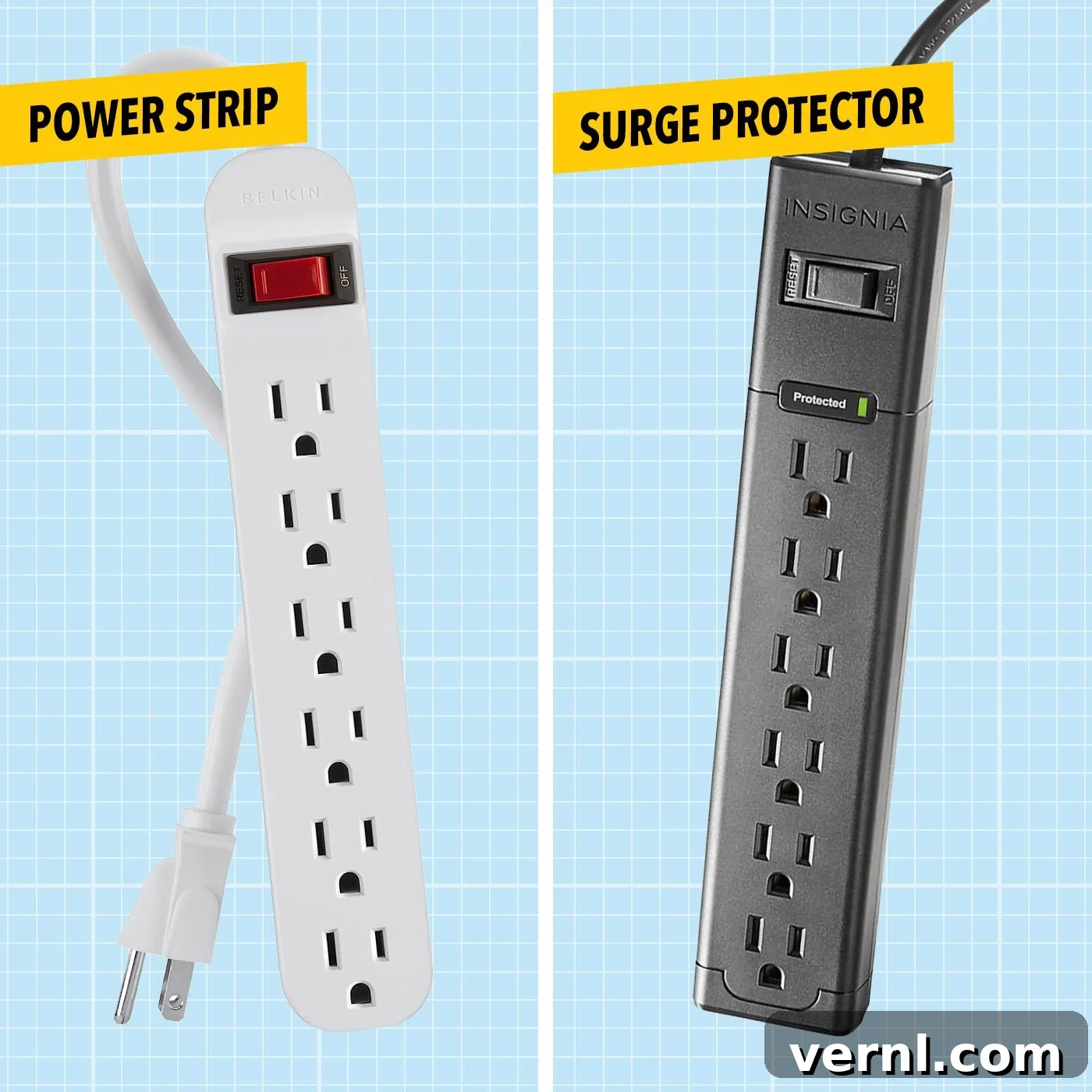
Wherever you work, play, or simply live in the modern age, you’re undoubtedly familiar with power strips and surge protectors. These ubiquitous devices have become indispensable tools for managing our ever-growing collection of electronics. Whether it’s a television, a computer workstation, multiple phone chargers, or a robust gaming console like an Xbox, most of our cherished gadgets rely on these multi-outlet solutions, often hidden discreetly in cabinets or beneath desks.
The ability to extend power from wall receptacles is not just a convenience; it’s a necessity, especially in older homes that may not conform to modern electrical layouts. According to the National Electrical Code, typical living rooms should ideally have a wall receptacle every 12 feet. However, many existing structures fall short of this standard, making supplementary power solutions essential for everyday functionality and connectivity.
But have you ever paused to consider the fundamental difference between a surge protector and a simple power strip? While they might appear similar, and are often interchangeably referred to as “extension cords with multiple outlets,” their underlying functions and the level of protection they offer are vastly different. Understanding this distinction is paramount, particularly when it comes to plugging in your sensitive, valuable, and often irreplaceable electronics.
Ignoring these differences can lead to significant risks, ranging from the gradual degradation of your devices to immediate, catastrophic damage caused by electrical anomalies. This guide will clarify the unique roles of each device, how to tell them apart, and when to confidently choose one over the other to ensure the safety and longevity of your electronic investments.
What Is a Power Strip? Simple Extension, Essential Convenience
A power strip, in its most straightforward definition, can be thought of as an extension cord that terminates with a block of multiple receptacles, commonly known as “outlets.” Its primary and sole function is to expand the number of available plug-in points from a single wall outlet, effectively distributing power to several devices simultaneously.
These devices are ideal for scenarios where you need more places to plug in simple, low-amperage appliances and electronics. Think of items such as desk lamps, alarm clocks, small fans, basic phone chargers, or other non-sensitive gadgets that merely require an electrical connection without needing any form of voltage regulation or protection. Power strips are perfect for tidying up cable clutter and making power accessible in areas with limited wall outlets.
Many basic power strips also come equipped with a master on/off switch. This feature allows users to conveniently toggle power to all connected devices at once, which can be useful for saving energy or ensuring all peripherals are completely off. Given their simple design and lack of advanced components, basic power strips are generally very affordable, often found for less than $10.
It is crucial to remember that a standard power strip does not offer any defense against electrical fluctuations. It merely acts as a passive splitter, providing more outlets but no safeguard. Therefore, while incredibly convenient for expanding plug-in capacity, it provides no protection for your delicate electronics against the unpredictable nature of the electrical grid.
What Is a Surge Protector? Your Electronic Guardian
A surge protector takes the fundamental concept of a power strip—providing multiple outlets—and significantly elevates it by adding a critical safety feature: protection against sudden electrical surges. Unlike a power strip, a surge protector is engineered to act as a defensive barrier, safeguarding your electronics and other sensitive devices from potentially damaging voltage spikes.
Power surges are defined as brief but intense increases in electrical voltage that significantly exceed the normal operating voltage of an electrical system. These spikes are incredibly fast, often lasting only microseconds, but they carry enough energy to cause serious harm. The damage can manifest immediately as device failure, or cumulatively, leading to a shortened lifespan and unreliable performance of your electronics over time.
The sources of power surges are diverse. External factors include lightning strikes, even those that don’t directly hit your home but cause inductive surges in nearby power lines, and fluctuations from the utility grid itself. These grid fluctuations can occur due to changes in power demand, switching of electrical equipment at power stations, or unforeseen events like power line damage. Within your home, large appliances with motors, such as refrigerators, air conditioners, washing machines, and vacuum cleaners, can generate smaller, localized surges when they cycle on and off. Even minor static electricity discharges can create small voltage spikes.
At the heart of most surge protectors are components known as Metal Oxide Varistors (MOVs). These clever devices are designed to divert excess voltage. When the incoming voltage exceeds a safe threshold, the MOV quickly shunts the surplus electrical current away from the connected devices and dissipates it as heat, thereby “clamping” the voltage down to a safe, acceptable level. This sacrificial action protects your valuable equipment from the brunt of the surge.
Given this advanced protective capability, surge protectors naturally come at a higher price point than basic power strips. While a basic model might start around $20, more feature-rich units—offering higher surge protection capacity, a greater number of outlets, USB charging ports, and specialized protection for coaxial cables or Ethernet lines—can range up to $50 or more, depending on their specifications.
It’s important to understand that surge protection comes in various forms. While this discussion primarily focuses on the common “Type 3” point-of-use surge protector, which resembles a power strip, there are also “Type 2” protectors installed in electrical panels for whole-house protection, and “Type 1” protectors at the service entrance. For most consumers, the power strip-style surge protector is the most accessible and frequently used device for localized electronic protection.
Surge Protector vs. Power Strip: How to Identify the Right Device
The visual similarity between power strips and surge protectors makes it essential to know how to distinguish them beyond a superficial glance. Mistaking a simple power strip for a surge protector can leave your expensive computers, elaborate entertainment systems, and powerful gaming setups completely exposed to damaging electrical surges, undoing all your efforts to protect them.
When you’re in the market for a new device, always scrutinize the labeling on the packaging and the product description if buying online. This information is your most reliable source for making an informed decision. For devices you already own, crucial details are often printed directly on the strip itself, even if the original box has long been discarded.
- Listing Mark and Certification: A vital indicator of both safety and functionality is the listing mark from a recognized certification organization. Look for logos from entities like UL (Underwriters Laboratories) or Intertek (ETL). These marks signify that the product has been tested and meets rigorous safety standards. Crucially, a genuine surge protector will feature the listing mark alongside explicit text like “surge protection device” or “SPD.” A power strip will also have a listing mark for safety but will lack any mention of “surge protection.” It is imperative never to purchase an unlisted surge protector or power strip, as their safety and performance are unverified.
- Indicator Light(s): Many surge protectors incorporate one or more indicator lights to communicate their operational status. A common configuration includes a “Protection ON” or “Protected” light and often a separate “Grounded” light. If your surge protector has a dedicated protection light and it is no longer illuminated, it means the internal components (like the MOVs) designed to absorb and dissipate surges have been depleted or sacrificed. In this state, the device will likely still function as a basic power strip, but it will no longer offer any surge protection, signaling that it’s time for a replacement.
- Joule Rating: Expressed in joules (J), this numerical value is a key specification for surge protectors, indicating the maximum amount of energy the device can absorb before it fails. A higher joule rating generally signifies greater protective capacity and a longer lifespan for the surge protector itself. For sensitive electronics such as computers, gaming consoles, and home theater systems, aim for a surge protector with a rating of at least 1000 to 2000 joules. For critical or very expensive equipment, a rating of 2500 joules or higher is advisable.
- Voltage Protection Rating (VPR) / Clamping Voltage: The VPR, often called the clamping voltage, specifies the maximum voltage level that the surge protector will permit to pass through to your connected devices during a surge event. This rating typically begins at 330 volts and goes upwards. A lower VPR is always better, as it indicates that the surge protector will clamp down more aggressively on excess voltage, allowing less harmful current to reach your delicate electronics.
- Nominal Discharge Current (In): Found on higher-quality and more robust surge protectors, the “In” rating specifies the peak current (measured in kiloamperes or kA) that the protector can safely divert from the protected circuit a set number of times. For typical home-use surge protectors, this value is often around 3kA, but it can be higher for industrial or whole-house units. A higher Nominal Discharge Current suggests a more durable device capable of enduring multiple surge events without degradation.
- Response Time: While not always prominently displayed on consumer-grade strip protectors, a good quality surge protector boasts an extremely rapid response time, usually measured in nanoseconds (billionths of a second). This ensures that the protector activates almost instantaneously to divert a surge, minimizing the window of vulnerability for your electronics.
When Is a Surge Protector the Best Choice? Prioritizing Protection
The decision to opt for a surge protector over a basic power strip should be driven by the value, sensitivity, and importance of the electronics you intend to connect. Any device that would be expensive to replace, contains critical data, or is central to your daily activities warrants the superior protection provided by a surge protector.
This category typically includes: desktop computers, laptops, monitors, external hard drives, high-definition televisions (HDTVs and 4K TVs), home theater systems, gaming consoles (such as PlayStation, Xbox, and Nintendo Switch), sophisticated audio equipment, smart home hubs (like Google Home or Amazon Echo devices), Wi-Fi routers, modems, and even high-end phone and tablet chargers. For professional environments, servers, network switches, and other critical office equipment absolutely demand robust surge protection to prevent costly downtime and irreparable data loss.
When making this choice, consider the potential repercussions: the financial burden of replacing a top-tier gaming PC or a large smart TV, the anguish of losing irreplaceable personal photos or important work documents from a damaged hard drive, or the significant inconvenience caused by the failure of crucial home network infrastructure. The relatively modest investment in a quality surge protector is a small price to pay compared to these potential losses. It acts as an affordable insurance policy for your electronics.
While there’s no inherent harm in using a surge protector for less expensive items like a simple lamp or an alarm clock, it’s generally not the most cost-effective choice, given that surge protectors are typically more expensive than basic power strips. For those who prioritize maximum peace of mind and protection across the board, however, using surge protectors for all plugged-in devices is a valid, albeit pricier, approach.
When Is a Power Strip the Best Choice? Simple Extension, Simple Needs
Power strips are the optimal choice when your primary requirement is simply to increase the number of available electrical outlets without the need for any form of surge protection. They excel in scenarios where you have more low-power, non-sensitive devices than wall receptacles can accommodate.
Ideal applications for power strips include: connecting multiple strings of holiday or decorative lights, powering a simple reading lamp or floor lamp that can’t reach a wall outlet, operating a small, non-motorized fan, charging a basic, less critical mobile phone, or running a small radio or humidifier. In a workshop setting, a power strip might be suitable for low-draw hand tools, provided the strip’s ratings are carefully observed.
However, a critical safety caveat accompanies the use of power strips: never overload them. It’s vital to understand that both power strips and surge protectors function merely as extensions of an existing electrical circuit; they do not magically increase your home’s electrical capacity. This means the cumulative current drawn by all devices plugged into the strip must not surpass the strip’s maximum amperage rating, nor the capacity of the circuit breaker in your electrical panel.
Plugging multiple high-amperage appliances into a single power strip is extremely dangerous and is a frequent cause of electrical fires. Devices such as microwaves, air fryers, space heaters, refrigerators, washing machines, hair dryers, and vacuum cleaners draw a significant amount of power. Each of these appliances should ideally be plugged directly into a dedicated wall outlet. If an extension is absolutely necessary, use only a heavy-duty extension cord specifically rated for high-wattage appliances, and never plug such devices into a standard multi-outlet power strip or surge protector designed for electronics.
Always inspect the wattage or amperage ratings on your appliances and cross-reference them with the ratings of your power strip and the circuit it is connected to. Overloading can cause circuits to trip, damage the strip itself, or, in the worst-case scenario, ignite an electrical fire. Ensure that power strips and their cords are not covered or obstructed, allowing for proper heat dissipation. Furthermore, strictly avoid “daisy-chaining” – the hazardous practice of plugging one power strip into another – as this significantly increases the risk of dangerous overloads.
Essential Safety Tips for Both Power Strips and Surge Protectors
Regardless of whether you are utilizing a power strip or a surge protector, adhering to fundamental electrical safety guidelines is paramount. These practices are crucial not only for preventing potential hazards like electrical fires and shocks but also for extending the life of your devices and the strips themselves:
- Avoid Daisy-Chaining: Never plug one power strip or surge protector into another. This dangerous practice creates an easy path to overload the initial wall outlet and the entire circuit, presenting a severe fire risk.
- Respect Current Ratings: Always ensure that the total wattage or amperage of all devices simultaneously plugged into a strip does not exceed the strip’s maximum specified rating. For most standard household strips, this is typically 15 amps or 1875 watts. Exceeding these limits can lead to dangerous overheating and potential fires.
- Indoor Use Only (Unless Specified): The vast majority of power strips and surge protectors are designed exclusively for indoor, dry environments. If you need to power devices outdoors, it is imperative to use a product specifically rated for outdoor use, which will feature robust, weatherproof casings and often incorporate ground fault circuit interrupter (GFCI) protection for enhanced safety.
- No Covering or Obstruction: Do not place power strips or surge protectors underneath carpets, rugs, furniture, or any other material that can impede airflow. This practice prevents heat from dissipating effectively, leading to overheating, and also conceals potentially damaged cords or signs of malfunction.
- Regularly Inspect for Damage: Make it a habit to periodically inspect all cords and the devices themselves for any signs of wear and tear or damage. Look for frayed wires, exposed insulation, discolored areas, or any unusual burning smells. Immediately discontinue use and replace any unit exhibiting these signs.
- Replace Depleted Surge Protectors: Remember that surge protectors are sacrificial devices; they absorb and dissipate surges by sacrificing their internal components. If the “protection active” indicator light goes out, or if the device has experienced a significant surge event (e.g., a nearby lightning strike or major power fluctuation), assume its protective capabilities are compromised and replace it promptly.
- Keep Away From Water: Electrical devices and water are a dangerous combination. Never use power strips, surge protectors, or any other electrical equipment in wet or damp environments, or near sources of water like sinks, bathtubs, or outdoor puddles.
- Understand Cord Length and Gauge: While longer cords offer flexibility, excessively long extension cords or power strip cords can lead to voltage drop and increased electrical resistance, especially when powering higher loads. Always use the shortest practical cord length, and ensure the cord’s gauge (thickness) is appropriate for the intended load to prevent overheating.
Conclusion: Make Informed Choices for a Safer and More Protected Digital Life
In our modern, electronics-dependent world, understanding the critical distinctions between power strips and surge protectors is no longer merely a technical detail; it’s a fundamental aspect of ensuring electrical safety and prolonging the life of your valuable devices. While both serve the valuable purpose of expanding your electrical outlets, only one provides the crucial defense your sensitive electronics need against the unpredictable and often damaging nature of electrical surges.
By taking the time to learn how to identify the key features of a true surge protector – its specific listing mark, the presence and status of indicator lights, its joule rating, and its voltage protection rating (VPR) – you empower yourself to make informed decisions that actively protect your investments. Use power strips for simple, non-sensitive items where only additional outlets are needed. Conversely, always opt for a robust, high-quality surge protector for your computers, home entertainment systems, networking equipment, and any other sensitive or expensive electronics you rely on.
Prioritizing safety and making the correct choice between these two ubiquitous devices will not only safeguard your gadgets from potential damage and premature failure but also contribute significantly to a safer and more reliable electrical environment within your home or office. Invest wisely, plug in smartly, and protect your digital life for years to come.