
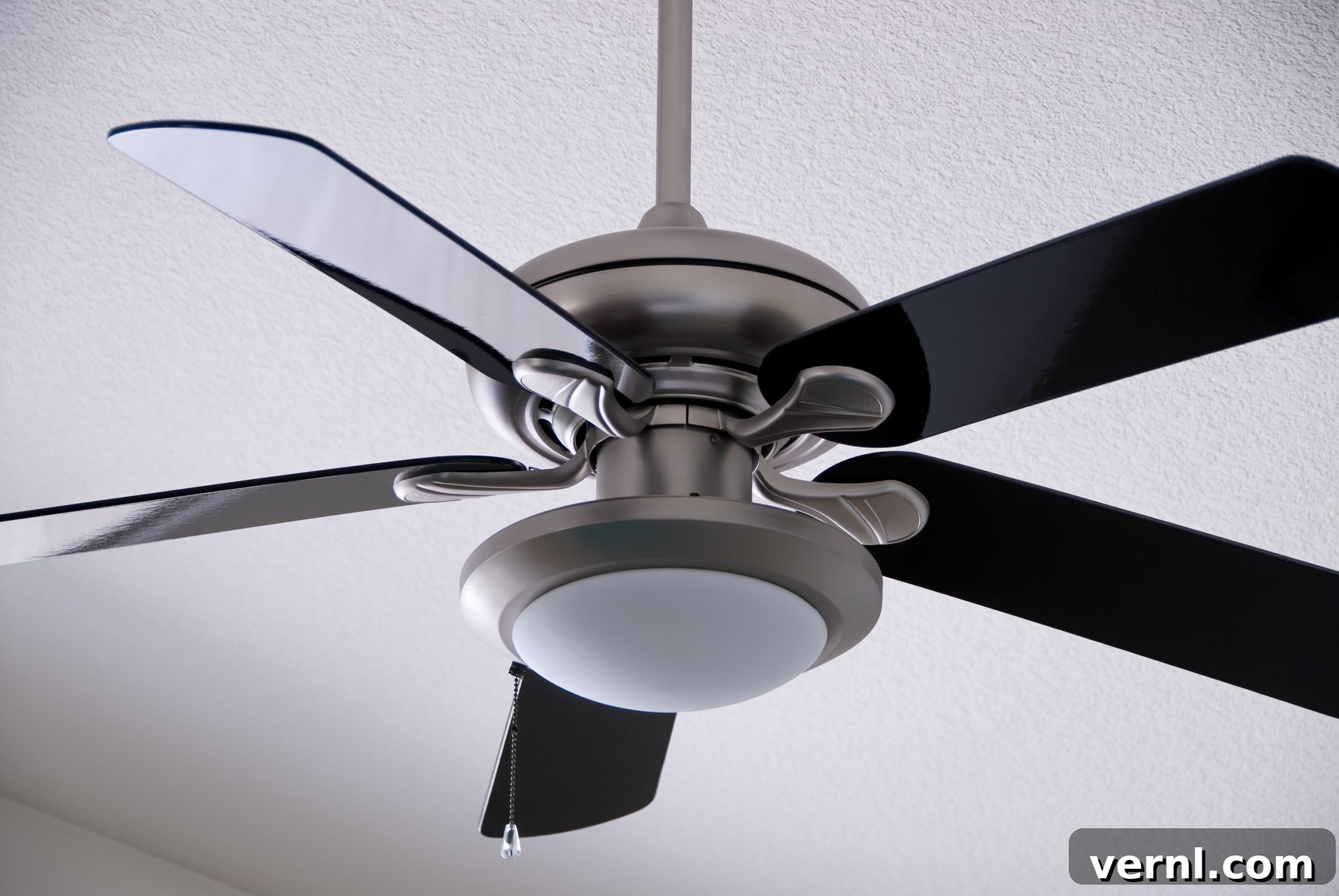
As summer’s relentless heat continues to grip many regions, finding effective and affordable ways to stay cool becomes a top priority for homeowners. Running an air conditioner constantly can lead to alarmingly high electricity bills, prompting a search for more budget-friendly and energy-efficient cooling alternatives. This is where the humble ceiling fan steps in, offering a refreshing breeze without the hefty price tag.
If you’re contemplating adding a ceiling fan to your home, either to complement your existing air conditioning system or simply to circulate air and maintain comfort when the AC isn’t necessary, understanding its energy consumption is crucial. This comprehensive guide will explore everything you need to know about ceiling fans and their electricity usage, helping you make an informed decision for a cooler, more cost-effective home.
The Energy Efficiency of Ceiling Fans: A Smart Cooling Choice
One of the most common questions homeowners ask is, “Do ceiling fans use a lot of electricity?” The short answer is no, especially when compared to other whole-room cooling appliances like air conditioners, or even portable units like box fans and tower fans. Ceiling fans are designed to create a wind-chill effect, making you *feel* cooler by evaporating perspiration from your skin, rather than actually lowering the ambient temperature of the room. This fundamental difference is key to their energy efficiency.
While a ceiling fan certainly consumes more energy than, say, a phone charger, it’s essential to put its power usage into a relevant context. Its primary purpose is to move air efficiently, and it accomplishes this with significantly less power than an air conditioner, which actively removes heat from a space. By creating a comfortable breeze, ceiling fans allow you to set your thermostat a few degrees higher in the summer, significantly reducing your air conditioner’s workload and, consequently, your electricity bills. This synergy makes ceiling fans an incredibly smart and cost-effective addition to any home cooling strategy.
Demystifying Electricity Costs: How Much Do Ceiling Fans Really Consume?
Understanding how much electricity your appliances use and what that translates to in monetary terms can empower you to make smarter energy choices. Calculating the electricity cost of a ceiling fan is straightforward once you know a few key figures. Let’s break down the process step by step, ensuring you can apply this to any appliance in your home.
Understanding Watts, Kilowatt-Hours, and Your Utility Bill
Every electrical appliance comes with a wattage (W) rating, which indicates how much power it consumes at any given moment. For ceiling fans, this wattage can vary depending on the speed setting – high, medium, or low. Most manufacturers list the wattage at the highest speed, which is typically the maximum power draw. You can usually find this information printed on the fan itself, in its user manual, or in the product’s online description.
To calculate the cost, we also need to know the price your utility company charges per kilowatt-hour (kWh). A kilowatt-hour is the standard unit of energy used for billing purposes; it represents the consumption of 1,000 watts for one hour. You can easily locate your specific kWh rate on your monthly electricity bill. If you’re looking for a general estimate, you can refer to national, regional, or local averages compiled by government agencies. For instance, the U.S. national average in July 2023 was approximately $0.169 per kWh. Finally, you’ll need to estimate how many hours a day you plan to run the fan. For our examples, we’ll use an average of eight hours per day.
Step-by-Step Calculation: A Real-World Example
Let’s put these numbers into practice with a popular and relatively inexpensive model: the Harbor Breeze 52-inch ceiling fan, commonly found at retailers like Lowe’s. This particular fan has a high-speed wattage of 38W.
- Calculate Daily Watt-Hours: Multiply the fan’s wattage by the number of hours it runs daily.
- 38 watts (W) x 8 hours/day = 304 watt-hours/day
- Convert to Kilowatt-Hours (kWh): Divide the daily watt-hours by 1,000 to convert to kilowatt-hours, as your utility company bills in kWh.
- 304 Wh / 1,000 = 0.304 kWh/day
- Calculate Daily Cost: Multiply the daily kWh by your electricity rate. Using the U.S. national average of $0.169 per kWh:
- 0.304 kWh/day x $0.169/kWh = $0.05136/day (approximately $0.05 per day)
- Calculate Annual Cost: Multiply the daily cost by 365 days.
- $0.05136/day x 365 days = $18.75/year
As this example clearly demonstrates, a typical ceiling fan running eight hours daily at its highest speed costs only about a nickel per day, adding up to less than $19 for an entire year. This remarkably low operational cost highlights why ceiling fans are such an attractive option for managing home cooling expenses.
Ceiling Fans vs. Other Cooling Appliances: A Cost Comparison
Less than $20 a year for continuous cooling comfort sounds incredibly affordable, but how do ceiling fans stack up against other popular cooling appliances? Let’s delve into a comparative analysis to truly appreciate their cost-effectiveness and explore how different types of fans and air conditioners impact your energy bill.
High-Efficiency Ceiling Fans: Investing in Long-Term Savings
For those looking to maximize their energy savings, high-efficiency ceiling fans are an excellent investment. The U.S. government’s Energy Star program plays a crucial role in evaluating and promoting energy-efficient appliances. Energy Star certified ceiling fans are designed to move air more effectively using less power than conventional models.
Among the most efficient models, you’ll find innovations like the Aeratron fan, which uses a mere 16.2 watts on its highest speed. Plugging this into our calculation (16.2 W x 8 hours/day x $0.169/kWh x 365 days), we find that this ultra-efficient fan costs just about $8 per year to operate. While the initial purchase price of such advanced fans can be considerably higher (e.g., $500 for the Aeratron compared to $60 for a standard Harbor Breeze fan), the long-term energy savings can justify the upfront investment, especially for continuous use.
Portable Cooling Solutions: Tower Fans and Box Fans
Portable fans offer flexibility and can provide localized cooling, but their energy consumption often surpasses that of ceiling fans. Let’s compare their typical operational costs:
- Tower Fan: These sleek, often remote-controlled, and oscillating fans are popular for their unobtrusive design and portability. A highly-rated model from a popular brand like Lasko might consume around 48 watts. Using our formula, this translates to roughly $0.065 per day, or about $24 per year. While still relatively inexpensive, this is already higher than a standard ceiling fan and significantly more than a high-efficiency model. Different brands and models will have varying wattages, but this provides a good average.
- Box Fan: Known for their robust air movement capabilities and affordability (typically $25-$50), box fans are excellent for quickly airing out a stuffy room. However, their wattage can vary widely. A basic Genesis model might use 60 watts, costing around $30 per year. A more powerful Lasko model could draw 110 watts, pushing its annual operational cost to approximately $54. While they offer powerful airflow, their higher wattage and often noisier operation make them less ideal for continuous, background cooling compared to ceiling fans.
The key takeaway here is that while portable fans offer convenience, they are generally less energy-efficient for sustained, room-wide air circulation than a ceiling fan, especially when considering the long run.
The Air Conditioner Conundrum: When AC is Essential (and Expensive)
When the heat becomes truly oppressive, an air conditioner is often a necessity, as it’s the only appliance that actively removes heat and humidity from the air, thereby lowering the room’s temperature. However, this superior cooling power comes at a significantly higher energy cost. Even the most efficient window air conditioners will cost substantially more to run than any ceiling fan.
Consider an Energy Star certified GE window air conditioner, which is among the most efficient models available. This unit might use approximately 482.5 kWh per year based on an estimated 750 hours of use (a typical seasonal usage). At our average rate of $0.169/kWh, this calculates to an annual cost of about $81.50. It’s crucial to note that this is for a highly efficient model used for a limited number of hours. Older or less efficient AC units, or those run for more extended periods, will incur much higher costs, potentially hundreds of dollars annually.
The difference is stark: an AC *cools the air*, while a ceiling fan *cools people*. This distinction is vital. While ceiling fans can’t replace an air conditioner in extreme heat, they can significantly reduce your reliance on it. By creating a comfortable environment, they allow you to set your AC thermostat four degrees higher without a noticeable change in comfort, according to Energy.gov. This small adjustment can lead to substantial savings on your overall cooling bill, making the combination of a ceiling fan and AC a powerful, energy-saving duo.
Optimizing Your Ceiling Fan for Maximum Comfort: Directional Rotation
Many homeowners are unaware that ceiling fans have a seasonal setting that can dramatically enhance their effectiveness. Adjusting your fan’s direction of rotation can optimize comfort and energy efficiency throughout the year.
In the summer, your ceiling fan should rotate counter-clockwise. This setting creates a strong downdraft, pushing cool air straight down onto the occupants below. This direct breeze creates the desired wind-chill effect, making you feel cooler by promoting the evaporation of sweat from your skin. As mentioned earlier, utilizing this summer setting can allow you to raise your air conditioner’s thermostat by several degrees, leading to significant energy savings without compromising comfort. To check, stand directly under your fan; if you feel a strong, direct breeze, it’s likely spinning counter-clockwise.
Conversely, during the winter months, you should switch your fan to rotate clockwise. In this mode, the fan gently pulls cooler air upwards, pushing the warmer air (which naturally rises and collects near the ceiling) down along the walls and back into the living space. This circulates the warm air more evenly throughout the room, helping your heating system work more efficiently and potentially allowing you to lower your thermostat without feeling cold. In winter, you should feel a gentle updraft and no direct breeze when standing under the fan.
Most ceiling fans have a small directional switch located on the motor housing, often near the blades. Some modern fans may offer a remote control setting or even a pull chain function to change the direction. Always ensure the fan is completely off and the blades have stopped moving before attempting to change its direction to prevent damage or injury.
Troubleshooting Common Ceiling Fan Issues: Achieving Smooth Operation
A ceiling fan is a robust appliance, but sometimes minor issues can arise, the most common being a wobbly fan. A wobbling ceiling fan is not only annoying but can also be potentially dangerous if the instability is severe or linked to loose mounting hardware. Fortunately, most wobbling issues can be resolved with a few simple troubleshooting steps.
Understanding and Fixing a Wobbly Fan
Before you jump to conclusions or call a professional, try these methods to balance your ceiling fan and restore its smooth operation:
- Check Installation and Hardware: The first step is always to ensure the fan was installed correctly and securely. Turn off the power to the fan at the circuit breaker. Carefully inspect the mounting bracket to make sure it’s firmly attached to the ceiling junction box. Check all screws holding the fan components together, from the canopy to the blades, ensuring they are tight. Loose screws are a frequent culprit behind fan wobble.
- Clean the Fan Blades: Dust and debris can accumulate unevenly on fan blades, creating an imbalance. Over time, a significant buildup on one blade compared to others can cause a wobble. With the power off, carefully wipe down each blade with a damp cloth to remove any grime. Ensure all blades are equally clean and free of obstructions.
- Measure and Adjust Blade Alignment: Sometimes, blades can get slightly bent or warped. Use a tape measure to check the distance from the ceiling to the tip of each blade. Start with one blade and then rotate the fan manually to measure each subsequent blade from the same point on the ceiling. If you find discrepancies, you can often gently bend the blade arm (the part connecting the blade to the motor) slightly to bring it back into alignment. Be very gentle to avoid breaking or further damaging the blade.
- Utilize a Ceiling Fan Balance Kit: If the wobble persists after checking and adjusting, a ceiling fan balancing kit is your next best solution. These inexpensive kits typically include small weights and a clip. The process involves attaching the clip to different points on each blade while the fan is running on its highest speed until the wobble reduces or disappears. Once the optimal spot is found, you then attach a self-adhesive weight to that position on the blade. These kits are effective for correcting minor weight imbalances that aren’t visible to the naked eye.
By following these steps, you can usually resolve most ceiling fan wobbling issues, ensuring your fan runs smoothly, quietly, and safely, continuing to provide efficient cooling for your home.
In conclusion, ceiling fans stand out as an exceptionally energy-efficient and cost-effective solution for enhancing comfort in your home, especially during the warmer months. Their minimal electricity consumption, ability to complement air conditioning, and versatility across seasons make them a smart investment for any homeowner looking to reduce energy bills and create a more pleasant living environment. By understanding their operation, optimizing their settings, and performing basic maintenance, you can maximize the benefits of your ceiling fan for years to come, keeping your home cool and your wallet happy.