Understanding the Versatility of a 3-Way Switch: Your Guide to Multi-Location Lighting Control
In modern homes and commercial spaces, convenience is paramount. Imagine walking into a long hallway, descending a staircase, or entering a large room with multiple entry points. Fumbling in the dark to find a single light switch can be frustrating and even hazardous. This is precisely where the ingenious design of a 3-way switch comes into play, offering a seamless solution for controlling a single light fixture or an entire circuit from two distinct locations. These specialized switches elevate the functionality of your electrical system, providing unparalleled ease of use and enhancing safety in various architectural layouts.
Common scenarios where 3-way switches shine include illuminating stairways, allowing you to turn lights on at the bottom and off at the top (or vice-versa). They are equally invaluable in rooms with two entrances, such as a living room with an entry from the foyer and another from the kitchen, ensuring that light is always within reach. Beyond mere convenience, 3-way switches contribute significantly to energy efficiency by preventing lights from being left on unnecessarily in unoccupied areas, as control is always readily available at either end of the circuit.
Distinguishing Between 2-Way, 3-Way, and 4-Way Switches
While all switches serve the fundamental purpose of controlling electrical flow, their internal mechanisms, appearance, and applications vary significantly based on the number of control points required for a light or device. A 3-way switch is distinctly different from a standard single-pole (2-way) switch in both its physical characteristics and operational principles. It typically features a larger body to accommodate additional internal contacts and an extra screw terminal. Crucially, it lacks the traditional “ON” and “OFF” markings found on single-pole switches, as its state is always dependent on the position of the other switch in the circuit.
For even greater control, circuits can incorporate a 4-way switch. This type of switch extends the functionality, allowing a single light or device to be controlled from three or more separate locations, making it ideal for very large rooms or exceptionally long corridors.
2-Way (Single Pole) Switch: The Foundation of Control
- Definition: Often referred to simply as a standard light switch, a single-pole switch is the most common and basic type. It is designed to control a light fixture or any other electrical device from a single location only. Think of it as a simple on-off valve for electricity.
- Appearance: A single-pole switch typically presents a straightforward design. Internally, it features two screw terminals: one for the incoming “hot” (live) wire from the power source and another for the outgoing “hot” wire that carries power to the light or device. Additionally, for safety, it always includes a ground terminal, usually green or bare copper.
- Functionality: Its operation is binary – it either completes the circuit to turn the light ON or breaks it to turn the light OFF. There are no other states or dependencies on other switches.
- Toggle Markings: For clarity and ease of use, most single-pole switches are clearly marked with “ON” and “OFF” positions, indicating the fixed state of the circuit when the switch is in that position.
3-Way Switch: Dual-Point Mastery
- Definition: A 3-way switch is a specialized device that, when paired with another 3-way switch, allows users to control a single light fixture or electrical device from two distinct locations. This is incredibly useful for convenience and safety in multi-point access areas.
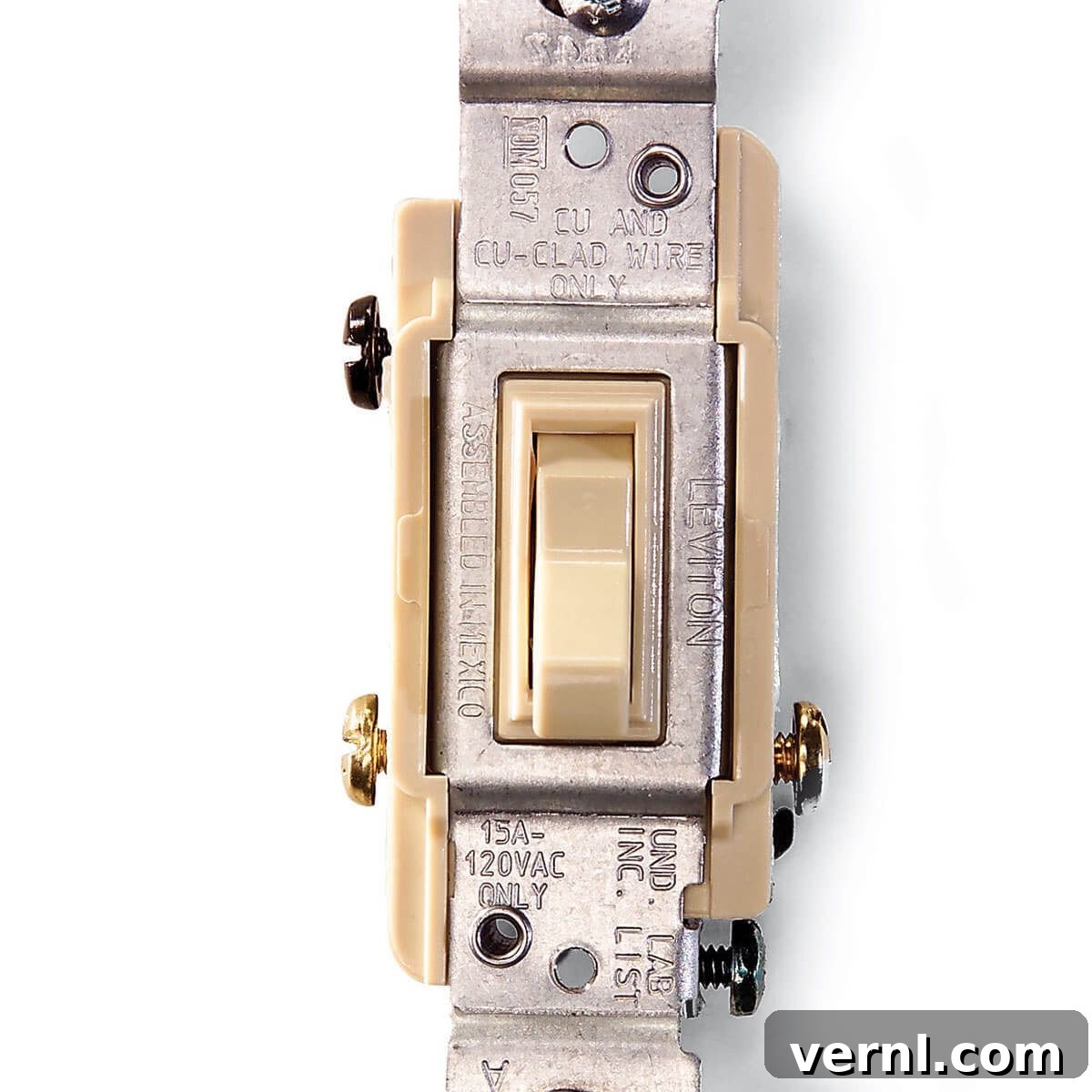
- Appearance: Visually, a 3-way switch is slightly larger than its single-pole counterpart due to more complex internal wiring. It typically features three screw terminals: one “common” terminal (often darker, like black or brass, to distinguish it) and two “traveler” terminals. Like all modern switches, it also includes a ground terminal for safety.
- Functionality: The unique capability of 3-way switches lies in their internal mechanism, which allows the incoming power to be directed to one of two traveler terminals. They work in tandem; the state of the light (on or off) depends on the combined positions of both 3-way switches in the circuit. Flipping either switch changes the current’s path, altering the light’s state.
- Toggle Markings: Due to their interdependent operation, 3-way switches do not have fixed “ON” or “OFF” markings. The toggle’s position merely indicates its internal state, not the absolute state of the light, as the other switch’s position is also a factor.
4-Way Switch: Expanding Control to Multiple Locations
- Definition: A 4-way switch is employed in electrical circuits where a light or device needs to be controlled from three or more different locations. It always functions as an intermediary switch, positioned between two 3-way switches in the wiring scheme.
- Appearance: A 4-way switch is typically the largest of the three types, easily identifiable by its four screw terminals. These terminals are arranged in two pairs, designed to connect to the “traveler” wires coming from the two 3-way switches it interacts with. A ground terminal is also present.
- Functionality: The primary role of a 4-way switch is to reverse the connections of the two traveler wires. When you toggle a 4-way switch, it changes which pair of traveler wires are connected, thereby altering the path of the electrical current and allowing the light to be switched on or off from that location, regardless of the positions of the other switches in the circuit. This makes it possible to add an unlimited number of 4-way switches to a circuit (between the two 3-ways) to achieve control from as many points as desired.
- Toggle Markings: Similar to 3-way switches, 4-way switches do not feature “ON” or “OFF” markings because their operation is dependent on the states of all other switches in the multi-point control system.
Demystifying the Mechanics: How a 3-Way Switch System Operates
Understanding how a 3-way switch works can initially seem complex, but it’s fundamentally about diverting the flow of electricity between two distinct paths. At its core, a 3-way switch system is designed to provide control for a single light or electrical fixture from two separate points. Inside each 3-way switch, there are three primary electrical terminals: one “common” terminal and two “traveler” terminals. For safety, a ground terminal is also always present.
The system functions by establishing or breaking the electrical circuit through one of the two traveler wires. In a standard 3-way setup, the wiring begins with the “hot” power source connecting to the common terminal of the first 3-way switch. From this first switch, two traveler wires extend to connect to the two traveler terminals of the second 3-way switch. Finally, the common terminal of the second 3-way switch connects to the light fixture itself, which then connects to the neutral wire to complete the circuit back to the electrical panel.
The magic happens through the internal switching mechanism. Each 3-way switch effectively acts as a single-pole, double-throw switch, meaning it takes the incoming power from its common terminal and directs it to one of its two traveler terminals. When both 3-way switches are in a position where they align to complete a continuous path through one of the traveler wires, the circuit is completed, and the light illuminates. If either switch is toggled, it changes its internal connection, effectively breaking the current path through that specific traveler wire and forcing the current to take the other traveler path (or no path, depending on the other switch’s position). This interruption or redirection of current flow causes the light to extinguish. Subsequently, toggling the other switch will either re-establish the circuit through the alternate traveler wire or interrupt it again, thereby controlling the light accordingly.
The term “3-way” doesn’t refer to three switches, but rather to the three possible pathways the electrical current can adopt: through the first traveler wire, through the second traveler wire, or remaining off if the path is broken. This innovative setup is what makes multi-location control so practical and efficient in various architectural designs, from long hallways to staircases and large rooms.
Ensuring Reliability: How to Test a 3-Way Switch
Testing a 3-way switch is a fundamental diagnostic step, essential not only for verifying its proper functionality but also for identifying potential electrical issues. A faulty switch can lead to erratic lighting behavior, intermittent functionality, or complete failure, posing an inconvenience and, in some cases, a potential safety hazard. Regular verification ensures consistent lighting control from multiple locations and helps maintain the integrity of your home’s electrical system.
Step-by-Step Testing Procedure:
- Prioritize Safety: Disconnect Power
Before touching any electrical components, your absolute first step must be to ensure the power is completely off. Go to your main circuit breaker or fuse box and switch off the breaker that controls the specific circuit you’ll be working on. To confirm the power is truly off, use a non-contact voltage tester (held near the switch wires) or attempt to operate the light or device controlled by the switch. Absolutely no power should be detected or operational. - Access the Switch
Once you’re certain the power is disconnected, carefully remove the switch plate cover using a screwdriver. This will expose the switch mechanism and its terminals. A typical 3-way switch will reveal three primary screw terminals in addition to the ground terminal: one “common” terminal (often a darker color, like black or brass, or otherwise marked) and two “traveler” terminals (usually lighter in color, like silver). - Utilize a Multimeter for Continuity Testing
Set your multimeter to the continuity setting. This setting usually emits a beep or displays a “0” or a low resistance reading when a continuous electrical path is detected. If your multimeter doesn’t have a continuity setting, you can use the lowest resistance (Ohms) setting. - Perform the Continuity Test
- Place one probe of your multimeter on the common terminal of the 3-way switch.
- Place the other probe on one of the traveler terminals.
- Toggle the switch to its first position. A functioning 3-way switch should show continuity (a beep or low resistance) in one position and no continuity (open circuit, “OL” or infinite resistance) in the other position. This indicates that the common terminal is making contact with that specific traveler terminal when the switch is in one of its two states.
- Now, toggle the switch to its second position. The continuity reading should reverse: if it had continuity before, it should now show none, and vice-versa.
- Repeat this entire process for the other traveler terminal. The common terminal should show continuity with the second traveler in one of the switch’s positions, and no continuity in the other. The two traveler terminals should never show continuity with each other directly through the common terminal in a functioning 3-way switch.
- Interpret the Results
If you find that in neither position does the common terminal show continuity with either traveler terminal, or if it shows continuity with both travelers simultaneously, then the switch is likely defective. This usually points to internal wear, corrosion, or a mechanical failure within the switch. A faulty switch needs to be replaced immediately to restore proper functionality and safety. - Reassembly and Power Restoration
Once testing is complete, carefully reassemble the switch, ensuring all wire connections are secure and properly seated. Replace the switch plate cover. Finally, return to your circuit breaker panel and restore power to the circuit. Verify that the light or device now operates as expected from both control points.
As always, safety is paramount when working with electricity. If you are ever unsure about any step, or if you encounter complex wiring situations, it is highly recommended to seek assistance from a qualified professional electrician. They can ensure that the work is done correctly and safely, adhering to all local electrical codes.
Common Queries and Applications of 3-Way Switches
Understanding the nuances of 3-way switches often leads to practical questions regarding their versatility, limitations, and potential issues. Here, we address some of the most frequently asked questions to further clarify their role in electrical systems.
- Can a 3-way switch be used as a single-pole (2-way) switch?
Yes, a 3-way switch can indeed be utilized as a single-pole switch, though it’s generally not the most cost-effective or recommended long-term solution if a standard single-pole switch is available. To do this, you would connect the incoming hot wire to the common terminal of the 3-way switch, and the outgoing wire to the light/device to one of the traveler terminals. The other traveler terminal would simply be left unused and properly capped off with a wire nut for safety. While functional, it’s typically done in a pinch or if you happen to have a spare 3-way switch on hand during a repair, as a dedicated single-pole switch is simpler and cheaper. - Can you use a 4-way switch as a 3-way switch?
No, a 4-way switch cannot be directly used as a 3-way switch in a functional circuit. The internal wiring and terminal configuration of a 4-way switch are fundamentally different. A 4-way switch is designed to switch two pairs of traveler wires, effectively reversing their connections to enable control from three or more locations when situated between two 3-way switches. Trying to substitute a 4-way for a 3-way would result in an improperly wired circuit that would not function correctly and could potentially pose safety risks. For a 3-way function, it is always best to use a correctly specified 3-way switch. - Can a 3-way switch go bad?
Absolutely. Like any electrical component that experiences mechanical movement and electrical current flow, a 3-way switch is subject to wear and tear over time. Common reasons for failure include internal contacts corroding or burning out due to arcing, the spring mechanism failing to properly switch positions, or loose connections developing over years of use. Symptoms of a failing 3-way switch often include intermittent operation (the light works sometimes but not always), flickering lights, or the light simply failing to respond to one or both switches. If you observe any of these issues in a circuit controlled by 3-way switches, it’s highly probable that one or both of the switches might be faulty and require replacement. - What are “traveler wires” and why are they important?
Traveler wires are specialized conductors in a 3-way (or 4-way) switch circuit that carry power between the switches, but not directly to the light fixture itself. In a 3-way circuit, there are two traveler wires running between the two 3-way switches. They get their name because they “travel” between the switches, carrying the “switched hot” power depending on the position of the first switch. The position of the second 3-way switch then determines which of these traveler wires completes the circuit to the light. They are crucial for creating the alternate paths needed for multi-location control. - What is the “common terminal” on a 3-way switch?
The common terminal is the critical connection point on a 3-way switch. It’s typically identified by a darker-colored screw (often black or brass) or may be labeled “COM.” For the first 3-way switch in a circuit, the common terminal receives the incoming “hot” (line) power from the electrical panel. For the second 3-way switch, the common terminal sends the switched “hot” power directly to the light fixture. It acts as the pivot point from which the electrical current is directed to one of the two traveler terminals. - Are smart 3-way switches available?
Yes, with the rise of smart home technology, smart 3-way switches are widely available. These switches allow you to control your lights not only from two physical locations but also via a smartphone app, voice commands (through assistants like Alexa or Google Assistant), or automated schedules. They typically work by replacing one of the 3-way switches with a “master” smart switch and the other with a “slave” or “add-on” switch, or by requiring both to be smart switches that communicate wirelessly. They offer enhanced convenience, energy management, and integration into a broader smart home ecosystem.
In conclusion, 3-way switches are a cornerstone of convenient and efficient residential and commercial lighting systems. By understanding their distinct operation, proper testing procedures, and common applications, you can ensure your electrical installations are both functional and safe.