
Unmasking the Makers: A Deep Dive into Who Manufactures Your Favorite Tool Brands
Every time you pick up a drill, wrench, or saw, have you ever paused to consider its origins? The tools we rely on daily, from tackling home improvement projects to professional job sites, represent a significant investment. Yet, the question of “who makes my tools” is often far more intricate than it appears. You might wonder if seemingly distinct brands share a common lineage, if different price points reflect different manufacturers, or simply where your trusted companion was brought to life.
These aren’t just idle curiosities; understanding the relationships between tool brands and their manufacturers can profoundly impact your purchasing decisions. It offers insights into quality consistency, brand specialization, and even value propositions. To demystify this complex landscape, we’ve undertaken an extensive investigation into the ownership and manufacturing processes of some of the most prominent and frequently discussed tool brands in the market.
Before we delve into specific brands, it’s crucial to establish a clear understanding of some fundamental concepts that govern the modern tool industry.
“Makes” vs. “Owns”: A Crucial Distinction in the Tool Industry
The first step in unraveling the mystery of tool origins is to differentiate between who owns a tool brand and who actually manufactures the tools under that brand. This distinction is paramount because the entity that holds the brand’s intellectual property, markets it, and sets its strategic direction often has little to do with the physical production process.
Often, a parent company will own a portfolio of tool brands. This parent company might be a vast conglomerate with diverse interests, or a specialized holding company focused solely on tools. While they dictate the brand’s vision, quality standards, and market positioning, they may lack the in-house manufacturing capabilities for every product line. In such scenarios, the actual production is outsourced to third-party manufacturers, often referred to as contract manufacturers.
To complicate matters further, these manufacturing licenses are frequently segmented and can be incredibly dynamic. It’s not uncommon for a single brand’s power tools to be manufactured by one company, while its hand tools are produced by an entirely different entity, potentially on the opposite side of the globe. These licensing agreements can also be time-sensitive, meaning a specific tool model could be manufactured by Company A for a few years, only to switch to Company B for subsequent production runs. This constant evolution makes pinning down a definitive “maker” a continuous challenge for consumers and industry watchers alike.
Mergers, Acquisitions, and Corporate Strategy in the Tool Sector
The tool industry is characterized by an ongoing flurry of mergers and acquisitions (M&A). Large corporations frequently acquire smaller, specialized brands, or even integrate with competitors to expand market share, diversify product offerings, or gain access to new technologies and manufacturing efficiencies. These corporate maneuvers significantly reshape the landscape of tool production and branding.
When an acquisition occurs, there are typically two main outcomes. In some cases, the acquired brand retains a significant degree of autonomy. It might continue to operate from its original facilities, maintain its distinct engineering teams, and adhere to its own quality standards. This strategy allows the parent company to leverage the acquired brand’s reputation and loyal customer base while potentially integrating it into a larger distribution network. However, in other instances, the acquired brand’s manufacturing operations are fully absorbed by the parent company. When this happens, the distinct differences between the two brands can become largely cosmetic, relying on brand legacy and marketing to differentiate products that might share a common manufacturing platform.
The line between these two approaches can also be quite fluid and subject to change over time. A subsidiary that enjoys years of independent operation might eventually be fully integrated, rebranded, or even spun off again by its parent company based on market conditions or strategic shifts. It’s also vital to remember that tool brands are commodities in the corporate world, constantly being bought, sold, and licensed. This dynamic environment means any comprehensive overview, like the one presented here, can swiftly be rendered outdated by a few corporate signatures and strategic announcements. Staying informed requires continuous attention to industry news and corporate filings.
With these foundational caveats in place, let’s now dive into the specifics of some of the most common tool brands that spark curiosity among DIY enthusiasts and professionals alike.
Who Makes Ridgid Tools? The Emerson Electric Connection
Ridgid stands as a quintessential example of why identifying the true manufacturer behind a tool brand can be remarkably complex. Many consumers, especially those who frequent The Home Depot, often mistakenly assume Ridgid is an exclusive “house brand” of the retail giant. While it’s true that Ridgid tools are prominently sold at The Home Depot, the brand’s ownership lies elsewhere: with Emerson Electric, a diversified global technology and engineering company that acquired Ridgid way back in 1966.
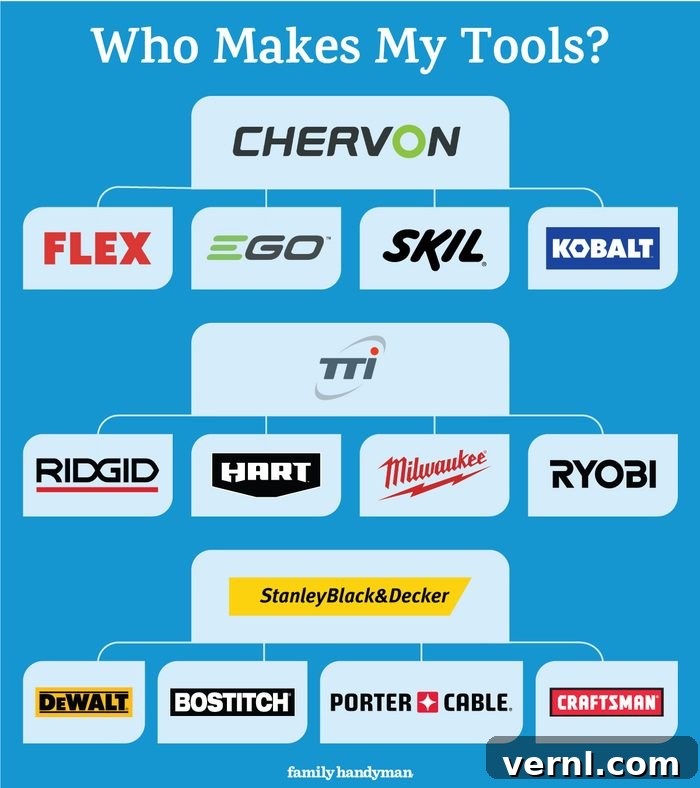
The intricacies deepen when you examine Ridgid’s product lines. Ridgid hand tools, easily recognizable by their traditional red and black color scheme, are indeed manufactured in the U.S. by the Ridge Tool Company, a direct subsidiary of Emerson. This division specializes in robust, durable tools primarily for the plumbing and pipe trades, upholding a long-standing reputation for quality and reliability. However, the story changes dramatically for Ridgid power tools. These tools, featuring a distinctive orange and black aesthetic, are produced in China by Techtronic Industries Co., LTD (TTI), a powerful Hong Kong-based multinational known for manufacturing a vast array of popular power tool brands.
But wait, there’s yet another twist! Ridgid shop vacuums, which sport a gray and orange color combination, buck the trend once more. These are manufactured by Emerson itself, back in the U.S., leveraging its own domestic production capabilities for this specific product category. This multi-faceted manufacturing strategy, involving different companies and geographical locations for distinct product lines under the same brand name, truly makes the question of “Who makes Ridgid tools?” as clear as mud, highlighting the intricate supply chains prevalent in the industry. The unique spelling of “Ridgid” itself is a nod to its origins, stemming from North Ridgeville, Ohio, where the Ridge Tool Company was founded.
Who Makes Hart Tools? Walmart’s Exclusive Budget Brand by TTI
Just as Ridgid power tools find an exclusive retail home at The Home Depot, Hart power tools are exclusively available through Walmart. Positioned as a budget-friendly option, Hart tools have carved out a significant niche for DIYers and homeowners looking for dependable performance without breaking the bank. The ownership and manufacturing of the Hart tool line trace back to Techtronic Industries Co., LTD (TTI) in China, the very same industrial powerhouse responsible for producing a significant portion of Ridgid’s power tool offerings.
TTI’s pervasive presence in this roundup is no coincidence; they are a dominant force in the global power tool market. It’s crucial to understand, however, that TTI is not simply operating a single, monolithic manufacturing facility and slapping different brand labels on identical products to command varying price points. TTI demonstrates a keen understanding of market segmentation. They meticulously design and engineer distinct product lines, each tailored to specific quality standards, feature sets, and price points, to meet the diverse expectations of consumers across their brand portfolio. Hart, under TTI’s stewardship, is specifically engineered to provide accessible quality and value, making it an ideal choice for everyday tasks and casual use, aligning perfectly with Walmart’s broader retail strategy.
Who Makes Milwaukee Tools? TTI’s Professional Powerhouse
Milwaukee Tool stands as another illustrious brand within the Techtronic Industries Co., LTD (TTI) family, though it operates with a remarkable degree of autonomy and a distinct identity. Headquartered in Milwaukee, Wisconsin, as its name logically suggests, the company has cultivated a revered reputation among professionals and high-end DIYers for its innovation, rugged durability, and uncompromising performance. Milwaukee is a prime example of TTI’s strategy to own and nurture premium brands alongside their value-oriented offerings.
In recent years, Milwaukee has made significant investments in expanding its domestic manufacturing footprint. This commitment includes establishing and growing plants in Wisconsin and Mississippi, which produce a variety of tools and critical components. This push towards localized production not only strengthens the brand’s connection to its heritage but also allows for greater control over quality and supply chain efficiency for certain product lines. Despite this, Milwaukee, like many global brands, does engage in overseas production for other parts of its extensive product catalog, ensuring it can meet global demand and maintain competitive pricing for its diverse range of professional-grade tools. Being part of the larger TTI family provides Milwaukee with substantial benefits, including shared research and development, access to cutting-edge manufacturing technologies, and economies of scale. Yet, it masterfully maintains its distinct brand identity, focusing relentlessly on the needs of professional tradespeople and advanced enthusiasts, delivering solutions that are known for their power, longevity, and technological sophistication.
Who Makes Ryobi Tools? TTI’s Accessible Innovation for DIYers
Ryobi is a Japanese company with a broad and diverse portfolio of products that extends far beyond tools, encompassing items from power tools to printing equipment. However, their highly popular cordless power tool lineup, particularly the extensive 18V ONE+ system, is manufactured under license by the ever-present Techtronic Industries Co., LTD (TTI). This arrangement positions Ryobi as another critical component of TTI’s market segmentation strategy, aimed squarely at the vast DIY market.
Predominantly sold by The Home Depot and through various online channels, Ryobi tools are celebrated for striking an optimal balance between quality and affordability. They are specifically designed to meet the demands of homeowners and casual users, providing reliable performance for a wide array of household projects and maintenance tasks. While Ryobi tools typically come with shorter warranty coverage compared to TTI’s more premium, professional-grade brands like Milwaukee, their robust construction and user-friendly features make them more than capable of enduring the rigors of casual homeowner demands. The brand focuses on providing extensive interchangeability within its battery platform, offering a wide ecosystem of tools that all share the same battery, a significant draw for cost-conscious DIYers building out their tool collection.
Who Makes Flex Tools? German Engineering Under Chervon’s Banner
Flex power tools, renowned for their robust design and performance, particularly in woodworking and metalworking, are the product of FLEX-Elektrowerkzeuge GmbH, a distinguished German company. This historic brand is now owned by Chervon, a powerful Chinese manufacturing company. It’s crucial to note that this Chervon is an industrial powerhouse known for its tool brands, not the prominent oil and gas corporation. Chervon has strategically built an impressive portfolio of tool brands, which also includes popular names like Ego (known for outdoor power equipment) and Skil.
Flex boasts a rich heritage, having been founded in Germany in 1922. It holds a significant place in tool history, notably credited with inventing the first angle grinder in 1954, a tool that revolutionized many trades. Chervon acquired FLEX-Elektrowerkzeuge and the esteemed Flex brand in 2013. A key aspect of Chervon’s strategy with Flex has been its commitment to preserving the brand’s core identity and manufacturing excellence. Consequently, a significant portion of Flex’s manufacturing operations has remained in Germany, ensuring that the legacy of German engineering and quality continues to define these professional-grade tools. This approach allows Chervon to offer a premium, European-made option within its diverse global tool lineup, catering to professionals who value precision and durability.
Who Makes Kobalt Tools? Lowe’s House Brand with Diverse Manufacturers
Kobalt is a prime example of a “house brand,” meaning it is owned and exclusively sold by a major retailer – in this case, Lowe’s. While Lowe’s controls the branding, marketing, and distribution of Kobalt tools, the big-box retailer is not in the business of manufacturing tools itself. This naturally leads to the perennial question: who truly makes Kobalt tools? The answer is nuanced and depends heavily on the specific type of tool and its production timeline, showcasing the dynamic nature of retail-owned brands.
Currently, the cordless power tool segment of Kobalt’s offering is manufactured by Chervon, the same diversified company that owns Flex, Ego, and Skil. However, Kobalt’s outdoor power equipment (OPE), such as lawnmowers and chainsaws, took a different manufacturing path. As of 2020, these products were being made by the Chinese manufacturer Globe Tools Group, a significant player in the outdoor equipment market and the owner of the well-known Greenworks brand. Interestingly, in 2016, the venerable German company Stihl, a leader in chainsaws and outdoor power tools, acquired a minority stake in Globe Tools, further illustrating the interconnectedness of the industry.
Pinning down the manufacturers for Kobalt hand tools proves even more challenging. Historical reports suggest that Kobalt mechanic’s tools were, at one point, manufactured by Snap-On, a highly respected name in professional tools. While we couldn’t definitively verify if this arrangement still holds true, it highlights the potential for high-quality partnerships. The majority of Kobalt hand tools today appear to be manufactured by Apex Tool Group, a U.S.-based company with extensive global operations in more than a dozen countries, known for producing a wide range of hand tools and tool storage solutions. This multi-vendor approach allows Lowe’s to procure different product categories from specialized manufacturers, ensuring a broad and competitive offering under the Kobalt brand.
Who Makes DeWalt Tools? The Powerhouse Within Stanley Black+Decker
DeWalt tools, instantly recognizable by their iconic yellow and black livery, are proudly manufactured primarily in the U.S. by the colossal entity that is Stanley Black+Decker. This brand’s journey is a compelling narrative of strategic acquisition, rebranding, and sustained market dominance, especially within the professional trades.
The story of DeWalt’s modern resurgence began in the 1960s when Black+Decker, already a significant player in the tool market, acquired the original DeWalt company. However, it was in the early 1990s that Black+Decker orchestrated a brilliant rebranding strategy. They recognized the need for a distinct, high-performance brand to target the professional market, which was traditionally underserved by their more consumer-oriented Black+Decker line. By reviving the DeWalt name, adopting a distinctive yellow and black color scheme, and focusing on rugged durability and innovative features, they successfully appealed to their target audience of contractors and skilled tradespeople.
The corporate landscape shifted again in 2010 when Black+Decker merged with Stanley Works, forming Stanley Black+Decker, a global powerhouse in tools and security solutions. Today, Stanley Black+Decker continues to manufacture DeWalt tools, maintaining its position as a flagship brand within their diverse portfolio, which also includes Stanley, Black+Decker, and Craftsman, among others. DeWalt benefits from the extensive research and development capabilities, vast manufacturing resources, and global distribution network of its parent company. While DeWalt does leverage global manufacturing for certain components and tools, the brand has also demonstrated a strong commitment to U.S. manufacturing, investing in factories across the country to produce a significant portion of its renowned power tools, hand tools, and accessories, reinforcing its promise of quality and reliability to its dedicated professional user base.
In conclusion, the world of tool manufacturing is a vibrant and ever-changing ecosystem, driven by corporate strategy, market demands, and global supply chains. The journey from initial concept to the tool in your hand is rarely a straight line, often involving multiple companies, diverse manufacturing locations, and complex ownership structures. Understanding these intricate relationships not only satisfies curiosity but also empowers consumers to make more informed decisions, appreciate the specialization within the industry, and ultimately choose the tools that best fit their needs and values.