
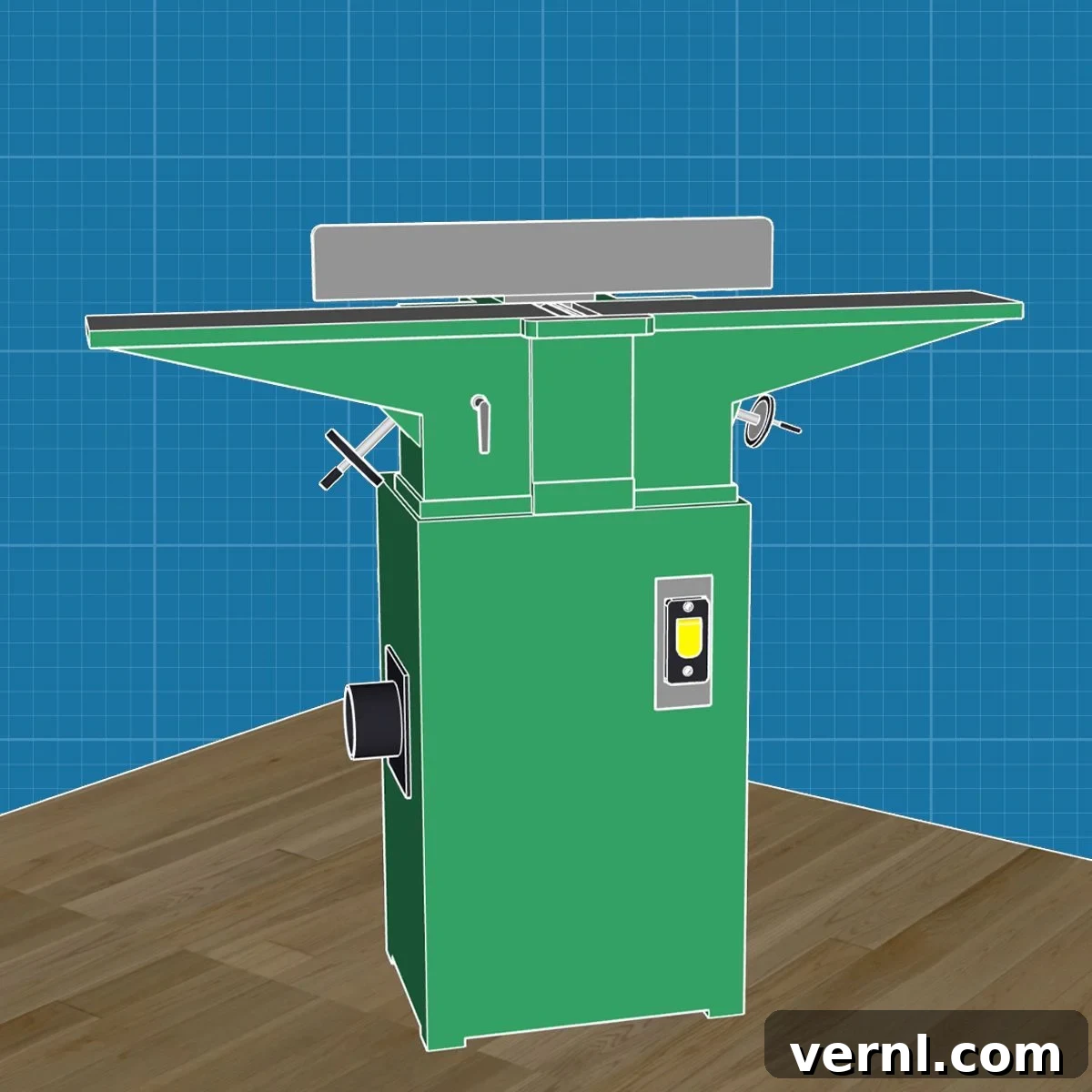
In the realm of woodworking, certain tools are fundamental to nearly every workshop, like reliable saws and versatile sanders. Then there are specialized machines, such as the wood jointer, which, while not universally ubiquitous, are absolutely indispensable for achieving a level of precision that sets professional-grade work apart. No other tool performs the unique task of a jointer with such exactitude, making it a critical asset for serious woodworkers, even if its necessity isn’t immediately apparent to every hobbyist.
For many beginner woodworkers, store-bought lumber, with its pre-milled flat faces and edges, is perfectly adequate for most initial projects. The factory finish often meets basic requirements. However, for artisans specializing in constructing high-quality custom cabinetry, exquisite dressers, or seamless tabletops, the standards for flatness, smoothness, and straightness far exceed what standard mill-run lumber offers. For these discerning craftsmen, a jointer is not just an advantage; it is an absolute necessity, enabling them to prepare wood with the rigorous accuracy demanded by fine furniture making. Furthermore, it becomes an invaluable companion for anyone who frequently works with rough-sawn or reclaimed lumber, transforming irregular stock into perfectly workable material.
What Exactly Is a Wood Jointer?
A wood jointer is a precision woodworking machine designed primarily to create one perfectly flat face and one perfectly square edge on a piece of lumber. It comes in various forms, typically as a benchtop unit for smaller shops or as a larger, stationary floor model for more substantial operations. The fundamental components of a jointer include an in-feed table and an out-feed table, which together form the “bed” upon which the wood slides. A robust fence guides the workpiece, and at the heart of the machine is a spinning cutter head equipped with knives or inserts.
The operational principle is straightforward yet highly effective: a piece of wood is placed with one face or edge flat on the in-feed table. It is then held firmly against the fence and pushed across the cutter head. As the wood passes over the spinning blades, a precise layer of material is shaved off, resulting in a perfectly flat and smooth surface. The unique design of a jointer allows it to mill one face of a board truly flat and then create an adjacent edge that is precisely perpendicular (90 degrees) to that newly flattened face. This critical step is the foundation for creating accurate, tight-fitting joints and achieving overall dimensional stability in woodworking projects.
The capacity of a jointer is primarily defined by the width of its bed, which determines the maximum width of wood it can effectively flatten. While bed widths can vary significantly, a six-inch width is the most common and versatile choice for many home workshops. Larger professional shops may opt for eight, ten, or even twelve-inch jointers to handle wider panels or rough stock. Equally important is the length of the jointer’s bed, which dictates how long a board can be comfortably and accurately surfaced without requiring external in-feed and out-feed support stands. Average bed lengths hover around three feet, but they can range from as short as 28 inches for compact benchtop models to an impressive 72 inches for industrial-grade freestanding units. As a general rule of thumb, you can typically joint boards up to twice the length of the jointer’s bed without significant additional support, though longer boards always benefit from more assistance.
Key Applications: What Is a Wood Jointer Used For?
Given that the primary action of a jointer involves removing material from wood surfaces, similar to a planer, it’s easy for newcomers to confuse the two machines. However, a jointer is a highly specialized tool with a very distinct and critical purpose: to mill one face of a board perfectly flat and to create one perpendicular, flat edge. This capability is absolutely essential for creating surfaces suitable for strong, clean butt joints, edge-to-edge glue-ups, and other precise joinery – hence its name, “jointer.” Woodworkers predominantly utilize jointers to efficiently flatten out warps, twists, and other irregularities that commonly occur in lumber due to drying, storage, or inherent wood movement.
Imagine a board that is “cupped,” meaning its edges are raised relative to its center, forming a concave shape. A jointer is the ideal tool for correcting this. By repeatedly feeding the board through the jointer, with the concave side facing down on the in-feed table, the machine shaves down the elevated edges, progressively flattening that surface. It’s crucial to understand, however, that while one face becomes perfectly flat, the opposite side of the board will likely exhibit a “crown” (the opposite of cupping). Experienced woodworkers caution against attempting to correct both sides of a warped board using only a jointer. Because you manually apply downward pressure on the top surface, you lack the consistent reference needed to achieve parallel faces. For making faces parallel and achieving a consistent thickness, the board must first have one truly flat face, which is the jointer’s job, before moving to a thickness planer.
Beyond correcting deformities, the jointer is vital for preparing rough lumber. When you start with rough-sawn timber, it often has uneven surfaces and inconsistent thickness. The jointer’s first task is to establish a single flat reference face. This flat face then serves as a reliable base when you feed the board through a thickness planer, allowing the planer to make the opposite face perfectly parallel to the jointed face. Without this initial flattening, a planer would simply reproduce the existing irregularities on both sides, resulting in a board that is still warped, albeit thinner. This two-step process – jointing one face, then planing to thickness – is fundamental to precision woodworking and ensures your material is truly square and dimensionally accurate for subsequent operations like ripping, cross-cutting, and joinery.
Understanding the Mechanics: How Does a Wood Jointer Work?
The core of any wood jointer’s operation lies within its spinning cutter head. Modern jointers often incorporate advanced cutter head designs, such as spiral or helical cutter heads, which feature small, carbide-tipped inserts arranged in a spiral pattern. These designs offer several advantages over traditional straight-knife cutter heads, including quieter operation, a shear-cutting action that reduces tear-out, and easier, more cost-effective blade replacement (as only individual inserts need to be swapped if damaged, rather than a full set of long knives). Regardless of the specific cutter head type, its role is to precisely remove material from the wood’s surface.
The interaction between the in-feed and out-feed tables is critical to the jointer’s precision. The out-feed table is set to be perfectly flush with the highest point of the cutter head’s knives. This stationary table provides a consistent reference plane for the newly jointed surface. The in-feed table, conversely, is precisely adjustable and set slightly lower than the out-feed table. The difference in height between these two tables determines the depth of cut. As the wood is pushed across the in-feed table and encounters the spinning cutter head, the blades shave off material equal to this height difference. The newly cut surface then registers against the out-feed table, ensuring a perfectly flat plane is created.
The fence is another indispensable component, just as crucial as the bed and the blade for successful and accurate jointing. It must be exceptionally sturdy, capable of maintaining a precise 90-degree angle to the bed (though many fences can also tilt for bevel cuts). When you flatten the face of a board, you then typically use that newly flattened face against the jointer’s fence to create a perfectly square edge. By holding the board firmly against the fence as you pass the edge through the blade, you establish a reliable 90-degree corner between the jointed face and the jointed edge. This rigorous squaring process is what allows for extremely tight-fitting joints and the creation of perfectly square lumber, which is the cornerstone of high-quality furniture and cabinet making.
Wood Jointer vs. Planer: Understanding the Crucial Differences
For woodworkers who process their own raw lumber, reclaim wood from demolition projects, or purchase rough-sawn stock to save costs, the ability to transform a mottled, wavy surface into a smooth, flat one is paramount. Both a jointer and a planer contribute to this goal, but they do so in fundamentally different ways, and understanding these distinctions is key to effective lumber preparation. While a jointer can flatten a face, a thickness planer excels at making that face parallel to an opposing face and achieving a consistent thickness. If making tight, seamless, and strong joints is your primary concern, ensuring perfectly flat and square edges and faces, then a wood jointer is an indispensable tool in your arsenal.
A planer, often referred to as a thickness planer, also utilizes a horizontal spinning cutter head, much like a jointer. The critical difference lies in the cutter head’s position and the wood’s feeding mechanism. On a planer, the cutter head is positioned *above* the wood, not underneath. The wood rests on an adjustable table, and crucially, a drive gear or roller system automatically feeds the wood through the machine. This automatic feed mechanism allows for consistent material removal across the entire length of the board. You regulate the final thickness of the board by adjusting the height of the table (typically in small increments, often no more than 1/8-inch per pass) and can sometimes adjust the feed speed to achieve the desired surface quality.
Because of its flat reference table and automatic, consistent drive, a planer is designed to surface all four sides of a piece of wood, achieving precise, parallel dimensions and a uniform thickness. You cannot accomplish this with a jointer. With a jointer, you manually push the wood into the cutter, relying on the flatness of the initial surface and the fence for guidance. If a board starts out severely tapered or uneven, a jointer will simply flatten one side or edge, potentially reproducing the taper or unevenness if not carefully handled. A jointer cannot make opposing faces parallel; it can only flatten one at a time. This is why a jointer is always the first step for preparing rough stock: it establishes that initial flat reference face.
The most efficient workflow for preparing rough lumber almost always involves both machines. First, the jointer flattens one face (the “reference face”) and squares one edge (the “reference edge”) to that face. With these two true surfaces established, the board can then be fed through the planer. The planer uses the jointer-flattened face as its reference, making the opposing face perfectly parallel and bringing the board to a consistent thickness. Subsequently, the jointed edge can be used against a table saw fence to rip the opposite edge parallel. Therefore, you don’t necessarily have to choose one or the other, as they complement each other perfectly. In fact, for those with limited space or budget, combination planer/jointers are available. These ingenious machines offer the functionality of both tools in a single footprint, often at a lower cost than purchasing two separate machines, especially benchtop models.
Selecting the Right Tool: What Size Wood Jointer Do I Need?
Choosing the right size wood jointer is a crucial decision that depends heavily on the type and scale of woodworking projects you undertake, as well as your available workshop space. For the majority of home woodworkers and hobbyists, a standard six-inch wide jointer with a bed length between 28 and 36 inches proves to be perfectly adequate. This size offers enough capacity for most common lumber dimensions used in furniture, cabinetry, and general woodworking tasks. It strikes a good balance between capability and footprint, making it suitable for many workshops.
However, if your projects frequently involve wider stock, such as making large tabletops, wide panels for casework, or processing wider rough-sawn lumber, then upgrading to an eight-inch, 10-inch, or even a 12-inch bed jointer would be a wise investment. The wider the bed, the wider the board you can flatten in a single pass, significantly speeding up the milling process for larger components. Similarly, if you regularly work with exceptionally long boards for applications like long dining tables, lengthy mouldings, or boat building, you will greatly benefit from a jointer with an extended bed that is 48 inches or even 72 inches long. These longer beds provide superior support for long workpieces, ensuring maximum accuracy and stability during the jointing process.
Beyond bed width and length, consider the motor horsepower, especially for larger machines. Higher horsepower (typically 1.5 HP to 3 HP or more) allows the jointer to handle denser woods and deeper cuts more efficiently without bogging down, leading to smoother results and less strain on the motor. Ultimately, while a standard six-inch bed jointer works exceptionally well for most general woodworking purposes, carefully assessing your typical material dimensions and project ambition will guide you to the most appropriate and efficient jointer for your workshop.
Top Recommendations: Best Wood Jointers on the Market
When you’re ready to invest in a wood jointer, you essentially have three primary categories to consider, each catering to different needs, budgets, and workshop spaces: benchtop jointers, freestanding jointers, and versatile jointer/planer combo machines. Here are our top picks representing the best in each category, chosen for their performance, reliability, and value.
Best Benchtop Jointer: Practicality and Performance in a Compact Design
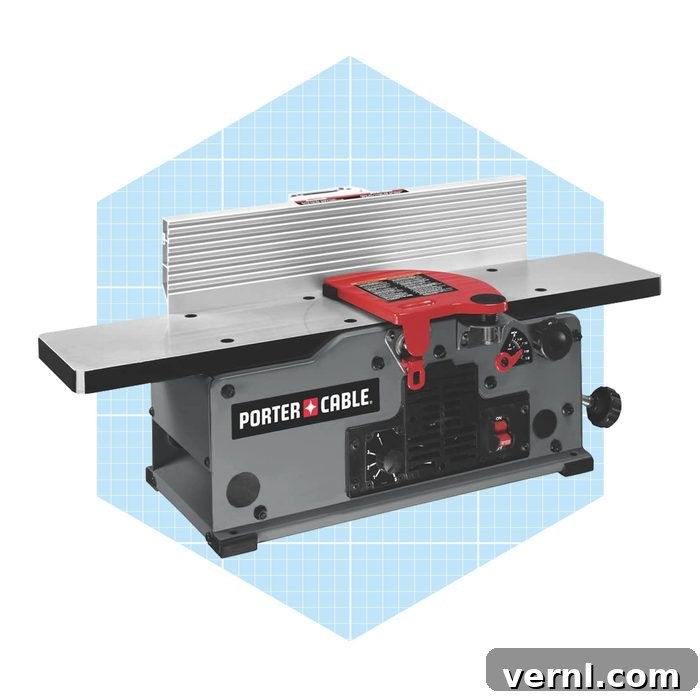
For woodworkers with limited space or those who need a portable solution, the Porter-Cable Benchtop Jointer stands out. This model offers a practical six- by 31-inch bed, providing sufficient capacity for many common woodworking tasks, all built upon a sturdy sheet metal base. Weighing in at approximately 35 pounds, it’s substantial enough to remain stable on your workbench during operation but light enough to be easily moved and stored when not in use. A key feature of this jointer is its variable speed control, which allows you to adjust the cutter head speed. This versatility is incredibly beneficial, as it enables you to optimize the cutting action for different wood species – slower speeds for challenging grain or hardwoods to minimize tear-out, and faster speeds for softer woods for a cleaner finish.
Best Freestanding Jointer: Uncompromising Power and Precision
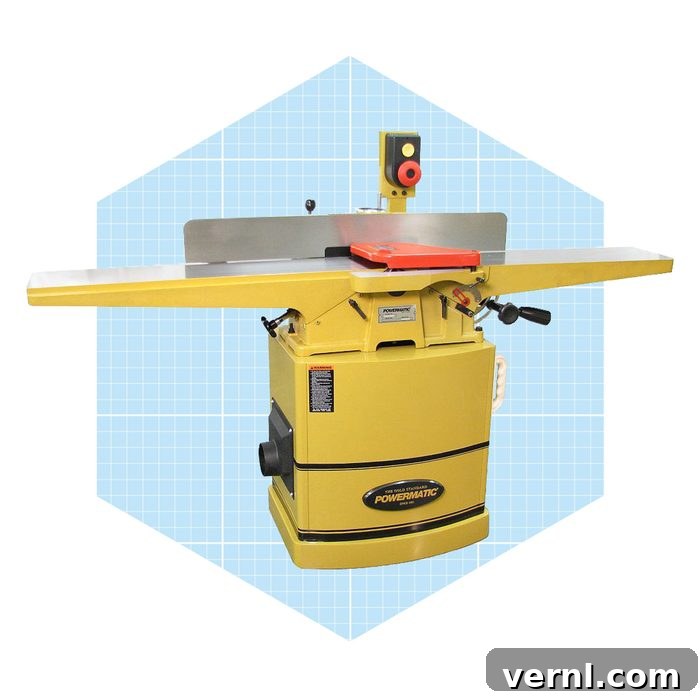
If your woodworking ambitions demand the highest levels of precision, power, and capacity, the Powermatic Eight-Inch Jointer with Helical Cutterhead represents a valuable, long-term investment for any serious workshop. This robust machine is designed for heavy-duty use, featuring an eight-inch width capacity suitable for a wide range of stock. It can be equipped with either a conventional three-knife cutter head or, more commonly, a high-performance helical cutter head, known for its superior finish and quieter operation, powered by a substantial two-horsepower, 240-volt motor. A standout feature is its extended bed, measuring an impressive 73 inches, which provides unparalleled support for jointing even the longest boards with exceptional accuracy. While it comes with a higher price tag, the Powermatic jointer consistently receives top reviews online for its build quality, precision, and reliable performance, making it a cornerstone tool for professional-grade woodworking.
Best Jointer/Planer Combo: Maximizing Space and Versatility
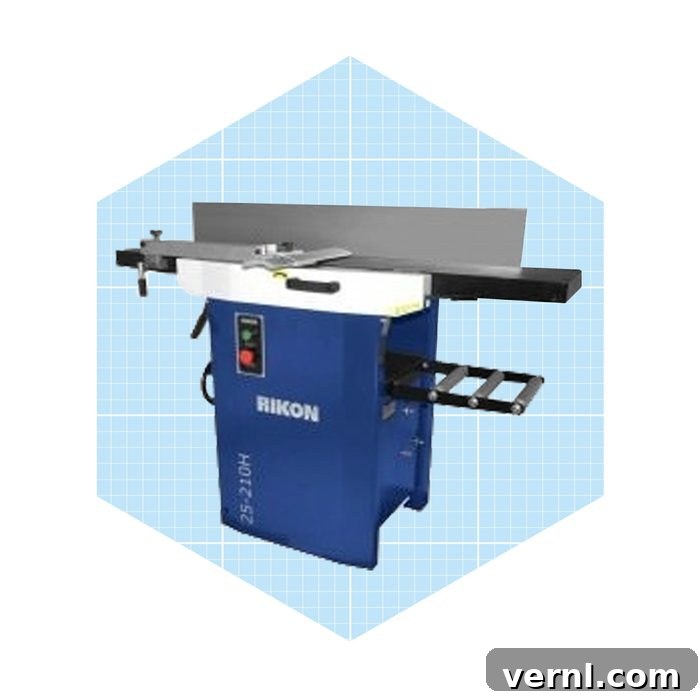
For woodworkers seeking to combine the essential functions of jointing and planing into a single, space-saving machine, the investment in a combo unit should yield versatile performance across a broad spectrum of stock sizes. The Rikon 25-210H 12-Inch Planer/Jointer with Helical Cutterhead is precisely such a machine, designed to handle virtually all types of woodworking material with ease and precision. Boasting a generous 12-inch width capability in both jointer and planer modes, it is powered by a powerful three-horsepower, 240-volt motor that can tackle even the toughest hardwoods without hesitation. Reviewers consistently praise the Rikon 25-210H for its rugged construction, exceptional accuracy, and surprisingly straightforward setup process, despite its dual functionality. For added convenience and workshop flexibility, an optional mobility kit is available, allowing you to easily maneuver this substantial tool around your shop, making the most of your workspace.
In conclusion, a wood jointer is far more than just another power tool; it’s a foundational machine for anyone serious about achieving true precision in their woodworking. From flattening warped boards and squaring rough lumber to preparing stock for seamless glue-ups and perfect joinery, the jointer empowers woodworkers to elevate their craft. Understanding its unique function, how it differs from a planer, and choosing the right size and type for your needs will undoubtedly unlock new levels of quality and satisfaction in your projects.