Upgrade Your Home: A Comprehensive Guide to Choosing the Right Thermostat for Comfort and Savings
As the days grow shorter, nights lengthen, and cooler temperatures arrive, the thought of higher heating bills often comes to mind. Winter is undoubtedly on its way, bringing with it the annual challenge of keeping your home warm without breaking the bank. At the heart of managing your home’s indoor climate lies one crucial device: your thermostat.
If your current thermostat is functioning flawlessly, you’re already one step ahead in your winter preparedness efforts. However, if your thermostat is old, unreliable, or simply lacks modern features, now is the opportune moment to consider an upgrade. Replacing an outdated thermostat with a modern, more efficient model can make a monumental difference not just in your comfort level, but also in your monthly energy expenditures.
The impact of a new thermostat extends beyond mere convenience. According to the United States Department of Energy, installing certain types of programmable thermostats can reduce heating and cooling costs by up to 10 percent annually. This translates into tangible savings that accumulate over time, making an upgrade a wise financial decision for any homeowner.
So, with a myriad of options available, how do you navigate the market to choose the perfect thermostat for your unique home and lifestyle? Before making a decision, it’s essential to understand the fundamental details and distinctions between different thermostat types and features. Let’s delve into the inside scoop to help you make an informed choice.
Should You Replace Your Thermostat? Understanding When to Upgrade
Often, the decision to replace a thermostat stems more from a desire for enhanced features and modern convenience than an urgent need due to malfunction. As Wes Davis, the director of technical services for the Air Conditioning Contractors of America, points out, “Thermostats are a very robust device. They should easily last the lifetime of the (home’s HVAC) system.” This means it’s relatively uncommon for a thermostat to fail completely or stop working altogether.
Therefore, if your primary motivation for a replacement is simply the desire for an upgrade – perhaps you want smart features, better aesthetic integration, or more precise control – that reason alone is entirely valid. Modern thermostats offer significant advancements that can genuinely improve your quality of life and energy management, even if your old unit technically still “works.”
However, there are specific scenarios where replacing your thermostat becomes a necessity rather than a choice. For instance, if your furnace fails and requires replacement, it’s often recommended, and sometimes even required by HVAC professionals, to replace the thermostat simultaneously. This ensures optimal compatibility between the new furnace and its control system, maximizing efficiency and preventing potential issues. Additionally, if you notice inconsistencies in temperature, frequent system cycling, or if your thermostat display is faulty, it might indicate a deeper problem that warrants a replacement.
Ultimately, whether driven by a proactive desire for improvement or a reactive need due to system changes, understanding the benefits of a modern thermostat can guide your decision towards a more comfortable and energy-efficient home.
Exploring the Different Types of Thermostats
The world of thermostats offers a wide spectrum of choices, ranging from basic models to those equipped with all the latest technological advancements. Navigating these options can seem daunting, but broadly, thermostats fall into three standard types: non-programmable, programmable, and WiFi/smart thermostats. Each type caters to different needs, budgets, and lifestyles, offering varying degrees of control and automation.
-
Non-Programmable Thermostats: Simplicity at its Core
The most straightforward and often most affordable option is the non-programmable thermostat. This type is operated manually, meaning you physically adjust the temperature setting whenever you want your home to be warmer or cooler. It comes without advanced features or scheduling capabilities. While some models feature digital displays, many traditional designs still utilize analog sliders or dials. These thermostats are ideal for individuals who prefer direct, manual control, or for homes with highly unpredictable schedules where automated programming offers little benefit. They are also a cost-effective choice for spaces like guest rooms, vacation homes, or rarely used areas where consistent manual adjustments are manageable. Most non-programmable thermostats are budget-friendly, often priced at $30 or less.
-
Programmable Thermostats: The Foundation of Energy Savings
Stepping up in functionality, programmable thermostats offer a significant advantage over their non-programmable counterparts by allowing you to set temperature schedules in advance. This capability enables your HVAC system to automatically adjust temperatures throughout the day or week, aligning with your daily routine. You can program your home to be cooler when you’re away at work or sleeping, and warmer just before you return or wake up. This pre-set automation not only enhances comfort but also plays a crucial role in energy conservation. Programmable thermostats typically come with various scheduling options, such as 7-day programming (allowing different settings for each day), 5-2 day programming (weekdays vs. weekends), or 1-day programming. They are an excellent balance between cost and functionality, providing substantial energy savings without the higher price tag of smart models. Like their non-programmable counterparts, programmable thermostats are generally quite affordable. For example, this highly-rated Honeywell version is available for around $25, demonstrating that energy efficiency can be achieved on a modest budget.
-
WiFi/Smart Thermostats: The Apex of Convenience and Efficiency
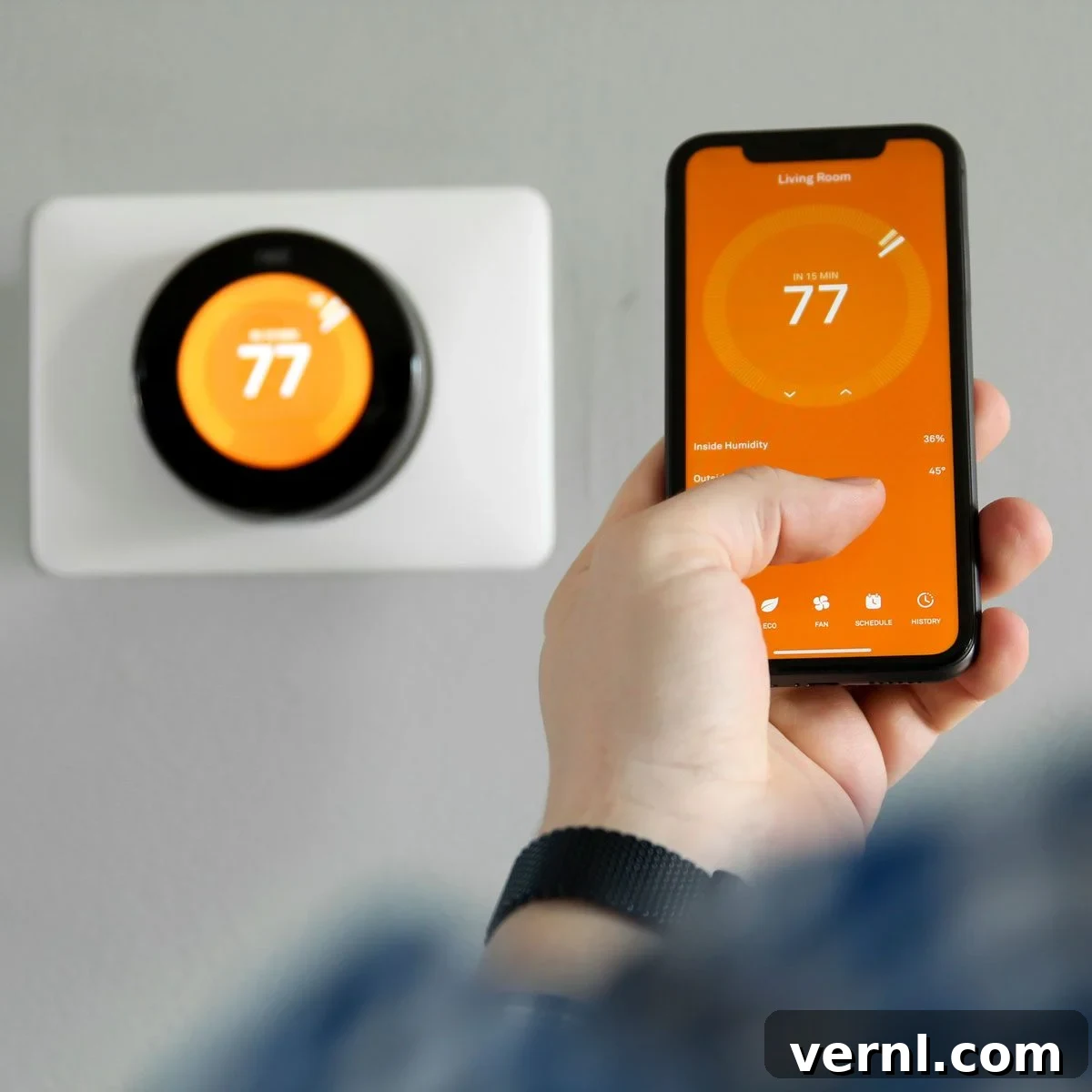
The pinnacle of modern climate control technology is the WiFi/smart thermostat. Building upon the scheduling capabilities of programmable models, these devices connect to your home’s WiFi network, unlocking a world of advanced features and remote control. With a smart thermostat, you can manage your home’s temperature from virtually anywhere using your mobile device, whether you’re at work, on vacation, or simply in another room. This remote access provides unparalleled convenience, allowing you to adjust settings, monitor energy usage, or pre-heat your home before you arrive.
Beyond remote control, most smart thermostats incorporate intelligent capabilities. They often feature learning algorithms that observe your heating and cooling preferences over time, automatically creating optimized schedules tailored to your habits. Some models include geofencing, which uses your phone’s location to automatically adjust the temperature when you leave or approach your home. They can also integrate seamlessly with popular smart home ecosystems and voice assistants like Amazon Alexa, Google Assistant, and Apple HomeKit, responding to voice commands for hands-free control.
Many smart thermostats offer additional functionalities such as detailed energy usage reports, which provide insights into your consumption patterns, helping you identify opportunities for further savings. Some even support multiple sensors placed throughout your home, enabling more precise temperature control in different zones and ensuring consistent comfort in every room. These advanced features, while coming at a higher initial cost – with some models exceeding $200 – often deliver significant long-term energy savings and enhance overall home comfort to a degree traditional thermostats cannot match. For a deeper dive into specific models and their features, explore our list of the best smart thermostats.
Do I Need to Hire a Professional for Thermostat Installation?
For many homeowners, the prospect of installing a new thermostat can seem daunting. However, the good news is that experienced DIYers often possess the necessary skills to install non-programmable, programmable, and even WiFi/smart home thermostats, especially when it involves an upgrade to an existing thermostat. The process typically involves working with low-voltage wiring, which minimizes the risk of electric shock. As Wes Davis advises, “This is typically low voltage, so there is no real threat of being shocked or electrocuted.”
For a successful DIY installation, careful attention to detail and thorough preparation are key. It’s paramount to read the installation instructions provided with your new thermostat meticulously, no matter your level of experience. These guides often include specific wiring diagrams and step-by-step instructions tailored to the particular model. Before you begin, always turn off the power to your HVAC system at the circuit breaker for safety. Taking a picture of your old thermostat’s wiring can also be incredibly helpful for reference during the installation of the new unit.
However, there are scenarios where professional assistance is highly recommended. New construction thermostat installations, for instance, are generally more complicated as they involve running new wiring and integrating with a newly installed HVAC system. Similarly, if you have an older, less common HVAC system, a multi-stage system, a heat pump, or a zoned system, the wiring can be more complex and may require specific knowledge to ensure proper functionality and compatibility. Any uncertainty regarding wiring, system compatibility, or personal ability should be a clear indicator to seek professional help. “And for anyone that questions their ability, I recommend letting a professional do it,” Davis adds. A professional HVAC technician can ensure correct installation, optimal system performance, and often, provide programming assistance and troubleshooting tips, giving you peace of mind.
Other Essential Considerations When Choosing Your Thermostat
Beyond the core functionalities and installation aspects, several other factors can influence your choice of thermostat. Taking these into account will ensure that your new device not only meets your temperature control needs but also seamlessly integrates into your home and lifestyle.
-
Aesthetics and Design
For many homeowners, how a thermostat looks on the wall is an important consideration. Thermostats are no longer just functional devices; they can be integrated into your home’s decor. Explore your options for style, color, and shape. Some thermostats feature a basic, utilitarian look designed to blend in discreetly, while others incorporate more sophisticated design elements, touchscreens, and premium finishes that can act as a modern accent. Consider whether you prefer a minimalist design, a large digital display for easy readability, or a sleek, futuristic device that complements your smart home ecosystem.
-
Power Source and Wiring
Thermostats draw power in different ways, and it’s crucial to select one compatible with your home’s wiring. Some thermostats run on batteries, offering flexibility if a common wire (C-wire) is not available. Others are plug-in models or, most commonly, link directly to your furnace or HVAC system’s circuit board. For smart thermostats, a C-wire is almost always required to provide continuous power for their advanced features, Wi-Fi connectivity, and backlit displays. Without a C-wire, these devices may not function reliably or may quickly drain battery power. If your home lacks a C-wire, you might need to install one, which could involve professional help, or opt for a smart thermostat specifically designed to work without one (though these are less common or have limitations).
-
HVAC System Compatibility
One of the most critical factors is ensuring that your chosen thermostat is designed to work with your specific HVAC system. HVAC systems vary widely, from conventional single-stage heating and cooling to multi-stage systems, heat pumps with auxiliary heat, and zoned systems. A thermostat compatible with a conventional furnace and A/C unit may not be suitable for a heat pump, which requires specific wiring terminals (like O/B for reversing valves). Before purchasing, carefully check the product specifications for compatibility with your furnace type (gas, oil, electric), air conditioning system (single-stage, multi-stage), and any other components like humidifiers or dehumidifiers you wish to integrate. Referencing your existing thermostat’s wiring configuration can also provide clues about your system’s requirements.
-
Privacy Concerns
With the rise of smart home technology, privacy has become an increasingly significant consideration. Be aware that some smart thermostats, particularly those integrated with voice assistants like Alexa, Google Assistant, or Siri, may collect data about your usage patterns and even “listen” to voice commands. This essentially means that anytime you interact with the voice assistant, data related to that command may be processed and stored by the manufacturer or associated third parties. If data privacy is a significant concern for you, research the privacy policies of different brands. You might opt for smart thermostats with strong privacy features, local control options, or choose models that do not include voice assistant integration.
-
Advanced Features and Integration
Beyond basic temperature control, many modern thermostats offer a suite of advanced features. These can include humidity control, which helps manage indoor air quality and comfort, especially in humid climates; fan cycle settings, allowing you to run the fan periodically even when heating or cooling isn’t active for better air circulation; air filter change reminders; and even occupancy sensors to detect when rooms are in use. Consider which of these additional features would genuinely enhance your home comfort and energy management, and look for thermostats that offer them.
Making an Informed Choice for Your Home
Selecting the right thermostat is a pivotal decision that directly impacts your home’s comfort, energy efficiency, and overall living experience. By understanding the distinctions between non-programmable, programmable, and smart WiFi thermostats, assessing your installation comfort level, and considering crucial factors like aesthetics, power source, HVAC compatibility, and privacy, you can confidently choose a device that perfectly aligns with your needs.
An upgraded thermostat is more than just a temperature controller; it’s an investment in a more comfortable, convenient, and cost-effective home. Whether you prioritize simplicity, automated scheduling, or the full suite of smart home integration, there’s a thermostat out there designed for you. Take the time to research, compare options, and make an informed decision that will bring lasting comfort and savings for years to come.