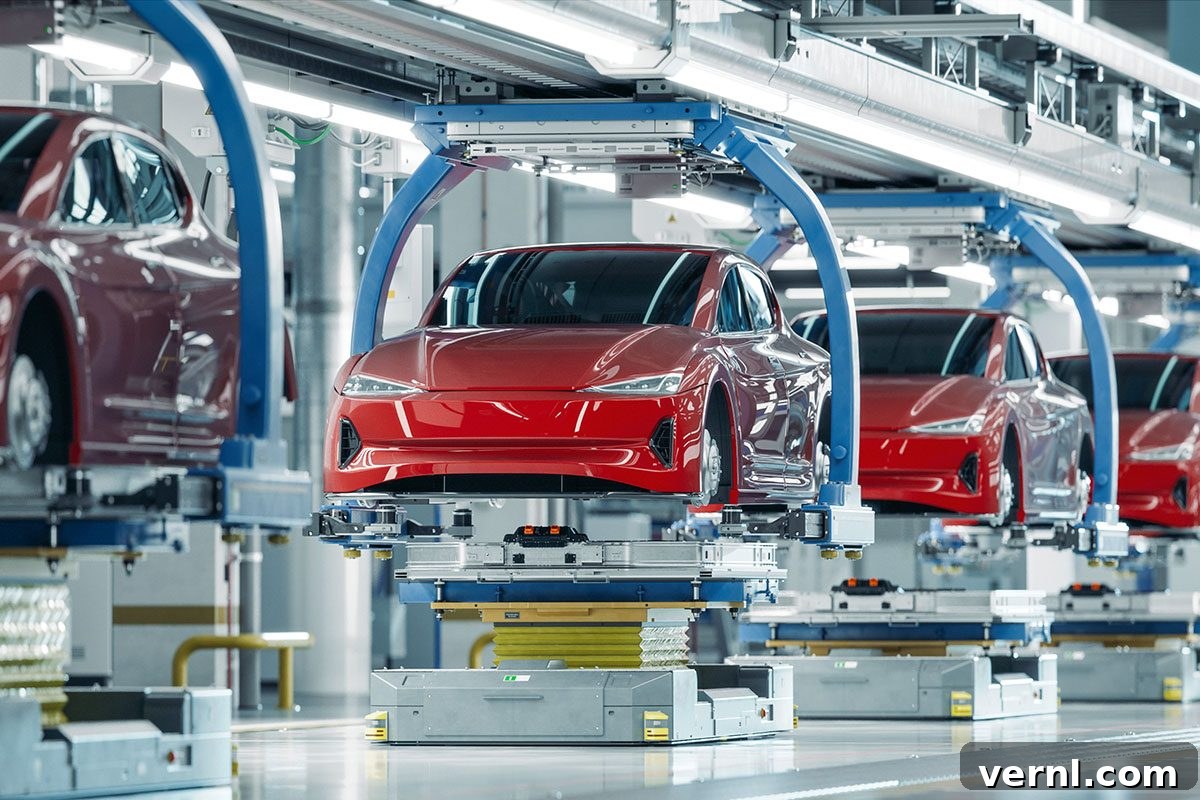
Automotive Industry Slowdown: Fewer New Car Models Expected in 2025
For many, the unveiling of new car models is an annual highlight, a moment eagerly anticipated by enthusiasts and casual observers alike. The promise of cutting-edge design, enhanced performance, and advanced technology keeps the automotive world buzzing with excitement. Manufacturers consistently push boundaries, introducing features that redefine safety, comfort, and connectivity, from sophisticated infotainment systems to groundbreaking driver-assistance technologies. Yet, a surprising trend is emerging for 2025: the automotive landscape is poised to witness a significant reduction in the number of new car models hitting the market, a development that signals a period of recalibration for the entire industry.
This anticipated slowdown, particularly pronounced in the electric vehicle (EV) sector, reflects a complex interplay of market dynamics, evolving consumer preferences, and regulatory uncertainties. While the industry has been on a fast track towards electrification and rapid expansion, a combination of factors is prompting automakers to reassess their strategies, leading to a more cautious approach to new product launches. This shift is not merely a minor adjustment but a notable deviation from previous years’ aggressive expansion plans, prompting questions about the future trajectory of vehicle innovation and consumer choice in the immediate term.
The “Car Wars” Forecast: A Stark Decline in New Model Launches
The annual “Car Wars” study, conducted by Bank of America, serves as a crucial barometer for the automotive industry, forecasting the number of new and redesigned vehicles slated for release over the coming years. Industry insiders and analysts eagerly await its findings, as it provides a comprehensive outlook on future product pipelines. While the full report for the upcoming period is typically unveiled later in the year, preliminary insights have already sent ripples through the sector. The American International Automotive Dealers Association (AIADA) has reported on a teaser from this influential study, highlighting a substantial downturn in projected model introductions.
According to John Murphy, a senior analyst at Bank of America whose insights often shape industry expectations and investment decisions, the forecast is considerably more conservative than in recent memory. Murphy revealed to reporters that “we expect 159 models to be launched over the next four years,” a figure that represents a “dramatic decline from above 200 last year.” To put this into perspective, this isn’t just a slight dip; it’s a significant contraction in the pipeline of new vehicles consumers can anticipate. Furthermore, Automotive News further clarifies that out of these 159 models projected over the next four years, a mere 29 are slated for release in 2025 alone. This means that for the upcoming year, the choice of brand-new vehicles – whether they are completely new nameplates or significantly redesigned versions of existing models – will be considerably more limited than consumers have become accustomed to.
The implications of such a sharp decline are multifaceted. A “new model launch” typically signifies either an entirely new vehicle nameplate (e.g., a brand entering a new segment), a complete redesign of an existing model (e.g., a new generation of a popular car), or a significant mid-cycle refresh that substantially alters the vehicle’s appearance and features. Fewer launches suggest a slower pace of innovation and fewer options for consumers looking for the latest and greatest in automotive technology and design. This trend is particularly evident in the electric vehicle segment, where the previous years saw a veritable flood of new designs and platforms. Murphy explicitly noted that the primary driver behind this overall reduction is a pullback in the EV sector, indicating a more cautious stance by manufacturers towards the rapid expansion of their electric lineups.
Unpacking the Reasons: Why Automakers Are Pushing the Brakes on New Models
The decision by automotive manufacturers to scale back their new model launches is not arbitrary but rather a strategic response to a confluence of challenging market conditions. John Murphy’s preliminary report from the “Car Wars” study points to several key factors, describing the situation as “the tumult caused by slowing EV adoption rates, tariffs and regulatory hurdles.” These elements combine to create an environment of uncertainty, prompting automakers to “retrench into their traditional strengths” rather than venturing aggressively into untested or volatile market segments.
Slowing EV Adoption Rates and Shifting Market Realities
Initial projections for electric vehicle adoption were incredibly optimistic, driven by environmental concerns, government incentives, and the allure of new, cleaner technology. However, the reality of mass market adoption has proved to be more complex than initially envisioned. While a segment of early adopters enthusiastically embraced EVs, broader consumer uptake has faced significant obstacles. High upfront costs, despite long-term fuel savings, remain a significant deterrent for many buyers, especially when compared to more affordable gasoline-powered alternatives. Range anxiety—the fear of running out of charge before reaching a charging station—persists as a major concern, compounded by ongoing worries about the availability, reliability, and speed of public charging infrastructure, particularly in less urbanized areas or for individuals without home charging access.
Furthermore, the resale value proposition for some EVs is still evolving, and some consumers are hesitant to commit to a rapidly advancing technology where today’s cutting-edge might quickly become tomorrow’s obsolescence. As governments begin to scale back or modify EV incentives, and as the initial novelty wears off, manufacturers are finding that consumer demand for electric vehicles is not growing at the exponential rate once anticipated. This necessitates a re-evaluation of production targets and new model development, particularly for models that may not achieve sufficient sales volumes to justify their substantial development costs and resource allocation. Automakers are becoming more selective, focusing on EV models that have a proven market demand or a clear path to profitability.
The Impact of Tariffs and Global Trade Tensions
Tariffs and international trade disputes introduce another layer of complexity and cost into the automotive supply chain, significantly impacting manufacturers’ strategic decisions. Policies such as those impacting trade relations between major economies – for example, potential tariffs on Chinese-made EVs entering European or North American markets, or broader trade tensions affecting material costs – can drastically alter manufacturing costs and profitability. Automakers operate on a global scale, sourcing raw materials and components from various countries and distributing finished vehicles across continents. Unpredictable tariff regimes make long-term financial planning and investment strategies incredibly difficult and risky.
When the cost of importing key components or exporting finished vehicles becomes subject to fluctuating tariffs and trade barriers, manufacturers face increased expenses that cut into their already thin margins or force them to raise vehicle prices, potentially dampening consumer demand. This uncertainty can lead companies to delay investments in new product lines, preferring to wait for more stable and predictable trade policies before committing vast resources to new model development and expanding production facilities globally. The risk of stranded assets or uncompetitive pricing due to trade policy changes is a powerful deterrent to aggressive expansion.
Navigating a Labyrinth of Regulatory Hurdles and Policy Uncertainty
Perhaps one of the most significant impediments to new model launches, especially in the EV space, comes from the fragmented and often contradictory regulatory landscape across different regions. Environmental and emissions standards vary widely across different jurisdictions, creating a complex web of compliance requirements for global automakers. The state of California, for instance, has historically been a trailblazer in setting stringent emissions standards, often influencing federal policy and prompting other states to adopt similar rules. California passed legislation mandating that “all sales of new light-duty passenger vehicles in California must be [Zero Emission Vehicles] ZEVs by 2035,” encompassing battery-electric and fuel-cell electric vehicles. This ambitious goal requires a complete overhaul of vehicle lineups to meet strict deadlines, demanding massive investments in new technologies and production capabilities.
However, the federal regulatory environment in the United States is not always in lockstep with state-level mandates, creating significant policy uncertainty. The California ZEV mandate, which relies on a waiver granted under the Clean Air Act, has become a focal point of a significant legal and political battle. According to Cal Matters, the matter “is likely to become a high-stakes legal and political battle between California and the Trump administration,” specifically regarding the US Senate’s attempt to revoke California’s authority to set its own more stringent emissions standards. Such legal challenges create immense uncertainty for automakers. Should they invest billions in R&D and manufacturing facilities to meet a 2035 ZEV mandate that might be overturned or significantly altered at the federal level? This dilemma forces a conservative approach, as the financial risks of misjudging the future regulatory environment and committing to a potentially short-lived mandate are monumental. Until manufacturers have clear, stable, and consistent regulatory frameworks regarding emissions, fuel economy, and ZEV requirements, they are likely to exercise caution, pulling back on alternative fuel vehicle development and focusing on more established, profitable product lines.
Implications for Consumers and the Future of Automotive Innovation
The projected decline in new car models for 2025, particularly in the EV segment, carries several implications for consumers and the broader automotive industry. For buyers, this might mean fewer options to choose from in showrooms, particularly if they are seeking the very latest in electric vehicle technology or groundbreaking new designs. The pace of innovation in certain segments might appear to slow down temporarily as manufacturers consolidate their efforts and refine existing platforms rather than launching entirely new ones. This could also lead to a greater emphasis on hybrid models, which offer a practical bridge between traditional internal combustion engines and pure electric vehicles, as automakers seek to hedge their bets amidst market and regulatory flux. Consumers might see more improvements to existing models rather than a rush of completely new ones.
For automakers, this period represents a strategic recalibration. Rather than a headlong rush into electrification and rapid market expansion, the focus shifts to optimizing profitability, streamlining supply chains, and developing more cost-effective EV technologies. It’s a move towards a more sustainable and pragmatic transition, prioritizing solid business cases over aggressive market share pursuits in uncertain environments. This doesn’t necessarily mean a halt to innovation; rather, it suggests a more focused approach, perhaps concentrating on refining battery technology to improve range and reduce cost, enhancing charging speeds, and improving software capabilities and connectivity features for existing and already planned models. The industry might witness more strategic partnerships and platform sharing to distribute development costs and risks.
Ultimately, while 2025 may see fewer brand-new models, the automotive industry remains dynamic and resilient. This period of contraction could pave the way for a more robust and strategically sound phase of growth in the years that follow, once market conditions stabilize, regulatory clarity emerges, and consumer confidence in new technologies fully solidifies. It’s a pause for reflection and strategic adjustment, rather than a retreat, for an industry that has always thrived on adaptation and continuous innovation, ensuring that the future of mobility, though perhaps paced differently, continues to advance.
Sources
Bank of America ‘Car Wars’: Automakers Pull Back Hard on EVs, While Dealers Need to Tap Lost Service Via Connectivity, American International Automotive Dealers Association, 2025.
Bank of America Car Wars: Automakers pull back hard on EVs, while dealers need to tap lost service via connectivity, Automotive News, 2025.
Electricity Laws and Incentives in California: Light-Duty Zero Emission Vehicle (ZEV) Sales Requirement, US Department of Energy.
US Senate blocks California’s electric car mandate in historic vote, Cal Matters, May 22, 2025.
Related Articles
- Do You Know What That Little Button on Your Seat Belt Is For?
- What Those Lines on Your Backup Camera Really Tell You
- Here’s What The Small Panel On Your Car’s Front Bumper Is For